


The Responsible Minerals Initiative (RMI) published updated versions of its three core reporting templates on April 17, 2026—CMRT 6.6, EMRT 2.11, and AMRT 1.31—expanding product-level transparency, broadening critical minerals coverage, and strengthening data consistency across global supply chains. For compliance engineers, procurement leaders, and regulatory directors at manufacturers managing multi-tier supplier networks, these updates carry direct operational consequences: revised data fields, expanded mineral scope, and tighter alignment with emerging battery and sustainability regulations.
This guide breaks down every material change, identifies affected industries, explains reporting and documentation challenges, and outlines how conflict minerals automation workflows and AI-native compliance tools can reduce the burden of transition.
📌 Book a free compliance assessment to understand your current responsible minerals reporting readiness across products and supply chains.
Why the 2026 RMI Template Updates Matter Now
Responsible minerals reporting is no longer a voluntary best practice confined to conflict minerals under Dodd-Frank Section 1502. Regulatory expectations have expanded in scope, granularity, and enforcement intensity. The EU Battery Regulation, the EU Corporate Sustainability Due Diligence Directive (CSDDD), and national-level supply chain laws in Germany (LkSG) and France now require verifiable, mineral-level supply chain transparency.
RMI's updated templates respond to this shift. They are the global de facto standard for collecting and exchanging responsible minerals data between buyers and suppliers. When RMI changes template structure, every manufacturer relying on these templates must update internal systems, supplier questionnaires, and compliance workflows.
For organizations managing conflict minerals compliance across hundreds or thousands of suppliers, these changes demand immediate attention. The gap between old-version submissions and updated-template requirements creates audit exposure, customer dissatisfaction, and regulatory risk.
Companies that treat template updates as administrative housekeeping—rather than as signals of regulatory direction—risk falling behind on regulatory intelligence and horizon scanning capabilities that distinguish compliance leaders from laggards.
What Changed in CMRT 6.6
The Conflict Minerals Reporting Template version 6.6 introduces expanded product-level reporting fields. This is the most operationally significant change for manufacturers filing conflict minerals disclosures.
Key Enhancements in CMRT 6.6
✓ Expanded Product List Fields — CMRT 6.6 adds new data fields that allow declarants to provide more granular product-level information when reporting on Tin, Tungsten, Tantalum, and Gold (3TG). This moves the template from facility-level declarations toward product-specific transparency.
✓ Improved Data Validation — Built-in validation rules have been tightened to reduce common errors in smelter identification, country-of-origin reporting, and declaration scope.
✓ Alignment with Downstream Requirements — The expanded fields support automotive OEMs, aerospace primes, and electronics brands that now require product-level mineral mapping from their supply base.
For manufacturers already managing BOM-level compliance intelligence across product families, CMRT 6.6 reinforces the importance of linking mineral declarations to specific products and bill-of-materials structures rather than submitting blanket facility-level responses.
⚠ Organizations still using CMRT versions prior to 6.6 should expect customer-facing audit findings and increased rejection rates on submitted declarations.
What Changed in EMRT 2.11
The Extended Minerals Reporting Template version 2.11 represents the most substantial scope expansion in this update cycle.
Expanded Mineral Coverage
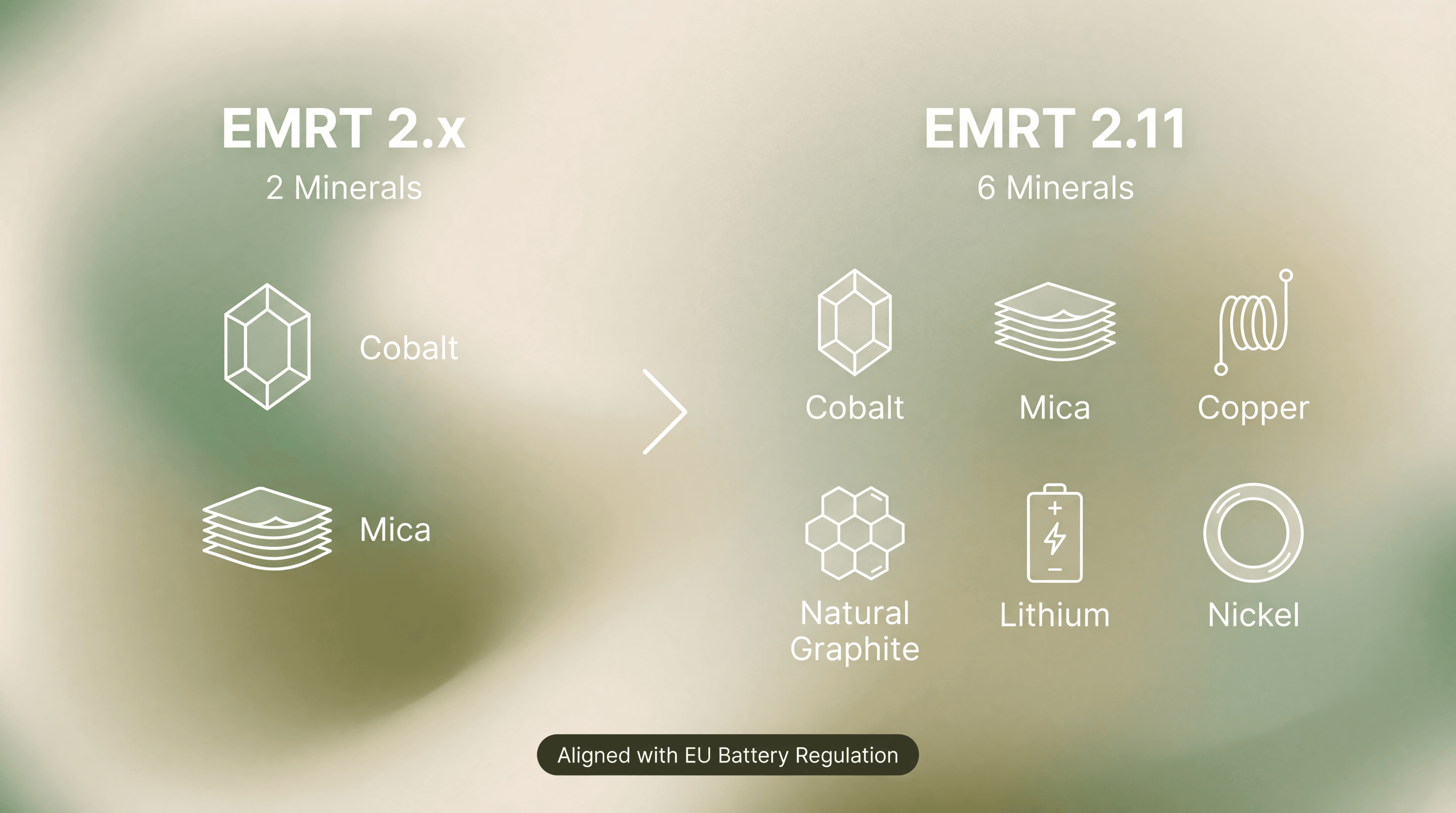
Previously, the EMRT covered Cobalt and Mica. Version 2.11 now adds:
Mineral | Relevance | Key Regulatory Driver |
|---|---|---|
Copper | Electronics, EV motors, wiring harnesses | EU Battery Regulation, REACH |
Natural Graphite | Battery anodes, lubricants, refractories | EU Battery Regulation, EU CBAM |
Lithium | Battery cells, energy storage systems | EU Battery Regulation, CSDDD |
Nickel | Battery cathodes, stainless steel, plating | EU Battery Regulation, REACH |
This expansion directly aligns with the EU Battery Regulation's due diligence requirements for battery raw materials. Manufacturers in automotive, energy storage, and electronics sectors now face a single template framework that covers six critical extended minerals.
Operational Implications
Supplier questionnaires must be updated to capture Copper, Natural Graphite, Lithium, and Nickel data
Existing supplier responses filed under EMRT 2.x (prior versions) are incomplete by definition
Companies managing supplier and contractor management programs must recalibrate data collection campaigns
For organizations preparing for the EU Battery Regulation, the EMRT 2.11 update provides a structured pathway to begin collecting the mineral-origin data that regulators will require.
EMRT 2.11 expanded minerals coverage for responsible minerals reporting compliance
Click on image to view full
What Changed in AMRT 1.31
The Additional Minerals Reporting Template version 1.31 provides updates to support reporting of additional critical minerals beyond the 3TG and extended minerals categories.
Key Updates
✓ Structural improvements for reporting on emerging critical minerals identified by regulatory and industry bodies
✓ Better data consistency across the AMRT, CMRT, and EMRT template family
✓ Enhanced alignment with global sustainability initiatives and supply chain due diligence frameworks
The AMRT is particularly relevant for manufacturers in aerospace and defense, semiconductor and high-tech, and energy infrastructure sectors, where reliance on critical minerals extends well beyond traditional conflict minerals.
Based on currently available regulatory guidance, the AMRT's expanded scope is expected to continue growing as governments in the US, EU, and Asia-Pacific designate additional minerals as "critical" for national security and economic resilience.
Minerals Covered Under Updated Templates
A consolidated view of mineral coverage across all three updated templates:
Template | Version | Minerals Covered |
|---|---|---|
CMRT | 6.6 | Tin, Tungsten, Tantalum, Gold (3TG) |
EMRT | 2.11 | Cobalt, Mica, Copper, Natural Graphite, Lithium, Nickel |
AMRT | 1.31 | Other emerging critical minerals |
This combined framework now covers the mineral categories most scrutinized by the EU Battery Regulation, CSDDD, Dodd-Frank Section 1502, and various national supply chain due diligence laws. Organizations operating across multiple jurisdictions benefit from treating the RMI template suite as a centralized compliance data backbone for responsible minerals reporting.
For a deeper look at conflict minerals requirements, see the Ultimate Guide to Conflict Minerals Compliance on Certivo.
Industries and Product Categories Affected
The 2026 RMI template updates affect a broad cross-section of manufacturing sectors:
📊 Electronics & Electrical Equipment — 3TG and extended minerals are embedded across PCBs, connectors, solders, and battery components. The EMRT 2.11 expansion to Copper and Lithium increases the reporting footprint for electronics manufacturers.
📊 Automotive & Battery Manufacturing — EV battery supply chains require due diligence on Cobalt, Lithium, Nickel, and Natural Graphite. EMRT 2.11 is now the de facto collection mechanism for automotive manufacturers responding to EU Battery Regulation obligations.
📊 Aerospace & Industrial Manufacturing — Tantalum, Tungsten, and critical minerals in specialty alloys trigger CMRT and AMRT reporting for defense and aerospace supply chains.
📊 Energy Storage & Renewable Energy — Battery cell manufacturers and energy infrastructure companies face the broadest impact from EMRT 2.11's expanded mineral scope.
📊 Consumer Products & Retail Supply Chains — Companies sourcing electronics, batteries, and metal components must cascade RMI template requirements to sub-tier suppliers through standardized supplier questionnaire frameworks.
Reporting, Documentation, and Data Challenges
For compliance engineers managing responsible minerals programs at scale, the 2026 template updates introduce several practical challenges:
Data Collection at Scale
Collecting completed CMRT, EMRT, and AMRT templates from hundreds or thousands of suppliers is the single largest operational burden. Each template version change requires:
Re-issuing data requests to suppliers
Validating that responses use the correct template version
Cross-referencing smelter and refiner lists against RMI's Responsible Minerals Assurance Process (RMAP) database
Mapping mineral declarations to specific products or product families
Manual processes using spreadsheets and email cannot scale. Organizations that have not yet transitioned to automated supplier data collection portals face exponential increases in labor hours per template update cycle.
Data Quality and Consistency
EMRT 2.11's addition of four new minerals means that many suppliers will be reporting on Copper, Natural Graphite, Lithium, and Nickel for the first time. Expect:
⚠ Incomplete or inaccurate initial submissions ⚠ Confusion about declaration scope (product vs. facility vs. company-level) ⚠ Inconsistent smelter identification across mineral categories
AI document parsing and certificate validation capabilities become essential for identifying errors at intake rather than during audit.
Multi-Template Management
Managing three templates simultaneously—each with its own version cadence, mineral scope, and field structure—requires a centralized compliance data backbone that normalizes data across template types and links responses to product-level BOMs.
📌 Struggling with supplier mineral data collection? See how Certivo automates this → Book a Demo
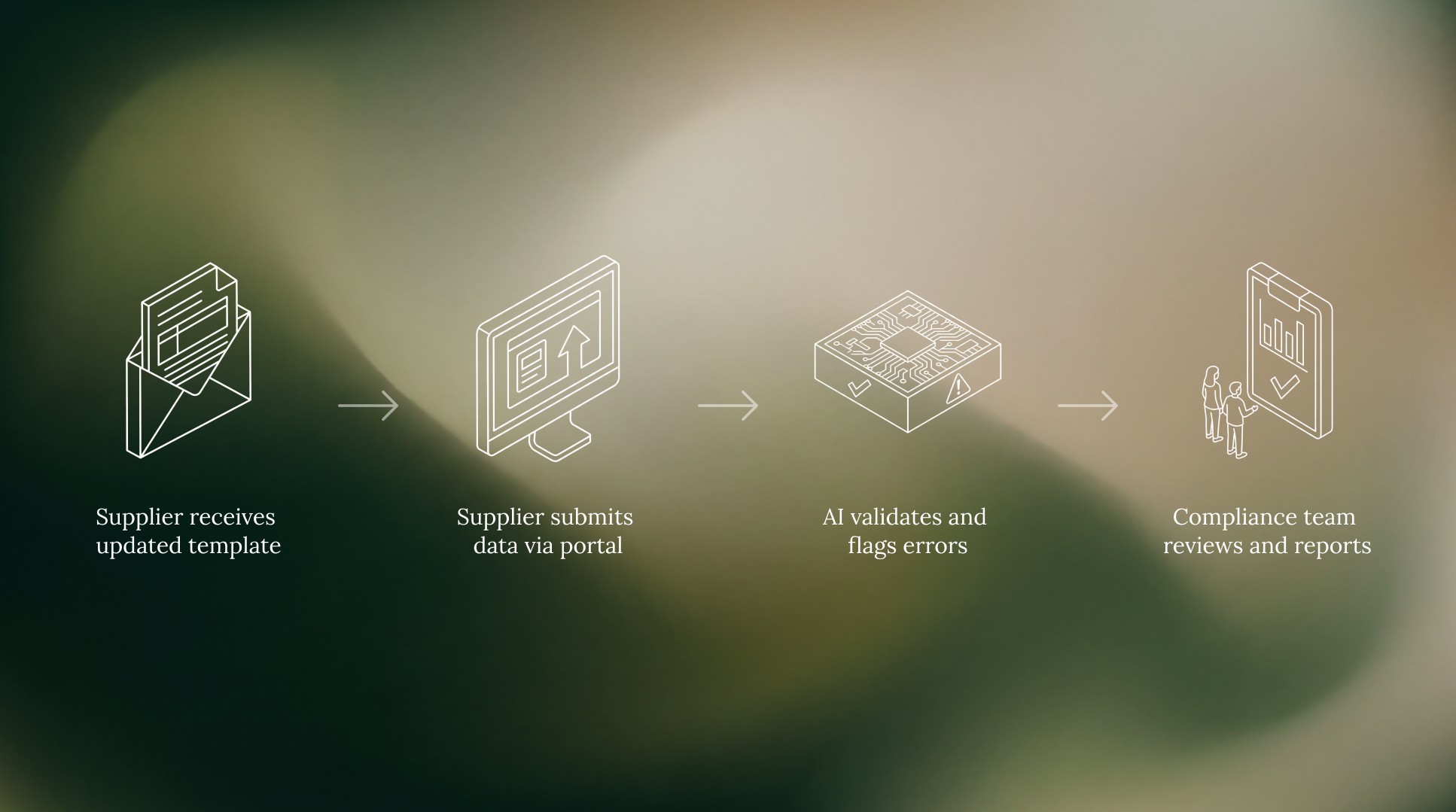
Responsible minerals reporting template data collection workflow for manufacturers
Click on image to view full
Compliance Risks and Enforcement Exposure
Failure to adopt updated RMI templates exposes manufacturers to multiple risk categories:
Customer Audit Findings — OEMs and brand customers increasingly mandate specific template versions. Submitting outdated CMRT or EMRT versions triggers corrective action requests and potential supply chain disqualification.
Regulatory Non-Compliance — The EU Conflict Minerals Regulation (2017/821), CSDDD, and EU Battery Regulation reference supply chain due diligence standards that RMI templates operationalize. Non-adoption creates gaps in demonstrating due diligence.
Reputational Risk — Investors, ESG rating agencies, and civil society organizations scrutinize responsible minerals disclosures. Outdated or incomplete filings signal weak supply chain governance.
Supply Chain Disruption — Suppliers that cannot complete updated templates risk being deprioritized or removed from approved supplier lists by downstream customers.
Organizations maintaining continuous audit-ready documentation are better positioned to absorb template updates without disruption to ongoing reporting programs.
Supply Chain and Operational Impact
The ripple effect of RMI template updates flows in both directions—upstream to sub-tier suppliers and downstream to customers.
Upstream Impact
Tier 1 suppliers must collect updated template responses from Tier 2 and Tier 3 suppliers
Smelters and refiners must maintain RMAP conformance to appear as "compliant" in submitted templates
Smaller suppliers with limited compliance resources may require training or portal-based guidance to complete new fields
Downstream Impact
Manufacturers must update customer-facing conflict minerals reports and customer trust centers with data from current template versions
Customer RFQ responses increasingly require mineral-level documentation at the product or BOM level
Multi-tier supply chain transparency expectations continue to increase
The EMRT 2.11 expansion to six minerals means that multi-tier supply chain transparency programs must now track a significantly broader set of materials through every tier. This is not achievable with manual methods at enterprise scale.
Timeline and Future Enforcement Outlook
Date | Event |
|---|---|
April 17, 2026 | RMI publishes CMRT 6.6, EMRT 2.11, AMRT 1.31 |
Q2–Q3 2026 | Expected adoption window; OEMs begin requiring updated versions |
2027 | EU Battery Regulation due diligence obligations fully enforceable |
2027–2028 | CSDDD enforcement ramp-up across EU member states |
Ongoing | RMI template scope expected to expand as critical mineral designations grow |
Based on currently available regulatory guidance, the trend is clear: mineral-level supply chain due diligence requirements will continue to expand in both geographic scope and mineral coverage. Manufacturers that invest now in scalable, template-version-agnostic data infrastructure will absorb future changes more efficiently.
For a broader view of regulatory developments, explore Certivo's regulatory frameworks library.
Strategic Compliance Preparation Checklist
Compliance engineers and regulatory directors should prioritize the following actions:
✅ 1. Verify Current Template Versions — Confirm that all active supplier data collection campaigns use CMRT 6.6, EMRT 2.11, and AMRT 1.31. Retire prior versions.
✅ 2. Update Supplier Communication — Notify all in-scope suppliers of the template changes, provide updated templates, and set submission deadlines aligned with customer reporting cycles.
✅ 3. Expand EMRT Data Collection Scope — Add Copper, Natural Graphite, Lithium, and Nickel to supplier questionnaire programs. Identify which product families trigger EMRT reporting.
✅ 4. Map Minerals to BOMs — Link mineral declarations to specific products and BOM structures. This supports product-level transparency and customer audit response through BOM-level material mapping.
✅ 5. Validate Smelter and Refiner Data — Cross-reference supplier-reported smelters against the current RMAP-conformant smelter list. Flag discrepancies for follow-up.
✅ 6. Audit Internal Systems — Ensure that compliance management systems, ERP integrations, and supplier self-service compliance portals support the new template field structures.
✅ 7. Train Internal and Supplier Teams — Provide guidance on new fields, validation rules, and mineral scope changes. Targeted training reduces error rates and accelerates data collection.
✅ 8. Establish Version Control Protocols — Implement processes to detect and reject submissions on outdated template versions automatically.
How AI and Automation Reduce RMI Reporting Burden
Manual responsible minerals reporting programs—built on spreadsheets, email chains, and ad hoc tracking—cannot scale with the pace of template updates and expanding mineral scope. AI-native compliance automation addresses the structural challenges that template updates create.
Automated Supplier Data Collection
Certivo's supplier self-service portals allow suppliers to submit completed RMI templates directly, with built-in version validation that ensures only current templates are accepted. This eliminates the manual effort of chasing suppliers, checking template versions, and re-requesting submissions.
AI-Powered Document Parsing
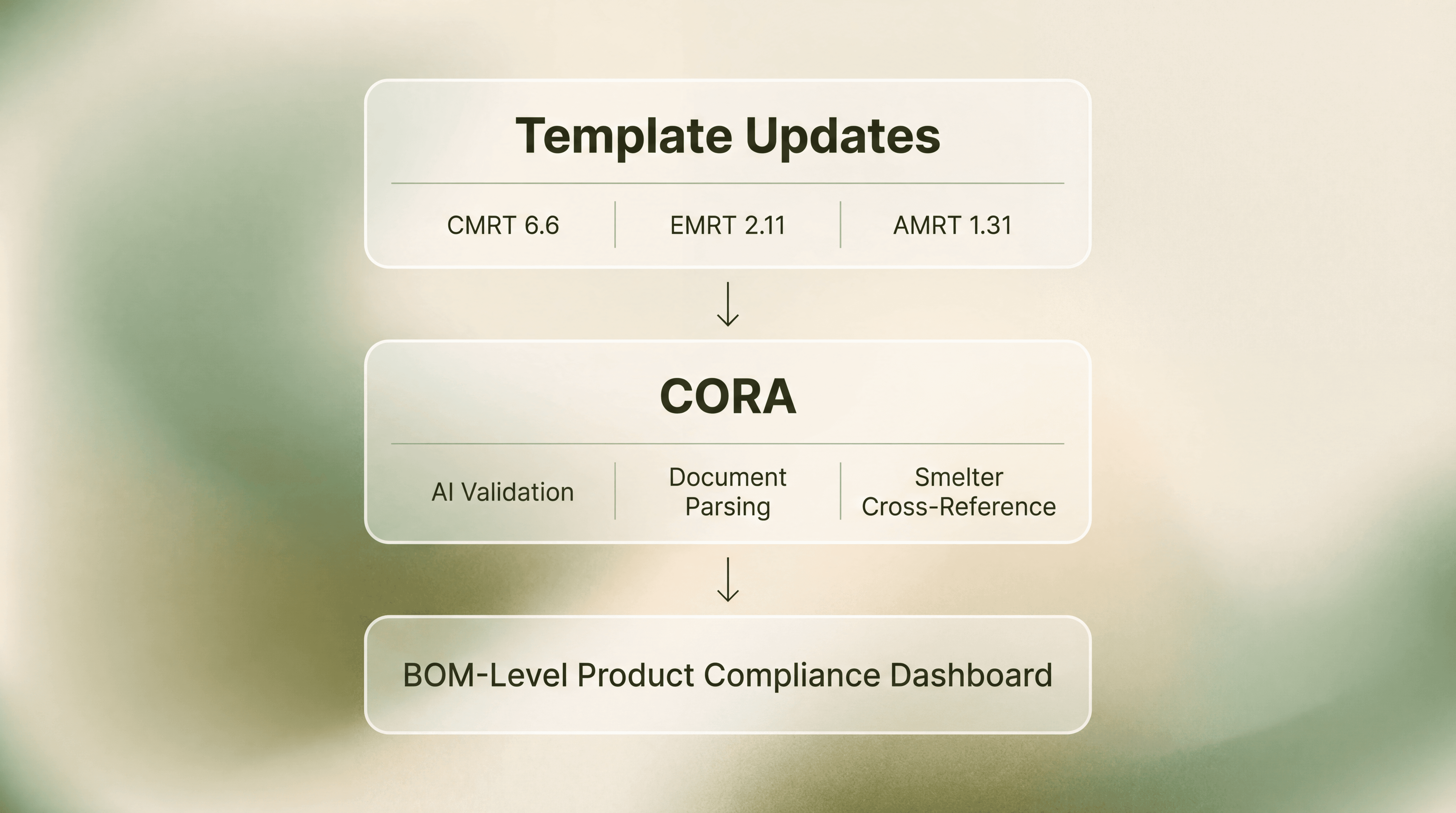
CORA-powered regulatory intelligence enables automated extraction and validation of data from submitted CMRT, EMRT, and AMRT templates. CORA identifies incomplete fields, flags inconsistent smelter data, and cross-references submissions against known databases—reducing manual review time by orders of magnitude.
BOM-Level Compliance Intelligence
Linking mineral declarations to specific products and BOMs is the critical step that transforms responsible minerals reporting from a checkbox exercise into actionable compliance intelligence. Certivo maps template data to product-level structures, enabling compliance teams to answer customer queries and audit requests at the product level rather than the company level.
Regulatory Intelligence and Horizon Scanning
CORA's regulatory intelligence layer monitors changes to RMI templates, smelter conformance lists, and related regulations—alerting compliance teams before changes take effect rather than after. This shifts organizations from reactive compliance toward continuous compliance monitoring and audit readiness.
For a deeper perspective on how AI transforms compliance management, see AI Tools for Compliance Management: The Complete Guide.
AI-powered responsible minerals reporting template automation workflow with CORA
Click on image to view full
Conclusion
The RMI's release of CMRT 6.6, EMRT 2.11, and AMRT 1.31 reflects the accelerating convergence of conflict minerals due diligence, critical minerals supply chain transparency, and sustainability regulation. The EMRT's expansion to six minerals—Cobalt, Mica, Copper, Natural Graphite, Lithium, and Nickel—is a direct response to the EU Battery Regulation and signals that responsible minerals reporting scope will continue to grow.
For compliance leaders at global manufacturers, the 2026 template updates are not optional. Customers, regulators, and investors expect current-version compliance declarations with product-level granularity. Organizations that rely on manual, spreadsheet-based processes face increasing audit risk, supplier friction, and competitive disadvantage.
Investing in conflict minerals automation workflows, AI-native compliance automation, and centralized supplier self-service portals is the most effective strategy for absorbing current and future RMI template changes without proportional increases in headcount or manual effort.
📌 Book a demo to see how Certivo automates responsible minerals reporting across your product portfolio and multi-tier supply chain—or get a free compliance risk assessment to evaluate your current RMI template readiness.
FAQs
1. How does EMRT 2.11 differ from previous EMRT versions in mineral scope?
EMRT 2.11 expands coverage from two minerals (Cobalt and Mica) to six, adding Copper, Natural Graphite, Lithium, and Nickel. This aligns with EU Battery Regulation due diligence requirements. Certivo's CORA intelligence automates data collection for all six minerals through centralized supplier portals.
2. Do manufacturers need to re-collect supplier data when RMI templates are updated?
Yes. Prior-version submissions do not include the new fields and mineral categories introduced in CMRT 6.6, EMRT 2.11, and AMRT 1.31. Manufacturers should issue updated data requests to all in-scope suppliers. Certivo's automated supplier data collection portals streamline this process at scale.
3. Which regulations are driving the 2026 RMI template changes?
The updates align with the EU Battery Regulation, EU Corporate Sustainability Due Diligence Directive (CSDDD), Dodd-Frank Section 1502, and national supply chain due diligence laws such as Germany's LkSG. CORA-driven compliance intelligence tracks these regulatory dependencies automatically.
4. How can manufacturers link mineral declarations to specific products or BOMs?
CMRT 6.6's expanded product-level fields enable more granular reporting. By integrating RMI template data with BOM structures, compliance teams can provide product-specific mineral declarations. Certivo supports BOM-level material mapping to connect supplier mineral data to individual products.
5. What is the recommended timeline for transitioning to the updated RMI templates?
Based on currently available regulatory guidance, manufacturers should complete the transition within Q2–Q3 2026, before major OEM customers begin mandating updated template versions. Early adoption reduces audit findings and supplier friction during peak reporting periods.
Lavanya
Lavanya is an accomplished Product Compliance Engineer with over four years of expertise in global environmental and regulatory frameworks, including REACH, RoHS, Proposition 65, POPs, TSCA, PFAS, CMRT, FMD, and IMDS. A graduate in Chemical Engineering from the KLE Institute, she combines strong technical knowledge with practical compliance management skills across diverse and complex product portfolios.