


For any brand selling into the United States, state PFAS regulations are now the primary compliance constraint on consumer products, not federal rules. As of 2026, states fall into two camps: those that ban intentionally added PFAS in specific product categories, and those that require manufacturers to report it. Maine, Minnesota, Colorado, Vermont, California, Connecticut, Washington, and New York already have live obligations, and roughly 30 jurisdictions now carry restrictions, disclosure rules, or reporting deadlines that vary by product and date.
This guide maps that patchwork by product category, shows what is live now versus coming in the next 18 months, and explains how to keep pace without managing it in a spreadsheet.
If you want the one-page reference, you can download the 2026 State PFAS Compliance Map or book a compliance risk assessment to understand your exposure across products and states.
Key Takeaways
📌 State PFAS regulations, not federal rules, now drive consumer product market access in the US, with obligations split between sales bans and mandatory reporting.
🏭 Maine, Colorado, and Vermont began banning intentionally added PFAS in cookware, cosmetics, cleaning products, and other categories on January 1, 2026.
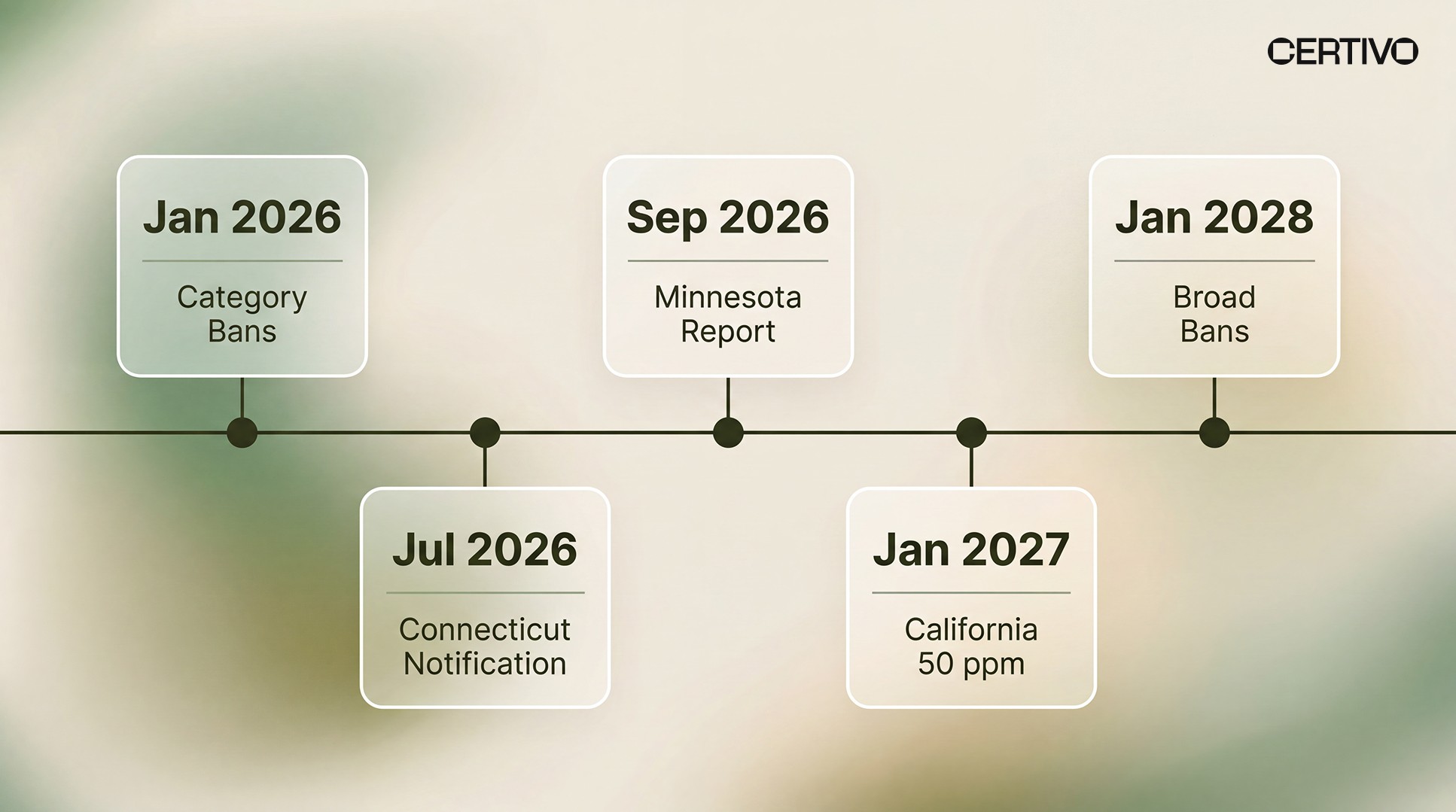
📊 Minnesota's Amara's Law reporting deadline was extended to September 15, 2026, submitted through the PRISM system, with a possible 90-day extension to December 14, 2026.
⏳ Connecticut's cosmetics notification and labeling rules start July 1, 2026, ahead of a broader ban on January 1, 2028.
⚠️ California regulates PFAS in textiles by total organic fluorine, with the threshold dropping from 100 ppm to 50 ppm on January 1, 2027.
🔗 Compliance now depends on supplier data, bill-of-materials screening, and defensible documentation, because PFAS is rarely declared at the finished-product level.
🤖 Tracking dozens of state deadlines and category definitions across a product portfolio is not manageable manually, which is why manufacturers are moving to AI-native compliance automation.
State PFAS regulations 2026 US map showing ban states and reporting states
Click on image to view full

Why states moved faster than the federal government
The federal picture is contracting while the state picture expands. The EPA has moved to rescind drinking water limits for four PFAS compounds, PFBS, PFHxS, PFNA, and GenX, while retaining limits on PFOA and PFOS with compliance extended toward 2031. The agency has also proposed narrowing TSCA Section 8(a)(7) reporting, with the reporting window running from April 13 to October 13, 2026, and proposed exemptions for imported articles.
States filled the gap. Nearly 350 PFAS bills were introduced across 39 states in 2025, and 2026 opened with roughly 100 new bills in 17 states plus about 280 carried over. The practical result for manufacturers is a fragmented map that is harder to track, not easier. Our global PFAS master guide puts this US shift in cross-jurisdictional context.
Two regulatory models: reporting states vs sales-ban states
Most state PFAS laws follow one of two structures. Understanding which model a state uses tells you whether your obligation is to disclose or to remove.
PFAS reporting by state
Reporting states require manufacturers to disclose products containing intentionally added PFAS, usually including the chemical identity, function, and concentration. Minnesota is the leading example. Under Amara's Law, initial reports are due September 15, 2026 through the PRISM system, with a one-time $800 fee and annual updates each February 1. A 90-day extension to December 14, 2026 is available if requested by August 16, 2026. Washington's reporting trigger began January 1, 2026, with its first annual reporting deadline on January 31, 2027. New Mexico set a manufacturer reporting deadline of January 1, 2027, and Kentucky's HB 196 adds reporting obligations as well.
PFAS bans by state
Sales-ban states prohibit the sale or distribution of products with intentionally added PFAS in named categories. Maine, Colorado, and Vermont moved category bans into effect on January 1, 2026, and California, Connecticut, New York, and New Jersey are phasing in bans through 2028. Reporting is often the precursor to a ban, so a disclosure obligation today frequently signals a prohibition tomorrow. Certivo's state PFAS regulations 2026 guide tracks how these two tracks interact.
State | Model | Key 2026 trigger |
|---|---|---|
Maine | Sales ban | Category bans live Jan 1, 2026 |
Minnesota | Reporting + ban | Report by Sept 15, 2026; ban phased to 2032 |
Colorado | Sales ban | Category bans live Jan 1, 2026 |
Vermont | Sales ban | Category bans live Jan 1, 2026 |
California | Sales ban | Textiles step down to 50 ppm Jan 1, 2027 |
Connecticut | Disclosure to ban | Notification/labeling Jul 1, 2026; ban Jan 1, 2028 |
Washington | Reporting + restriction | Reporting from Jan 1, 2026; first filing Jan 31, 2027 |
New Jersey | Ban + reporting | AFFF banned Jan 8, 2026; product ban Jan 1, 2028 |
PFAS bans by state versus PFAS reporting by state comparison for 2026
Click on image to view full

State PFAS regulations by product category
Because obligations vary by product, the most useful view for a portfolio is category-first.
Cookware
Maine, Colorado, and Vermont ban intentionally added PFAS in cookware as of January 1, 2026. California takes a disclosure route under AB 1200, requiring cookware makers to list intentionally added chemicals, including PFAS, on the handle or food-contact surface and in online listings since 2024. The recurring debate is fluoropolymers such as PTFE, which several state statutes still capture under an "intentionally added" definition. For a portfolio spanning consumer goods, cookware is often the first SKU set to fail.
Cosmetics and personal care
California's AB 2771 banned intentionally added PFAS in cosmetics from January 1, 2025. Maine, Colorado, and Vermont added cosmetics bans on January 1, 2026. Connecticut requires prior written notification to its environmental agency and compliant labeling from July 1, 2026, converting to a full ban on January 1, 2028.
Children's and juvenile products
California prohibited intentionally added PFAS in juvenile products from July 1, 2023, using a 100 ppm total organic fluorine threshold. Maine and Vermont include juvenile and children's products in their 2026 category bans. Washington and Oregon reporting programs also capture children's products under toxics-in-children's-products rules.
Food packaging
California banned PFAS in plant-fiber food packaging from January 1, 2023. Colorado, Vermont, and New York restrict PFAS food packaging, and Maine's separate toxics-in-packaging statute extends prohibitions in 2026. Food packaging is frequently the earliest live obligation for food and beverage brands.
Textiles and apparel
California's AB 1817 bans regulated PFAS in textile articles, measured as total organic fluorine, at 100 ppm from January 1, 2025 and 50 ppm from January 1, 2027, with outdoor apparel for severe wet conditions exempt until January 1, 2028 subject to a disclosure label. New York's apparel ban began January 1, 2025 with tighter limits expected in 2027. Our California AB 1817 analysis covers the threshold step-down in detail.
What is live now vs coming in the next 18 months
The near-term calendar is dense. The table below summarizes the highest-impact dates.
Date | State | Obligation |
|---|---|---|
Jan 1, 2026 | Maine, Colorado, Vermont | Category sales bans live |
Jan 8, 2026 | New Jersey | AFFF firefighting foam ban |
Jan 31, 2027 | Washington | First annual PFAS reporting filing |
Jul 1, 2026 | Connecticut | Cosmetics notification and labeling |
Sep 15, 2026 | Minnesota | Initial Amara's Law report (PRISM) |
Jan 1, 2027 | California | Textile threshold drops to 50 ppm TOF |
Jan 1, 2027 | New Mexico | Manufacturer reporting deadline |
Jan 1, 2028 | Connecticut, New Jersey | Broad product bans |
Beyond this window, Kansas HB 2674 targets cookware, food packaging, and dental floss in 2027 with cosmetics and cleaning products in 2028, and Ohio HB 743 proposes a broad ban from January 1, 2028. Massachusetts and Rhode Island are advancing category rules through active rulemaking.
If your team cannot currently answer "which of my SKUs are exposed in which states, and by when," that gap is the risk. Book a compliance risk assessment to map your PFAS exposure across products and jurisdictions.
How PRISM is becoming a multi-state reporting model
Minnesota's PRISM system is built on the High Priority Chemicals Data System already used for other chemical disclosures, and it collects the data structure that reporting states increasingly share: product description, PFAS identity, function, and concentration range. Washington, New Mexico, and others are converging on the same disclosure logic. That convergence is useful, because a manufacturer that builds a clean, structured PFAS dataset once can reuse it across states rather than rebuilding for each portal. Our guide on tracking PFAS across the US and EU explains how to structure that data layer.
Compliance risk, enforcement, and audit exposure
Enforcement in 2026 is shifting toward verification. Regulators and customers are asking for substantiation, so recordkeeping and testing carry evidentiary weight. A defensible program treats several audit types differently.
Internal audits confirm your own SKU-to-regulation mapping is current.
Customer audits, often OEM or retailer driven, request certificates of compliance and PFAS attestations at the product level.
Regulatory inspections by state agencies focus on the accuracy of a submitted report or the basis for a "no intentionally added PFAS" claim.
Certification audits under ISO 9001, IATF 16949, or ISO 14001 examine process control around chemical data.
The harder engineering problem is historic state tracking. A PFAS declaration is a point-in-time record, so you need immutable audit logs, time-stamped declarations, and the ability to retrieve exactly what a supplier stated and on what date. Evidence chain integrity, who submitted the data, when, and with what authority, is what turns a report into a defensible one.
No software makes a program audit-proof. The realistic objective is audit-ready: fewer surprises and a faster response time when a customer or regulator asks. Certivo supports this through audit-ready documentation across frameworks and versioned, retrievable evidence.
State PFAS regulations timeline showing 2026 to 2028 bans and reporting deadlines
Click on image to view full
How to track state PFAS regulations without a spreadsheet
The core difficulty is that PFAS is rarely declared at the finished-product level. Compliance depends on supplier engagement, material declarations, and validated data, often several tiers upstream. Reconciling incomplete or conflicting supplier responses across dozens of states is not a spreadsheet task at portfolio scale.
This is where a compliance data backbone matters. Certivo maps regulations to specific SKUs and bills of materials, so BOM-level material mapping and threshold management flag which parts become non-compliant when a state rule changes. Automated supplier data collection and portals reduce the manual chase, and AI document parsing validates certificates and test reports at intake. CORA-powered regulatory intelligence provides horizon scanning across state deadlines, so a change in Minnesota, California, or Connecticut surfaces against your affected products rather than in a newsletter you read later. Explore Certivo's chemical and hazmat compliance solution and BOM-level compliance tracking to see the model.
The practical difference is a shift from reactive, deadline-driven scrambles to continuous, audit-ready readiness. Instead of rebuilding a state matrix every quarter, a manufacturer maintains one governed dataset that answers customer RFQs, populates state reports through automated supplier data collection, and adapts as the PFAS framework landscape expands. That is how leading brands manage PFAS alongside adjacent obligations like Prop 65 without adding headcount.
To see it against your own portfolio, book a compliance risk assessment or download the 2026 State PFAS Compliance Map.
Vasanth
Vasanth is a skilled Compliance Engineer with over five years of experience specializing in global environmental regulations, including REACH, RoHS, Proposition 65, POPs, TSCA, PFAS, CMRT, EMRT, FMD, and IMDS. With a strong academic foundation in Chemical Engineering from Anna University, he brings a deep technical understanding to compliance processes across complex product lines.
Vasanth excels in analyzing Bills of Materials (BOMs), evaluating supplier declarations, and ensuring regulatory conformity through meticulous review and risk assessment. He is highly proficient in supplier engagement, adept at interpreting material disclosures, and experienced in preparing customer-ready compliance documentation tailored to diverse global standards.