


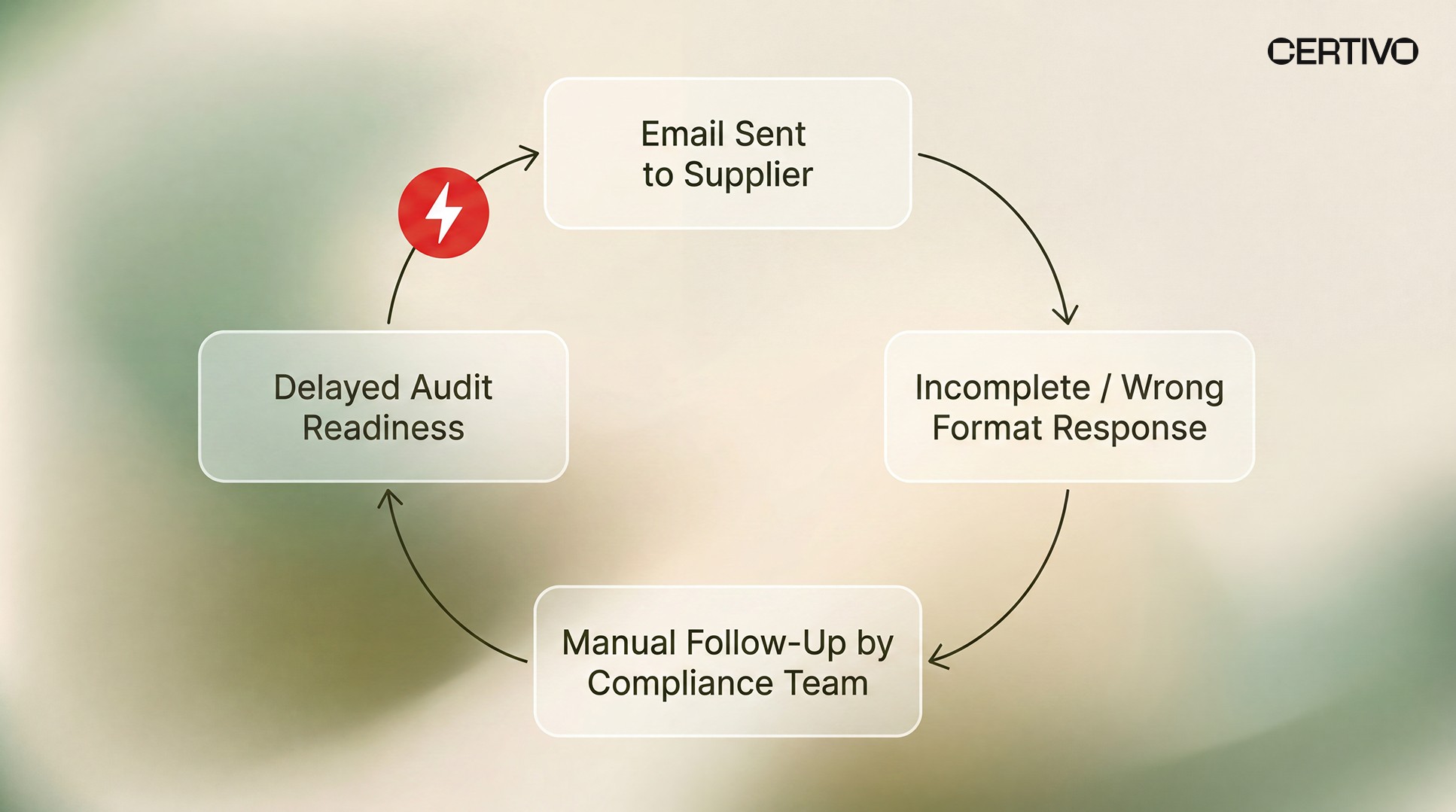
Annual supplier re-declaration cycles expose a structural failure in how most manufacturers collect compliance data. Organizations managing 500–1,000+ suppliers still rely on email-based chase loops, mismatched IPC-1752A template versions, certificates arriving as photographs of scanned PDFs, and handwritten notes that no system can parse. The result: 20–25% first-outreach response rates, months of manual follow-up, and audit findings that trace back to incomplete or unverifiable supplier documentation.
An automated supplier compliance portal eliminates this cycle by replacing fragmented email workflows with structured, self-service data collection—paired with AI document parsing that extracts, validates, and flags inconsistencies at intake rather than during audit.
📌 Book a free supplier data quality audit to assess your current supplier response rates, declaration gaps, and certificate validation readiness.
Why Email-Based Supplier Compliance Collection Has Failed
The operational reality at most global manufacturers is this: compliance teams send templated emails to hundreds of suppliers requesting RoHS certificates, REACH declarations, IPC-1752A material disclosures, conflict minerals templates (CMRT/EMRT), or IMDS submissions. What comes back is inconsistent, incomplete, and often unusable.
⚠ Certificates arrive in four or five different formats—PDF, JPEG, scanned images, Excel attachments
⚠ Suppliers submit outdated template versions that do not match current regulatory framework requirements
⚠ Follow-up emails go unanswered for weeks, delaying product launches and customer RFQ responses
⚠ No version control exists—teams cannot tell whether a declaration supersedes a prior submission
For organizations managing supplier and contractor compliance across automotive, electronics, aerospace, and industrial sectors, this email-driven model creates invisible cost. Labor hours accumulate across procurement, quality, and compliance functions. Audit exposure grows silently. Customer satisfaction erodes when RFQ responses are delayed by missing supplier data.
The core problem is structural, not behavioral. Suppliers are not intentionally non-compliant—they lack a clear, frictionless channel to submit the right data in the right format at the right time. Centralized supplier self-service portals solve the channel problem. AI solves the data quality problem.
Automated supplier compliance portal breaks the email-based data collection failure loop
Click on image to view full
What Platforms Provide Self-Service Portals for Suppliers to Upload Compliance Documents?
An automated supplier compliance portal is a structured, web-based platform where suppliers log in, view their specific compliance obligations, upload required documents, complete standardized supplier questionnaire frameworks, and track their submission status—without email dependency.
Core Capabilities of a Supplier Self-Service Compliance Portal
✓ Role-based supplier access — Each supplier sees only the declarations, certificates, and templates relevant to their products and relationship scope
✓ Template enforcement — The portal presents only current-version templates (IPC-1752A, IEC 62474, CMRT 6.6, EMRT 2.11) and rejects outdated submissions automatically
✓ Real-time status dashboards — Compliance teams see which suppliers have submitted, which are overdue, and which submissions have validation errors
✓ Multi-language support — Critical for engaging Tier 2 and Tier 3 suppliers across Asia, Europe, and Latin America
✓ Audit trail — Every upload, revision, and communication is logged for continuous audit-ready documentation
For manufacturers that have tried to build compliance portals internally and failed—often due to underestimating the complexity of template versioning, multi-format document handling, and supplier onboarding friction—purpose-built platforms like Certivo provide the infrastructure without the development burden. Certivo's supplier self-service compliance portals are designed specifically for this workflow, supporting automated supplier data collection at enterprise scale.
What Makes a Self-Service Portal Enterprise-Ready?
Capability | Why It Matters |
|---|---|
Template version enforcement | Prevents suppliers from submitting outdated IPC-1752A or CMRT versions that trigger audit findings |
Guided questionnaires | Replaces complex spreadsheets with step-by-step forms accessible to non-specialist suppliers |
Configurable obligation mapping | Links each supplier to the specific declarations required based on their commodity, geography, and product scope |
Automated intake validation | Flags incomplete fields, missing attachments, and format errors before submission is accepted |
Full audit trail logging | Every interaction is timestamped and stored for regulatory and customer audit readiness |
What Is the Best Way to Automate Follow-Ups with Suppliers for Missing Compliance Data?
Automated follow-up is not about sending more emails. It is about sending the right reminders, to the right contacts, at the right escalation cadence, with full visibility into what is still missing.
Effective Automated Follow-Up Architecture
Initial request with deadline — The portal sends a structured request specifying exactly which documents or declarations are needed, in which template version, by which date
Automated reminders at intervals — Configurable cadence (e.g., 7 days, 14 days, 21 days) with escalating urgency in messaging
Escalation to supplier management contacts — If the primary contact does not respond, the system escalates to the supplier's account manager or quality director
Internal escalation to procurement — If supplier non-response persists, the system alerts the manufacturer's procurement or supplier quality team for intervention
Dashboard visibility — Compliance leaders see real-time response rates by supplier, region, commodity, and template type
This replaces the invisible labor of compliance analysts manually tracking who has responded and who has not—across spreadsheets that go stale within hours. Certivo's automated supplier data collection workflows handle this end-to-end, with full audit trail logging for multi-framework compliance management.
Measuring Follow-Up Effectiveness
Organizations using an automated supplier compliance portal should track:
📊 First-outreach response rate (target: 60%+ within 14 days) 📊 Average declaration cycle time (from request issuance to validated submission) 📊 Escalation frequency by supplier tier and geography 📊 Non-response rate after three automated follow-ups (triggers manual intervention workflow)
These metrics inform supplier risk scoring and due diligence programs and help procurement teams identify chronically non-responsive suppliers before audit season.
How Can OCR and NLP Be Used to Digitize and Structure Supplier Compliance Documents?
The single largest bottleneck in supplier compliance data collection is not the collection itself—it is the unusable format of what arrives. Certificates scanned at odd angles. Material declarations in local languages. Test reports embedded in multi-page PDFs where only page 3 is relevant. Handwritten annotations on printed certificates.
What AI Document Parsing Actually Does
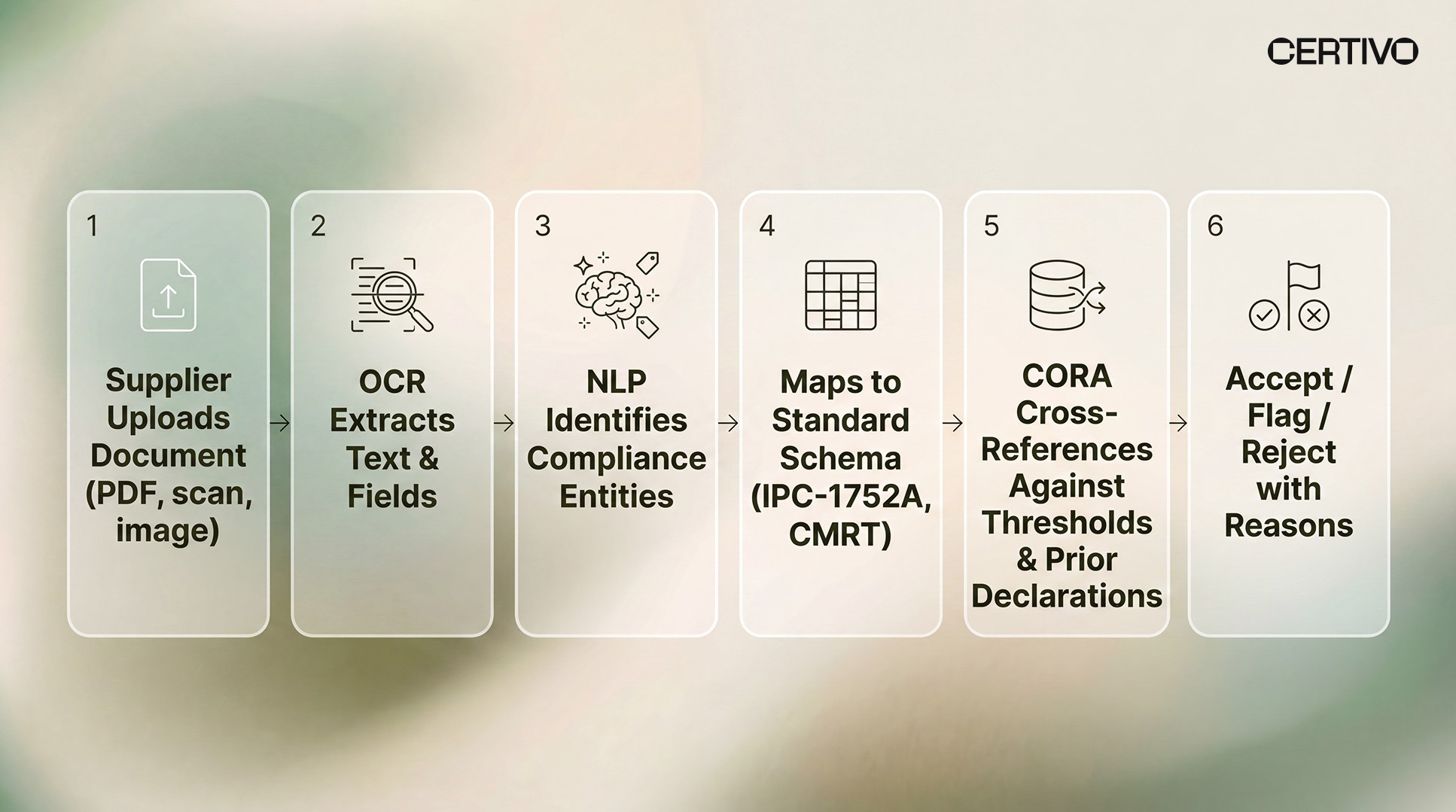
AI document parsing for compliance combines Optical Character Recognition (OCR) with Natural Language Processing (NLP) to transform unstructured supplier inputs into validated, structured compliance data:
Capability | What It Solves |
|---|---|
OCR extraction | Converts scanned images, photos, and non-searchable PDFs into machine-readable text |
NLP entity recognition | Identifies key compliance fields: substance names, threshold values, expiration dates, issuing authorities, exemption claims |
Template matching | Maps extracted data against expected fields for IPC-1752A, IEC 62474, CMRT, or customer-specific formats |
Cross-reference validation | Compares extracted values against prior supplier declarations, known substance lists, and regulatory thresholds |
CORA: The Strongest AI Showcase for Supplier Document Parsing
CORA-powered document parsing within Certivo is purpose-built for the compliance document problem. Upload a scanned RoHS Certificate of Conformity in any supported language. CORA extracts substance scope, validity dates, exemption claims, issuing party details, and declaration scope—then validates against the supplier's historical submission record and flags inconsistencies automatically.
Concrete example: A supplier uploads a multi-language REACH declaration as a scanned PDF. CORA:
Extracts text via OCR—including from handwritten margin notes
Identifies SVHC substance names, concentration thresholds, and exemption references via NLP
Maps extracted fields to the expected IPC-1752A or IEC 62474 data structure
Cross-references reported substance levels against current REACH SVHC Candidate List thresholds
Flags discrepancies with the supplier's prior declaration (e.g., a substance previously reported at 0.05% now reported at 0.12%)
Generates an acceptance, conditional acceptance, or rejection notification with specific reasons
How Can Organizations Validate Supplier Certificates for Authenticity and Accuracy at Scale?
Certificate validation is the step most manufacturers skip—or perform only during audits, when it is too late. An automated supplier compliance portal must address validation at the point of intake, not after the fact.
✓ Expiration date check — Reject or flag certificates that have already expired or will expire within the next reporting cycle
✓ Scope verification — Confirm that the certificate covers the specific products, substances, or exemptions relevant to the manufacturer's BOM
✓ Issuing authority recognition — Cross-reference the claimed issuing body against known certification bodies for RoHS, REACH, UL, CE, or industry-specific standards
✓ Consistency check — Compare current submission against prior declarations from the same supplier to detect contradictions or scope changes
✓ Substance threshold validation — For material declarations, verify that reported substance concentrations fall within regulatory threshold limits
CORA-enabled analysis automates these checks at upload time, transforming supplier certificate validation from a quarterly manual audit task into a continuous, automated gatekeeping function integrated into the centralized compliance data backbone.
⚠ Important accuracy note: AI document parsing extracts, structures, and flags inconsistencies. It does not independently verify authenticity against the issuing body's own records unless a direct integration with that authority's database exists. Compliance teams must understand this boundary. CORA reduces manual review effort by 70–80% but does not eliminate human oversight for high-risk or ambiguous cases.
What Tools Support Continuous Monitoring of Supplier Certifications and Expirations?
Collecting a valid certificate once is not enough. Certificates expire. Regulations change. Supplier production processes evolve. Without continuous monitoring, a certificate that was valid at intake becomes a compliance liability six months later.
What Continuous Monitoring Requires:
✓ Automated expiration tracking with advance alerts (90, 60, 30, 15 days before expiry) ✓ Re-declaration triggers when regulatory changes affect the scope of existing certificates
✓ Supplier risk scoring updates based on response timeliness, document quality, and historical compliance behavior
✓ Integration with regulatory intelligence and horizon scanning to identify when new regulations invalidate existing declarations
CORA's regulatory intelligence layer monitors changes to substance lists—REACH SVHC Candidate List updates, PFAS restrictions, RoHS exemption renewals, TSCA reporting requirements—and proactively flags which supplier certificates need re-validation based on changed regulatory scope. This shifts organizations from periodic, calendar-driven re-declaration cycles toward continuous compliance monitoring and audit readiness.
For a deeper look at how Certivo handles document-level automation, see AI Tools for Compliance Management: The Complete Guide.
AI document parsing and certificate validation workflow for automated supplier compliance portal
Click on image to view full
📌 Managing hundreds of supplier certificates manually? See how Certivo automates validation at scale → Map your regulatory exposure in 60 seconds
Handling Supplier Resistance: Hybrid Email-to-Portal Ingestion
The practical reality: not all suppliers will adopt a portal. Tier 2 and Tier 3 suppliers in certain geographies may lack IT infrastructure, dedicated compliance staff, or English-language capability. Mandating portal-only submission creates friction that slows data collection rather than accelerating it.
The Pragmatic Solution
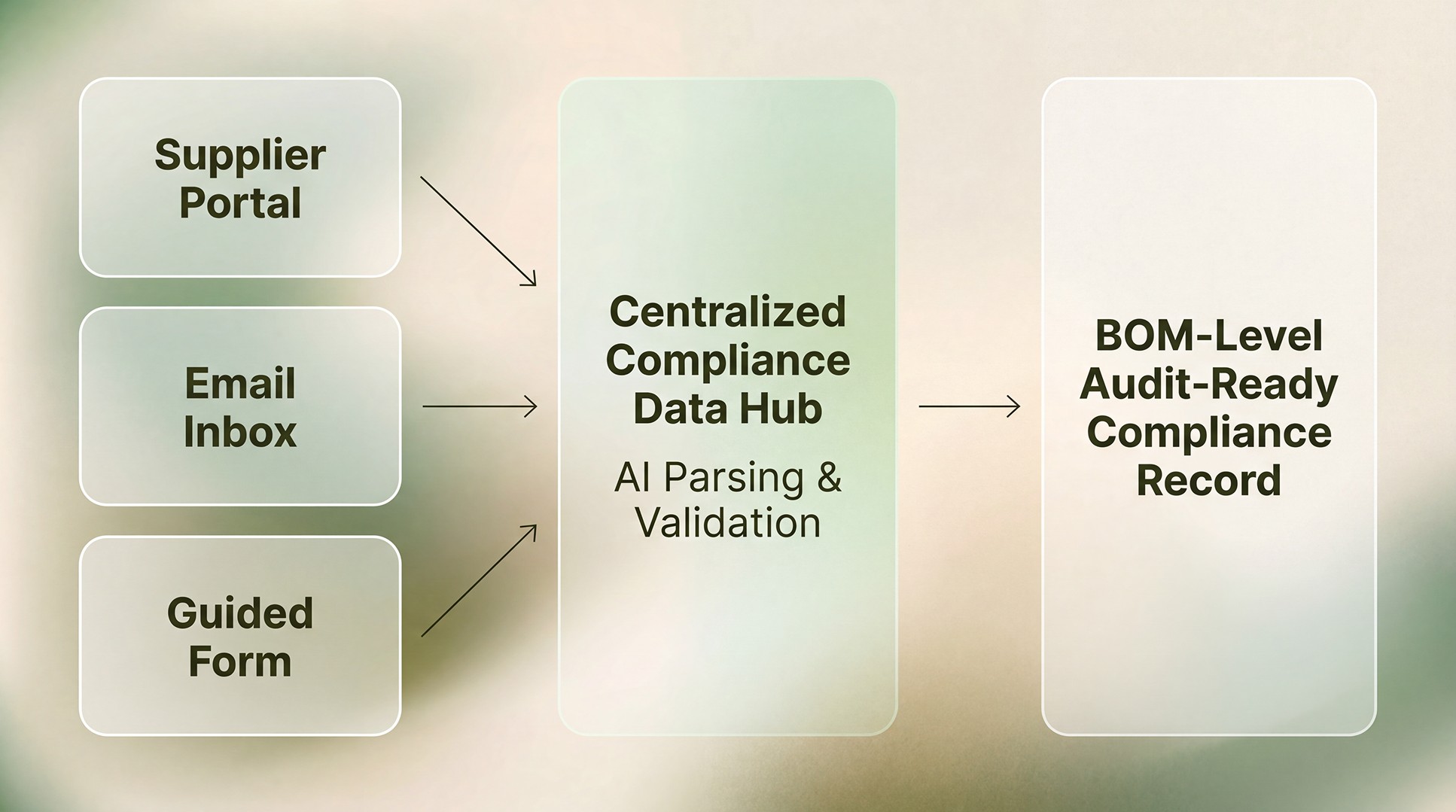
A hybrid ingestion model accepts supplier data through multiple channels—email, portal upload, or even dedicated intake email addresses—and routes all submissions into the same centralized system for parsing and validation.
Portal-native suppliers submit directly through the self-service interface
Email-submitting suppliers send documents to a dedicated compliance inbox; CORA parses attachments automatically and routes them to the correct supplier profile
Guided forms for smaller suppliers replace complex spreadsheets with simple, step-by-step questionnaires that require no compliance expertise
This approach respects the reality of multi-tier supply chain transparency while maintaining data integrity. The goal is not to force suppliers onto a single channel—it is to ensure that regardless of how data arrives, it is structured, validated, and linked to the correct products and BOMs.
For guidance on engaging smaller suppliers effectively, see Certivo's approach to supplier collaboration.
What Platforms Can Handle Both Compliance Management and Supplier Engagement Workflows?
The most effective automated supplier compliance portals do not operate in isolation. They connect supplier data collection to the broader compliance management system—linking supplier declarations to product BOMs, regulatory frameworks, and customer reporting obligations.
What End-to-End Integration Looks Like
Workflow Layer | Connection Point |
|---|---|
Supplier portal | Collects declarations, certificates, material disclosures via centralized supplier self-service portals |
Maps supplier data to specific parts, assemblies, and finished goods | |
Regulatory framework engine | Evaluates supplier data against REACH, RoHS, PFAS, TSCA, conflict minerals requirements |
Customer reporting | Generates compliance declarations for OEM customers and customer trust centers |
Audit readiness | Maintains the full documentation chain from raw supplier input to final product declaration |
Without this integration, supplier data collection becomes another silo—useful for collection but disconnected from the compliance decisions it needs to inform. Certivo's platform architecture connects automated supplier data collection directly to product compliance management, creating an end-to-end thread from supplier input to customer output through an integrated PLM ERP compliance thread.
Hybrid supplier compliance data ingestion with automated portal AI parsing and validation
Click on image to view full
Data Privacy and GDPR Considerations in Supplier Data Collection
Enterprise buyers evaluating an automated supplier compliance portal will—and should—ask about data privacy. When collecting supplier data across jurisdictions, manufacturers must address:
✓ GDPR compliance for supplier contacts located in the EU (personal data of supplier personnel submitting documents)
✓ Data residency requirements — Where is supplier data stored? Can it remain within specific geographic boundaries?
✓ Access controls — Role-based permissions ensuring that only authorized personnel access supplier-specific data
✓ Data retention policies — Defined retention and deletion protocols aligned with regulatory requirements and customer contracts
Based on currently available regulatory guidance, any platform handling supplier data across the EU must demonstrate GDPR-compliant data processing practices. This is a baseline requirement, not a differentiator—but failure to address it disqualifies a solution from enterprise consideration.
How Certivo and CORA Solve Supplier Compliance Data Collection
Certivo provides the infrastructure for automated supplier compliance portal deployment—from self-service portal configuration through AI-powered document parsing to continuous certificate monitoring.
CORA's Role Across the Supplier Data Lifecycle
CORA-powered document parsing extracts compliance-relevant data from any uploaded format—PDFs, scanned images, multi-language declarations—using OCR and NLP at enterprise scale
CORA-driven compliance intelligence validates extracted data against substance thresholds, expiration dates, and regulatory scope for REACH, RoHS, PFAS, TSCA, and conflict minerals
CORA's regulatory intelligence layer triggers re-declaration requests when regulatory changes (new SVHC additions, PFAS threshold updates, exemption expirations) affect the validity of existing supplier certificates
Standardized supplier questionnaire frameworks within the portal ensure suppliers submit data in the right structure from the start—reducing the parsing burden downstream
Supplier risk scoring continuously updates based on response timeliness, document quality, and declaration accuracy—feeding into procurement and supplier management decisions
The result: compliance teams shift from chasing suppliers and reviewing documents manually to managing exceptions and making decisions. The system handles volume. Humans handle judgment.
For organizations still managing compliance through spreadsheets, the transition to an automated portal represents the single highest-ROI investment in compliance operations.
Conclusion
Supplier compliance data collection is the foundation of every product compliance program. If supplier data is incomplete, late, or unverifiable, every downstream activity—BOM-level compliance intelligence, customer declarations, audit preparation, market access decisions—is compromised.
An automated supplier compliance portal paired with AI document parsing and certificate validation addresses both the collection problem (getting data from suppliers) and the quality problem (ensuring that data is accurate, current, and complete). Hybrid ingestion models accommodate supplier diversity. Continuous monitoring prevents certificate decay. Integration with broader compliance management systems ensures that supplier data drives actual product-level decisions.
The compliance teams that will operate effectively in 2026 and beyond are those that stop treating supplier data collection as an annual project and start treating it as a continuously automated function within their centralized compliance data backbone.
Book a demo to see how Certivo automates supplier compliance data collection across your product portfolio and multi-tier supply chain—or get a free supplier data quality audit to assess your current response rates, declaration gaps, and certificate validation readiness.
FAQs
1. How does Certivo's CORA AI extract data from non-standard supplier compliance documents?
CORA uses a combination of OCR and NLP to parse unstructured supplier documents—scanned PDFs, photographs of certificates, multi-language declarations, and handwritten annotations. It extracts key compliance fields (substance names, thresholds, expiration dates, issuing authorities, exemption claims), maps them to standard schemas like IPC-1752A or IEC 62474, and cross-references against the supplier's prior submissions and current regulatory thresholds.
2. What happens in Certivo when a supplier certificate expires or a declaration becomes outdated?
CORA's regulatory intelligence layer tracks expiration dates and monitors regulatory changes (new SVHC additions, PFAS threshold updates, RoHS exemption renewals). When a certificate approaches expiry—at 90, 60, 30, and 15 days—the system sends automated re-declaration requests to the supplier. If a regulatory change invalidates the scope of an existing declaration, CORA triggers a targeted re-collection request for the affected documents.
3. How can manufacturers reduce manual data entry when dealing with supplier compliance documents?
AI document parsing using OCR and NLP extracts compliance-relevant fields from unstructured uploads at the point of intake, eliminating manual re-keying. CORA-enabled analysis within an automated supplier compliance portal reduces manual review effort by 70–80% compared to spreadsheet-based processes while maintaining validation accuracy.
4. How do large manufacturers handle multi-language supplier compliance communication?
Enterprise-grade supplier portals with multi-language support allow suppliers to submit documents and complete questionnaires in their local language. CORA parses and extracts compliance data from multi-language certificates, mapping extracted content to standardized compliance schemas regardless of source language—supporting multi-tier supply chain transparency across global supplier bases.
5. Can supplier compliance portals integrate with existing ERP and PLM systems?
Effective automated supplier compliance portals connect supplier data to BOM-level compliance intelligence, PLM workflows, and ERP master data through API-based integrations. Certivo's architecture links supplier declarations directly to product structures, enabling design-for-compliance PLM workflows and continuous audit-ready documentation from a single platform.
Vasanth
Vasanth is a skilled Compliance Engineer with over five years of experience specializing in global environmental regulations, including REACH, RoHS, Proposition 65, POPs, TSCA, PFAS, CMRT, EMRT, FMD, and IMDS. With a strong academic foundation in Chemical Engineering from Anna University, he brings a deep technical understanding to compliance processes across complex product lines.
Vasanth excels in analyzing Bills of Materials (BOMs), evaluating supplier declarations, and ensuring regulatory conformity through meticulous review and risk assessment. He is highly proficient in supplier engagement, adept at interpreting material disclosures, and experienced in preparing customer-ready compliance documentation tailored to diverse global standards.
Known for his attention to detail, up-to-date regulatory knowledge, and proactive communication style, Vasanth plays a critical role in maintaining product compliance and advancing sustainability goals within fast-paced, globally integrated manufacturing environments.