


California's updated Proposition 65 warning requirements are now in effect — and the January 1, 2028 compliance deadline is less than two years away. The California Office of Environmental Health Hazard Assessment (OEHHA) introduced revised warning statement formats and expanded short-form warning obligations that took effect on January 1, 2025, including a new mandate to name at least one listed chemical in short-form warnings. With the transition window closing, the updated Proposition 65 warning requirements demand immediate action from every manufacturer selling into California.
These changes are not future obligations — they are current law with a hard enforcement cutoff approaching. Every manufacturer, importer, and retailer placing products into the California market must evaluate their labeling practices against the new rules now. Organizations that delay compliance risk enforcement actions and costly product relabeling once the transition period expires. Understanding how these changes intersect with your existing product compliance management processes is essential for avoiding disruption.
This article covers what changed, who is affected, what the new labeling formats look like, and how manufacturers should prepare before the transition deadline closes.
Need help assessing your Prop 65 labeling readiness before the 2028 deadline? Talk to Certivo's compliance team →
Table of Contents
What Changed in the Proposition 65 Warning Requirements
New Warning Statement Formats Explained
Expanded Short-Form Warning Obligations
Transition Period: January 2025 to January 2028
Industries and Products Affected
Compliance Risks and Enforcement Exposure
Operational and Supply Chain Impact
Compliance Readiness Checklist
The Role of AI in Proposition 65 Labeling Compliance
FAQs
Executive Conclusion
What Changed in the Proposition 65 Warning Requirements
OEHHA's update to Proposition 65 warning requirements — effective since January 1, 2025 — introduced two material changes that affect product labeling across every industry serving the California market. With the 2028 enforcement deadline now approaching, manufacturers must act during the remaining transition window. For broader context on California chemical compliance, see this breakdown of California Proposition 65 compliance obligations for businesses.
Change 1: New acceptable warning statement prefixes
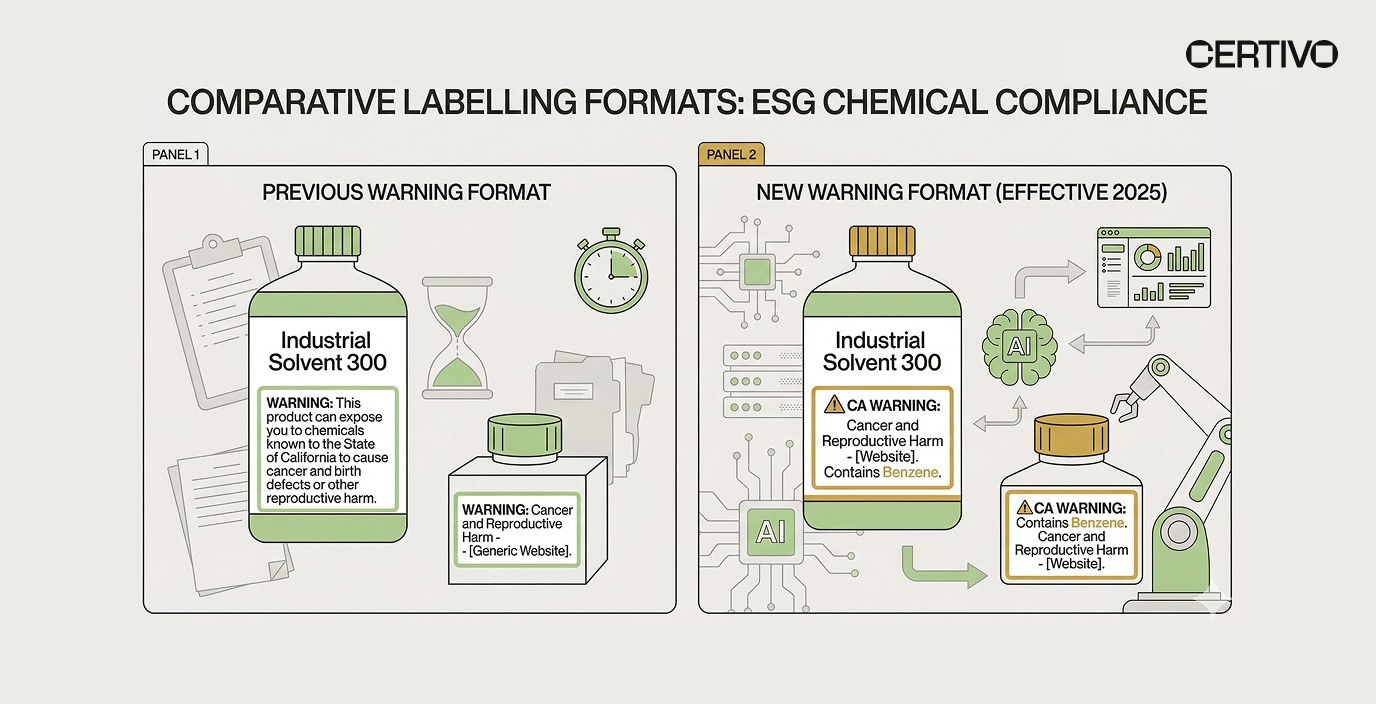
Previously, Proposition 65 warnings were required to begin with "WARNING:" — using specifically that word. The updated rule now permits two additional formats:
✓ "CA WARNING:"
✓ "CALIFORNIA WARNING:"
✓ "WARNING:" (still accepted)
This change is designed to improve consumer clarity — particularly for products sold nationally, where the California-specific nature of the warning was not always apparent to consumers.
Change 2: Expanded short-form warning requirements
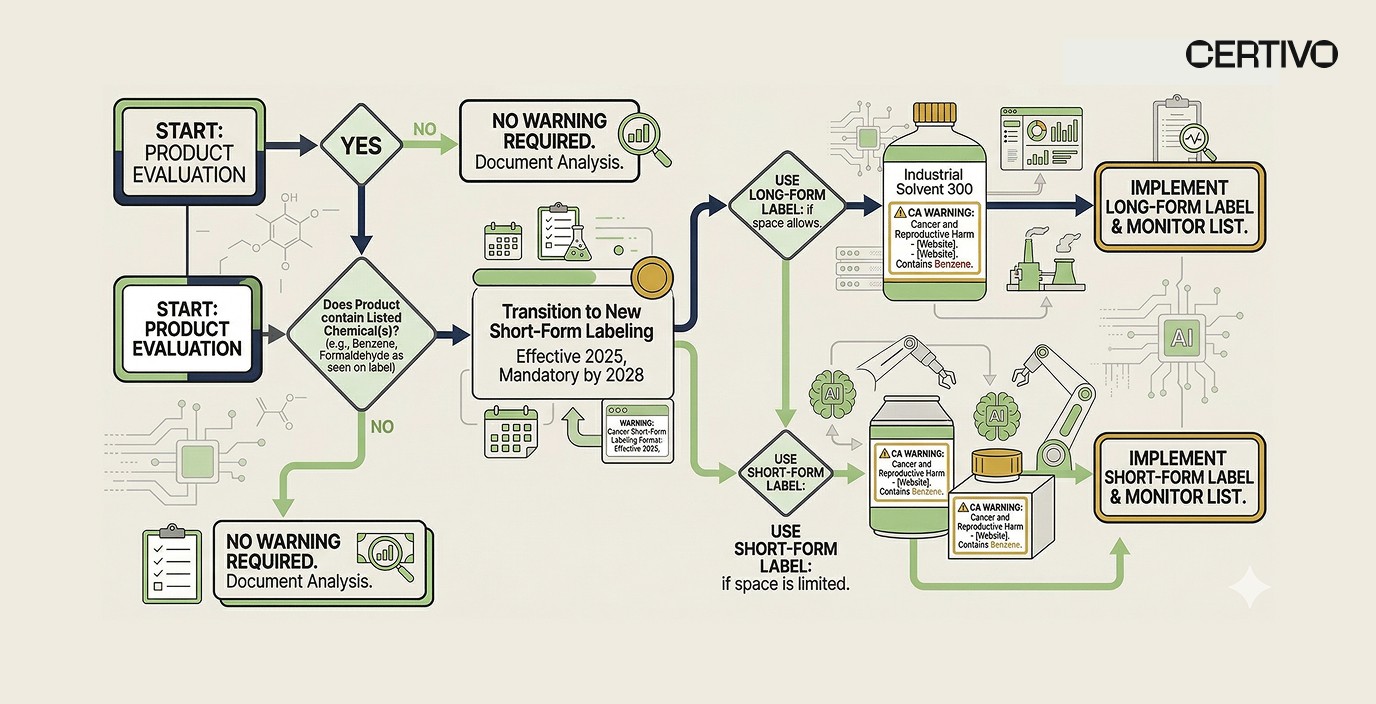
Short-form warnings — the condensed format used on smaller products or packaging — must now include at least one listed chemical name. Previously, short-form warnings could reference general exposure risks without naming specific substances.
⚠ This is the more operationally significant change. Manufacturers must now identify which Proposition 65 listed chemicals are present in their products and include at least one by name in any short-form warning. This requires substance-level product knowledge that many organizations do not currently maintain in their materials and environmental compliance systems.
New Warning Statement Formats Explained
The addition of "CA WARNING:" and "CALIFORNIA WARNING:" as acceptable prefixes gives manufacturers more flexibility in how they present Proposition 65 disclosures — but does not reduce the underlying obligation. All three formats carry the same legal weight under California law. Organizations managing labeling across multiple U.S. states should evaluate how this change affects their ability to expand into new markets with compliant product packaging.
📌 Acceptable warning prefix formats (effective January 1, 2025):
Format | Status | Notes |
|---|---|---|
WARNING: | ✓ Still accepted | Legacy format, remains compliant |
CA WARNING: | ✓ New option | Shorter California-specific identifier |
CALIFORNIA WARNING: | ✓ New option | Full state name for maximum clarity |
The practical benefit for manufacturers is the ability to use a prefix that clearly signals the warning is California-specific. This is particularly relevant for companies that sell identical products across all 50 states and want to avoid consumer confusion about whether a warning reflects a federal standard or a state-specific requirement. Consumer goods manufacturers selling nationally will find this flexibility especially useful.
⚠ Important: The prefix change does not alter the content requirements of the warning itself. All required elements — hazard identification, exposure statement, and (for short-form) at least one chemical name — must still be included regardless of which prefix is used.
Expanded Short-Form Warning Obligations
The most consequential change in the updated Proposition 65 warning requirements is the expansion of short-form warning content. This is where the compliance burden increases meaningfully for manufacturers. For practical approaches to managing this type of compliance workload, see how to save time on compliance management with AI solutions.
Previous short-form warning requirement:
General exposure statement (e.g., "This product can expose you to chemicals known to the State of California to cause cancer")
No requirement to name specific chemicals
Updated short-form warning requirement (effective January 1, 2025 — mandatory for all products by January 1, 2028):
Must include at least one listed chemical by name
Must provide "more clarity to consumers" about the nature of the exposure
📊 What this means operationally:
Manufacturers must know which Proposition 65 listed chemicals are present in each product
Labels must be updated to include at least one chemical name in every short-form warning
Product-specific chemical data must be traceable and documented for enforcement defense
The ability to track compliance at the BOM level becomes essential for identifying which chemicals are present in which products
This change transforms Prop 65 short-form warnings from a generic disclosure into a product-specific chemical declaration. Organizations that have relied on blanket warnings across product lines will need to differentiate their labels based on actual substance content.
⚠ No new chemicals were added to the Proposition 65 list under this update. The focus is entirely on labeling format and content — not on expanding the list of regulated substances. However, the requirement to name chemicals means manufacturers must have verified substance data for every product that carries a warning. Chemical and hazmat compliance infrastructure must support this level of product-specific chemical identification.
Transition Period: Now Through January 2028
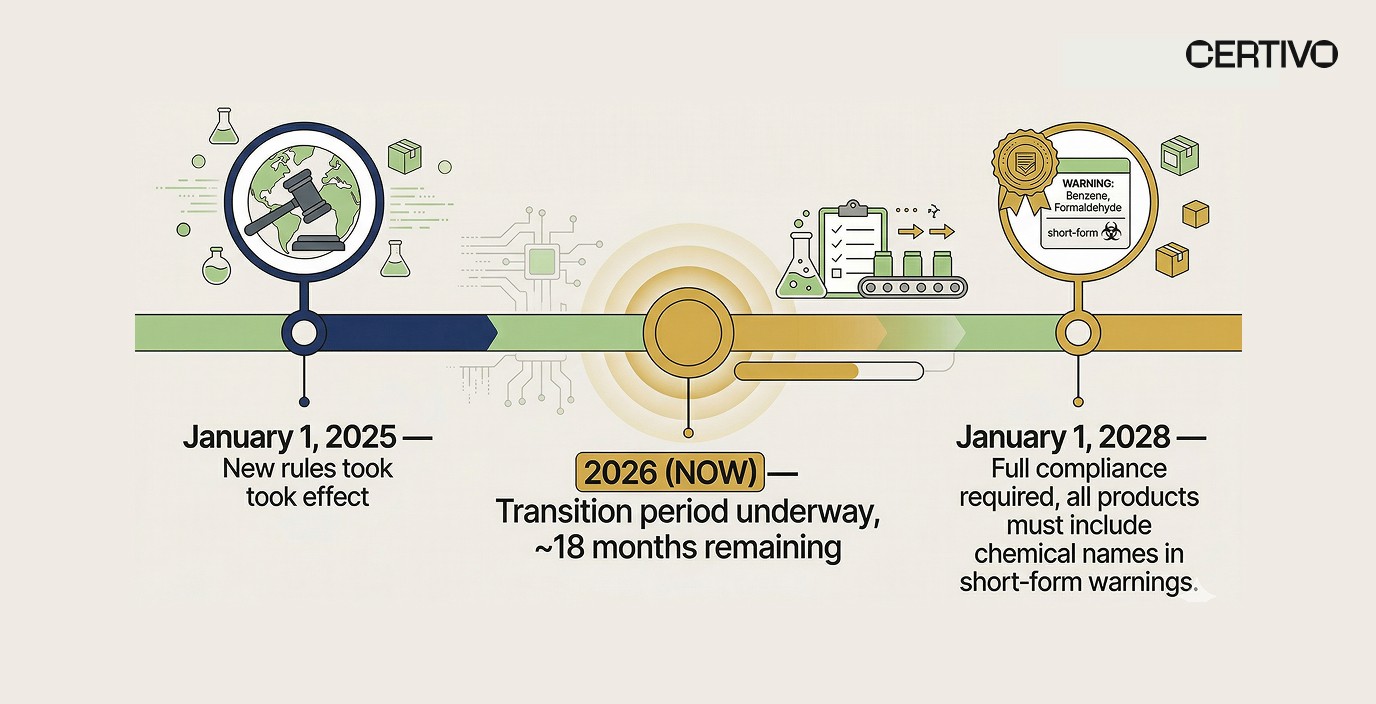
OEHHA provided a three-year transition period when the rules took effect in January 2025. As of mid-2026, approximately 18 months remain before full enforcement begins. This is a narrowing window — particularly for organizations with large product portfolios and long packaging lead times. For a broader view of how compliance infrastructure should evolve during transition periods, see building a future-ready compliance infrastructure.
📌Transition timeline:
Milestone | Date |
|---|---|
New warning requirements effective | January 1, 2025 (already in effect) |
New formats required for all newly manufactured/labeled products | Now (recommended for all new production runs) |
Products manufactured and labeled before January 1, 2028 | May use old short-form format |
Transition deadline — all products must comply | January 1, 2028 |
What the transition period means in practice:
✓ Products manufactured and labeled before January 1, 2028 may continue using the previous short-form warning format
⚠ Products manufactured or labeled on or after January 1, 2028 must use the new format with at least one named chemical
⚠ The transition applies to manufacturing/labeling date — not the date of sale
Organizations with long production cycles or large pre-labeled inventory should plan their transition urgently — 18 months is a compressed timeline for enterprises managing thousands of SKUs. Operations leaders should coordinate with packaging, procurement, and compliance teams to establish cutover timelines that align with manufacturing schedules before the deadline arrives.
Industries and Products Affected
The updated Proposition 65 warning requirements affect every industry that places products into the California market — and with the 2028 deadline approaching, the urgency is increasing across all sectors. Because California is the largest consumer market in the United States, the practical reach extends to virtually all manufacturers selling domestically. For context on how electronics manufacturers specifically manage substance compliance, see the dedicated industry resource.
Industry | Impact | Key Considerations |
|---|---|---|
Consumer Electronics | ⚠ High | Products contain listed substances (lead, cadmium, phthalates); short-form labels common on small devices |
Household Goods | ⚠ High | Wide product variety requiring differentiated chemical-specific labels |
Personal Care & Cosmetics | ⚠ High | Ingredient-level Prop 65 exposure; labeling on small packaging |
Retail & E-commerce | ⚠ Moderate–High | Responsible for compliant labeling at point of sale; website warnings affected |
Manufacturing (all sectors) | ⚠ High | Must supply chemical-specific data to downstream customers for labeling |
Chemical & Materials Suppliers | ⚠ Moderate | Must provide substance data enabling customers to meet naming requirement |
Automotive manufacturers are also affected, particularly for aftermarket parts and accessories that carry Prop 65 warnings. Similarly, medical device and equipment manufacturers must evaluate whether their current labeling practices meet the new chemical-naming obligation.
For companies supplying products across multiple states, the Prop 65 labeling update adds a California-specific layer on top of existing federal and state requirements. The ability to standardize compliance across plants and regions becomes critical for avoiding label fragmentation.
Compliance Risks and Enforcement Exposure
Proposition 65 is enforced through both government action and private litigation — and private enforcement has historically been the primary driver of compliance pressure. Organizations should understand the risk landscape and evaluate their exposure. For a broader perspective on proactive risk management, see managing compliance risk proactively.
Enforcement mechanisms:
⚠ Private "bounty hunter" lawsuits — California law allows private citizens and organizations to file lawsuits against businesses that fail to provide adequate Prop 65 warnings. These lawsuits can result in penalties of up to $2,500 per day per violation
⚠ Government enforcement — The California Attorney General and district attorneys can bring enforcement actions
⚠ Settlement costs — The vast majority of Prop 65 cases result in settlements that include penalty payments, injunctive relief, and attorney fees
📊 Risk amplification under the new rules:
The chemical-naming requirement creates a new category of potential violation that will become fully enforceable in 2028. Previously, a generic short-form warning was sufficient. Now, a warning that does not name at least one specific chemical may be treated as inadequate — even if the product was otherwise properly labeled. This means:
Products with outdated labels after January 1, 2028 face immediate enforcement risk
Products with inaccurate chemical names face enforcement risk regardless of date
Products with no chemical name in short-form warnings will be non-compliant from 2028 onward
Organizations that lack supplier and contractor management systems capable of capturing chemical-specific data from upstream suppliers will struggle to meet the naming requirement accurately. The compliance risk extends beyond labeling — it requires reliable substance data throughout the supply chain.
Operational and Supply Chain Impact
The updated warning requirements create operational demands that extend well beyond the packaging department. Compliance teams, procurement, product management, and supplier relations must all be involved. For context on how documentation workloads are increasing across the supply chain, see how tariffs and reshoring are increasing material compliance and documentation workloads.
Operational impacts:
Label redesign and printing — Every product carrying a short-form Prop 65 warning must be evaluated and potentially relabeled with chemical-specific information
Product-level chemical identification — Compliance teams must map which listed chemicals are present in each product SKU
Supplier data collection — Upstream suppliers must provide verified substance data to enable accurate chemical naming on labels
E-commerce warning updates — Online product listings with Prop 65 warnings must also be updated to reflect the new format
Streamlining supplier documentation is critical because chemical naming accuracy depends on the quality of data received from material and component suppliers. Organizations using manual data collection methods face higher error rates and longer cycle times.
For companies managing large product catalogs, the effort required to identify the correct chemical name for each product — and then update labels, packaging, and digital listings — is substantial. Replacing spreadsheets with a scalable compliance system is a practical step toward managing this at scale without excessive manual effort.
Compliance Readiness Checklist
📌 Use this checklist to assess your organization's preparedness for the updated Proposition 65 warning requirements before the 2028 deadline:
# | Action Item | Owner | Status |
|---|---|---|---|
1 | Inventory all products currently carrying Prop 65 warnings (short-form and long-form) | Compliance + Product Management | ☐ |
2 | Identify which Prop 65 listed chemicals are present in each product | Compliance + Engineering | ☐ |
3 | Determine which products use short-form warnings that require updating | Packaging + Compliance | ☐ |
4 | Select at least one listed chemical to name in each updated short-form warning | Compliance + Legal | ☐ |
5 | Update label artwork to include new warning format ("CA WARNING:" or "CALIFORNIA WARNING:" or "WARNING:") | Packaging + Design | ☐ |
6 | Issue structured supplier data requests for chemical substance content | Procurement | ☐ |
7 | Update e-commerce listings and digital product warnings | Marketing + Compliance | ☐ |
8 | Establish manufacturing/labeling cutover date well before January 1, 2028 | Operations | ☐ |
9 | Document chemical identification basis for enforcement defense | Legal + Compliance | ☐ |
10 | Monitor OEHHA for any further guidance or clarifications | Regulatory Affairs | ☐ |
Compliance and regulation managers should own the overall timeline and coordinate across packaging, legal, procurement, and engineering functions. For organizations evaluating system readiness, this overview of Certivo's platform features provides a reference for compliance infrastructure capabilities.
The Role of AI in Proposition 65 Labeling Compliance
The chemical-naming requirement in the updated Proposition 65 warning rules creates a data challenge that scales with product portfolio size — and with less than two years until full enforcement, time-to-compliance matters. For organizations with hundreds or thousands of SKUs, manually identifying which listed chemicals are present in each product is resource-intensive and error-prone. For a practical view of how AI transforms compliance workflows, see a compliance engineer's week with and without AI.
Core challenges requiring AI-driven solutions:
Mapping Prop 65 listed chemicals against product BOMs across large product portfolios
Aggregating chemical substance data from multiple suppliers into a single compliance view
Automating label content generation based on verified substance data
Monitoring OEHHA updates to the Proposition 65 chemical list for new additions
AI-native compliance platforms address these challenges through:
✓ BOM-level substance scanning that identifies Prop 65 listed chemicals at the component and material level
✓ Automated supplier data collection through structured portals that request specific chemical content information
✓ Document parsing that extracts substance data from safety data sheets, certificates, and material declarations
✓ Regulatory monitoring that tracks OEHHA publications for new chemical listings, guidance updates, and enforcement trends
For a comprehensive overview of AI compliance capabilities, see AI tools for compliance management: the complete guide. Organizations managing Prop 65 alongside REACH, RoHS, and TSCA obligations should also evaluate AI in supply chain compliance management for multi-framework consolidation.
CTOs and technical leaders play a critical role in evaluating how compliance platforms integrate with existing PLM and ERP systems to enable automated label content workflows.
Frequently Asked Questions (FAQs)
Q1: Are the new Proposition 65 warning formats mandatory immediately?
The new formats took effect on January 1, 2025 and are already in force. However, OEHHA provided a transition period until January 1, 2028, during which products manufactured and labeled before that date may continue using the previous short-form warning format. After January 1, 2028, all products must comply with the updated requirements — regardless of when they were manufactured. As of mid-2026, approximately 18 months remain. Compliance regulation managers should have transition plans actively underway.
Q2: What exactly must be included in the new short-form warning?
The updated short-form warning must now include at least one Proposition 65 listed chemical by name, in addition to the standard exposure statement. The warning may begin with "WARNING:", "CA WARNING:", or "CALIFORNIA WARNING:". The chemical named must be one that is actually present in the product. Organizations need reliable BOM-level compliance intelligence to identify the correct chemical for each product.
Q3: Were any new chemicals added to the Proposition 65 list under this update?
No. This update focuses exclusively on warning label format and content requirements — not on expanding the list of regulated substances. The requirement to name at least one chemical in short-form warnings applies to chemicals already on the existing Prop 65 list. For broader chemical compliance context, see the Prop 65 framework overview.
Q4: Does this affect e-commerce and online product listings?
Yes. Proposition 65 warnings are required on all products sold into California, including those sold online. E-commerce listings that display Prop 65 warnings must be updated to reflect the new format requirements, including chemical naming in short-form warnings. Responding faster to customer compliance requirements includes ensuring digital labeling is accurate and current.
Q5: What happens if my product label does not name a specific chemical after January 1, 2028?
After the transition deadline, a short-form warning that does not include at least one named listed chemical will be considered inadequate under Proposition 65. This could expose the business to private enforcement lawsuits and government enforcement actions, with penalties of up to $2,500 per day per violation. With the January 1, 2028 deadline now less than two years away, organizations should use the remaining transition period to audit and update all affected labels immediately. For a broader perspective on managing regulatory risk across frameworks, see the ultimate guide to compliance management.
Conclusion
The updated Proposition 65 warning requirements represent a meaningful shift in how California expects manufacturers to communicate chemical exposure risks to consumers. The new rules are already in effect, and the January 1, 2028 enforcement deadline is now less than two years away. The addition of "CA WARNING:" and "CALIFORNIA WARNING:" as acceptable prefixes provides useful flexibility. But the expanded short-form warning obligation — requiring at least one named listed chemical — creates new operational, data, and supply chain demands for every organization selling products into California.
The remaining transition window is narrowing. Identifying which Proposition 65 warning requirements apply to each product, mapping the listed chemicals present, updating labels and digital listings, and ensuring supplier data supports accurate chemical naming — all of this requires systematic effort that should already be underway. Organizations that have not started will face compressed timelines and elevated enforcement risk as 2028 approaches.
Organizations managing Prop 65 labeling alongside other chemical compliance frameworks such as REACH, RoHS, and TSCA need infrastructure that connects substance data to labeling and reporting requirements across jurisdictions.
📌 The 2028 Prop 65 deadline is less than two years away. Explore how AI-driven compliance platforms like Certivo help manufacturers automate chemical identification, label compliance, and supplier data collection across frameworks. Schedule a compliance readiness assessment →
Lavanya
Lavanya is an accomplished Product Compliance Engineer with over four years of expertise in global environmental and regulatory frameworks, including REACH, RoHS, Proposition 65, POPs, TSCA, PFAS, CMRT, FMD, and IMDS. A graduate in Chemical Engineering from the KLE Institute, she combines strong technical knowledge with practical compliance management skills across diverse and complex product portfolios.
She has extensive experience in product compliance engineering, ensuring that materials, components, and finished goods consistently meet evolving international regulatory requirements. Her expertise spans BOM analysis, material risk assessments, supplier declaration management, and test report validation to guarantee conformity. Lavanya also plays a key role in design-for-compliance initiatives, guiding engineering teams on regulatory considerations early in the product lifecycle to reduce risks and streamline market access.
Her contributions further extend to compliance documentation, certification readiness, and preparation of customer deliverables, ensuring transparency and accuracy for global stakeholders. She is adept at leveraging compliance tools and databases to efficiently track regulatory changes and implement proactive risk mitigation strategies.
Recognized for her attention to detail, regulatory foresight, and collaborative approach, Lavanya contributes significantly to maintaining product compliance, safeguarding brand integrity, and advancing sustainability goals within dynamic, globally integrated manufacturing environments.