

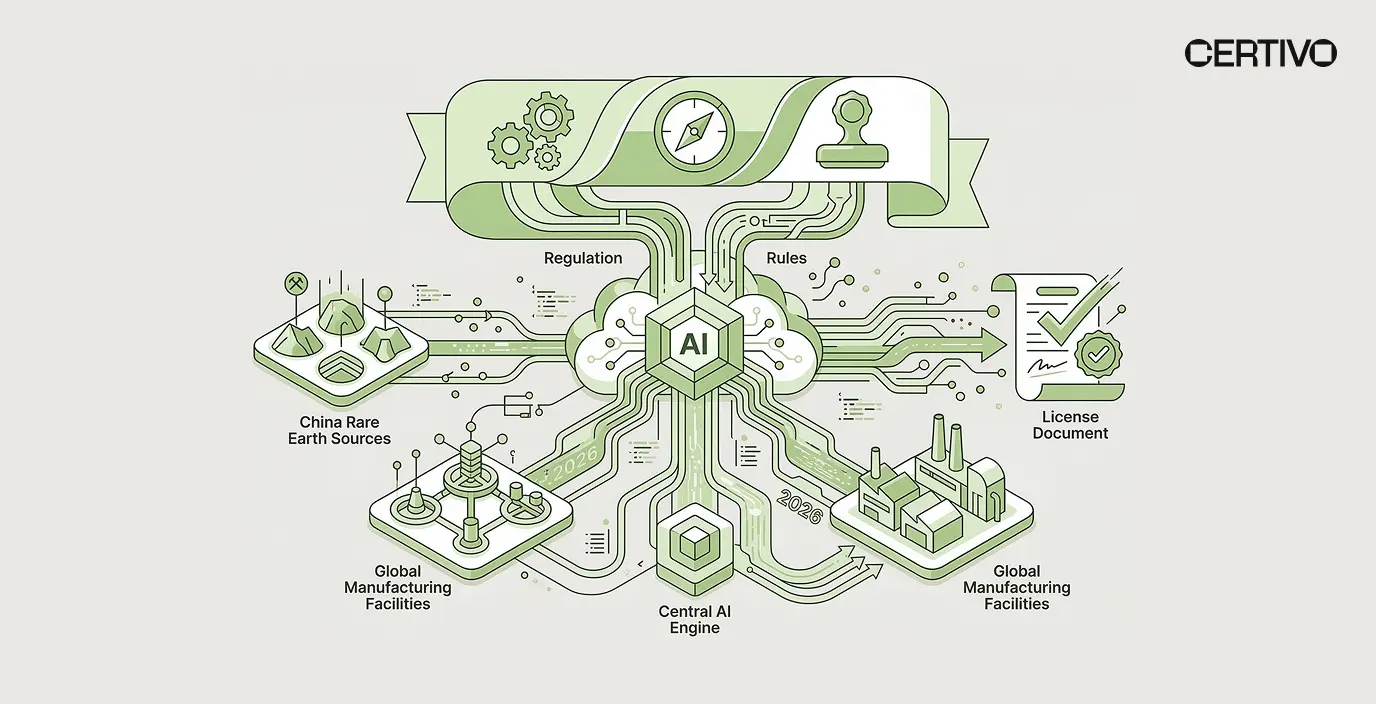
China's updated rare earth export controls are reshaping how global manufacturers source critical materials. Through revisions to the 2026 Import-Export Licensing Catalogue, China has introduced new licensing requirements for several rare earth elements — including samarium, gadolinium, and lutetium compounds — that are foundational to electronics, automotive, aerospace, and clean energy manufacturing.
These changes, administered jointly by the Ministry of Commerce (MOFCOM) and the Ministry of Industry and Information Technology (MIIT), represent a significant escalation in China's strategic management of critical mineral exports. For compliance and regulation managers across global supply chains, understanding the scope, timeline, and operational impact of these China rare earth export controls is now an urgent priority.
This article provides a complete breakdown of the regulatory changes, affected materials, industry impact, extraterritorial provisions, and compliance readiness steps manufacturers should take now.
Table of Contents
What Changed: China's Expanded Rare Earth Licensing Framework
Materials Now Subject to Export Licensing
Extraterritorial Export Control Provisions
Industries and Supply Chains Affected
Compliance Risks and Enforcement Considerations
Timeline and Key Dates
Operational and Supply Chain Impact
Compliance Readiness Checklist
The Role of AI in Strategic Materials Compliance
FAQs
Executive Conclusion
1. What Changed: China's Expanded Rare Earth Licensing Framework
China has long maintained export controls on rare earth elements. However, the 2026 revisions to the Import-Export Licensing Catalogue mark a meaningful expansion. The updated framework introduces new licensing requirements for specific rare earth compounds that were previously subject to less restrictive oversight. For background on how China's export control strategy has evolved, see China's earlier rare earth export control expansion and its impact on global manufacturers.
The key changes include:
New export licensing classifications for compounds containing samarium, gadolinium, and lutetium
Joint administration by MOFCOM and MIIT as part of China's broader critical minerals strategy
Extraterritorial provisions introduced in October 2025, allowing China to regulate the overseas use of certain controlled materials
Delayed extraterritorial enforcement — following diplomatic consultations, enforcement of extraterritorial provisions has been pushed to November 2026
⚠ This is not a ban. It is a licensing regime. Manufacturers can still source these materials from China — but only through licensed channels, with enhanced documentation and regulatory oversight. Organizations managing multi-jurisdictional material sourcing need centralized compliance infrastructure to track evolving export control requirements across regions.
The regulatory intent is clear: China is tightening control over strategic materials that underpin advanced manufacturing globally. For compliance teams, this means material sourcing decisions now carry regulatory risk that must be actively monitored and documented. Understanding the full regulatory frameworks applicable to your material inputs is essential.
2. Materials Now Subject to Export Licensing
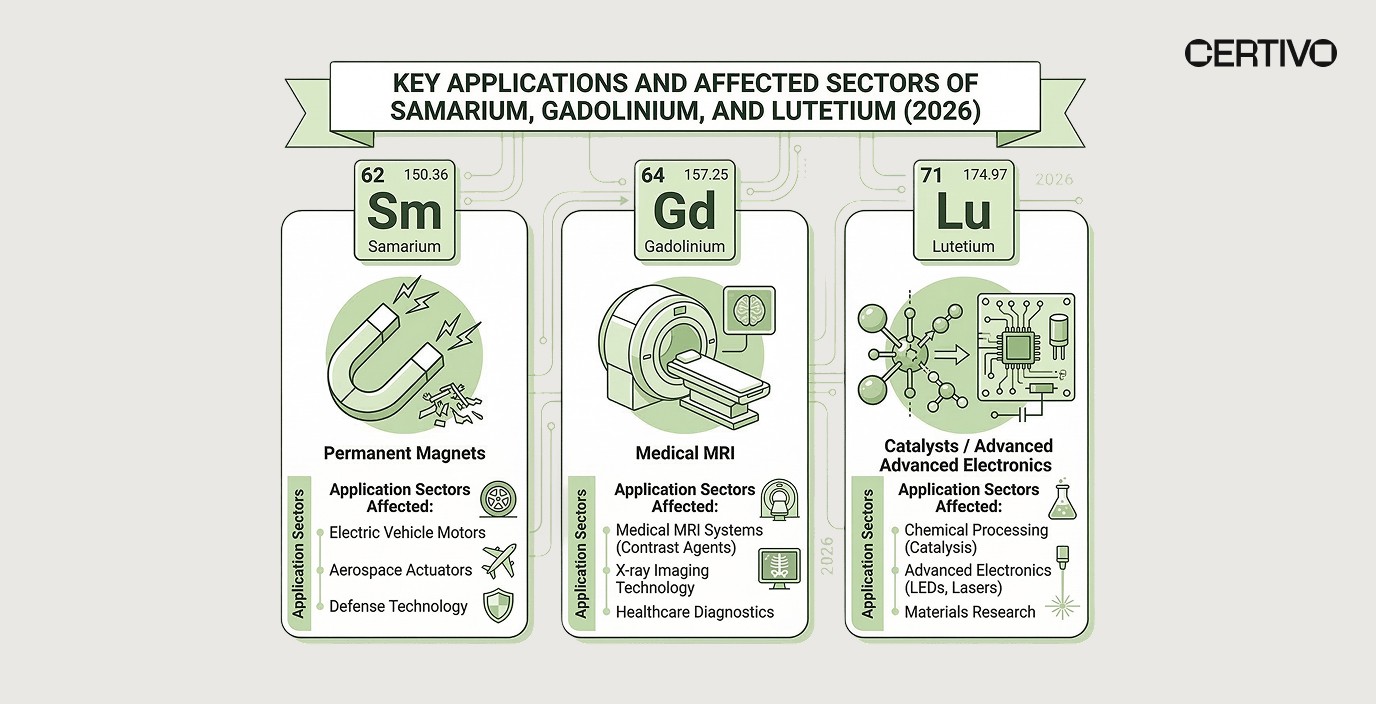
The updated licensing requirements target specific rare earth compounds with high strategic and industrial value. Manufacturers must understand which materials are affected and where they appear in their product BOMs and supply chains. The ability to track compliance at the BOM level is critical for identifying exposure to controlled substances.
Material | Category | Typical Applications |
|---|---|---|
Samarium compounds | Rare earth element | Permanent magnets, aerospace components |
Gadolinium compounds | Rare earth element | Medical imaging, nuclear and electronic applications |
Lutetium compounds | Rare earth element | Catalysts, advanced electronics, research equipment |
📌 Why these materials matter:
These three elements are not commodity chemicals — they are precision materials embedded deep within advanced manufacturing supply chains. Samarium-cobalt magnets are used in aerospace guidance systems and high-temperature motor applications. Gadolinium is essential for MRI contrast agents and neutron radiography. Lutetium compounds appear in PET scan detectors and specialty catalysts.
For many manufacturers, these materials enter the supply chain not as direct purchases but as components within imported assemblies, sub-components, or specialty parts. This means the compliance obligation extends beyond procurement teams to product engineering and design-for-compliance PLM workflows that map material content at every tier.
Organizations that lack visibility into their multi-tier supply chain material composition face the greatest risk. Multi-tier supply chain transparency — the ability to trace material origin and licensing status from raw material to finished product — is now a compliance necessity, not a supply chain optimization exercise.
3. Extraterritorial Export Control Provisions
One of the most significant aspects of China's updated framework is the introduction of extraterritorial export control provisions in October 2025. These provisions theoretically allow the Chinese government to regulate the downstream use of certain controlled materials even after they have left Chinese territory.
This represents a new dimension of compliance risk. Under these provisions, a manufacturer that sources controlled rare earth materials from China could face regulatory consequences if those materials are subsequently used in applications or exported to destinations that China restricts — even if the manufacturer operates entirely outside China. For organizations evaluating how this intersects with other critical mineral regulations, see how China's rare earth export licenses disrupt compliance.
⚠ Key timeline note: Following diplomatic consultations, enforcement of these extraterritorial provisions has been delayed until November 2026. This gives manufacturers a compliance preparation window — but not a reason to defer action.
Organizations should use this window to:
✓ Map all product lines and components that rely on Chinese-origin rare earth materials
✓ Identify downstream use cases that could trigger extraterritorial compliance obligations
✓ Establish documentation trails proving material origin, licensing status, and end-use compliance
✓ Engage legal and compliance counsel on extraterritorial risk exposure
Regulatory intelligence and horizon scanning capabilities are essential for tracking how these extraterritorial provisions evolve before the November 2026 enforcement date. CEOs and executive teams should ensure this risk is elevated to board-level strategic planning.
4. Industries and Supply Chains Affected
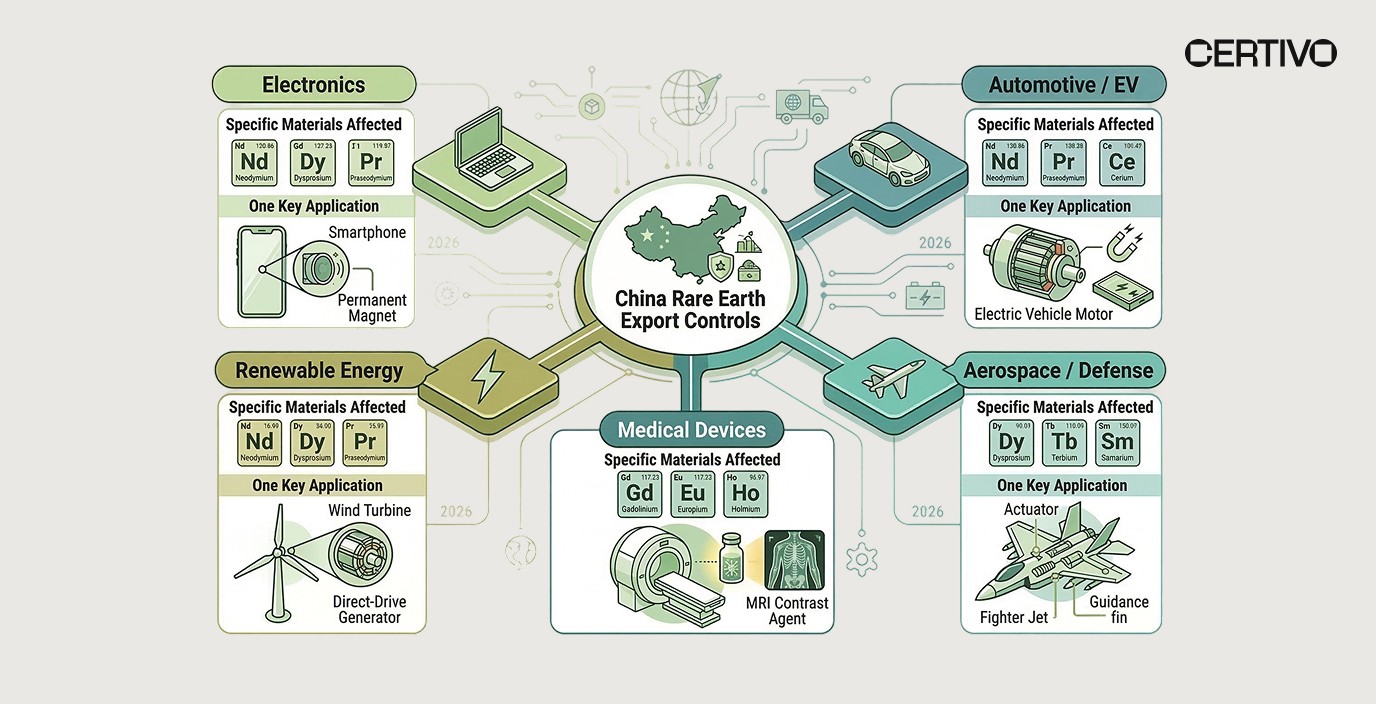
The impact of China's rare earth export controls is not limited to mining or raw material companies. It extends across every manufacturing sector that depends on rare earth elements in finished products, sub-assemblies, or components.
Industry | Materials Affected | Impact Area |
|---|---|---|
Electronics & Semiconductors | Samarium, gadolinium, lutetium | Magnets, microelectronics, sensors |
Automotive & Electric Vehicles | Samarium, gadolinium | Motors, batteries, power electronics |
Renewable Energy | Samarium, gadolinium | Wind turbines, energy storage systems |
Aerospace & Defense | Samarium, lutetium | Precision guidance, radar technologies |
Medical Devices | Gadolinium, lutetium | Imaging equipment, specialized electronics |
For electronics and semiconductor manufacturers, rare earth materials are embedded in magnets, sensors, and microelectronic components that are often sourced as part of larger assemblies. Semiconductor compliance teams must trace rare earth content through multiple supply chain tiers.
For automotive and EV manufacturers, samarium and gadolinium compounds are critical to electric motor performance and power electronics. The automotive regulatory landscape is becoming increasingly complex as material sourcing regulations layer on top of existing emissions and safety requirements.
For aerospace and defense companies, the implications are particularly acute. Samarium-cobalt magnets are used in mission-critical guidance and radar systems where substitution is not straightforward. Aerospace and defense compliance teams must assess supply continuity risk alongside regulatory compliance.
For medical device manufacturers, gadolinium is indispensable for MRI contrast agents and lutetium for PET scan detectors. Supply disruption in this sector carries patient safety implications. Medical device compliance infrastructure must account for strategic material sourcing risk.
For renewable energy companies, rare earth magnets are essential for wind turbine generators and energy storage technologies. The energy storage and battery sector faces compounding regulatory pressure as both chemical compliance and material sourcing controls tighten simultaneously.
5. Compliance Risks and Enforcement Considerations
While the licensing framework is not a ban, non-compliance with China's export control requirements carries significant consequences — both for Chinese exporters and for international manufacturers who fail to verify sourcing compliance.
Key risk areas include:
⚠ Supply disruption: Licensed export channels may create bottlenecks, delays, and allocation constraints for manufacturers dependent on Chinese-origin rare earth materials
⚠ Extraterritorial liability: After November 2026, manufacturers using Chinese-origin controlled materials in restricted downstream applications could face regulatory action under China's extraterritorial provisions
⚠ Customer compliance inquiries: Downstream OEMs and government procurement bodies are increasingly requiring material origin and compliance declarations from suppliers
⚠ Conflict with other regulatory frameworks: Manufacturers subject to conflict minerals compliance requirements and emerging critical minerals due diligence obligations face overlapping reporting demands
Organizations that cannot demonstrate material sourcing compliance, licensing verification, and end-use documentation face both regulatory and commercial risk. The ability to manage compliance risk proactively — rather than reactively after a customer audit or supply disruption — is a competitive differentiator.
VPs and Directors of Quality should ensure that material sourcing compliance is integrated into incoming inspection and supplier qualification processes.
6. Timeline and Key Dates
📊 Critical dates for manufacturers:
Date | Event |
|---|---|
October 2025 | China introduces extraterritorial export control provisions |
Through March 2026 | Ongoing updates to Import-Export Licensing Catalogue (samarium, gadolinium, lutetium added) |
2026 (ongoing) | New licensing requirements in effect for affected compounds |
November 2026 | Scheduled enforcement of extraterritorial export control provisions |
The regulatory updates are ongoing through March 2026, meaning additional materials or compounds could be added to the licensing catalogue. Continuous monitoring is required. VP of Operations teams should establish a recurring review cadence for China export control updates.
The official source for all updates is the MOFCOM Export Control Information Portal.
7. Operational and Supply Chain Impact
The practical impact of these export controls extends far beyond compliance documentation. They affect procurement strategy, supplier qualification, product design, and market access.
For procurement and supply chain teams:
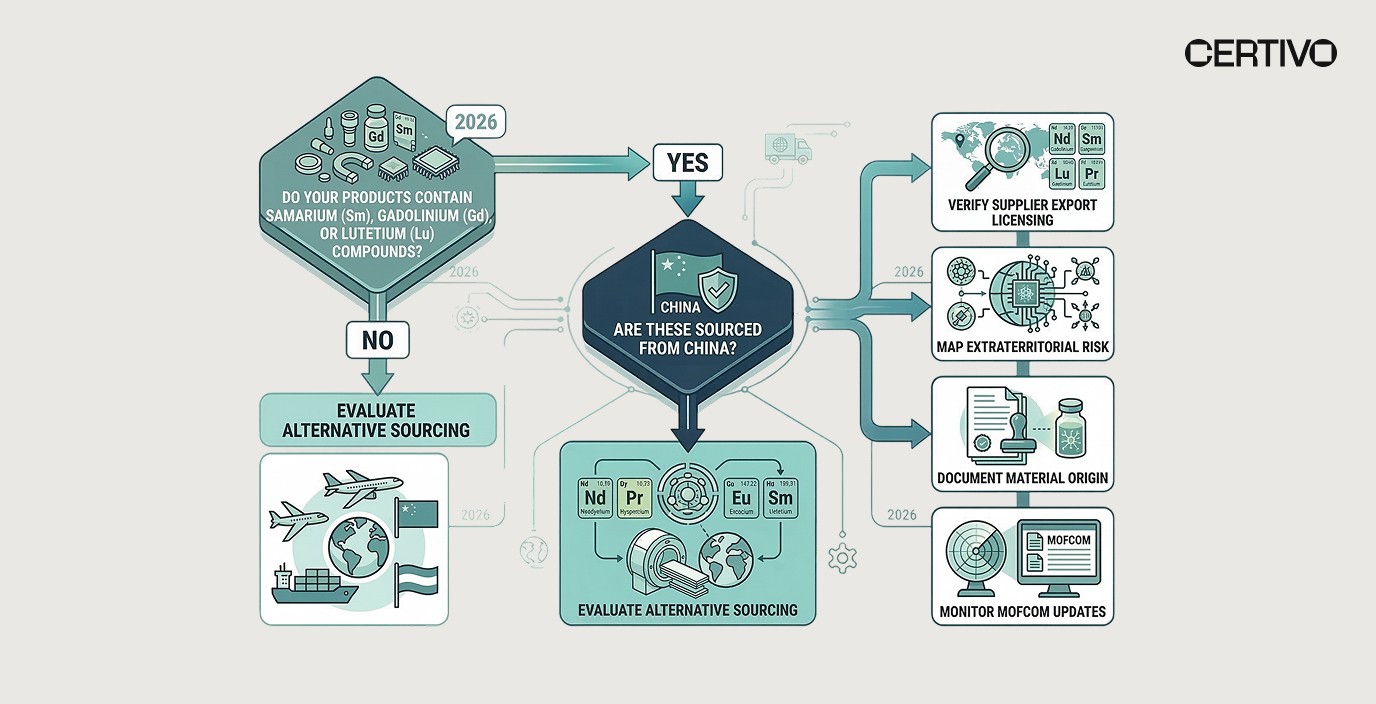
✓ Verify that all Chinese rare earth suppliers hold valid export licenses for affected compounds
✓ Request updated compliance declarations from suppliers covering samarium, gadolinium, and lutetium content
✓ Evaluate alternative sourcing options for critical materials to reduce single-country dependency
✓ Build inventory buffers where lead times may be affected by licensing delays
Procurement and supply chain leaders should lead cross-functional assessments of rare earth exposure across the product portfolio.
For product engineering teams:
✓ Identify all products containing rare earth materials sourced from China
✓ Evaluate substitution feasibility for non-critical applications
✓ Flag products where rare earth content creates export control re-transfer risk under extraterritorial provisions
Streamlining supplier documentation processes is critical for collecting and validating material origin data from upstream suppliers efficiently. Organizations still relying on email-based supplier data collection should evaluate replacing spreadsheets with scalable compliance systems that can handle structured material declarations at scale.
For companies navigating both material sourcing controls and chemical substance regulations simultaneously, understanding how tariffs and reshoring are increasing material compliance workloads provides essential context for resource planning.
8. Compliance Readiness Checklist
📌 Use this checklist to assess your organization's preparedness for China's updated rare earth export controls:
# | Action Item | Owner | Status |
|---|---|---|---|
1 | Identify all products and components containing samarium, gadolinium, or lutetium compounds | Engineering / Compliance | ☐ |
2 | Map supply chain tiers to determine Chinese-origin rare earth material exposure | Procurement | ☐ |
3 | Verify that Chinese suppliers hold valid MOFCOM export licenses for affected materials | Procurement / Supplier Quality | ☐ |
4 | Request updated material composition declarations from all rare earth suppliers | Supplier Management | ☐ |
5 | Assess downstream use cases for extraterritorial compliance risk (post-November 2026) | Legal / Compliance | ☐ |
6 | Evaluate alternative sourcing strategies to reduce single-source dependency on China | Procurement / Strategy | ☐ |
7 | Update product compliance documentation to reflect rare earth material origin and licensing status | Compliance / Quality | ☐ |
8 | Establish monitoring cadence for MOFCOM licensing catalogue updates | Regulatory Affairs | ☐ |
9 | Brief executive leadership and board on strategic materials supply risk | Compliance / CEO | ☐ |
10 | Integrate rare earth sourcing compliance into supplier qualification and audit processes | Supplier Quality | ☐ |
For organizations looking to standardize compliance processes across plants and regions, this checklist can serve as the foundation for a cross-site rare earth compliance program. IT and systems leaders should evaluate whether existing systems can support the documentation and traceability requirements outlined above.
9. The Role of AI in Strategic Materials Compliance
China's rare earth export controls create a compliance challenge that is fundamentally a data problem. Rare earth materials are embedded deep within multi-tier supply chains, often within sub-components and assemblies sourced from multiple countries. Identifying exposure, verifying licensing status, and maintaining documentation across thousands of SKUs and hundreds of suppliers exceeds manual capacity. For a detailed look at how AI transforms compliance operations, see AI tools for compliance management: the complete guide.
AI-native compliance platforms address these challenges by:
✓ BOM-level material mapping — scanning product compositions to identify rare earth content across all tiers
✓ Supplier risk scoring — evaluating supplier exposure to controlled material sourcing jurisdictions
✓ Regulatory horizon scanning — monitoring MOFCOM, MIIT, and other regulatory bodies for licensing catalogue changes in real time
✓ Automated supplier questionnaires — issuing structured data requests to suppliers for material origin and licensing verification
✓ Audit-ready documentation — generating compliance records that map material origin to licensing status for customer and regulatory inquiries
For organizations managing rare earth compliance alongside chemical substance regulations like REACH, RoHS, and PFAS restrictions, an integrated compliance platform eliminates duplication and ensures consistent documentation across frameworks.
AI in supply chain compliance management is no longer a forward-looking concept — it is an operational necessity for manufacturers facing simultaneous regulatory pressure across materials, chemicals, and trade controls. Organizations evaluating compliance infrastructure modernization should also review building a future-ready compliance infrastructure for a practical framework.
10. Frequently Asked Questions (FAQs)
Q1: Are China's rare earth export controls a complete ban on exports?
No. The updated framework introduces licensing requirements, not an outright ban. Manufacturers can still source samarium, gadolinium, and lutetium compounds from China, but only through suppliers who hold valid MOFCOM export licenses. The compliance obligation is to verify licensing status and maintain documentation. The MOFCOM Export Control Information Portal is the official source for licensing information.
Q2: Which specific rare earth materials are affected?
The 2026 licensing catalogue updates specifically target samarium compounds, gadolinium compounds, and lutetium compounds. These are used in permanent magnets, medical imaging equipment, aerospace components, catalysts, and advanced electronics. Organizations should track compliance by BOM to identify where these materials appear in their product portfolios.
Q3: What are the extraterritorial provisions and when do they take effect?
China introduced extraterritorial export control provisions in October 2025 that would allow regulation of controlled materials even after they leave Chinese territory. Following diplomatic consultations, enforcement has been delayed until November 2026. Manufacturers should use this window to assess downstream use-case risk. For a broader strategic assessment, see China rare minerals: navigating compliance and ensuring business continuity.
Q4: How do these controls affect companies that don't buy directly from China?
Even if your organization does not purchase directly from Chinese suppliers, rare earth materials may enter your supply chain through sub-components and assemblies sourced from intermediary countries. Multi-tier supply chain visibility is essential for identifying indirect exposure to Chinese-origin controlled materials.
Q5: What should manufacturers do right now to prepare?
Immediately: identify all products containing samarium, gadolinium, or lutetium; map supply chain exposure to Chinese-origin materials; verify supplier export licensing status; and establish a monitoring cadence for MOFCOM updates. For a structured approach, see the compliance readiness checklist in Section 8. Organizations managing this alongside chemical compliance should explore how to save time on compliance management with AI.
11. Executive Conclusion
China's updated rare earth export controls — expanding licensing requirements for samarium, gadolinium, and lutetium compounds, and introducing extraterritorial provisions with a November 2026 enforcement date — represent a structural shift in how global manufacturers must approach strategic material sourcing. These are not temporary trade measures. They are part of China's long-term framework for managing critical mineral exports.
For manufacturers across electronics, automotive, aerospace, medical devices, and renewable energy, the compliance imperative under these China rare earth export controls is clear: map your rare earth material exposure, verify supplier licensing, document material origin, and prepare for extraterritorial compliance obligations before the enforcement deadline. Organizations still operating with fragmented compliance processes should evaluate why people-only compliance approaches cannot scale under this level of regulatory complexity.
📌 The official MOFCOM Export Control Information Portal is available at mofcom.gov.cn.
To explore how AI-driven compliance platforms like Certivo support continuous regulatory readiness for strategic materials and chemical compliance, connect with the Certivo team.
Lavanya
Lavanya is an accomplished Product Compliance Engineer with over four years of expertise in global environmental and regulatory frameworks, including REACH, RoHS, Proposition 65, POPs, TSCA, PFAS, CMRT, FMD, and IMDS. A graduate in Chemical Engineering from the KLE Institute, she combines strong technical knowledge with practical compliance management skills across diverse and complex product portfolios.
She has extensive experience in product compliance engineering, ensuring that materials, components, and finished goods consistently meet evolving international regulatory requirements. Her expertise spans BOM analysis, material risk assessments, supplier declaration management, and test report validation to guarantee conformity. Lavanya also plays a key role in design-for-compliance initiatives, guiding engineering teams on regulatory considerations early in the product lifecycle to reduce risks and streamline market access.
Her contributions further extend to compliance documentation, certification readiness, and preparation of customer deliverables, ensuring transparency and accuracy for global stakeholders. She is adept at leveraging compliance tools and databases to efficiently track regulatory changes and implement proactive risk mitigation strategies.
Recognized for her attention to detail, regulatory foresight, and collaborative approach, Lavanya contributes significantly to maintaining product compliance, safeguarding brand integrity, and advancing sustainability goals within dynamic, globally integrated manufacturing environments.