


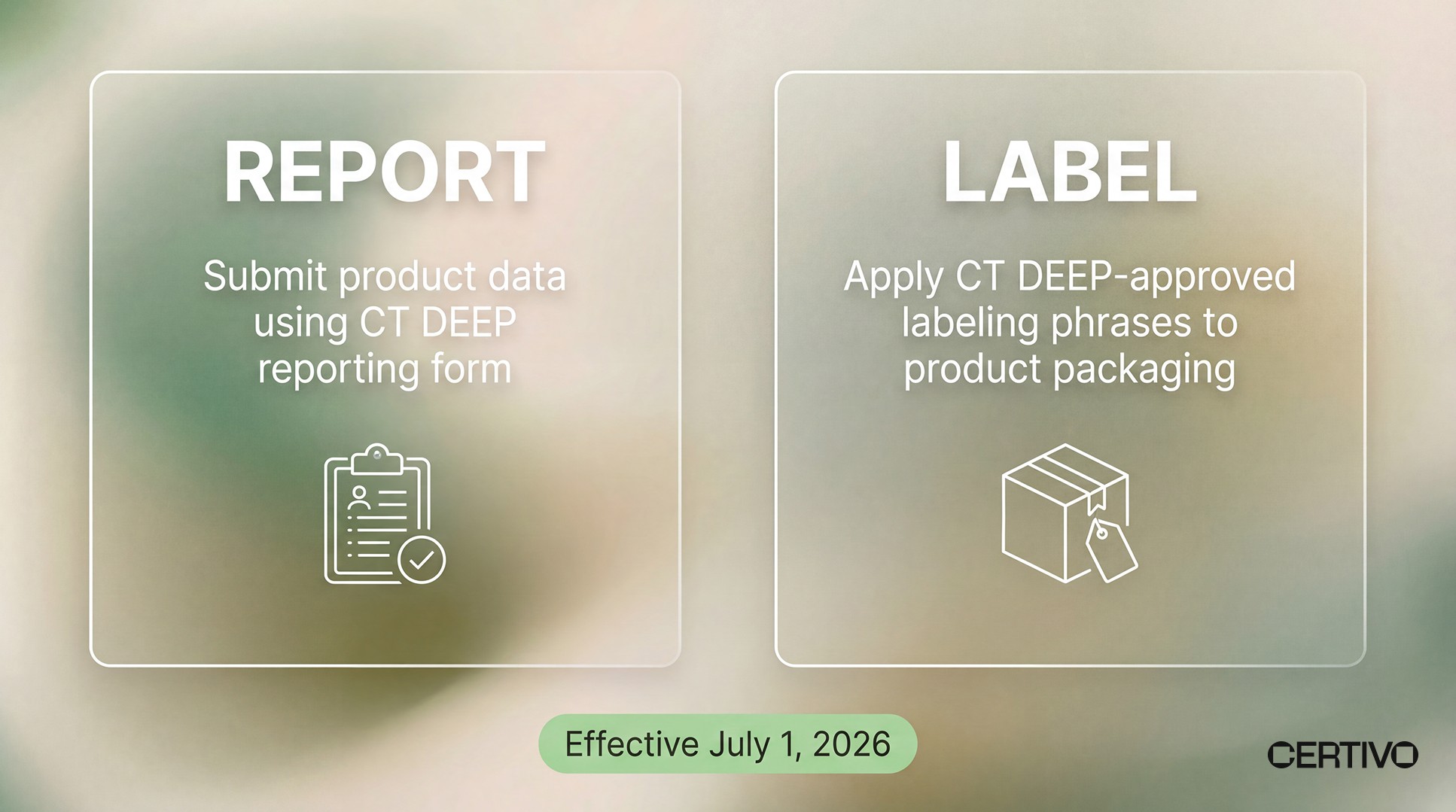
The Connecticut Department of Energy and Environmental Protection (CT DEEP) is enforcing new reporting and labeling obligations for consumer products containing intentionally added PFAS, effective July 1, 2026. Manufacturers, importers, distributors, and brand owners selling covered products in Connecticut must now identify affected items across their portfolios, prepare reporting submissions using CT DEEP's published form, and apply approved labeling language to compliant packaging.
This is not a future planning exercise. With the effective date weeks away, organizations that have not yet mapped PFAS presence across their product lines and supply chains face immediate market access risk in Connecticut.
Book a free compliance assessment to evaluate your PFAS reporting readiness before the Connecticut deadline.
Key Takeaways
📌 Connecticut's PFAS reporting and labeling requirements take effect July 1, 2026, covering all consumer products containing intentionally added PFAS sold in the state.
⚠️ Non-compliance may restrict a manufacturer's ability to market or distribute covered products within Connecticut.
📊 CT DEEP has released a preview of the reporting form and approved labeling phrases to support manufacturer preparation.
⏳ Manufacturers must identify affected products, collect supplier-level PFAS data, and establish reporting processes before the effective date.
🏭 Industries spanning electronics, textiles, food packaging, cosmetics, household products, and consumer goods face direct compliance obligations.
🔗 Supply chain engagement is required to determine whether products contain intentionally added PFAS, particularly for complex multi-tier sourcing.
🤖 AI-driven compliance platforms can accelerate PFAS substance identification, supplier data collection, and product-level reporting across large portfolios.
Connecticut PFAS labeling law 2026 compliance deadline for manufacturers
Click on image to view full

What Is Connecticut's PFAS Consumer Product Law
Connecticut's PFAS consumer product law requires manufacturers and sellers to report and label consumer products that contain intentionally added per- and polyfluoroalkyl substances (PFAS). The law is part of Connecticut's broader initiative to reduce PFAS exposure and increase chemical transparency for consumers.
CT DEEP oversees implementation and enforcement. The department has published a preview of the required reporting form along with a set of approved labeling phrases that manufacturers must use when disclosing PFAS content on product packaging.
The scope is significant. PFAS are a broad class of synthetic fluorinated chemicals, numbering in the thousands, known for environmental persistence and resistance to degradation. "Intentionally added" is the operative threshold, meaning the law targets products where PFAS were deliberately included for functional performance rather than present as trace contaminants.
For organizations already managing PFAS compliance across multiple jurisdictions, Connecticut adds another state-level obligation to an increasingly complex patchwork of US PFAS regulations.
Who Must Comply With Connecticut PFAS Reporting
The compliance obligation applies broadly across the commercial chain:
✓ Manufacturers producing consumer products containing intentionally added PFAS
✓ Importers bringing covered products into the US market for sale in Connecticut
✓ Distributors handling logistics and fulfillment for covered products
✓ Retailers selling covered consumer products to Connecticut consumers
✓ Brand owners whose products are manufactured by contract manufacturers or third parties
This broad scope means that compliance responsibility does not rest solely with the entity that physically adds PFAS to a product. Brand owners and importers who may not control formulation decisions still bear reporting and labeling obligations. This requires upstream supply chain engagement to determine PFAS content, making automated supplier data collection essential for organizations with large supplier networks.
What Products Are Covered Under the Connecticut PFAS Law
The law covers consumer products containing intentionally added PFAS sold within the state of Connecticut. Based on currently available regulatory guidance, "consumer products" encompasses a wide range of goods across multiple categories:
Product Category | Common PFAS Applications |
|---|---|
Textiles and apparel | Water-resistant coatings, stain repellents |
Food packaging | Grease-resistant coatings, moisture barriers |
Cosmetics and personal care | Smoothing agents, water resistance |
Household products | Non-stick coatings, cleaning agents |
Electronics and electrical equipment | Insulation, thermal management materials |
Children's products | Stain-resistant fabrics, waterproof materials |
Organizations managing compliance across thousands of SKUs need to assess each product line for PFAS presence. This is not feasible through manual review alone, particularly when PFAS content decisions were made at the formulation or component level by upstream suppliers. BOM-level material mapping capabilities allow compliance teams to trace PFAS-relevant substances to specific components and products.
CT DEEP Reporting Form and Approved Labeling Phrases
CT DEEP has taken a structured approach to implementation by releasing two key compliance resources ahead of the July 1, 2026 effective date:
Reporting Form Preview
CT DEEP has published a preview of the reporting form that manufacturers will use to disclose products containing intentionally added PFAS. This allows compliance teams to review field requirements, data structures, and submission expectations before the reporting window opens.
Organizations should map their internal product and substance data against the form's required fields now to identify gaps in available data.
Approved Labeling Phrases
CT DEEP has also released approved labeling phrases that manufacturers must use when identifying PFAS content on product labels. This standardization is intended to ensure consistent consumer communication across all covered products.
Manufacturers cannot create their own disclosure language. Only CT DEEP's approved phrases satisfy the labeling requirement. Compliance teams should coordinate with packaging, marketing, and label production functions to implement approved language before the deadline.
For organizations tracking labeling requirements across multiple states, a centralized compliance data backbone ensures that region-specific labeling obligations are mapped to the correct products and jurisdictions.
Connecticut PFAS reporting and labeling compliance steps for manufacturers 2026
Click on image to view full
Industries Affected by Connecticut PFAS Requirements
The Connecticut PFAS law impacts a broad cross-section of manufacturing and retail sectors:
📊 Consumer Products Manufacturing — Companies producing goods for retail sale face the broadest compliance footprint, particularly where PFAS are used in coatings, treatments, or functional additives.
📊 Textile and Apparel — Water-resistant and stain-resistant treatments in outdoor wear, uniforms, and upholstery frequently rely on PFAS chemistries. Manufacturers in this sector should review state PFAS regulations to understand Connecticut's requirements alongside similar obligations in other states.
📊 Food Packaging — Grease-resistant food contact packaging is a primary use case for PFAS. The EU packaging PFAS ban creates additional pressure for manufacturers selling into both US and EU markets.
📊 Cosmetics and Personal Care — PFAS in cosmetic formulations are under increasing regulatory scrutiny at both state and federal levels.
📊 Electronics and Electrical Equipment — PFAS compounds in insulation, thermal interface materials, and circuit board coatings affect electronics manufacturers with Connecticut market exposure.
📊 Retail and Distribution — Retailers and distributors bear compliance responsibility for products they sell, even when they do not control formulation. This requires supplier engagement to verify PFAS content.
Compliance Risks and Enforcement Exposure
Failure to comply with Connecticut's PFAS reporting and labeling requirements creates several risk categories:
⚠️ Market Access Restriction — Non-compliance may impact the ability to market or distribute covered products within Connecticut. This is a direct commercial risk for brands with retail presence in the state.
⚠️ Regulatory Enforcement — CT DEEP has the authority to enforce reporting and labeling obligations. Organizations without established reporting processes risk enforcement actions after the July 1, 2026 effective date.
⚠️ Customer and Retailer Pressure — Major retailers are increasingly requiring PFAS compliance documentation from suppliers. Connecticut's law adds a state-level regulatory basis to what was previously a voluntary retailer requirement.
⚠️ Reputational Risk — Consumer and investor scrutiny of PFAS use is intensifying. Non-disclosure or late compliance signals weak chemical management practices.
Organizations that maintain continuous audit-ready documentation across their product portfolios are better positioned to demonstrate compliance during regulatory inspections or customer audits without scrambling to assemble evidence after the fact.
Supply Chain and Operational Impact
Determining whether a product contains intentionally added PFAS requires data that often resides with upstream suppliers, not with the brand owner or final assembler.
Supplier Data Collection Challenge
For complex products with multi-tier supply chains, identifying PFAS content at the component or material level requires structured supplier engagement. Many suppliers, particularly smaller ones, may not have previously been asked to declare PFAS content. This creates a data collection bottleneck.
Organizations relying on email and spreadsheets for this process face significant delays. Supplier self-service compliance portals enable suppliers to submit substance declarations directly, reducing back-and-forth communication and accelerating data collection.
Cross-Jurisdictional Complexity
Connecticut is not acting in isolation. Multiple US states have enacted or proposed PFAS restrictions with varying scopes, thresholds, and timelines. Manufacturers selling across state lines must manage a patchwork of obligations. Certivo's PFAS framework page provides a consolidated view of PFAS regulatory requirements across jurisdictions.
For a comprehensive overview of the US state-level PFAS landscape, see State PFAS Regulations 2026: Bans, Labeling, and Compliance for Manufacturers.
Struggling with PFAS supplier data collection across your product portfolio? See how Certivo automates this at scale. Request a compliance review.
How to Prepare for Connecticut PFAS Compliance Before July 2026
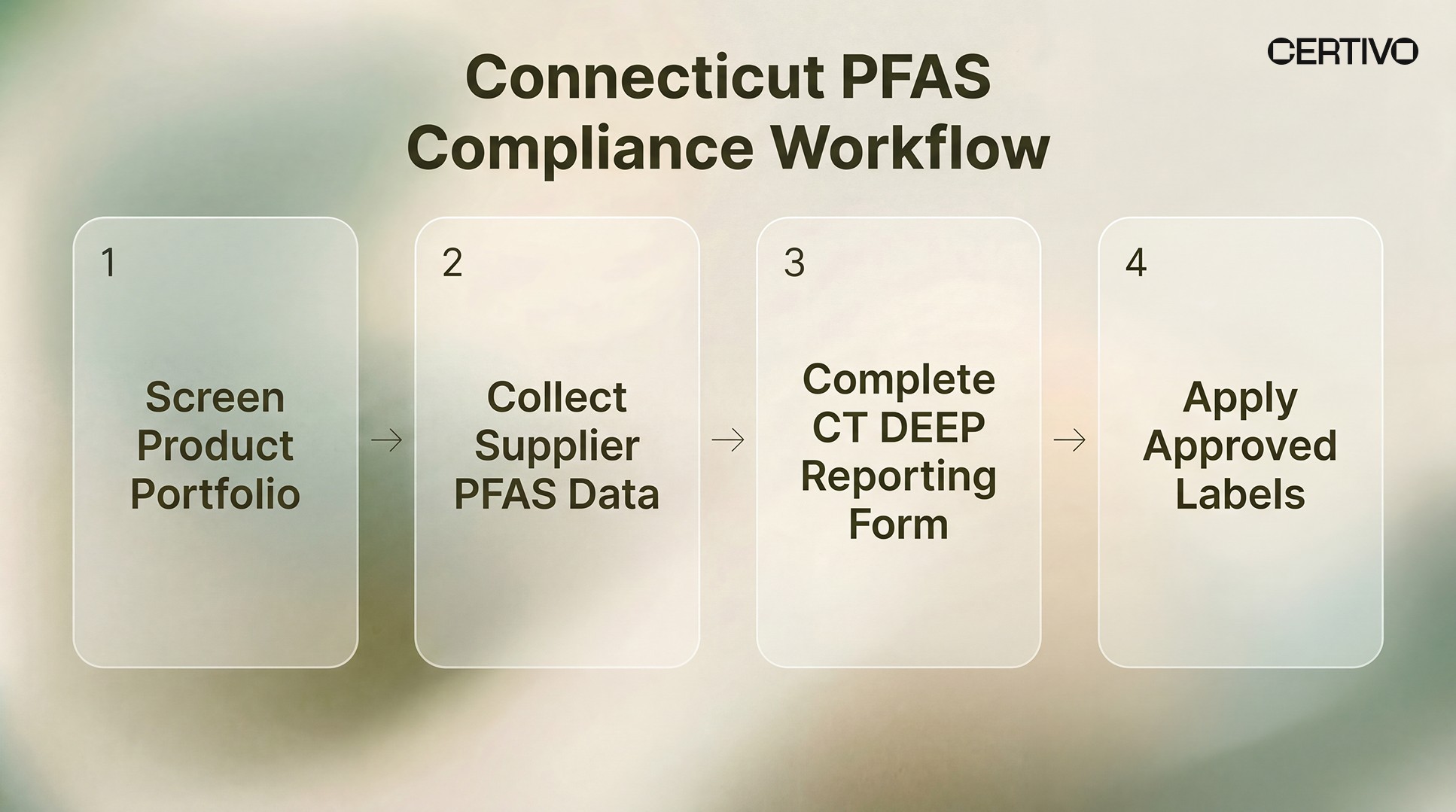
Compliance teams should prioritize the following actions before the effective date:
✅ 1. Conduct a Product Portfolio Screening — Identify all consumer products sold in Connecticut and assess each for intentionally added PFAS content. Prioritize product categories with known PFAS use (textiles, food packaging, cosmetics, electronics).
✅ 2. Engage Suppliers for PFAS Declarations — Issue structured PFAS substance inquiries to all relevant suppliers. Use standardized supplier questionnaire frameworks to ensure consistent data collection.
✅ 3. Review CT DEEP Reporting Form — Map internal product and substance data against the published reporting form fields. Identify any data gaps that must be resolved before submission.
✅ 4. Implement Approved Labeling Language — Coordinate with packaging and label production teams to apply CT DEEP-approved labeling phrases to all covered products before July 1, 2026.
✅ 5. Establish Ongoing Monitoring — Connecticut's requirements are part of a broader trend. Implement regulatory intelligence and horizon scanning processes to track PFAS obligations as they evolve across US states and federal agencies.
✅ 6. Document Compliance Evidence — Maintain records of supplier declarations, product screening results, reporting submissions, and labeling changes. This evidence supports audit readiness during regulatory inspections or customer inquiries.
Connecticut PFAS compliance preparation workflow for consumer product manufacturers
Click on image to view full
How AI Reduces the Burden of PFAS Product Reporting
Managing PFAS compliance across large product portfolios and multi-tier supply chains is a data-intensive challenge that manual processes cannot solve at enterprise scale.
Automated PFAS Substance Identification
CORA-powered regulatory intelligence enables automated screening of product and material data against PFAS substance lists spanning thousands of compounds. This eliminates the manual effort of cross-referencing individual chemicals against regulatory definitions of "intentionally added PFAS."
Scalable Supplier Data Collection
Certivo's automated supplier data collection portals allow organizations to issue structured PFAS inquiries to hundreds of suppliers simultaneously, track response rates, and validate submissions automatically.
Multi-Jurisdiction PFAS Tracking
Connecticut's law is one of dozens of state-level PFAS obligations. CORA-driven compliance intelligence tracks PFAS regulatory changes across all US states and international jurisdictions, alerting compliance teams when new obligations affect their product portfolios. This supports continuous compliance monitoring rather than periodic manual reviews.
For a deeper perspective on how AI manages PFAS compliance at scale, see How Certivo Manages PFAS Compliance Across 12,000 Substances and Multi-Tier Supply Chains.
Executive Conclusion
Connecticut's PFAS reporting and labeling requirements, effective July 1, 2026, add another layer of obligation for manufacturers, importers, and brand owners selling consumer products in the state. The law requires actionable product-level data on PFAS content, structured reporting through CT DEEP's published form, and the use of approved labeling phrases on covered products.
For organizations managing compliance across multiple US states and international markets, Connecticut's requirements reinforce the need for centralized PFAS data management, scalable supplier engagement, and regulatory intelligence capabilities that track obligations as they evolve.
The compliance window is narrow. Organizations that have not yet screened their product portfolios and initiated supplier data collection should begin immediately to avoid market access disruption after the effective date.
📌 Book a demo to see how Certivo automates PFAS compliance across your product portfolio and supply chain, or get a free compliance risk assessment to evaluate your Connecticut PFAS readiness.
FAQs
1. What types of PFAS trigger Connecticut's reporting and labeling requirements?
Connecticut's law applies to products containing intentionally added PFAS, covering the broad class of per- and polyfluoroalkyl substances. The threshold is functional intent, not a specific concentration limit. Certivo's CORA intelligence can screen product portfolios against thousands of PFAS compounds to identify affected items.
2. Are retailers and distributors also responsible for Connecticut PFAS compliance?
Yes. The law applies to manufacturers, importers, distributors, and retailers selling covered consumer products in Connecticut. Retailers should verify PFAS compliance documentation from their suppliers through structured data collection processes.
3. Where can manufacturers access CT DEEP's approved labeling phrases?
CT DEEP has published approved labeling phrases as part of its compliance guidance. Manufacturers must use only these approved phrases when disclosing PFAS content on product labels. Organizations managing labels across multiple jurisdictions benefit from centralized compliance platforms that map region-specific requirements to individual products.
4. How does Connecticut's PFAS law compare to other US state PFAS regulations?
Connecticut's approach focuses on reporting and labeling rather than outright product bans. Other states, such as Washington and Minnesota, have enacted PFAS sales prohibitions or broader reporting mandates. Certivo tracks PFAS obligations across all US states to support multi-jurisdiction compliance planning.
5. What happens if a manufacturer misses the July 1, 2026 compliance deadline?
Based on currently available regulatory guidance, non-compliance may impact the ability to market or distribute covered products within Connecticut. Organizations should prioritize product screening, supplier engagement, and reporting readiness before the effective date to avoid market access disruption.
Lavanya
Lavanya is an accomplished Product Compliance Engineer with over four years of expertise in global environmental and regulatory frameworks, including REACH, RoHS, Proposition 65, POPs, TSCA, PFAS, CMRT, FMD, and IMDS. A graduate in Chemical Engineering from the KLE Institute, she combines strong technical knowledge with practical compliance management skills across diverse and complex product portfolios.
She has extensive experience in product compliance engineering, ensuring that materials, components, and finished goods consistently meet evolving international regulatory requirements. Her expertise spans BOM analysis, material risk assessments, supplier declaration management, and test report validation to guarantee conformity. Lavanya also plays a key role in design-for-compliance initiatives, guiding engineering teams on regulatory considerations early in the product lifecycle to reduce risks and streamline market access