


On February 20, 2026, the U.S. Environmental Protection Agency finalized a sweeping revision to the Mercury and Air Toxics Standards (MATS) under Clean Air Act Section 112. This EPA MATS revision 2026 effectively rolls back the stricter mercury emission standards established just two years earlier, loosening mandates for coal- and oil-fired power plants across the United States. The revision reverses the 2024 requirement for plants to deploy maximum achievable control technology (MACT), increasing permissible levels of mercury, arsenic, lead, and other hazardous air pollutants (HAPs).
For CEOs and executive leaders across the energy sector, environmental technology manufacturing, and industrial supply chains, this regulatory shift creates both operational uncertainty and compliance complexity. Whether your organization operates power generation assets, manufactures emission control equipment, or supplies fuel and materials into the thermal power supply chain, understanding the full scope of this rollback is essential.
This article provides a complete breakdown of what changed, who is affected, and how compliance teams should respond.
Table of Contents
What Changed: The 2026 MATS Revision Explained
Key Regulatory Changes: 2024 vs. 2026 Standards Compared
Mercury Emission Standards: What the Rollback Means in Practice
Industries and Supply Chains Affected
Compliance Risks, Enforcement, and Penalty Exposure
Timeline and Effective Dates
Operational and Supply Chain Impact
Compliance Readiness Checklist
The Role of AI in Emission Compliance Monitoring
FAQs
Executive Conclusion
1. What Changed: The 2026 MATS Revision Explained
The Mercury and Air Toxics Standards (MATS) were originally established under Clean Air Act Section 112 to regulate hazardous air pollutants from coal- and oil-fired electric utility steam generating units (EGUs). In 2024, the EPA significantly tightened these mercury emission standards, requiring power plants to adopt near-zero mercury emission targets and deploy the most advanced MACT systems available. For context on how federal regulatory shifts are reshaping manufacturer obligations, see this analysis of the regulatory landscape under the current administration.
The February 2026 final rule reverses that trajectory. The EPA has determined that the 2024 standards imposed disproportionate costs on the power generation sector and has finalized a revision that:
⚠ Reverts mercury limits from near-zero emission targets to higher permissible thresholds for existing coal plants
⚠ Loosens HAP metals monitoring by reducing filterable particulate matter (fPM) requirements
⚠ Eliminates mandatory MACT upgrades, allowing continued use of legacy emission control equipment
⚠ Reduces reporting frequency from high-frequency continuous emission monitoring to streamlined intervals
This EPA MATS revision 2026 does not eliminate emission controls entirely — it recalibrates the stringency of what is required. But for manufacturers across the emission control technology supply chain, the operational and commercial implications are substantial. Organizations tracking multi-framework environmental obligations should explore how regulatory intelligence and horizon scanning capabilities help anticipate these shifts before they are finalized.
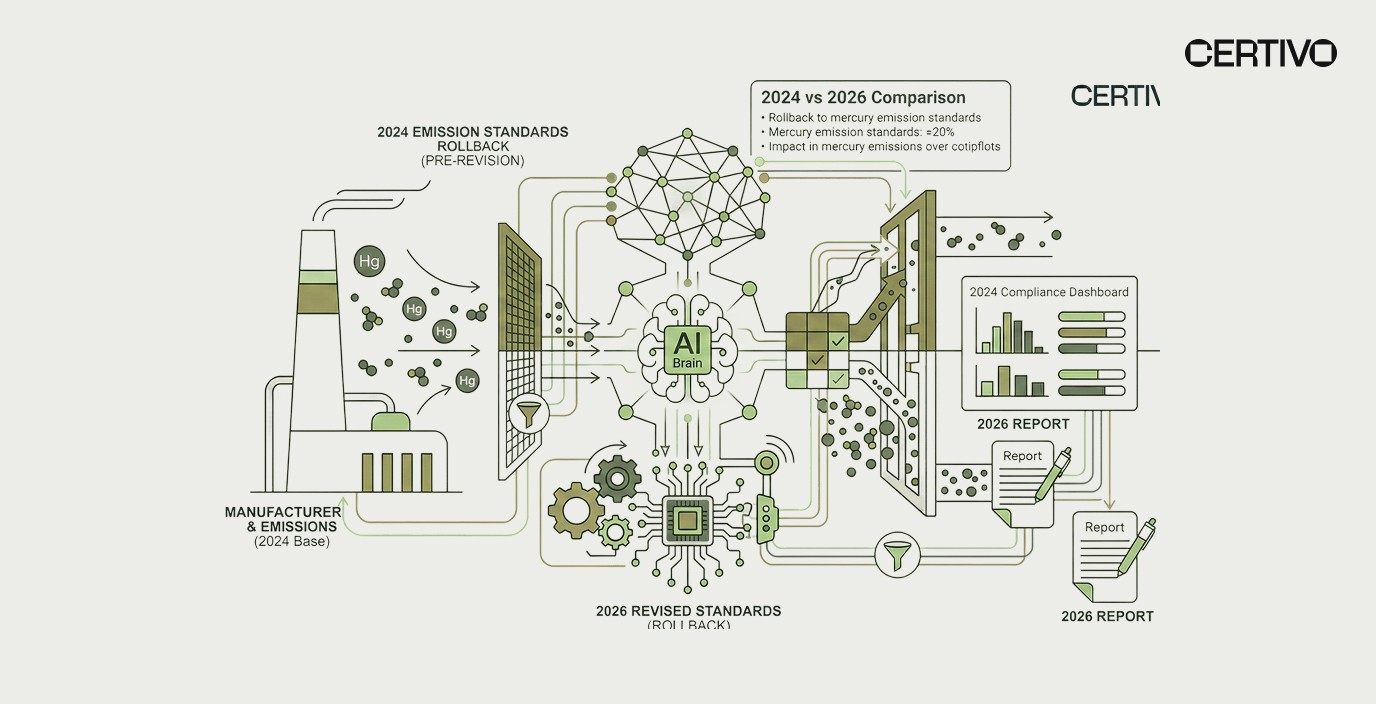
2. Key Regulatory Changes: 2024 vs. 2026 Standards Compared
The following table summarizes the material differences between the 2024 standards and the 2026 final rule, based on the EPA's Federal Register publication. Every compliance team managing environmental obligations should review this comparison carefully.
Provision | 2024 Standard (Previous) | 2026 Revised Standard (Final) |
|---|---|---|
Mercury Limits | Near-zero emission targets for existing coal plants | Reverted to higher permissible thresholds |
HAP Metals | Stricter filterable particulate matter (FPM) limits | Loosened monitoring and filtration requirements |
Compliance Technology | Mandatory upgrade to advanced MACT systems | Allows continued use of legacy control equipment |
Reporting | High-frequency continuous emission monitoring | Streamlined/reduced reporting frequency |
The rollback of the mercury emission standards has direct consequences for how power plants invest in — or defer investment in — emission control infrastructure. For manufacturers of scrubbers, activated carbon injection systems, and continuous emission monitoring systems (CEMS), reduced demand from utilities is a material business risk. Understanding market readiness versus risk exposure in shifting regulatory environments helps compliance leaders navigate this kind of uncertainty.
📊 Key insight: The shift from mandatory MACT to permissible legacy equipment use means that compliance verification now depends on documenting which standard applies to each facility — a task requiring continuous audit-ready documentation capabilities rather than one-time certifications.
3. Mercury Emission Standards: What the Rollback Means in Practice
The 2024 MATS rule established what many in the industry considered the most stringent mercury emission standards ever applied to U.S. coal-fired power plants. It set near-zero targets and required every existing facility to demonstrate compliance through advanced MACT systems and continuous monitoring.
The 2026 revision effectively restores a compliance floor closer to pre-2024 levels. In practical terms, this means:
✓ Existing plants that had not yet completed MACT upgrades may no longer be required to do so
✓ Plants using legacy scrubbers and filtration can continue operating without mandatory technology replacement
✓ Monitoring frequency is reduced, decreasing the operational burden on utility compliance teams
⚠ New plants or major modifications may still be subject to tighter standards under New Source Performance Standards (NSPS) — this revision applies primarily to existing EGUs
For environmental technology manufacturers, the reduced compliance burden on utilities translates to lower demand for emission control upgrades. VP-level operations leaders at emission control system manufacturers must reassess production planning, order pipelines, and supply chain commitments accordingly.
The revision also raises questions about state-level enforcement. States with more aggressive air quality programs — particularly those in the Northeast and on the West Coast — may choose to maintain stricter mercury emission standards regardless of the federal rollback. Manufacturers serving multi-state utility customers need a centralized compliance system of record that tracks both federal and state-level obligations simultaneously.
4. Industries and Supply Chains Affected
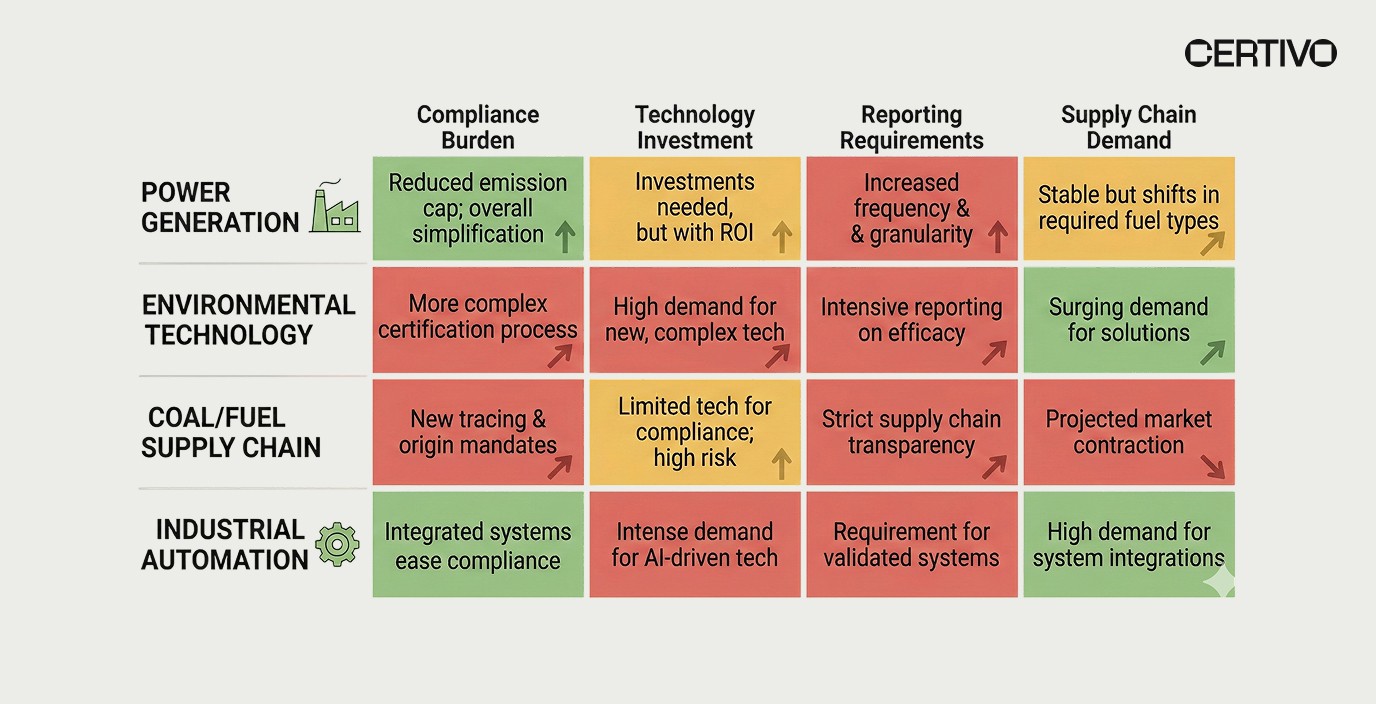
The EPA MATS revision 2026 impacts a broad set of industries and supply chain participants. The following breakdown maps the affected sectors and the nature of the impact. Compliance and regulation managers across these sectors should assess their exposure immediately.
Industry | Nature of Impact |
|---|---|
Power Generation (Coal & Oil EGUs) | Direct — reduced emission control mandates; compliance technology obligations relaxed |
Coal Mining & Fuel Supply Chains | Indirect — potential extension of coal-fired plant operational life increases fuel demand |
Environmental Technology Manufacturers | Direct — reduced demand for scrubbers, activated carbon injection systems, and CEMS |
Public Health & Utilities | Indirect — increased permissible HAP emissions may affect local air quality monitoring requirements |
Industrial Automation & Controls | Indirect — reduced demand for monitoring and control system upgrades at power plants |
For power generation operators, the revision provides compliance cost relief but introduces documentation complexity. Facilities must demonstrate which standard they are operating under and maintain records accordingly. The ability to manage compliance risk proactively — rather than reactively after enforcement actions — is critical.
For environmental technology manufacturers, this is a demand-side disruption. If utilities are no longer mandated to upgrade, order backlogs for emission control systems may contract. These manufacturers should review how supply chain collaboration can stabilize operations during regulatory transitions.
For the industrial automation sector, reduced monitoring requirements at power plants may affect demand for CEMS upgrades and sensor technology. Companies in industrial automation should evaluate exposure to utility-sector customers and diversify accordingly.
5. Compliance Risks, Enforcement, and Penalty Exposure
Even though the 2026 MATS revision loosens federal mandates, compliance risk does not disappear. Several dimensions of enforcement exposure remain — or are amplified — under the revised rule. Organizations that assume the rollback eliminates compliance obligations entirely are exposed to significant penalty risk. For context on why ESG and environmental compliance failures create supply chain risk beyond reporting, compliance leaders should review the broader risk landscape.
Federal enforcement risk:
⚠ Facilities must still comply with the revised MATS thresholds — operating above the new permissible limits triggers Clean Air Act enforcement
⚠ Reporting obligations, while reduced in frequency, remain mandatory — failure to report is a separate violation
⚠ Civil penalties under the Clean Air Act can reach $25,000+ per day per violation
⚠ Criminal penalties apply for knowing violations
State-level enforcement risk:
⚠ States may retain the stricter 2024 standards through their own State Implementation Plans (SIPs)
⚠ Multi-state operators face a patchwork of federal and state mercury emission standards that may differ significantly by jurisdiction
⚠ Failure to track jurisdiction-specific requirements creates audit exposure
Documentation and audit risk:
⚠ Facilities claiming compliance under the revised (less strict) standard must document that they are not subject to NSPS or state-level rules that impose tighter requirements
⚠ The absence of continuous monitoring creates gaps in compliance evidence — which becomes a liability during audits
For organizations navigating this layered enforcement environment, the ability to standardize compliance across plants and regions is no longer optional. Quality directors and compliance officers must ensure that every facility maintains auditable records under the correct applicable standard.
6. Timeline and Effective Dates
The following timeline captures the key dates associated with the MATS revision. Organizations that have not yet updated their compliance calendars should do so immediately. Regulatory intelligence capabilities that automate deadline tracking reduce the risk of missed obligations.
Date | Event |
|---|---|
2024 | EPA finalizes stricter MATS standards (near-zero mercury, mandatory MACT, continuous monitoring) |
February 20, 2026 | EPA finalizes the 2026 MATS revision, rolling back 2024 standards |
February 24, 2026 | Final rule published in the Federal Register |
Effective Date | Per Federal Register publication — typically 60 days after publication (est. late April 2026) |
State Response Window | States may choose to retain 2024 standards via SIPs — timeline varies by state |
📌 Note: Facilities that already invested in MACT upgrades to comply with the 2024 rule are not required to reverse those investments. However, they are no longer mandated to maintain the stricter compliance standard unless their state retains it. Understanding how proactive compliance delivers cost savings versus reactive adjustments helps executive teams assess sunk-cost implications.
7. Operational and Supply Chain Impact
The MATS revision creates distinct operational impacts depending on where an organization sits in the value chain. For a broader view of how shifting federal policy affects documentation workloads, see how tariffs and reshoring increase material compliance burdens.
For power plant operators:
✓ Reduced capital expenditure pressure — MACT upgrade mandates removed
✓ Lower ongoing monitoring and reporting operational costs
⚠ Must document which standard applies per facility (federal revised vs. state-retained 2024)
⚠ Facilities in states retaining stricter standards still face full compliance obligations
For emission control technology manufacturers:
⚠ Reduced order pipeline for scrubbers, activated carbon injection, and CEMS
⚠ Potential contract renegotiation or cancellation risk on in-progress upgrade projects
✓ Opportunity to pivot toward state-driven demand where stricter standards are retained
✓ Export markets with stricter emission standards (EU, Asia) remain unaffected
For fuel supply chains (coal mining):
✓ Extended operational viability of coal-fired plants may sustain fuel demand
⚠ Long-term demand uncertainty as renewable energy transition continues regardless of MATS policy
Supply chain documentation becomes more complex, not less, under a patchwork federal-state regulatory environment. The ability to streamline supplier documentation and maintain material compliance records across multiple jurisdictions is essential. Procurement and supply chain leaders must ensure supplier data reflects the applicable standard at each operating facility.
8. Compliance Readiness Checklist
📌 Use this checklist to assess your organization's readiness for the revised MATS standards:
# | Action Item | Status |
|---|---|---|
1 | Determine which MATS standard applies to each facility (2026 federal revised vs. state-retained 2024) | ☐ |
2 | Update emission monitoring and reporting schedules to reflect revised federal frequency requirements | ☐ |
3 | Assess whether in-progress MACT upgrade projects should continue, pause, or be re-scoped | ☐ |
4 | Review state-level air quality regulations to identify jurisdictions retaining stricter mercury emission standards | ☐ |
5 | Update compliance documentation to reflect the applicable standard per facility | ☐ |
6 | Notify emission control technology suppliers of any changes to procurement plans | ☐ |
7 | Ensure continuous emission monitoring data is archived for audit purposes — even under reduced frequency | ☐ |
8 | Brief executive leadership and board on compliance posture and risk exposure under the revised rule | ☐ |
9 | Evaluate whether existing compliance infrastructure supports multi-standard tracking across facilities | ☐ |
10 | Monitor federal and state regulatory developments for legal challenges to the revision | ☐ |
For organizations still managing compliance across spreadsheets, the multi-standard complexity of the MATS revision is a strong case for replacing manual systems with a scalable compliance platform. The ability to track compliance by BOM and by facility ensures that each site operates under the correct standard.
9. The Role of AI in Emission Compliance Monitoring
The 2026 MATS revision introduces a compliance environment that is more fragmented than the one it replaces. Rather than a single strict federal standard, compliance teams must now navigate facility-by-facility determinations across federal and state jurisdictions. For a comprehensive overview of how AI transforms compliance operations, see AI tools for compliance management: the complete guide.
AI-native compliance automation addresses this complexity through:
✓ Regulatory horizon scanning — automated monitoring of federal and state rulemaking, legal challenges, and SIP updates that affect mercury emission standards at each facility
✓ Multi-standard compliance mapping — classifying each facility under the correct applicable standard and flagging discrepancies
✓ Continuous audit-ready documentation — generating and maintaining compliance evidence that maps to both 2024 and 2026 standards as applicable
✓ Supplier and procurement intelligence — tracking emission control technology supplier commitments and contract obligations against changing compliance requirements
✓ Integrated PLM and ERP compliance threads — connecting environmental compliance data with operational systems across the enterprise
The shift from continuous monitoring to reduced-frequency reporting also creates a data gap risk. AI-powered compliance platforms can fill this gap by maintaining internal compliance baselines even when regulatory reporting requirements are relaxed. For a practical look at how AI changes day-to-day compliance work, see a compliance engineer's week with and without AI.
IT and systems leaders responsible for compliance technology infrastructure should evaluate whether current systems support the multi-standard, multi-jurisdiction tracking that the MATS revision demands. Building future-ready compliance infrastructure is essential in this environment.
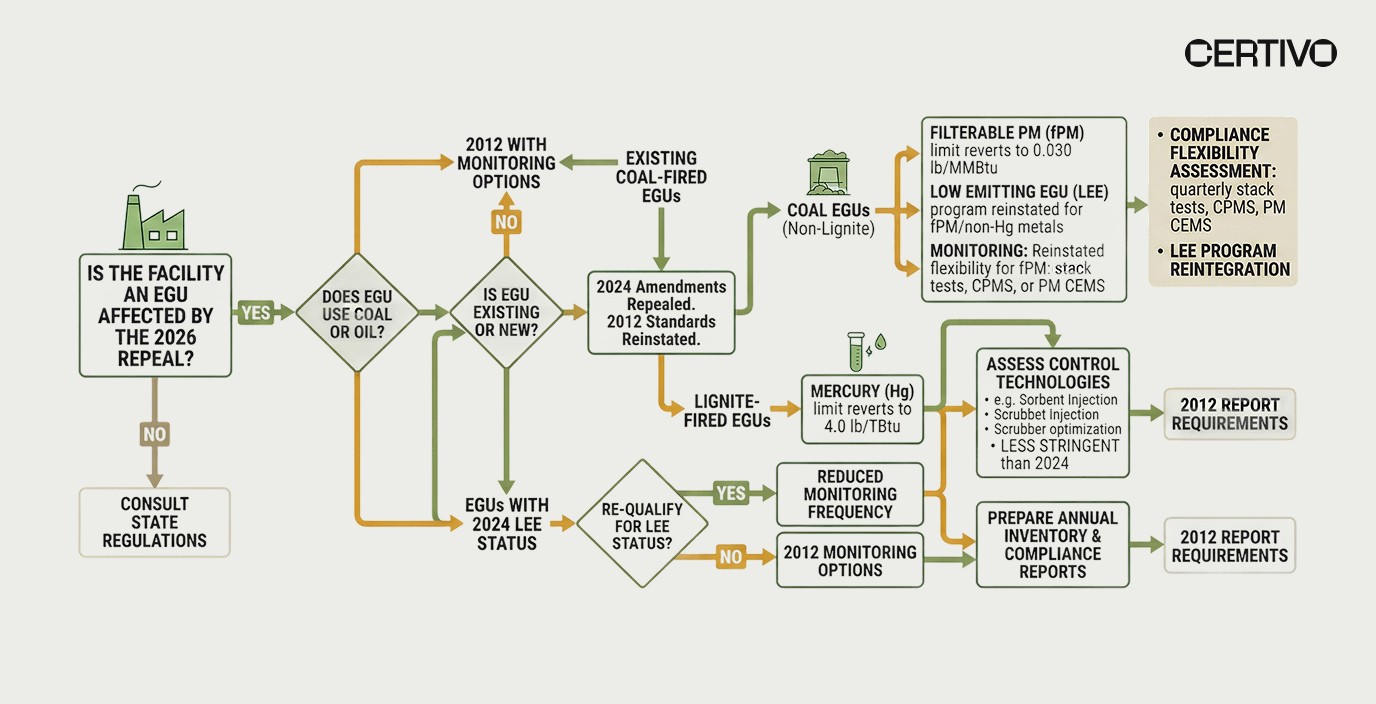
10. Frequently Asked Questions (FAQs)
Q1: Does the 2026 MATS revision eliminate mercury emission regulations for coal-fired power plants?
No. The EPA MATS revision 2026 does not eliminate mercury emission standards — it loosens them. Permissible mercury thresholds are raised, mandatory MACT upgrades are removed, and reporting frequency is reduced. But coal- and oil-fired EGUs must still comply with the revised standards. Facilities exceeding the new thresholds face Clean Air Act enforcement. For an overview of how compliance frameworks operate across environmental regulations, see the Certivo frameworks library.
Q2: Can states enforce stricter mercury emission standards than the federal 2026 rule?
Yes. Under the Clean Air Act, states may retain or adopt mercury emission standards stricter than the federal baseline through their State Implementation Plans (SIPs). Multi-state operators must track compliance requirements at the jurisdiction level. The ability to expand compliance across new markets and regions requires systems that handle regulatory variation by facility.
Q3: What penalties apply for non-compliance under the revised MATS?
Civil penalties under the Clean Air Act can reach $25,000+ per day per violation, with criminal penalties for knowing violations. Both emission exceedances and failure to report are independently enforceable violations. Organizations should review how proactive compliance management reduces penalty exposure.
Q4: How does this affect manufacturers of emission control equipment?
The removal of mandatory MACT upgrades reduces near-term demand for scrubbers, activated carbon injection systems, and continuous emission monitoring systems. Manufacturers should assess order pipeline risk, explore state-level demand where stricter standards are retained, and evaluate export markets. See optimizing supply chains with sustainable compliance strategies for operational planning guidance.
Q5: Should facilities that already completed MACT upgrades reverse those investments?
No. Facilities that already invested in advanced emission control technology are not required to remove or downgrade their systems. These investments may provide operational advantages — lower emission risk, stronger audit posture, and preparedness if stricter standards are reinstated or if state-level rules apply. The complete guide to product compliance management covers how to maintain compliance value from prior investments.
11. Executive Conclusion
The EPA MATS revision 2026 represents a significant shift in federal mercury emission standards policy — loosening mandates that were tightened just two years earlier. For power plant operators, the revision provides compliance cost relief but introduces multi-standard tracking complexity. For environmental technology manufacturers and their supply chains, it creates demand uncertainty that requires immediate operational assessment.
Whether your organization benefits from loosened mercury emission standards or faces demand disruption because of them, the compliance imperative is the same: understand which standard applies at each facility, document your compliance posture, and maintain audit-ready records. The patchwork of federal and state rules makes this more complex, not less. Organizations relying on people-only compliance approaches that cannot scale face the greatest exposure.
📌 The official EPA final rule is published on the Federal Register.
Organizations managing multi-facility environmental compliance across jurisdictions need infrastructure that scales with regulatory complexity. Explore how AI-driven compliance platforms like Certivo support continuous regulatory readiness
Lavanya
Lavanya is an accomplished Product Compliance Engineer with over four years of expertise in global environmental and regulatory frameworks, including REACH, RoHS, Proposition 65, POPs, TSCA, PFAS, CMRT, FMD, and IMDS. A graduate in Chemical Engineering from the KLE Institute, she combines strong technical knowledge with practical compliance management skills across diverse and complex product portfolios.
She has extensive experience in product compliance engineering, ensuring that materials, components, and finished goods consistently meet evolving international regulatory requirements. Her expertise spans BOM analysis, material risk assessments, supplier declaration management, and test report validation to guarantee conformity. Lavanya also plays a key role in design-for-compliance initiatives, guiding engineering teams on regulatory considerations early in the product lifecycle to reduce risks and streamline market access.
Her contributions further extend to compliance documentation, certification readiness, and preparation of customer deliverables, ensuring transparency and accuracy for global stakeholders. She is adept at leveraging compliance tools and databases to efficiently track regulatory changes and implement proactive risk mitigation strategies.
Recognized for her attention to detail, regulatory foresight, and collaborative approach, Lavanya contributes significantly to maintaining product compliance, safeguarding brand integrity, and advancing sustainability goals within dynamic, globally integrated manufacturing environments.