

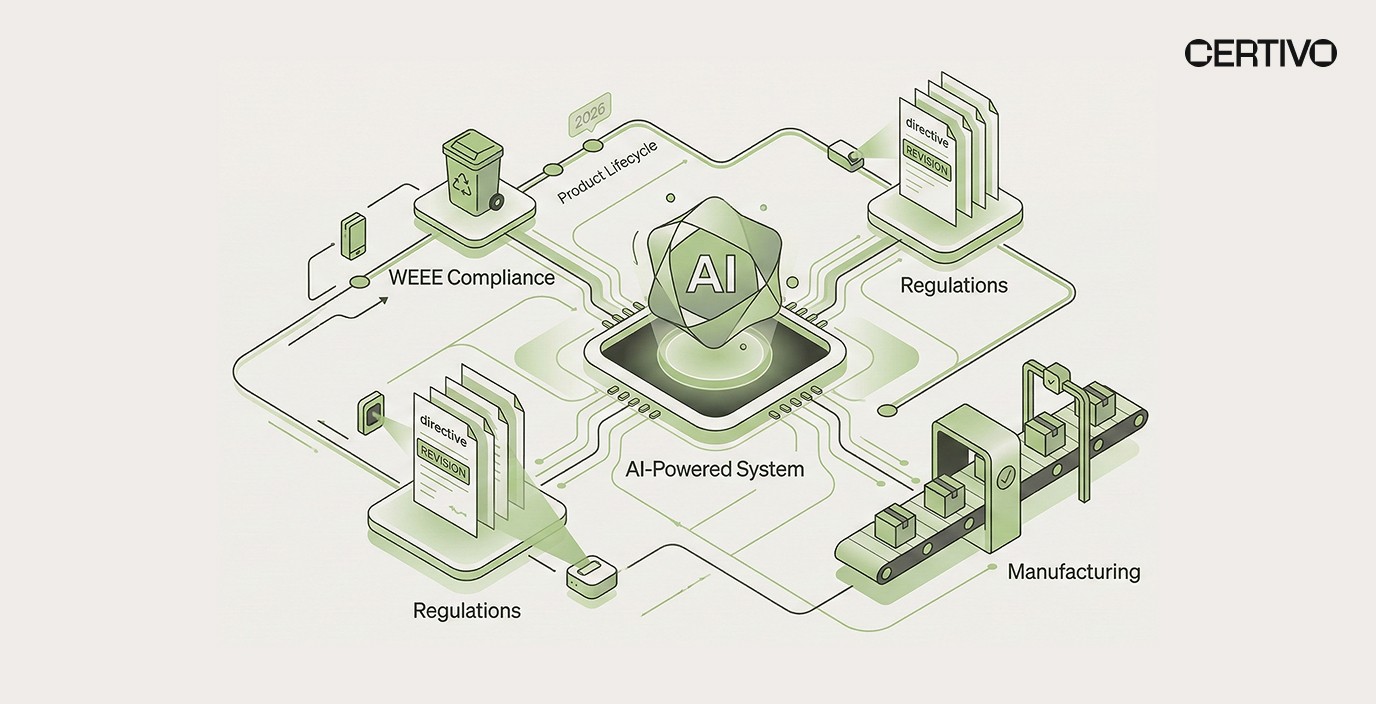
The European Commission is preparing a landmark EU WEEE Directive revision that will fundamentally reshape how electronics manufacturers, recyclers, and importers manage end-of-life obligations across Europe. This sweeping overhaul targets critical raw material recovery from e-waste, harmonized Extended Producer Responsibility, updated CENELEC treatment standards, and the creation of a unified secondary raw materials market — all under the broader Circular Economy Act.
Expected as a formal proposal in Q3 2026, this EU WEEE Directive revision transitions the existing WEEE Directive (2012/19/EU) into a stricter e-waste regulation framework — potentially elevating it from a Directive to a directly applicable Regulation. For CEOs and compliance leaders at global manufacturing organizations, the WEEE compliance implications are significant, and preparation must begin now.
📌 Table of Contents
What Changed: From WEEE Directive to Circular Economy Regulation
Key Requirements and Obligations Under the Revision
Critical Raw Material Recovery: New Compliance Thresholds
Harmonized EPR Across All EU Member States
Updated CENELEC Treatment Standards
Industries and Products Affected
Compliance Risks and Penalties
Timeline and Enforcement Dates
Operational and Supply Chain Impact
Compliance Readiness Checklist
The Role of AI in WEEE Compliance Monitoring
FAQs
Executive Conclusion
1. What Changed: From WEEE Directive to Circular Economy Regulation
The current WEEE Directive (2012/19/EU) has governed the collection, treatment, and recycling of electronic waste across Europe for over a decade. However, the European Commission's mid-term review — published as COM/2026/42 — identifies a critical "collection gap" that current e-waste regulation rules have failed to close. For a comprehensive overview of existing WEEE compliance obligations, see the complete WEEE compliance guide for manufacturers.
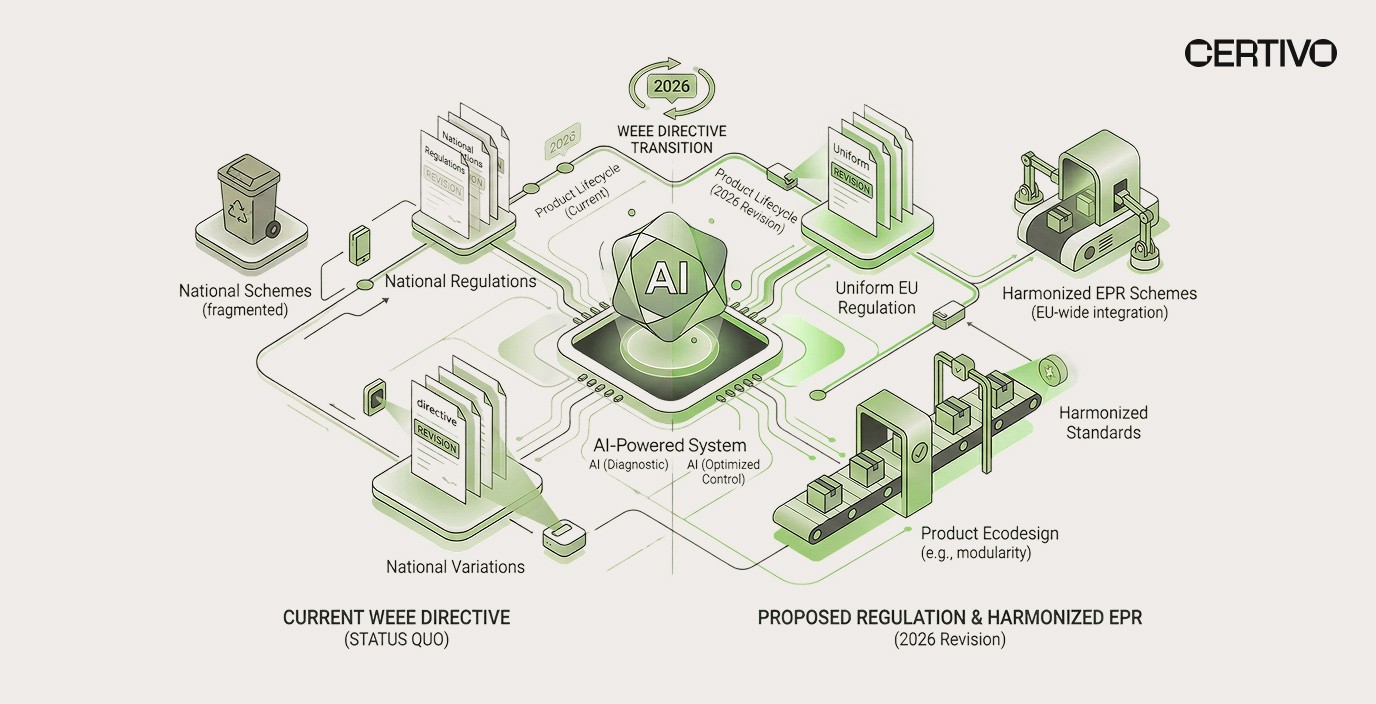
The most significant structural change is the potential transition from a Directive (requiring national transposition with variation between Member States) to a Regulation (applying directly and uniformly across all 27 EU Member States). This shift would eliminate the fragmented national interpretations that have created WEEE compliance complexity for cross-border manufacturers and undermined effective Extended Producer Responsibility implementation.
⚠ Why this matters: Under the current Directive model, producers face different EPR harmonization requirements, collection targets, and reporting formats in each Member State. A unified e-waste regulation would create a single compliance standard — but also a single, non-negotiable enforcement baseline. Organizations currently managing compliance across plants and regions must reassess their entire WEEE compliance architecture in response.
The EU WEEE Directive revision also repositions e-waste policy as a strategic raw materials security initiative supporting circular economy compliance objectives, not simply an environmental obligation. The EU's dependence on imported critical raw materials — rare earth elements, lithium, cobalt, precious metals — has made domestic critical raw material recovery from e-waste a matter of economic and geopolitical priority. Companies tracking rare earth export controls and supply chain disruptions should see this revision as a directly connected regulatory development that accelerates the secondary raw materials agenda.
2. Key Requirements and Obligations Under the Revision
The EU WEEE Directive revision introduces several interconnected WEEE compliance obligations that go well beyond current collection and recycling targets. Understanding how these fit within the broader EU regulatory frameworks is essential for circular economy compliance planning.
📌 Core obligations under the proposed revision:
Mandatory critical raw material recovery targets for components rich in magnets, precious metals, and rare earth elements
Harmonized Extended Producer Responsibility schemes with standardized registration, fee structures, and reporting across all EU Member States — a fundamental EPR harmonization overhaul
Updated CENELEC treatment standards requiring high-quality recycling that minimizes "downcycling" of secondary raw materials
Secondary raw materials market incentives promoting use of recycled materials over virgin imports to drive circular economy compliance
Enhanced producer take-back obligations with stricter collection rate targets aligned to the new e-waste regulation framework
Each of these obligations creates distinct compliance workflows. Compliance and regulation managers must map these requirements against current operational capabilities to identify gaps before the formal proposal arrives. The EU WEEE Directive revision demands a systems-level response to WEEE compliance, not piecemeal adjustments.
For manufacturers already managing substance compliance under REACH and RoHS, this revision adds an end-of-life compliance layer that connects product design to waste recovery. The RoHS and REACH compliance lessons and action steps for 2026 guide provides relevant context on how multiple e-waste regulation and substance frameworks interact.
3. Critical Raw Material Recovery: New Compliance Thresholds
The most strategically significant element of the EU WEEE Directive revision is the introduction of targeted critical raw material recovery requirements. The European Commission aims to secure domestic supply chains for green technology by mandating the extraction and recovery of specific high-value materials from end-of-life electronics — closing the gap that current WEEE compliance rules have left open.
CRM Category | Target Components | Strategic Relevance |
|---|---|---|
Rare Earth Elements | Magnets in motors, hard drives, speakers | Critical for EV motors, wind turbines; essential for critical raw material recovery |
Precious Metals | Gold, silver, platinum in PCBs and connectors | High value secondary raw materials; reduces import dependency |
Lithium & Cobalt | Batteries in portable electronics, EVs | Essential for energy storage; priority for critical raw material recovery |
Copper | Wiring, PCBs, transformers | Foundational industrial secondary raw materials with rising demand |
These critical raw material recovery targets are directly linked to the EU's 2030 circularity objectives and its broader Critical Raw Materials Act strategy. Manufacturers in the energy storage and battery sector and semiconductor and PCB manufacturing face the most immediate impact, as their products contain the highest concentrations of targeted CRMs.
⚠ WEEE compliance implication: Producers will likely need to provide detailed BOM-level material mapping to demonstrate what CRMs are present in their products, enabling downstream recyclers to target critical raw material recovery effectively. This connects product composition data directly to end-of-life compliance — a shift that requires BOM-level compliance intelligence across the product lifecycle.
For companies also navigating the EU Batteries Regulation requirements, critical raw material recovery obligations under the WEEE revision create overlapping demands that must be managed within an integrated circular economy compliance framework. The energy storage battery regulatory compliance maze is growing more complex with each new regulatory layer that targets secondary raw materials.
4. Harmonized EPR Across All EU Member States
One of the most operationally impactful changes in the EU WEEE Directive revision is the move toward standardized Extended Producer Responsibility across all Member States. Under the current Directive, Extended Producer Responsibility implementation varies significantly — different registration processes, fee calculations, reporting templates, and collection targets create a fragmented WEEE compliance landscape that undermines effective EPR harmonization.
📌 What EPR harmonization means for manufacturers:
Single registration standard replacing 27 different national Extended Producer Responsibility schemes
Standardized fee structures based on product category, weight, and recyclability — aligned to circular economy compliance incentives
Uniform reporting formats eliminating country-by-country data preparation under the new e-waste regulation
Consistent collection rate targets applied identically across the EU to support critical raw material recovery
Cross-border trade simplification reducing administrative burden through full EPR harmonization
This EPR harmonization directly reduces the administrative burden for manufacturers operating across EU markets. However, it also eliminates the flexibility that some companies have leveraged under more lenient national transpositions of Extended Producer Responsibility requirements. For VPs of operations managing multi-country EU distribution, the transition period will require significant process reconfiguration.
The Extended Producer Responsibility framework page provides a foundational overview of current EPR obligations that will be superseded by the harmonized model. Companies should audit their current Extended Producer Responsibility registrations and WEEE compliance workflows now to identify where EPR harmonization will create gaps.
Understanding how this EPR harmonization connects to the broader regulatory trajectory is important. The key EU regulations to watch analysis covers adjacent regulatory shifts that compound the Extended Producer Responsibility compliance burden under the evolving e-waste regulation landscape.
5. Updated CENELEC Treatment Standards
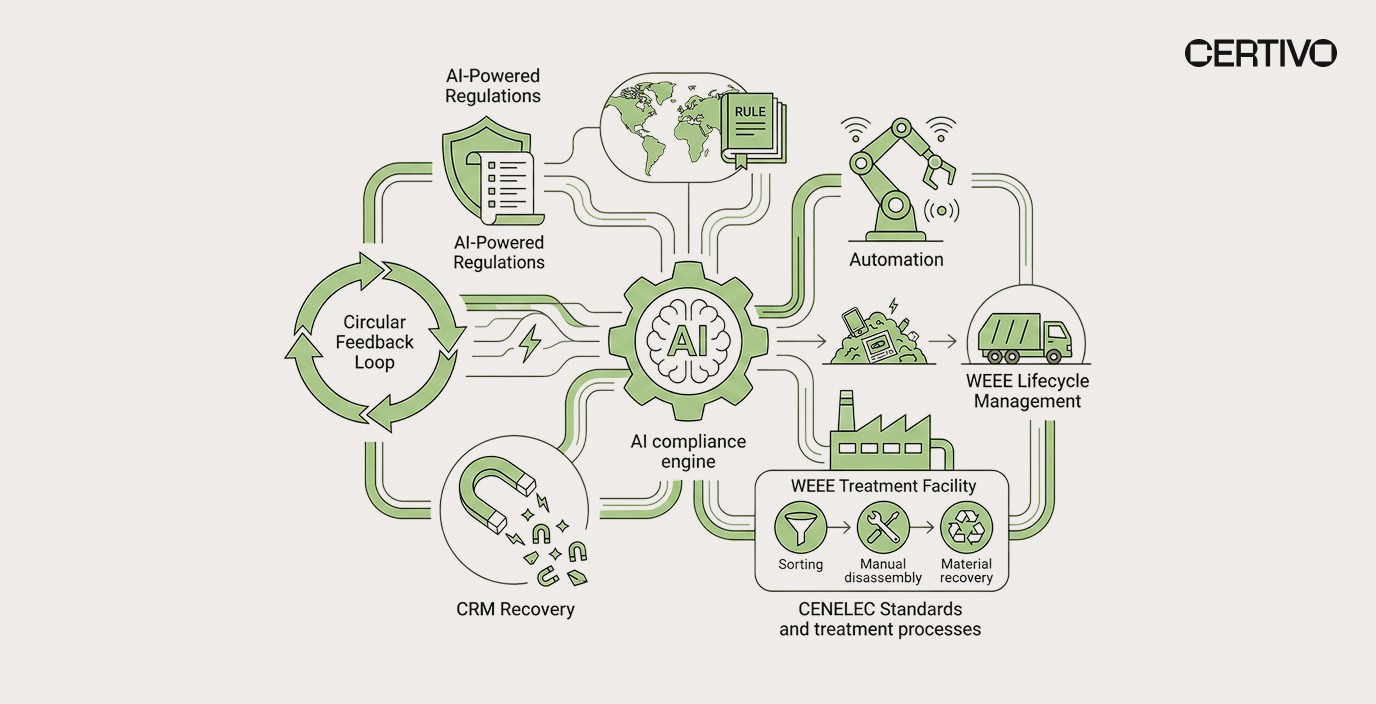
The EU WEEE Directive revision proposes updating the technical standards governed by CENELEC (European Committee for Electrotechnical Standardization) to ensure high-quality recycling outcomes that maximize the value of secondary raw materials. Current CENELEC treatment standards have allowed significant "downcycling" — where recovered materials are degraded to lower-value applications rather than being returned to equivalent-quality use as viable secondary raw materials.
📊 Key changes to CENELEC treatment standards:
Higher purity thresholds for recovered secondary raw materials to qualify as "recycled content" under circular economy compliance requirements
Component-level disassembly requirements for CRM-rich items (motors, magnets, batteries) to maximize critical raw material recovery
Traceability documentation linking recovered secondary raw materials to source products — essential for the new e-waste regulation
Quality certification for secondary raw materials entering the EU market, supporting circular economy compliance verification
These updated CENELEC treatment standards affect the entire e-waste value chain — from product design through collection, treatment, and material re-entry. Manufacturers must design products with end-of-life disassembly in mind, supporting downstream critical raw material recovery. Quality directors must integrate these downstream recyclability requirements into upstream product development processes to meet the revised CENELEC treatment standards.
The traceability documentation requirements under updated CENELEC treatment standards align with the broader EU push toward Digital Passports and Traceability IDs. For context on how digital product passports intersect with WEEE compliance obligations, see the analysis of EU POPs limits and digital product passports.
6. Industries and Products Affected
The EU WEEE Directive revision impacts a broad range of sectors, with varying degrees of WEEE compliance intensity. The official Tweede Kamer Document 2026D08291 identifies the following primary sectors affected by the new e-waste regulation.
Industry | Products Affected | Impact Level |
|---|---|---|
Electronics & ICT | Consumer electronics, IT equipment, telecom hardware | ⚠ High — Core WEEE compliance, Extended Producer Responsibility, and critical raw material recovery obligations |
Renewable Energy | Solar panels, inverters, high-capacity battery systems | ⚠ High — CRM recovery targets for batteries and magnets; circular economy compliance demands |
Waste Management & Recycling | E-waste collection schemes, specialized recyclers, material recovery | ⚠ High — New CENELEC treatment standards for secondary raw materials |
Manufacturing (Secondary Materials) | Any industry using copper, lithium, rare earths in production | ✓ Medium — Secondary raw materials sourcing opportunities under EPR harmonization |
For electronics and ICT manufacturers, the e-waste regulation revision creates obligations spanning the entire product lifecycle — from BOM-level material disclosure through Extended Producer Responsibility registration to end-of-life critical raw material recovery facilitation. Industrial electronics and test and measurement equipment manufacturers should assess product portfolios against the new CRM recovery categories and updated CENELEC treatment standards.
For renewable energy producers, solar panel and battery system manufacturers face particularly intensive critical raw material recovery obligations. These circular economy compliance obligations compound existing requirements under the EU Batteries Regulation. The compliance in sustainable manufacturing guide provides a broader perspective on managing overlapping green-economy WEEE compliance demands.
For automotive manufacturers, vehicles increasingly contain electronic components subject to WEEE classification and the new e-waste regulation. The automotive regulatory landscape guide outlines the full spectrum of compliance obligations. Automotive industry compliance teams should evaluate which vehicle electronics fall within WEEE scope and face Extended Producer Responsibility obligations.
7. Compliance Risks and Penalties
The potential shift from Directive to Regulation carries significant enforcement implications for WEEE compliance. Under the current Directive model, enforcement varies by Member State, with penalties set nationally. A directly applicable e-waste regulation would establish harmonized enforcement mechanisms across the entire EU — aligned with the EPR harmonization framework.
⚠ Key WEEE compliance risks:
Failure to register under harmonized Extended Producer Responsibility — Producers placing EEE on the EU market without proper EPR registration face market access restrictions and financial penalties
Failure to meet critical raw material recovery facilitation obligations — Insufficient BOM-level material data could result in non-compliance findings during circular economy compliance audits
Non-conforming treatment processes — Recyclers failing to meet updated CENELEC treatment standards risk losing authorization to process WEEE and produce secondary raw materials
Incomplete reporting — Gaps in collection, treatment, or recovery data submissions trigger enforcement under the new e-waste regulation
Cross-border non-compliance — Under a Regulation, non-compliance in one Member State means non-compliance across the entire EU
The ability to manage compliance risk proactively rather than reactively becomes essential under a harmonized enforcement regime. Organizations that cannot demonstrate continuous audit-ready documentation across all EU operations face elevated WEEE compliance risk.
For companies already managing penalties under RoHS, REACH, and EU Packaging rules, the WEEE revision adds another enforcement layer where Extended Producer Responsibility failures compound. The EU packaging compliance requirements share structural similarities in EPR harmonization reporting that can inform WEEE preparation.
8. Timeline and Enforcement Dates
The EU WEEE Directive revision follows a structured regulatory development process. Based on the mid-term review and preparatory phase, the key milestones for this e-waste regulation are:
Milestone | Estimated Date | Status |
|---|---|---|
Mid-term review published (COM/2026/42) | Q1 2026 | ✅ Complete |
Formal legislative proposal for e-waste regulation | Q3 2026 | 📌 Expected |
European Parliament & Council review | Q4 2026 – 2027 | ⏳ Pending |
Final adoption | 2027–2028 (estimated) | ⏳ Pending |
Transition period & Member State implementation | 18–24 months post-adoption | ⏳ Pending |
Full enforcement of WEEE compliance and EPR harmonization | 2029–2030 (estimated) | ⏳ Pending |
⚠ Critical note: While full enforcement is estimated for 2029–2030, the preparatory actions required — BOM-level material mapping for critical raw material recovery, Extended Producer Responsibility system reconfiguration, supplier data collection for secondary raw materials, CENELEC treatment standards compliance audits — demand years of lead time. Waiting for final text is not a viable WEEE compliance strategy.
Regulatory intelligence and horizon scanning capabilities enable organizations to track the legislative progress through proposal, trilogue, and final publication. The Certivo resources hub provides ongoing monitoring of circular economy compliance developments.
For companies beginning to build compliance infrastructure now, building a future-ready compliance infrastructure outlines foundational steps for managing the EU WEEE Directive revision alongside other e-waste regulation requirements.
9. Operational and Supply Chain Impact
The EU WEEE Directive revision creates operational demands that reach deep into manufacturing and supply chain processes, affecting WEEE compliance, Extended Producer Responsibility workflows, and critical raw material recovery readiness.
For producers placing EEE on the EU market:
✓ Map all products against WEEE categories and critical raw material recovery target components
✓ Prepare BOM-level material composition data identifying rare earths, precious metals, lithium, and cobalt for secondary raw materials traceability
✓ Consolidate Extended Producer Responsibility registrations across Member States in preparation for EPR harmonization
✓ Update product design documentation to include end-of-life disassembly instructions aligned with CENELEC treatment standards
✓ Engage with authorized CENELEC-compliant recyclers and treatment facilities supporting circular economy compliance
For supply chain and procurement teams:
⚠ Request material composition declarations from upstream suppliers for CRM-containing components to support critical raw material recovery
⚠ Verify secondary raw materials certifications for recycled content claims under the new e-waste regulation
⚠ Assess supplier readiness for digital product passport data requirements
⚠ Audit existing waste management partners against anticipated CENELEC treatment standards updates
Procurement and supply chain leaders play a central role in closing the data gaps that the WEEE compliance revision will expose. Much of the CRM composition data required for critical raw material recovery reporting resides with upstream suppliers. The ability to streamline supplier documentation and run structured supplier collaboration workflows is an operational prerequisite for EPR harmonization readiness.
For organizations managing multi-tier supply chains across regions, fixing supply chain fragmentation must happen before harmonized WEEE compliance reporting and secondary raw materials tracking can be achieved. The centralizing market readiness from silos to a single source of truth approach directly supports this transition under the evolving Extended Producer Responsibility landscape.
10. Compliance Readiness Checklist
📌 Use this checklist to assess organizational preparedness for the EU WEEE Directive revision and its WEEE compliance, Extended Producer Responsibility, and circular economy compliance demands:
# | Action Item | Owner | Status |
|---|---|---|---|
1 | Audit current WEEE category classifications for all EEE products placed on EU market | Compliance | ☐ |
2 | Map BOM-level CRM content (rare earths, lithium, cobalt, precious metals) to support critical raw material recovery | Engineering / Compliance | ☐ |
3 | Inventory all active Extended Producer Responsibility registrations across EU Member States for EPR harmonization readiness | Operations | ☐ |
4 | Identify gaps between current EPR processes and anticipated harmonized e-waste regulation requirements | Compliance | ☐ |
5 | Issue supplier data requests for CRM-containing component material declarations | Procurement | ☐ |
6 | Evaluate existing waste management and recycler partnerships against updated CENELEC treatment standards | Supply Chain | ☐ |
7 | Assess product design documentation for end-of-life disassembly and critical raw material recovery readiness | Product / Quality | ☐ |
8 | Configure WEEE compliance reporting systems for unified EU-wide data submission and secondary raw materials tracking | IT / Compliance | ☐ |
9 | Establish digital product passport data infrastructure for circular economy compliance traceability requirements | IT / Engineering | ☐ |
10 | Monitor EU legislative calendar for formal e-waste regulation proposal publication (Q3 2026) | Regulatory Affairs | ☐ |
IT and systems leaders should be directly involved in items 8 and 9. The shift to harmonized, data-intensive WEEE compliance reporting will require system-level integration. The current WEEE EU framework page provides the regulatory baseline against which to measure readiness gaps in Extended Producer Responsibility compliance.
For teams still relying on manual processes, replacing spreadsheets with a scalable system should be prioritized before the formal e-waste regulation proposal is published.
11. The Role of AI in WEEE Compliance Monitoring
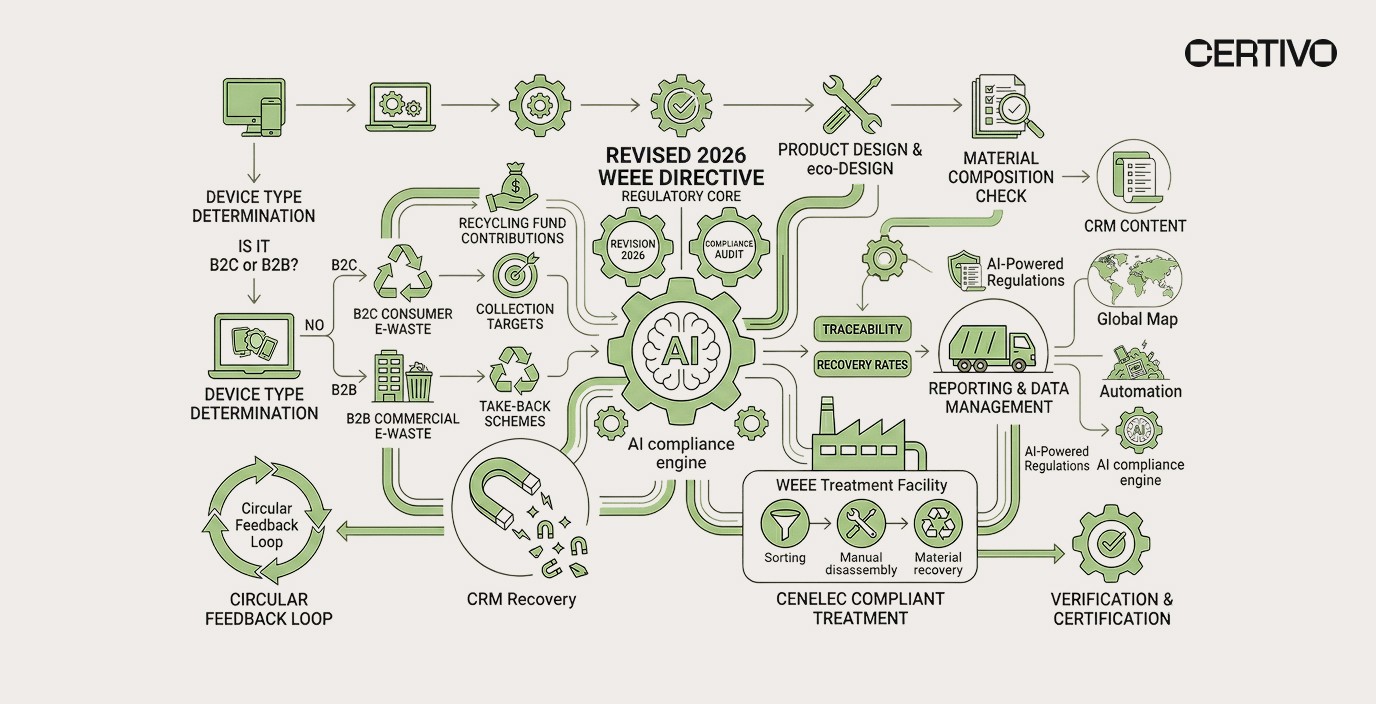
The EU WEEE Directive revision demands WEEE compliance capabilities that manual processes cannot deliver at scale. Organizations face simultaneous challenges in BOM-level material analysis for critical raw material recovery, EPR harmonization across Member States, supplier data aggregation for secondary raw materials, CENELEC treatment standards verification, and audit-ready documentation — all in support of circular economy compliance across multi-country EU operations. For a practical view of how AI transforms daily compliance operations, see a compliance engineer's week with and without AI.
📊 Where AI-native compliance automation adds value for e-waste regulation readiness:
✓ BOM-level CRM identification — Scanning product composition data to flag components containing targeted rare earths, precious metals, lithium, and cobalt for critical raw material recovery
✓ EPR harmonization mapping — Automatically reconciling existing multi-country Extended Producer Responsibility registrations against anticipated unified requirements
✓ Supplier data aggregation — Collecting, validating, and normalizing material declarations from suppliers at scale through Centralized Supplier Self-Service Portals to support secondary raw materials verification
✓ CENELEC treatment standards readiness assessment — Evaluating product designs against updated CENELEC treatment standards requirements for disassembly and CRM recovery
✓ Regulatory horizon scanning — Tracking the legislative progress of the EU WEEE Directive revision from proposal through adoption to enforce circular economy compliance proactively
The complexity of managing WEEE compliance alongside RoHS, REACH, EU Batteries Regulation, EU Packaging, and emerging digital product passport requirements makes Integrated PLM ERP Compliance threads essential. For a detailed guide on available AI compliance tools, see the complete guide to AI tools for compliance management.
Organizations that have invested in AI-powered compliance infrastructure will absorb the e-waste regulation requirements without proportional increases in headcount. Those still running Extended Producer Responsibility and WEEE compliance on spreadsheets face a scalability problem that only grows with each new regulation.
12. Frequently Asked Questions (FAQs)
Q1: When will the EU WEEE Directive revision become enforceable?
The formal legislative proposal for this e-waste regulation is expected in Q3 2026. Following European Parliament and Council review, final adoption is estimated for 2027–2028, with full WEEE compliance enforcement likely by 2029–2030 after an 18–24 month transition period. Preparatory work — BOM-level material mapping for critical raw material recovery, Extended Producer Responsibility audit, supplier data collection — should begin now. Monitor the EU Commission's mid-term review for updates.
Q2: Will the WEEE Directive actually become a directly applicable Regulation?
This is under active consideration. The mid-term review (COM/2026/42) identifies EPR harmonization failures under the current Directive model as a key driver for transitioning to a unified e-waste regulation. If adopted as a Regulation, it would apply uniformly across all 27 Member States without national transposition. The WEEE EU framework overview provides the current WEEE compliance baseline.
Q3: Which products face the most intensive new obligations under updated CENELEC treatment standards?
Products with high concentrations of critical raw materials — particularly those containing rare earth magnets, lithium batteries, and precious metal-rich PCBs — face the most intensive critical raw material recovery and reporting obligations under the new CENELEC treatment standards. Semiconductor and PCB manufacturers and battery producers are in the highest-impact category for both circular economy compliance and secondary raw materials reporting.
Q4: How does the WEEE revision interact with the EU Batteries Regulation?
The two frameworks share overlapping obligations around battery collection, critical raw material recovery, secondary raw materials traceability, and Extended Producer Responsibility reporting. Manufacturers placing battery-containing electronics on the EU market must maintain WEEE compliance under both frameworks. The EU Batteries Regulation framework page outlines existing requirements that the e-waste regulation revision will compound.
Q5: What should manufacturers do right now to prepare for EPR harmonization and circular economy compliance?
Begin with a BOM-level CRM audit across your product portfolio, inventory all active Extended Producer Responsibility registrations in EU Member States, and issue supplier data requests for CRM-containing components to support secondary raw materials tracking. Evaluate WEEE compliance systems for readiness to handle harmonized EU-wide reporting under the new CENELEC treatment standards. For end-to-end product compliance infrastructure, see tools that support product compliance from design through shipment.
13. Executive Conclusion
The EU WEEE Directive revision represents the most significant overhaul of European e-waste regulation in over a decade. By targeting critical raw material recovery, harmonizing Extended Producer Responsibility across Member States through comprehensive EPR harmonization, updating CENELEC treatment standards to maximize secondary raw materials quality, and creating a unified market for recycled content, the European Commission is repositioning WEEE compliance as a strategic pillar of circular economy compliance and raw materials security.
For global manufacturers, the EU WEEE Directive revision connects product design, BOM-level material transparency, supplier data management, multi-country Extended Producer Responsibility operations, critical raw material recovery facilitation, and compliance with updated CENELEC treatment standards into a single integrated challenge. Organizations that treat this as a peripheral environmental e-waste regulation — rather than a core operational transformation — risk significant enforcement exposure.
The formal proposal is expected in Q3 2026. The time to assess WEEE compliance readiness, close secondary raw materials data gaps, prepare for EPR harmonization, and build circular economy compliance infrastructure is now. Explore how AI-driven compliance platforms like Certivo support continuous regulatory readiness
Lavanya
Lavanya is an accomplished Product Compliance Engineer with over four years of expertise in global environmental and regulatory frameworks, including REACH, RoHS, Proposition 65, POPs, TSCA, PFAS, CMRT, FMD, and IMDS. A graduate in Chemical Engineering from the KLE Institute, she combines strong technical knowledge with practical compliance management skills across diverse and complex product portfolios.
She has extensive experience in product compliance engineering, ensuring that materials, components, and finished goods consistently meet evolving international regulatory requirements. Her expertise spans BOM analysis, material risk assessments, supplier declaration management, and test report validation to guarantee conformity. Lavanya also plays a key role in design-for-compliance initiatives, guiding engineering teams on regulatory considerations early in the product lifecycle to reduce risks and streamline market access.
Her contributions further extend to compliance documentation, certification readiness, and preparation of customer deliverables, ensuring transparency and accuracy for global stakeholders. She is adept at leveraging compliance tools and databases to efficiently track regulatory changes and implement proactive risk mitigation strategies.
Recognized for her attention to detail, regulatory foresight, and collaborative approach, Lavanya contributes significantly to maintaining product compliance, safeguarding brand integrity, and advancing sustainability goals within dynamic, globally integrated manufacturing environments.