

The state of Maryland has enacted Senate Bill 719 (SB 719) / House Bill 925 (HB 925), establishing new restrictions on the land application of sewage sludge containing PFAS at or above 50 parts per billion (ppb). Effective October 1, 2028, this regulation places mandatory PFAS testing, concentration monitoring, and mitigation requirements on organizations involved in biosolids generation, processing, land application, and industrial wastewater discharge.
For compliance leaders at manufacturers contributing PFAS to wastewater streams—and for utilities, agriculture operations, and waste management companies handling biosolids—the Maryland PFAS biosolids regulation creates new obligations that require source identification, testing infrastructure, and PFAS and chemicals risk management capabilities well ahead of the enforcement date.
📌 Book a free compliance risk assessment to map your PFAS exposure across wastewater, biosolids, and supply chain operations before the 2028 deadline.
What Is Maryland SB 719 and Why Does It Matter
Maryland SB 719 / HB 925 directs the Maryland Department of the Environment (MDE) to implement restrictions on the land application of sewage sludge (biosolids) containing PFAS concentrations equal to or greater than 50 parts per billion (ppb) of total regulated PFAS.
This is among the most stringent state-level PFAS biosolids thresholds in the United States.
The regulation targets a specific contamination pathway: PFAS-laden biosolids applied to agricultural land, which can contaminate soil, groundwater, and food supply chains. For manufacturers whose industrial processes contribute PFAS to municipal wastewater systems, SB 719 creates indirect but significant compliance exposure.
⚠ Unlike many PFAS regulations that focus on products or drinking water, this law targets waste outputs—making it relevant to any facility discharging PFAS into wastewater treatment systems that produce biosolids.
For a broader view of the evolving PFAS landscape, see Certivo's Global PFAS Regulations Master Guide.
Maryland PFAS biosolids regulation 50 ppb threshold for land application compliance
Click on image to view full

Key Requirements and PFAS Thresholds Under SB 719
The regulation establishes clear obligations for organizations handling biosolids in Maryland:
✓ 50 ppb PFAS Concentration Threshold — Land application of sewage sludge is restricted when total regulated PFAS concentration equals or exceeds 50 parts per billion.
✓ Mandatory PFAS Testing — Organizations generating or processing biosolids must implement PFAS concentration monitoring and testing programs.
✓ Mitigation Requirements — Where PFAS concentrations exceed the threshold, regulated entities must implement mitigation and alternative waste management measures.
✓ Source Identification — Wastewater treatment facilities and industrial contributors may need to identify and address PFAS sources entering the wastewater stream.
✓ Waste Management Compliance — Alternative disposal or treatment methods must be established for biosolids that cannot be land-applied.
Parameter | Requirement |
|---|---|
Substance Group | PFAS (Per- and Polyfluoroalkyl Substances) |
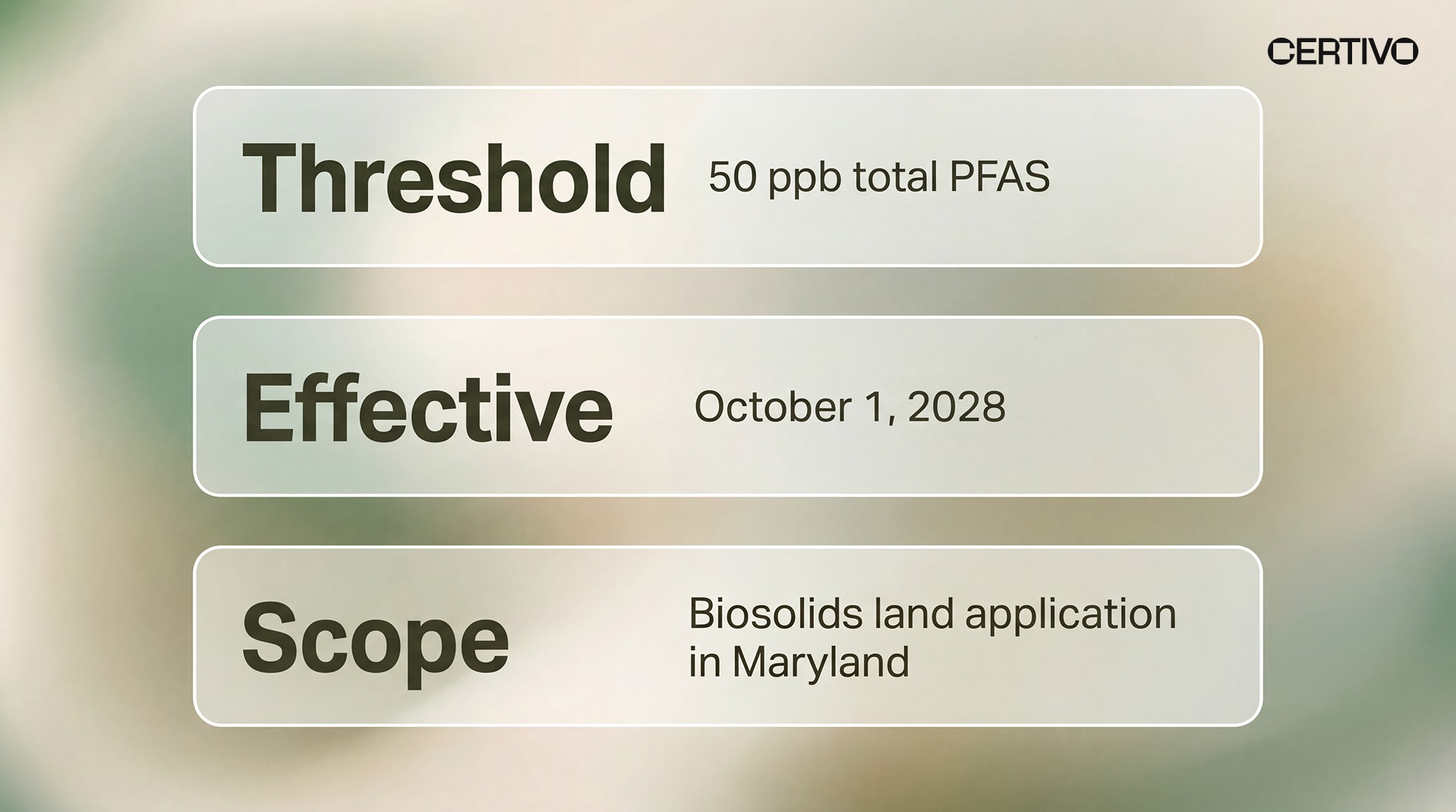
Threshold | 50 ppb total regulated PFAS |
Trigger | Land application of sewage sludge |
Effective Date | October 1, 2028 |
Enforcing Agency | Maryland Department of the Environment (MDE) |
For organizations already managing substance thresholds across products and BOMs, the operational logic is familiar: identify where PFAS concentrations exceed limits, trace the source, and implement corrective actions. The difference is that SB 719 applies this logic to waste streams rather than finished products.
Industries and Operations Affected
SB 719 affects a broader range of organizations than the regulation's title might suggest:
📊 Wastewater Treatment and Utilities — Facilities generating biosolids must test for PFAS, monitor concentrations, and restrict land application above the threshold. This is the primary compliance obligation.
📊 Agriculture and Land Application — Farmers and land managers receiving biosolids for soil amendment face restrictions on accepting sludge above 50 ppb PFAS. Agricultural operations in Maryland must verify biosolids compliance before application.
📊 Environmental Services and Waste Management — Companies processing, transporting, or disposing of sewage sludge must adapt operations to handle biosolids that can no longer be land-applied.
📊 Chemical and Industrial Manufacturing — Manufacturers using PFAS-containing materials in production processes may contribute PFAS to municipal wastewater systems. SB 719 creates indirect pressure on these facilities to identify and reduce PFAS in their discharge.
📊 Food and Agriculture Supply Chain — Indirect impacts arise from concerns about soil and water contamination affecting agricultural products grown on land where biosolids have been applied.
For manufacturers in chemical manufacturing and consumer goods sectors, the question is not whether biosolids regulations apply directly—but whether your facility's wastewater discharge contributes PFAS that triggers non-compliance downstream.
How SB 719 Connects to Broader PFAS Regulations
Maryland's biosolids regulation does not exist in isolation. It is part of an accelerating wave of PFAS restrictions across US states and federal agencies:
Federal EPA TSCA Section 8(a)(7) reporting requirements for PFAS manufacturers and importers are creating a national PFAS data infrastructure. See TSCA PFAS Reporting Requirements.
State-level PFAS bans and restrictions continue to expand across product categories, from textiles to packaging to electronics. Maryland's approach targets the waste pathway specifically. For a state-by-state view, see State PFAS Regulations 2026.
Minnesota, Massachusetts, Connecticut, New Jersey, Washington, and Kentucky have all enacted or proposed PFAS-related legislation with varying thresholds and product scopes. Maryland's 50 ppb biosolids threshold adds a new dimension: waste-stream compliance.
For organizations already tracking PFAS across products and supply chains, SB 719 extends the compliance perimeter to include wastewater and biosolids outputs. This requires regulatory intelligence and horizon scanning capabilities that connect product-level PFAS data to waste-stream obligations.
📌 Managing PFAS across multiple state jurisdictions? See how Certivo automates tracking → Explore PFAS Compliance Solutions
Maryland PFAS biosolids regulation key thresholds and deadlines for compliance teams
Click on image to view full
Reporting, Testing, and Documentation Challenges
SB 719 introduces operational challenges that extend beyond standard product compliance:
PFAS Testing Infrastructure
Biosolids PFAS testing at the 50 ppb level requires analytical methods capable of detecting total regulated PFAS at low concentrations. Wastewater treatment facilities must either develop in-house testing capabilities or contract with certified laboratories.
⚠ Testing frequency, methodology requirements, and specific PFAS analyte lists are subject to MDE implementation guidance. Based on currently available regulatory guidance, organizations should monitor MDE publications for finalized testing protocols.
Source Identification
When biosolids exceed the 50 ppb threshold, the next question is: where is the PFAS coming from? For municipal wastewater systems receiving industrial discharge, this requires tracing PFAS contributions back to specific facilities and processes.
Manufacturers connected to municipal systems may face requests to characterize their PFAS discharge—creating a new documentation burden that intersects with automated supplier data collection and substance tracking capabilities.
Documentation and Record-Keeping
Compliance with SB 719 will require maintaining:
PFAS test results with time-stamped records
Source identification documentation
Mitigation action records
Alternative disposal or treatment documentation
Evidence of monitoring program implementation
This is fundamentally a data versioning problem: immutable audit logs, time-stamped declarations, and point-in-time queries become essential for demonstrating compliance over time. No software eliminates audit findings entirely—the objective is to reduce surprises and compress response time when regulators or downstream stakeholders request evidence.
Compliance Risks and Enforcement Exposure
Failure to comply with SB 719 by October 1, 2028, exposes organizations to several risk categories:
⚠ Regulatory Penalties — MDE enforcement actions for non-compliant biosolids land application, including potential fines and operational restrictions.
⚠ Operational Disruption — Biosolids that exceed the 50 ppb threshold cannot be land-applied, requiring alternative disposal methods that may be more costly and logistically complex.
⚠ Upstream Liability — Industrial facilities contributing PFAS to wastewater systems may face cost-sharing obligations or regulatory scrutiny as source contributors.
⚠ Reputational and ESG Risk — Agricultural and food supply chain stakeholders are increasingly sensitive to PFAS contamination pathways. Organizations connected to non-compliant biosolids face reputational exposure.
⚠ Multi-Jurisdictional Complexity — Manufacturers operating across states face overlapping PFAS obligations. Maryland's biosolids-specific approach must be managed alongside product-level and discharge-level PFAS requirements in other jurisdictions through multi-jurisdiction EHS and ESG management capabilities.
Supply Chain and Operational Impact for Manufacturers
For manufacturers whose primary compliance concern is product-level regulation, SB 719 introduces a less familiar obligation: waste-stream accountability.
Direct Impacts
Facilities in Maryland discharging PFAS to municipal wastewater systems may be identified as source contributors
Discharge characterization and PFAS reduction programs may be required
Increased documentation obligations for industrial pretreatment compliance
Indirect Impacts
Suppliers providing PFAS-containing materials or chemicals may need to declare PFAS content to enable downstream compliance
Agricultural supply chain partners may impose biosolids-related PFAS requirements on upstream contributors
Insurance and ESG reporting may require disclosure of PFAS-related waste-stream exposure
For organizations managing multi-tier supply chain transparency, SB 719 reinforces the need to track PFAS not only in products but also in process waste and discharge.
Timeline and Enforcement Outlook
Date | Milestone |
|---|---|
2026 | SB 719 / HB 925 enacted |
2026–2028 | MDE develops implementation guidance, testing protocols, and enforcement procedures |
October 1, 2028 | Regulation effective — land application restrictions enforced |
2028+ | Ongoing monitoring, enforcement, and potential threshold tightening |
Based on currently available regulatory guidance, manufacturers and wastewater operators in Maryland should use the 2026–2028 window to establish testing programs, identify PFAS sources, and implement mitigation measures. Waiting until 2028 creates unacceptable compliance risk given the operational complexity of PFAS source identification and waste management transitions.
For the latest on PFAS deadlines across jurisdictions, see PFAS Compliance in 2026: Why Out-of-Scope No Longer Exists.
Strategic Compliance Preparation Checklist
How AI Supports Maryland PFAS Biosolids Compliance
Managing PFAS compliance across products, waste streams, and supply chains simultaneously is a multi-dimensional data challenge. AI-native compliance automation addresses the structural complexity that regulations like SB 719 create.
CORA-powered regulatory intelligence monitors state-level PFAS developments—including Maryland's SB 719 implementation guidance—and alerts compliance teams before changes take effect. This supports continuous compliance monitoring and audit readiness rather than periodic manual checks.
Certivo's PFAS compliance platform enables organizations to track PFAS exposure across products, materials, supplier declarations, and now waste-stream outputs within a centralized compliance data backbone. CORA-driven compliance intelligence connects product-level PFAS data to discharge and waste-stream obligations, closing the gap between product compliance and environmental compliance.
For manufacturers managing PFAS across multiple frameworks—TSCA, REACH, state bans, and now biosolids regulations—this centralized approach eliminates the data silos that create audit exposure and slow response times.
Executive Conclusion
Maryland's SB 719 establishes one of the most specific PFAS biosolids regulations in the United States, setting a 50 ppb threshold for land application of sewage sludge effective October 1, 2028. For wastewater utilities, this is a direct operational mandate. For manufacturers contributing PFAS to wastewater streams, it creates indirect but consequential compliance exposure.
The 2026–2028 preparation window is not generous. PFAS source identification, testing infrastructure, and alternative waste management pathways require planning and investment. Organizations that treat the Maryland PFAS biosolids regulation as an isolated state issue—rather than as part of an accelerating national and global PFAS compliance trajectory—risk being unprepared as similar regulations emerge in other jurisdictions.
📌 Book a demo to see how Certivo tracks PFAS compliance across products, supply chains, and waste-stream obligations—giving your team a single platform for managing the full scope of PFAS regulatory exposure.
FAQs
1. What PFAS threshold does Maryland SB 719 establish for biosolids?
Maryland SB 719 restricts land application of sewage sludge containing total regulated PFAS at or above 50 parts per billion (ppb). This is among the most stringent state-level biosolids PFAS thresholds in the US. Organizations managing PFAS compliance across jurisdictions can use Certivo's CORA intelligence to track threshold variations.
2. When does the Maryland PFAS biosolids regulation take effect?
The regulation becomes effective on October 1, 2028. Organizations should use the 2026–2028 window to implement testing programs, identify PFAS sources in wastewater discharge, and establish alternative biosolids management methods ahead of enforcement.
3. Are manufacturers directly affected by Maryland's biosolids PFAS regulation?
Manufacturers are indirectly affected if their facilities discharge PFAS-containing wastewater into municipal systems that produce biosolids. Source identification requirements may result in wastewater utilities requesting PFAS discharge characterization from industrial contributors.
4. How does SB 719 relate to federal PFAS regulations like TSCA Section 8(a)(7)?
SB 719 targets a specific contamination pathway—biosolids land application—while federal TSCA PFAS reporting addresses manufacturing and import of PFAS substances. Both regulations contribute to a growing national PFAS compliance infrastructure that requires centralized tracking across product, waste, and supply chain data.
5. What documentation should organizations maintain for Maryland PFAS biosolids compliance?
Organizations should maintain time-stamped PFAS test results, source identification records, mitigation action documentation, and evidence of monitoring program implementation. Audit-ready documentation with immutable audit logs and point-in-time query capabilities reduces response time during regulatory inspections.
Lavanya
Lavanya is an accomplished Product Compliance Engineer with over four years of expertise in global environmental and regulatory frameworks, including REACH, RoHS, Proposition 65, POPs, TSCA, PFAS, CMRT, FMD, and IMDS. A graduate in Chemical Engineering from the KLE Institute, she combines strong technical knowledge with practical compliance management skills across diverse and complex product portfolios.
She has extensive experience in product compliance engineering, ensuring that materials, components, and finished goods consistently meet evolving international regulatory requirements. Her expertise spans BOM analysis, material risk assessments, supplier declaration management, and test report validation to guarantee conformity. Lavanya also plays a key role in design-for-compliance initiatives, guiding engineering teams on regulatory considerations early in the product lifecycle to reduce risks and streamline market access.
Her contributions further extend to compliance documentation, certification readiness, and preparation of customer deliverables, ensuring transparency and accuracy for global stakeholders. She is adept at leveraging compliance tools and databases to efficiently track regulatory changes and implement proactive risk mitigation strategies.
Recognized for her attention to detail, regulatory foresight, and collaborative approach, Lavanya contributes significantly to maintaining product compliance, safeguarding brand integrity, and advancing sustainability goals within dynamic, globally integrated manufacturing environments.