

What Mexico's Proposed PFAS Import and Export Controls Mean for Global Manufacturers
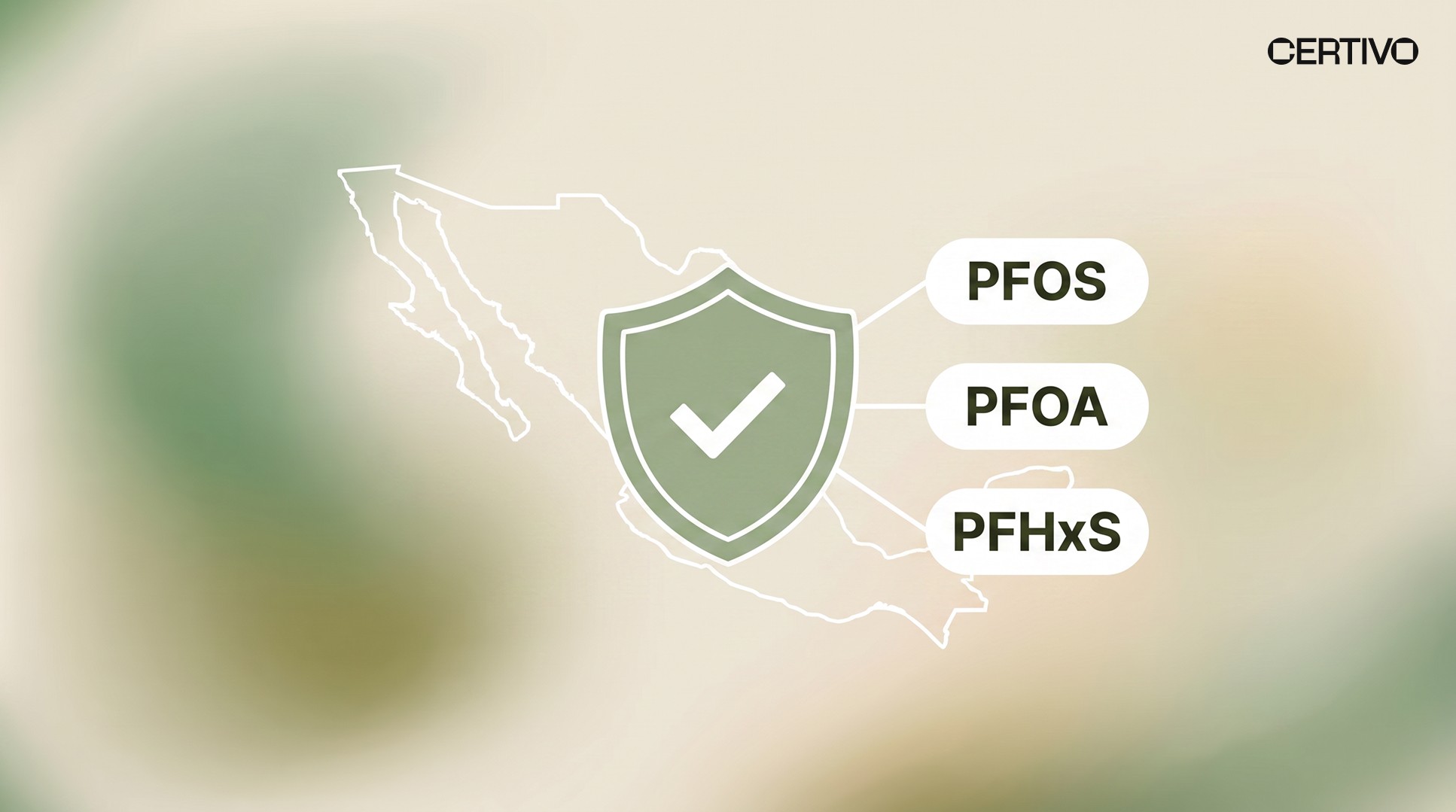
Mexico has proposed a regulatory framework that would impose permit-based import and export controls on PFAS substances—specifically PFOS, PFOA, and PFHxS, along with their salts and related compounds. Published for public comment on CONAMER (Mexico's regulatory review portal), this proposal implements Mexico's obligations under the Stockholm Convention on Persistent Organic Pollutants, to which Mexico has been a party since 2003.
As of mid-2026, the rule has not been finalized in the Diario Oficial de la Federación (DOF). It remains a proposal. However, for manufacturers, importers, and exporters operating in or through Mexico, the operational implications are significant. Per-shipment authorization requirements, multi-agency permit processes, and substance-level documentation obligations represent a meaningful shift in Mexico's PFAS compliance landscape.
This guide covers the scope of the proposal, affected industries, reporting obligations, enforcement exposure, and how organizations managing PFAS and chemicals risk management across multiple jurisdictions should prepare.
📌 Book a free compliance assessment to evaluate your PFAS exposure across Mexico-bound supply chains and product portfolios.
Framework Background: Mexico's Stockholm Convention Obligations
Mexico ratified the Stockholm Convention in 2003, committing to restrict or eliminate the production, use, import, and export of persistent organic pollutants (POPs). The convention has progressively expanded its annexes to include PFAS substances:
✓ PFOS and its derivatives — added to Annex B (restriction) in 2009
✓ PFOA, its salts and related compounds — added to Annex A (elimination) in 2019
✓ PFHxS, its salts and related compounds — added to Annex A in 2022
The current Mexican proposal translates these international obligations into domestic regulatory action. It also references the Montreal Protocol's Kigali Amendment regarding hydrofluorocarbons (HFCs), meaning that imports of certain industrial POPs and HFCs would require special permissions from Mexican authorities.
This proposal aligns Mexico with the broader global trajectory of tightening PFAS controls. For organizations already tracking PFAS regulations across the US and EU, Mexico adds another jurisdiction requiring active monitoring through regulatory intelligence and horizon scanning capabilities.
Mexico PFAS import export regulations 2026 compliance framework for manufacturers
Click on image to view full
Which PFAS Substances Are In Scope
The proposal targets three categories of PFAS substances based on their Stockholm Convention listings:
Substance | Convention Status | Key Identifiers |
|---|---|---|
PFOS, its salts, and PFOSF | Annex B (Restriction) | Perfluorooctane sulfonic acid, perfluorooctane sulfonyl fluoride |
PFOA, its salts, PFOA-related compounds | Annex A (Elimination) | Perfluorooctanoic acid and related substances |
PFHxS, its salts, PFHxS-related compounds | Annex A (Elimination) | Perfluorohexane sulfonic acid, added 2022 |
⚠ The proposal applies not only to raw chemical imports but also to articles containing these substances where the import classification triggers permit requirements. This is a critical distinction. Manufacturers importing finished goods, sub-assemblies, or components into Mexico must assess whether their products contain in-scope PFAS at levels that trigger the permit obligation.
For organizations managing BOM-level material mapping across product portfolios, this means extending substance screening to include Mexico-bound shipments—not just EU REACH or US TSCA reporting.
How the Proposed Permit System Would Work
Unlike annual or one-time reporting regimes (such as TSCA Section 8(a)(7) PFAS reporting in the US), Mexico's proposal establishes a per-shipment authorization model.
Key Reporting and Permit Requirements
📊 Who reports: Importers and exporters of PFOS, PFOA, PFHxS, their salts and related substances—including articles containing them where import classification triggers the requirement.
📊 Reporting scope: Permit application before each shipment. This is not a retrospective inventory report.
📊 Reporting frequency: Per-shipment authorization. Every qualifying import or export requires separate approval.
📊 Submission system: SEMARNAT (Mexico's Ministry of Environment) permit authorization, plus registration with PROFEPA's Registry of Verification (RV) before customs clearance.
📊 Required documentation: Substance identity, volume, intended use, end-user information, and supporting documentation per Annex I of the Stockholm Convention.
Operational Implications
This per-shipment model introduces significant friction for high-volume importers. Organizations shipping PFAS-containing products or components into Mexico on a regular basis would face:
Permit lead times for every shipment
Multi-agency coordination (SEMARNAT + PROFEPA + customs)
Documentation burden at the substance and shipment level
Risk of customs holds for incomplete or delayed permit approvals
Companies relying on automated supplier data collection portals to manage substance declarations will need to extend those workflows to capture Mexico-specific permit data and ensure that customs-facing documentation is generated before each qualifying shipment.
Industries and Product Categories Affected
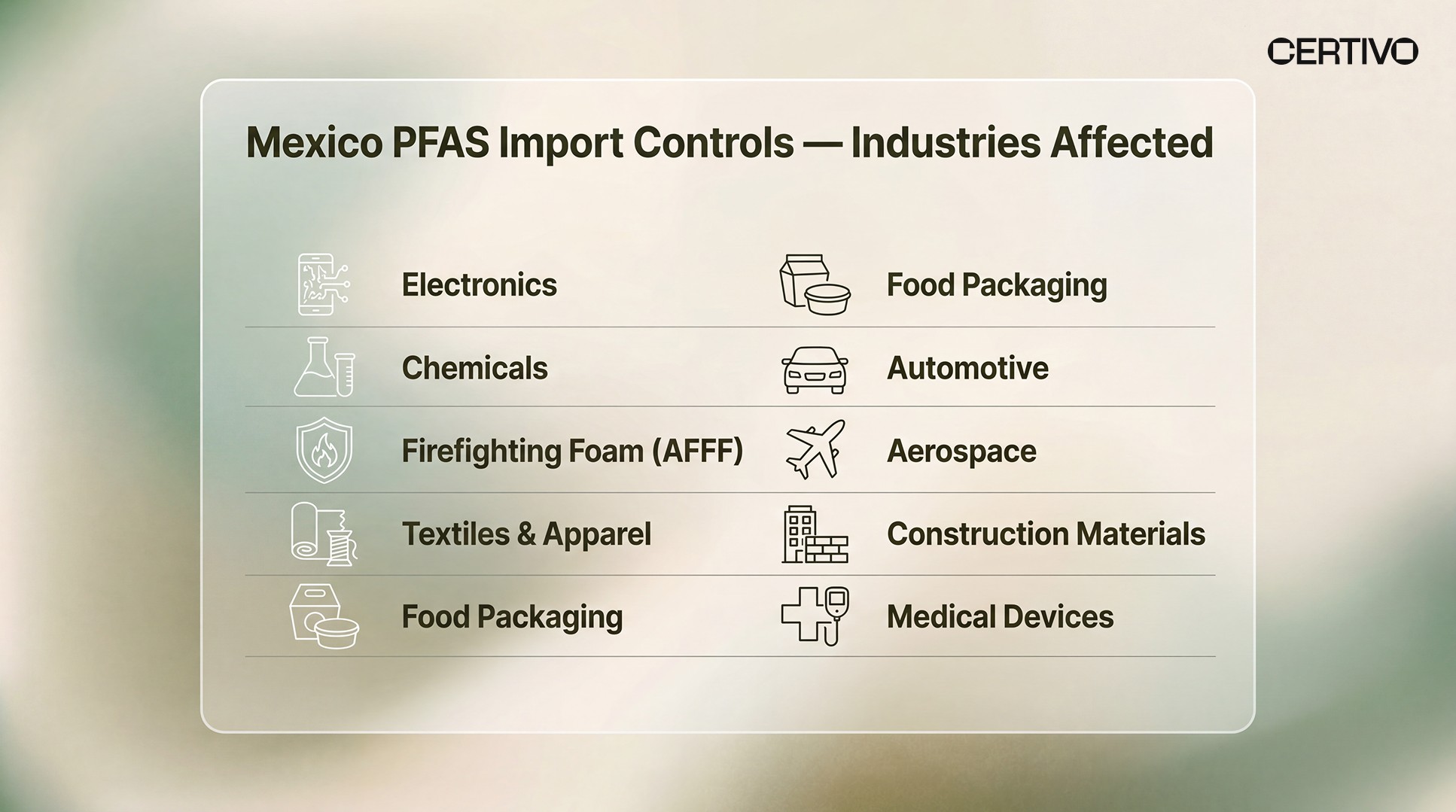
Based on the proposal's substance scope and the known industrial applications of PFOS, PFOA, and PFHxS, the following sectors face the most direct exposure:
✓ Chemicals & Plastics — Raw material imports of PFOS/PFOA compounds
✓ Textiles, Apparel & Footwear — Water and stain repellent finishes containing in-scope PFAS
✓ Electronics Manufacturing — PFOS-containing semiconductor photolithography chemicals
✓ Food Packaging & Food Contact Materials — PFAS-treated packaging substrates
✓ Firefighting Foam (AFFF) — Aqueous film-forming foams containing PFOS
✓ Metal Plating & Surface Treatment — Chrome plating mist suppressants
✓ Medical Devices — Components using PFAS coatings or lubricants
✓ Aviation Hydraulic Fluids — Specialty fluids for aerospace applications
For manufacturers selling into multiple regions, the challenge is not Mexico in isolation—it is managing Mexico's permit requirements alongside EU REACH restrictions, US EPA TSCA reporting, state-level PFAS bans, and emerging requirements in jurisdictions like New Zealand and France. This is where multi-jurisdiction EHS and ESG management capabilities become operationally essential.
📌 Managing PFAS compliance across multiple regions? See how Certivo centralizes your regulatory obligations → Book a Demo
Mexico PFAS import regulations 2026 affected industries for manufacturer compliance
Click on image to view full
Compliance Risks and Enforcement Exposure
Although the proposal has not been finalized, manufacturers should assess their risk posture now. Mexico's environmental enforcement agency, PROFEPA, has authority to inspect, fine, and suspend operations for non-compliance with environmental permits.
⚠ Customs holds — Shipments lacking proper SEMARNAT permits could be detained at the border, causing production delays and contractual penalties.
⚠ Fines and sanctions — Mexico's environmental law (Ley General del Equilibrio Ecológico y Protección al Ambiente) provides for administrative fines, facility closure, and criminal liability for serious violations.
⚠ Customer audit exposure — OEMs and brand customers increasingly require evidence of PFAS compliance across all operating jurisdictions. Missing Mexico from your compliance documentation creates audit findings.
⚠ Supply chain disruption — Sub-tier suppliers importing PFAS-containing components into Mexican manufacturing facilities without proper permits could halt assembly lines.
Organizations maintaining continuous audit-ready documentation that includes Mexico in their jurisdictional coverage will be better positioned to respond to both regulatory inspections and customer audits. The objective is not to claim audit-proof status—no software eliminates audit findings—but to reduce surprises and compress response time when audit requests arrive.
Evidence chain integrity matters here: who provided the substance data, when it was provided, with what authority, and whether it reflects the current regulatory state. Time-stamped declarations and immutable audit logs are the data infrastructure that supports this.
How Does Mexico's PFAS Proposal Compare to US and EU Restrictions
Mexico's approach differs structurally from the two largest PFAS regulatory regimes:
📊 US (EPA/TSCA): The US requires retrospective reporting under TSCA Section 8(a)(7) for entities that have manufactured or imported PFAS since 2011. This is a one-time look-back report, not a per-shipment permit. State-level bans (e.g., California, Massachusetts, Connecticut) add product-specific restrictions but do not require shipment-level permits.
📊 EU (REACH): The EU's proposed universal PFAS restriction under REACH would restrict manufacturing, placing on the market, and use of PFAS above defined thresholds. This is a market access restriction, not a per-shipment permit system. See Certivo's coverage of the EU REACH PFAS restriction proposal for details.
📊 Mexico: The proposed system is permit-based and per-shipment, closer to a trade compliance model than a chemical regulation model. It requires pre-clearance for every qualifying import or export.
This structural difference means that companies cannot simply extend their US or EU PFAS compliance programs to cover Mexico. A separate workflow for permit generation, multi-agency coordination, and customs documentation is required. CORA-driven compliance intelligence can help map these jurisdictional differences and ensure that regional requirements feed into a centralized compliance data backbone rather than creating isolated compliance silos.
Strategic Compliance Preparation Checklist
Even while the proposal awaits finalization, compliance leaders should take the following steps:
How AI Helps Manufacturers Manage Multi-Jurisdiction PFAS Compliance
Mexico's proposed PFAS controls add yet another jurisdiction to an already complex global patchwork. Managing PFAS compliance manually—across the US federal level, individual US states, EU REACH, and now Mexico—is unsustainable at enterprise scale.
CORA-powered regulatory intelligence monitors regulatory developments across all active PFAS jurisdictions, including pending proposals like Mexico's, and maps them to affected products, substances, and supply chain nodes. When Mexico finalizes its rule, CORA can alert compliance teams and trigger the appropriate workflow updates automatically.
AI document parsing and certificate validation reduces the manual burden of reviewing supplier declarations for PFAS content, extracting substance data, and cross-referencing it against jurisdictional thresholds and permit requirements. This is how organizations shift from reactive, jurisdiction-by-jurisdiction compliance to continuous compliance monitoring and audit readiness.
For a comprehensive view of how AI addresses PFAS compliance complexity, see Managing 12,000 PFAS Compounds: How AI Automates TSCA Section 8(a)(7) Compliance.
Conclusion
Mexico's proposed PFAS import and export controls represent a meaningful regulatory development for manufacturers operating in or shipping through Mexico. The per-shipment permit model, multi-agency approval process, and substance-level documentation requirements create operational obligations that differ fundamentally from US and EU PFAS frameworks.
While the rule has not been finalized, the trajectory is clear. Mexico is implementing its Stockholm Convention commitments, and the substances in scope—PFOS, PFOA, PFHxS—are already under restriction or elimination globally. Organizations that proactively screen their product portfolios, map their Mexico-bound supply chains, and integrate Mexico into their multi-jurisdiction PFAS compliance programs will absorb this regulation with minimal disruption.
Waiting for finalization before acting creates unnecessary audit exposure and customs risk. The compliance preparation work—substance screening, supplier data collection, permit workflow design—is the same work that strengthens your broader PFAS and chemicals risk management posture across all jurisdictions.
📌 Book a demo to see how Certivo automates PFAS compliance across your product portfolio and multi-tier supply chain—or get a free compliance risk assessment to evaluate your current PFAS exposure across Mexico, the US, and EU.
FAQs
1. Is Mexico's PFAS import regulation currently enforceable?
No. As of mid-2026, the proposal has been published for public comment on CONAMER but has not been finalized in the Diario Oficial de la Federación. However, manufacturers should prepare now, as the rule implements Mexico's existing Stockholm Convention obligations. CORA's regulatory intelligence layer tracks finalization status in real time.
2. What types of permits would be required under Mexico's PFAS proposal?
The proposal requires per-shipment authorization from SEMARNAT, plus registration with PROFEPA's Registry of Verification before customs clearance. This applies to each qualifying import or export of PFOS, PFOA, PFHxS, their salts, and related compounds—including articles containing them.
3. Does the Mexico PFAS proposal apply to finished products or only raw chemicals?
Both. The proposal covers raw PFAS substances and articles containing in-scope substances where the import classification triggers permit requirements. Manufacturers importing components or finished goods into Mexico must assess whether their products contain PFOS, PFOA, or PFHxS at triggering levels.
4. How does Mexico's per-shipment permit model differ from US TSCA PFAS reporting?
US TSCA Section 8(a)(7) requires a one-time retrospective report of historical PFAS manufacturing and import activity. Mexico's proposal requires pre-shipment authorization for every qualifying import or export — a fundamentally different compliance workflow requiring ongoing permit management.
5. How can manufacturers prepare for Mexico PFAS regulations while the rule is still pending?
Screen product portfolios for in-scope substances, map Mexico-bound supply chains, update supplier questionnaires, and integrate Mexico into multi-jurisdiction monitoring systems. Certivo's platform enables centralized PFAS tracking across all active and pending jurisdictions through automated supplier data collection and BOM-level substance screening.
Lavanya
Lavanya is an accomplished Product Compliance Engineer with over four years of expertise in global environmental and regulatory frameworks, including REACH, RoHS, Proposition 65, POPs, TSCA, PFAS, CMRT, FMD, and IMDS. A graduate in Chemical Engineering from the KLE Institute, she combines strong technical knowledge with practical compliance management skills across diverse and complex product portfolios.