

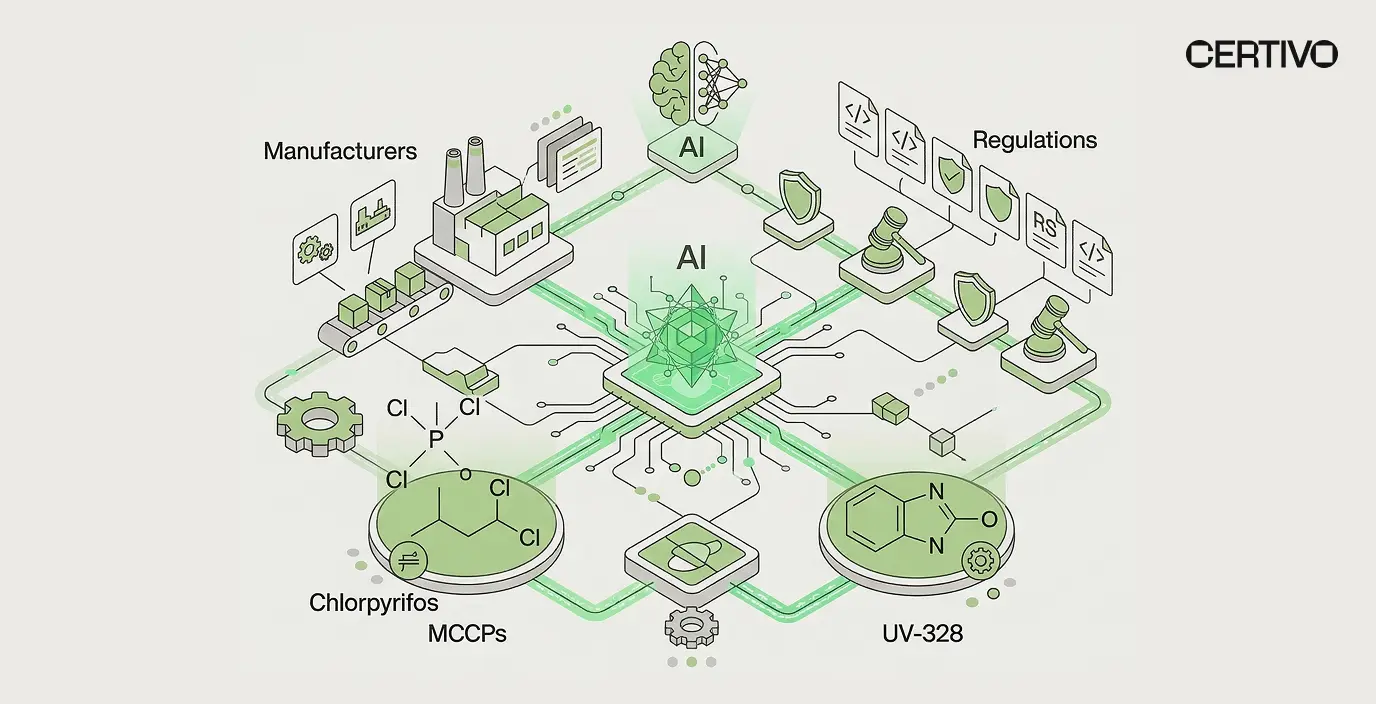
If your products contain chlorpyrifos, MCCPs, or UV-328 — and you sell into New Zealand — your compliance window is closing. The Environmental Protection Authority of New Zealand has proposed new restrictions on these three chemicals under the Stockholm Convention on Persistent Organic Pollutants (POPs). These New Zealand POPs restrictions aren't theoretical. Chlorpyrifos faces a full ban by July 8, 2027. MCCPs hit initial restrictions on December 16, 2026. And UV-328 is next.
The problem? Most manufacturers don't know whether these substances are embedded in their supply chains. They don't have BOM-level substance visibility. They don't have automated supplier data collection. And they're running out of time to find out manually. If you're a compliance director asking "how do I identify restricted POPs substances in my products" or a procurement leader wondering "how do I get substance data from my suppliers before a ban takes effect" — this regulatory update is your action plan. Start by understanding where these substances sit within the broader POPs regulatory framework.
📌 Table of Contents
What Is Being Proposed — And Why Manufacturers Can't Afford to Wait
Chemicals Affected: Chlorpyrifos, MCCPs, and UV-328
Key Timelines and Phase-Out Dates
Industries and Products at Risk
What the Public Consultation Means — Your Last Window to Influence
The Real Supply Chain Problem: You Don't Know What You Don't Know
What Happens If You Don't Act: Compliance Risks and Business Impact
Compliance Readiness Checklist
How AI Solves the POPs Compliance Problem at Scale
FAQs
Executive Conclusion
1. What Is Being Proposed — And Why Manufacturers Can't Afford to Wait
The New Zealand EPA has proposed restrictions on three substances newly listed under the Stockholm Convention on Persistent Organic Pollutants: chlorpyrifos, medium-chain chlorinated paraffins (MCCPs), and UV-328. The Stockholm Convention is a binding global treaty that eliminates or restricts persistent chemicals that bioaccumulate in ecosystems and pose risks to human health.
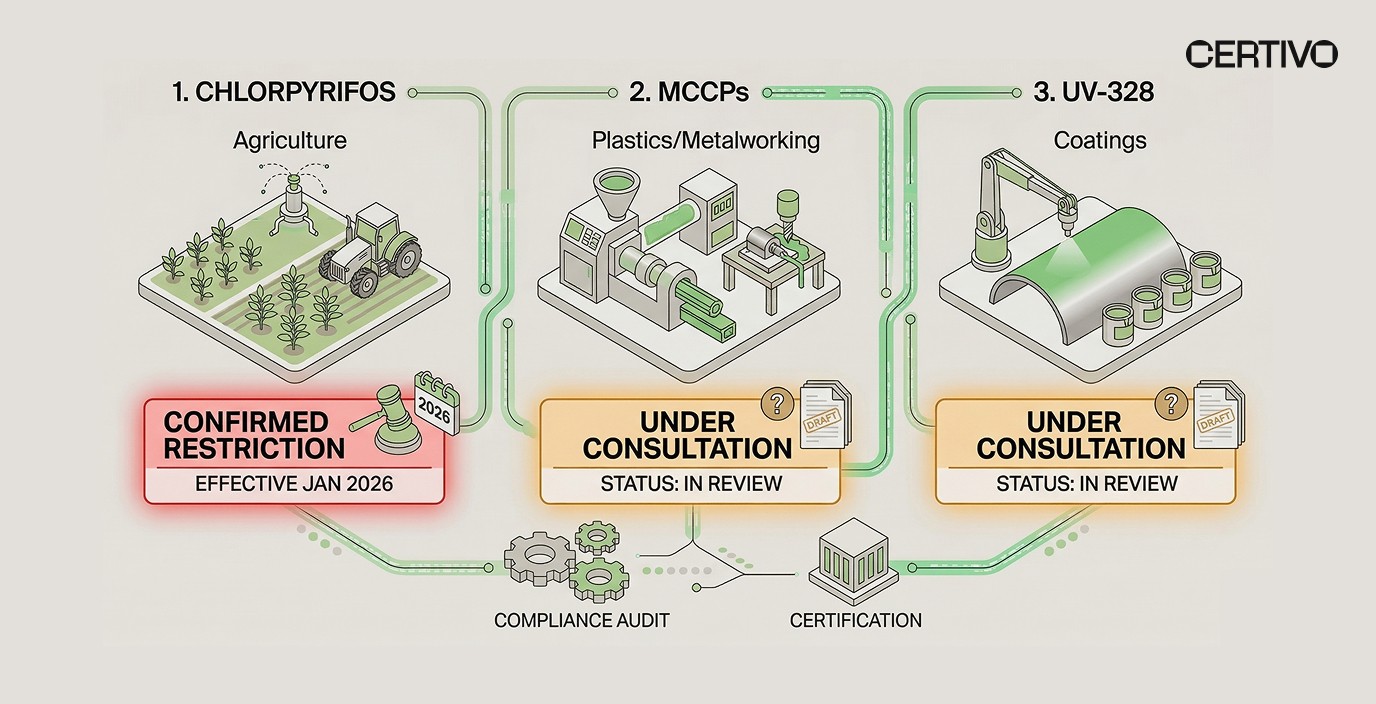
Here's what makes this different from a typical regulatory update: the chlorpyrifos phase-out date is already set. July 8, 2027. That is not a consultation proposal — it is a confirmed deadline. For MCCPs, the initial restriction date of December 16, 2026 is proposed, and the final phase-out is pending. UV-328 timelines are entirely under consultation.
⚠ The compliance challenge isn't the regulation itself — it's the discovery problem. Most manufacturers don't have a centralized system that tells them whether chlorpyrifos, MCCPs, or UV-328 exist anywhere in their product BOMs or supply chain inputs. They rely on spreadsheets, email chains, and manual supplier outreach — processes that cannot deliver substance-level answers before a deadline hits. Organizations tracking how POPs listings cascade across jurisdictions should review the EU POPs limits and digital product passport requirements for essential parallel context.
📌 Current status: The proposal is under public consultation. Final implementation details for MCCPs and UV-328 will be determined following the consultation process. But for chlorpyrifos, the clock is already running.
Compliance and regulation managers should initiate substance exposure assessments immediately — not after final dates are confirmed.
2. Chemicals Affected: Chlorpyrifos, MCCPs, and UV-328
Each of the three targeted substances serves a different industrial purpose — but they share the environmental persistence that triggers Stockholm Convention action. The compliance pain for manufacturers is that these substances are often hidden deep in supply chain inputs, not sitting visibly on a product label.
Chemical | Primary Use | Initial Restriction | Full Phase-Out | Compliance Urgency |
|---|---|---|---|---|
Chlorpyrifos | Organophosphate insecticide | Dec 16, 2026 | July 8, 2027 | 🔴 Critical |
MCCPs | Plasticizers in PVC; metalworking fluids | Dec 16, 2026 | To be finalized | 🟡 High |
UV-328 | UV stabilizer in plastics/coatings | In consultation | In consultation | 🟡 High |
Chlorpyrifos — The Most Urgent Deadline
Chlorpyrifos is a widely used organophosphate insecticide already banned or restricted in the EU and United States. Under the New Zealand proposal, the full phase-out is July 8, 2027 — less than 18 months from proposal to complete market withdrawal.
The pain point: If you manufacture or distribute agrochemical formulations containing chlorpyrifos for the New Zealand market, you need to begin product withdrawal, customer notification, and alternative qualification now. There is no grace period after July 2027. Companies in the chemical manufacturing sector should treat this as an immediate action item, not a future planning exercise.
MCCPs — The Hidden Supply Chain Risk
MCCPs are chlorinated hydrocarbons used as plasticizers in PVC, as flame retardants, and as additives in metalworking fluids and lubricants. They are embedded across industrial supply chains in ways that are difficult to trace without structured substance tracking.
The pain point: You may not buy MCCPs directly — but your PVC supplier, your lubricant vendor, or your metalworking fluid provider may be using them. Without automated supplier data collection, you have no way to confirm or deny MCCP presence before the December 2026 restriction date. Manufacturers in industrial machinery and heavy equipment should evaluate MCCP exposure in production fluids and material inputs immediately.
UV-328 — The Slow-Moving Risk That Will Accelerate
UV-328 is a benzotriazole UV stabilizer used in plastics, coatings, adhesives, and sealants. It prevents UV degradation in automotive components, construction materials, and consumer products.
The pain point: UV-328 is a performance-critical additive. Substitution isn't simple — alternatives must match UV resistance specifications, which may require product re-qualification and testing. Companies in the building materials and construction sector that use UV-stabilized coatings or sealants should begin alternative evaluation now. For strategic context on how POPs listings drive product compliance changes globally, see navigating POPs regulations with proactive compliance strategies.
3. Key Timelines and Phase-Out Dates
📊 Every compliance director's first question: "When do I need to be ready?"
Milestone | Chlorpyrifos | MCCPs | UV-328 |
|---|---|---|---|
Stockholm Convention listing | ✓ Completed | ✓ Completed | ✓ Completed |
NZ EPA proposal published | ✓ Current | ✓ Current | ✓ Current |
Public consultation | ✓ Open | ✓ Open | ✓ Open |
Initial restriction date | Dec 16, 2026 | Dec 16, 2026 | To be finalized |
Full phase-out date | July 8, 2027 | To be finalized | To be finalized |
⚠ Planning reality check: December 2026 is approximately 14 months away. If you need to identify restricted substances across hundreds of product BOMs, collect substance data from dozens of suppliers, qualify alternative materials, and reformulate affected products — 14 months is not a comfortable window. It is a compressed one.
Organizations that lack centralized substance tracking capabilities should evaluate their infrastructure gap now. The Certivo platform features are designed to address exactly this type of time-sensitive, multi-substance compliance challenge. For teams still manually tracking regulatory deadlines, regulatory intelligence and horizon scanning capabilities automate this monitoring and alert compliance teams to status changes in real time.
4. Industries and Products at Risk
"Does this regulation affect my products?" is the question every VP of Operations asks first. Here's the answer, broken down by sector.
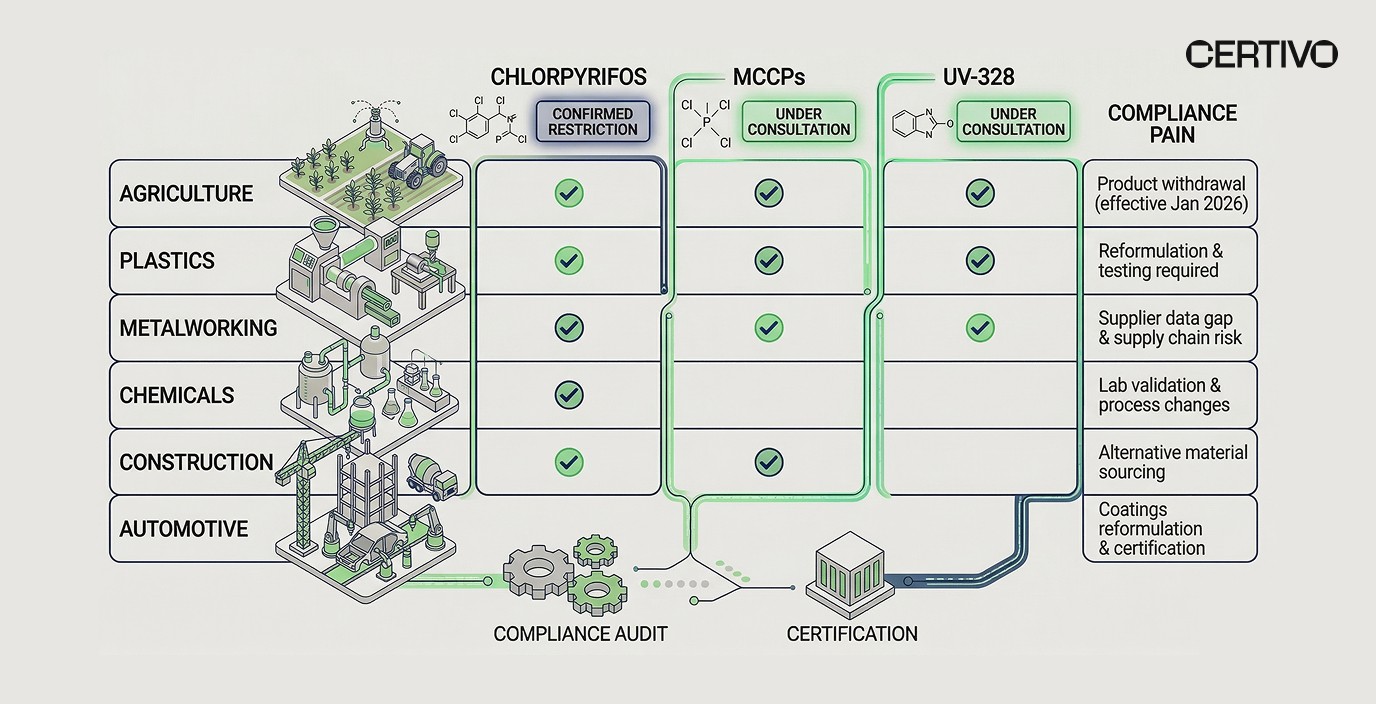
Industry | Substances Affected | Key Applications at Risk | Compliance Pain |
|---|---|---|---|
Agriculture & Agrochemicals | Chlorpyrifos | Crop protection, pest control formulations | Product withdrawal + alternative registration required |
Plastics & Polymers | MCCPs, UV-328 | PVC plasticizers, UV stabilizers | Reformulation + supplier data gap |
Metalworking & Industrial | MCCPs | Metalworking fluids, lubricants, cutting oils | Supplier substance verification required |
Chemical Industry | All three | Formulation and distribution | Full product portfolio review |
Construction & Coatings | UV-328 | UV-resistant coatings, sealants, adhesives | Re-qualification with alternative stabilizers |
Automotive Components | UV-328, MCCPs | Interior/exterior plastics, underbody coatings | Multi-tier supplier substance tracing |
For agriculture companies: The chlorpyrifos phase-out means product registrations must be withdrawn and alternative active ingredients qualified. This isn't a reformulation — it's a product replacement. The complete guide to product compliance management provides a framework for managing product-level substance transitions at scale.
For plastics and automotive manufacturers: MCCPs and UV-328 may sit deep in purchased materials. You need BOM-level substance tracking that can identify these substances at the component level — not just at the finished product level.
For companies exporting to multiple regions: These New Zealand restrictions will mirror EU POPs regulation obligations. The ability to standardize compliance across plants and regions prevents you from solving the same problem twice in different jurisdictions.
5. What the Public Consultation Means — Your Last Window to Influence
The New Zealand EPA's proposal is under public consultation. This is not a bureaucratic formality — it is your last structured opportunity to influence the final regulation before it becomes binding.
What you can still shape:
✓ Transition period lengths for MCCPs and UV-328 — the final phase-out dates are not yet set
✓ Sector-specific exemptions for applications where alternatives don't yet exist commercially
✓ Concentration thresholds that determine which products are actually caught by the restriction
✓ Implementation details including product category definitions and enforcement mechanisms
📌 Why this matters for your business: A 3-year transition period versus a 5-year transition period can mean the difference between an orderly reformulation process and an emergency product withdrawal. Generic objections carry no weight. Quantified evidence — on substitution costs, alternative readiness, and sector-specific timelines — does. For context on why early engagement in regulatory processes protects market access, see market readiness vs. risk exposure.
CEOs and founders at organizations with New Zealand market exposure should ensure compliance teams are resourced and authorized to submit evidence during the consultation window. Silence during consultation means accepting whatever outcome regulators decide.
6. The Real Supply Chain Problem: You Don't Know What You Don't Know
This is the section that compliance directors, procurement leaders, and supply chain teams need to read carefully. Because the biggest compliance risk isn't the regulation itself — it's the substance visibility gap in your supply chain.
The problem in concrete terms:
Your metalworking fluid supplier may be using MCCPs as a performance additive — and you've never asked
Your PVC compound supplier may include MCCP plasticizers that don't appear on the standard material data sheet
Your coatings supplier may use UV-328 in formulations that you purchase as finished materials
Your sub-tier component suppliers may be using chlorpyrifos-treated agricultural inputs in packaging or processing
⚠ Manual supplier outreach cannot solve this at scale. If you have 50 suppliers and three restricted substances, you need 150 verified substance declarations — collected, validated, and mapped to product BOMs — before December 2026. If you have 500 suppliers, the math becomes impossible without automation.
Streamlining supplier documentation through centralized, structured collection portals is the only way to close this gap within the available timeline. Organizations managing multi-tier supply chains should also evaluate multi-tier compliance automation for electronics and complex supply chains as a reference model — the same principles apply across manufacturing sectors.
For procurement teams specifically: You need a system that sends structured questionnaires to suppliers, tracks response rates, flags gaps, and maps substance data to your product BOMs automatically. Supplier collaboration workflows that depend on email-based follow-up cycles cannot deliver this before a hard deadline. For more on how supply chain fragmentation creates compliance gaps, see fixing fragmentation in supply chain collaboration.
7. What Happens If You Don't Act: Compliance Risks and Business Impact
Let's be direct about the consequences. This is what inaction looks like in business terms.
Risk | Impact | Who Feels It |
|---|---|---|
Market access loss | Products containing restricted POPs barred from NZ market | Sales + Revenue |
Inventory write-offs | Unsold stock becomes unsellable after phase-out date | Finance + Operations |
Customer attrition | Failure to provide compliant alternatives loses accounts | Sales + Account Management |
Regulatory penalties | Non-compliance with NZ EPA restrictions triggers enforcement | Legal + Compliance |
Reputation damage | POPs are high-profile environmental toxicants — non-compliance attracts scrutiny | Brand + Executive |
Supply chain cascade | Your non-compliance makes your customers non-compliant | All stakeholders |
The chlorpyrifos window is especially tight — only seven months between initial restriction (December 2026) and full ban (July 2027). That is not enough time to discover, reformulate, test, register, and distribute an alternative product if you haven't started.
Managing compliance risk proactively isn't just a compliance best practice — it is a business continuity requirement. For a quantified view of how proactive compliance reduces cost versus reactive scrambles, see cost savings through proactive compliance with AI.
8. Compliance Readiness Checklist
📌 Your 10-step action plan — assign owners and start today:
# | Action Item | Owner | Deadline Guidance |
|---|---|---|---|
1 | Screen all product BOMs for chlorpyrifos, MCCPs, and UV-328 | Compliance + R&D | Immediate |
2 | Map substance presence across all supply chain tiers | Procurement + Compliance | Within 30 days |
3 | Issue structured supplier substance data requests | Procurement | Within 30 days |
4 | Review NZ EPA consultation documents and prepare submission | Regulatory Affairs | Before consultation closes |
5 | Identify and begin qualifying alternative substances | R&D + Engineering | Within 60 days |
6 | Assess product reformulation timelines and costs | Operations + R&D | Within 90 days |
7 | Review NZ product registrations for chlorpyrifos formulations | Regulatory Affairs | Immediate |
8 | Coordinate with EU POPs obligations to align compliance efforts | Compliance | Within 60 days |
9 | Plan inventory management for products affected by phase-out | Supply Chain + Ops | Within 90 days |
10 | Assign executive ownership for POPs restriction response | C-Suite | Immediate |
Organizations still tracking substance compliance in spreadsheets should evaluate replacing spreadsheets with a scalable compliance system — the December 2026 deadline does not allow for manual processes.
VP and Directors of Quality should own items 5 and 6, ensuring reformulation efforts meet product performance specifications within the regulatory timeline.
9. How AI Solves the POPs Compliance Problem at Scale
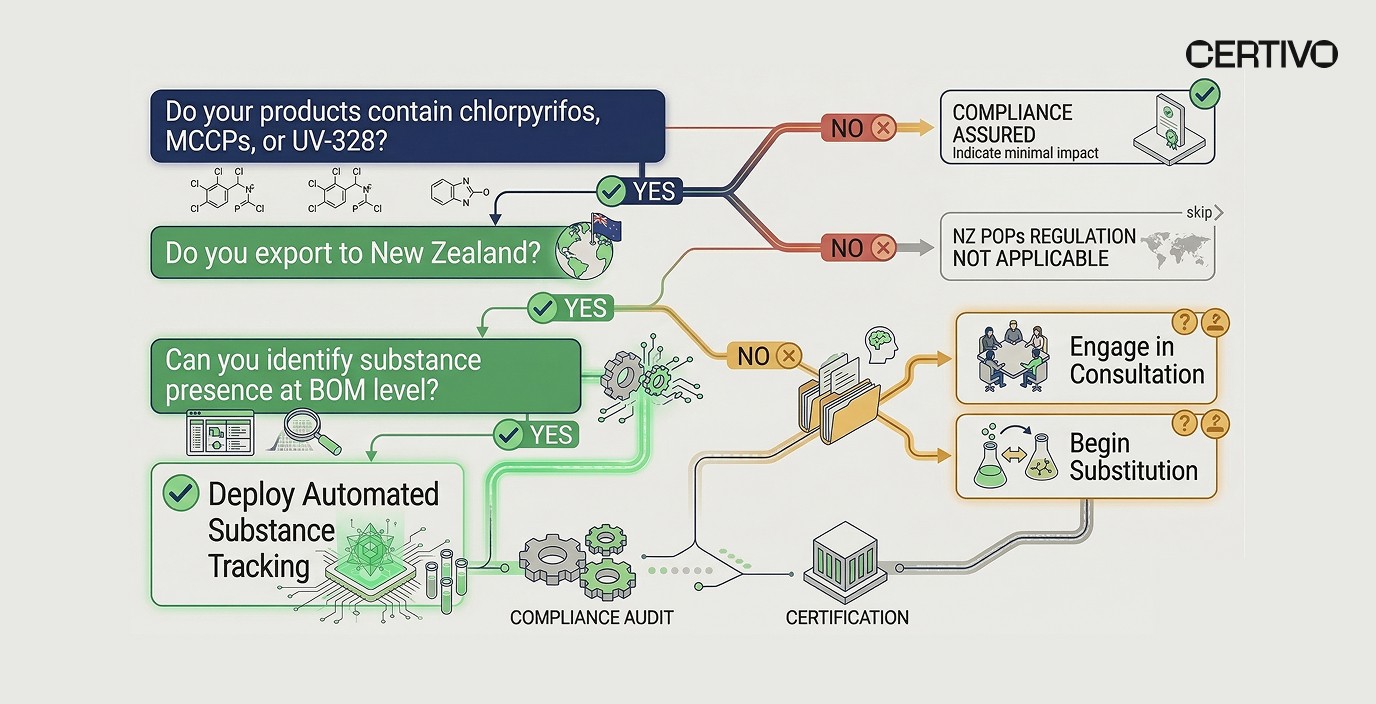
Let's connect the compliance challenges in this article to the technology that solves them. Every pain point above — substance discovery, supplier data gaps, multi-jurisdictional coordination, compressed timelines — has a corresponding AI-powered solution. For a practical comparison of manual versus AI-assisted workflows, see a compliance engineer's week with and without AI.
Compliance Pain Point | Manual Approach | AI-Native Solution |
|---|---|---|
"I don't know if my products contain restricted POPs" | Manual BOM review across spreadsheets | Automated BOM scanning flags chlorpyrifos, MCCPs, UV-328 at component level |
"My suppliers haven't provided substance data" | Email-based outreach with no tracking | Centralized supplier portals with automated questionnaires, response tracking, and gap flagging |
"I need to track NZ, EU, and other POPs restrictions simultaneously" | Separate tracking per jurisdiction | Cross-jurisdictional regulatory mapping aligned across frameworks |
"I don't know when consultation deadlines or final rules publish" | Manual monitoring of government websites | Regulatory horizon scanning with automated alerts on status changes |
"My supplier certificates are in PDFs I can't search" | Manual document review | AI document parsing extracts substance data from SDS, certificates, and declarations |
For compliance directors asking "how do I automate POPs substance tracking across my supply chain" — this is the answer. AI-native compliance platforms eliminate the manual bottleneck that makes substance discovery slow, expensive, and unreliable. For the complete capability overview, see AI tools for compliance management: the complete guide.
Organizations managing POPs alongside PFAS, REACH, and RoHS should also explore how AI in supply chain compliance management consolidates multi-framework substance tracking into a single system of record.
IT and systems leaders evaluating compliance infrastructure should act before the December 2026 restriction — deploying a platform under deadline pressure costs significantly more than proactive implementation. For teams questioning whether compliance automation should come before or alongside ERP/PLM, see why compliance automation is the first step in digital transformation.
10. Frequently Asked Questions (FAQs)
Q1: Are the New Zealand POPs restrictions already in effect?
No. The restrictions are currently proposed and under public consultation. For chlorpyrifos, the initial restriction is December 16, 2026, with a full phase-out by July 8, 2027. MCCPs have a proposed initial restriction of December 16, 2026, but the full phase-out date is pending. UV-328 timelines are entirely under consultation. Organizations should monitor the New Zealand EPA for final confirmation. Staying audit-ready across regulatory frameworks ensures teams are prepared regardless of when final dates are confirmed.
Q2: How do I find out if my products contain chlorpyrifos, MCCPs, or UV-328?
Start by reviewing product BOMs, raw material specifications, and supplier safety data sheets. Issue structured substance data requests to all suppliers for the specific CAS numbers associated with these chemicals. Manual approaches work for small product portfolios, but organizations managing hundreds of products and dozens of suppliers need automated materials and environmental compliance solutions that scan BOMs and aggregate supplier data at scale.
Q3: How do New Zealand's POPs restrictions relate to EU POPs regulation?
Both are driven by the Stockholm Convention. When a substance is listed under the Convention, party nations implement domestic restrictions. The EU has already adopted restrictions on chlorpyrifos, MCCPs, and UV-328 through its own POPs regulation. Companies exporting to both regions should coordinate compliance responses to avoid duplicated effort. See the EU POPs and digital product passport update for EU-specific details.
Q4: Can manufacturers still influence the final restriction terms through consultation?
Yes — the consultation is specifically designed for stakeholder input. Manufacturers can submit technical evidence on alternative availability, sector-specific challenges, and required transition timelines. This input can influence final phase-out dates, potential exemptions, and concentration thresholds for MCCPs and UV-328. Procurement and supply chain leaders should contribute supply chain impact data to strengthen these submissions.
Q5: What is the most urgent action I should take right now?
Screen your product BOMs and supply chain for chlorpyrifos, MCCPs, and UV-328. If you cannot answer "do my products contain these substances?" with documented evidence today, that is your highest priority. Certivo's rapid risk assessment can help you map your global regulatory exposure quickly and identify where these substances may be hiding in your supply chain.
11. Executive Conclusion
New Zealand's proposed POPs restrictions on chlorpyrifos, MCCPs, and UV-328 are not isolated events — they are the latest national implementation of Stockholm Convention obligations that will cascade across every jurisdiction in the coming years. For manufacturers, the New Zealand POPs restrictions create a simple but urgent question: do you know where these substances are in your products and supply chain?
If the answer is no — or "probably not" — that is the compliance gap that must be closed before December 2026. The chlorpyrifos phase-out by July 2027 leaves no room for discovery delays. MCCPs and UV-328 will follow on timelines that are still being shaped by the consultation process your organization should be participating in.
The organizations that will navigate this transition successfully are the ones that have substance-level visibility across their BOMs and supply chains, automated supplier data collection that doesn't depend on email follow-ups, and regulatory monitoring that alerts them when final dates are confirmed. The ones that don't have this infrastructure will face market access loss, inventory write-offs, and customer disruption.
📌 The official consultation details are available through the New Zealand EPA.
For manufacturers managing multi-jurisdictional POPs, PFAS, and chemical compliance obligations across New Zealand, the EU, and beyond — scalable compliance infrastructure isn't optional. It's the difference between orderly transition and costly disruption. To explore how AI-driven compliance platforms like Certivo support continuous regulatory readiness, connect with the Certivo team.
Lavanya
Lavanya is an accomplished Product Compliance Engineer with over four years of expertise in global environmental and regulatory frameworks, including REACH, RoHS, Proposition 65, POPs, TSCA, PFAS, CMRT, FMD, and IMDS. A graduate in Chemical Engineering from the KLE Institute, she combines strong technical knowledge with practical compliance management skills across diverse and complex product portfolios.
She has extensive experience in product compliance engineering, ensuring that materials, components, and finished goods consistently meet evolving international regulatory requirements. Her expertise spans BOM analysis, material risk assessments, supplier declaration management, and test report validation to guarantee conformity. Lavanya also plays a key role in design-for-compliance initiatives, guiding engineering teams on regulatory considerations early in the product lifecycle to reduce risks and streamline market access.
Her contributions further extend to compliance documentation, certification readiness, and preparation of customer deliverables, ensuring transparency and accuracy for global stakeholders. She is adept at leveraging compliance tools and databases to efficiently track regulatory changes and implement proactive risk mitigation strategies.
Recognized for her attention to detail, regulatory foresight, and collaborative approach, Lavanya contributes significantly to maintaining product compliance, safeguarding brand integrity, and advancing sustainability goals within dynamic, globally integrated manufacturing environments.