


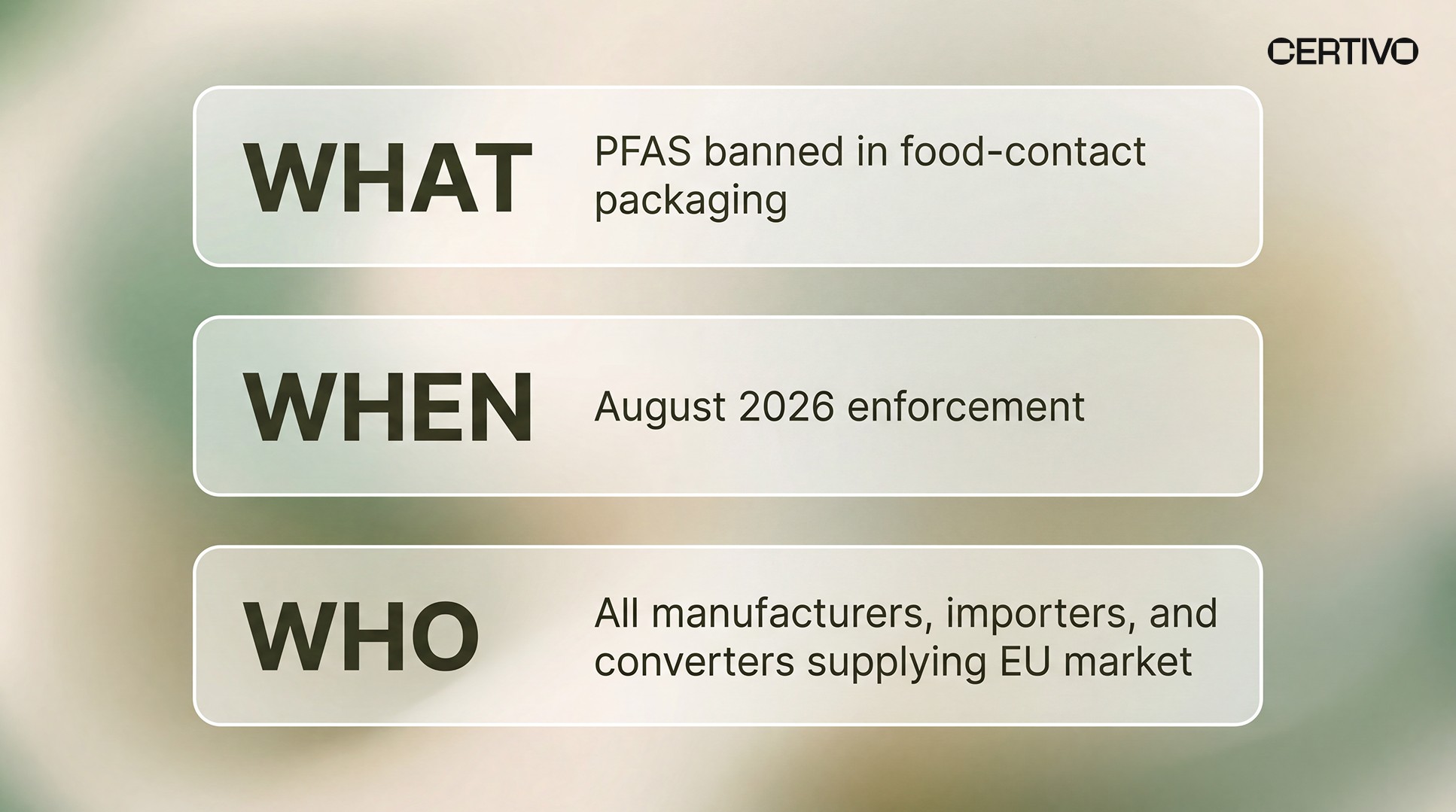
The EU Packaging and Packaging Waste Regulation (PPWR) introduces a binding PFAS ban in food-contact packaging with an August 2026 enforcement date. For manufacturers supplying food-contact materials into the European market, this is not a distant regulatory signal—it is an operational deadline requiring immediate action across formulation, supplier verification, testing, and documentation systems.
Most manufacturers are not ready. The challenge is not awareness—it is execution. Identifying PFAS presence across multi-tier supply chains, reformulating packaging materials, collecting verifiable supplier declarations, and maintaining continuous audit-ready documentation at scale demands infrastructure that spreadsheets and email cannot provide.
📌 Book a free compliance assessment to evaluate your PPWR PFAS readiness across products, packaging materials, and supplier networks before the August 2026 deadline.
This guide provides a regulation-first breakdown of the PPWR PFAS ban in food-contact packaging: what it requires, who it affects, what the thresholds are, and how to build a compliance-ready posture using PFAS and chemicals risk management systems designed for enterprise-scale manufacturing.
What Is the PPWR PFAS Ban in Food-Contact Packaging?
The PPWR is the EU's comprehensive overhaul of packaging rules, replacing the older Packaging and Packaging Waste Directive (94/62/EC) with a directly applicable regulation. Among its most operationally significant provisions is a restriction on per- and polyfluoroalkyl substances (PFAS) in packaging that comes into contact with food.
This ban targets the intentional use of PFAS in food-contact packaging materials—including coatings, barriers, and surface treatments commonly used to provide grease resistance, moisture barriers, and non-stick properties. The restriction applies to all packaging placed on the EU market, regardless of where it is manufactured.
For organizations managing materials and environmental compliance across global product portfolios, the PPWR PFAS ban creates a new compliance layer that intersects with existing REACH obligations, national PFAS restrictions, and customer-specific requirements.
⚠ This is a market-access requirement. Non-compliant packaging cannot be legally placed on the EU market after enforcement begins.
PPWR PFAS ban food-contact packaging 2026 deadline overview for manufacturers
Click on image to view full
Legal Scope and Regulatory Framework
The PPWR was adopted as an EU Regulation, meaning it applies directly across all 27 EU member states without requiring national transposition. The PFAS restriction within the PPWR specifically targets:
✓ Intentionally added PFAS in food-contact packaging materials
✓ All forms of food-contact packaging — primary, secondary, and tertiary where food contact occurs
✓ All economic operators placing such packaging on the EU market — manufacturers, importers, converters, and brand owners
The regulation operates alongside the broader EU chemicals framework. Manufacturers already managing REACH compliance and RoHS obligations must now add PPWR-specific PFAS restrictions to their regulatory tracking systems.
Based on currently available regulatory guidance, the PPWR PFAS ban is enforceable from August 2026. Compliance teams should treat this as a hard cutoff—not a transition period.
PFAS Thresholds and Substance Requirements
The PPWR PFAS ban in food-contact packaging prohibits the intentional addition of PFAS to packaging materials. Key technical parameters include:
Parameter | Requirement |
|---|---|
Scope | Intentionally added PFAS |
Material Types | Coatings, barriers, surface treatments, inks |
Packaging Function | Food-contact (grease resistance, moisture barrier) |
Enforcement Date | August 2026 |
Geographic Applicability | All 27 EU member states |
For compliance teams managing BOM substance and threshold management across packaging specifications, this means:
Every food-contact packaging component must be evaluated for intentional PFAS use
Supplier declarations must explicitly confirm PFAS-free status for covered materials
Testing protocols must be capable of detecting PFAS at relevant thresholds
Historical formulation data must be reviewed for legacy PFAS-containing materials
The challenge is that PFAS encompasses over 12,000 individual substances. Determining whether a packaging material contains intentionally added PFAS requires substance-level visibility that most manual compliance systems cannot provide.
For a comprehensive view of PFAS regulatory developments, see Certivo's global PFAS regulations master guide.
Which Industries and Product Categories Are Affected?
The PPWR PFAS ban in food-contact packaging affects any manufacturer, converter, or importer whose products include packaging that contacts food. Affected sectors include:
📊 Food & Beverage Packaging — Wraps, trays, cups, bowls, bags, and containers with grease-resistant or moisture-barrier coatings
📊 Consumer Goods & Retail — Private-label and branded food products with PFAS-treated packaging, relevant to consumer goods manufacturers
📊 Quick-Service Restaurant Supply Chains — Takeaway containers, wrappers, and paper-based food packaging
📊 Chemical Manufacturing — Companies producing PFAS-based coatings and barrier treatments supplied to converters, relevant to chemical manufacturers
📊 Electronics & Industrial Manufacturers — Where food-contact packaging is used for component shipping or secondary packaging in mixed-product facilities
Any organization exporting packaged food products or food-contact packaging materials into the EU must verify PFAS-free status across the full packaging bill of materials.
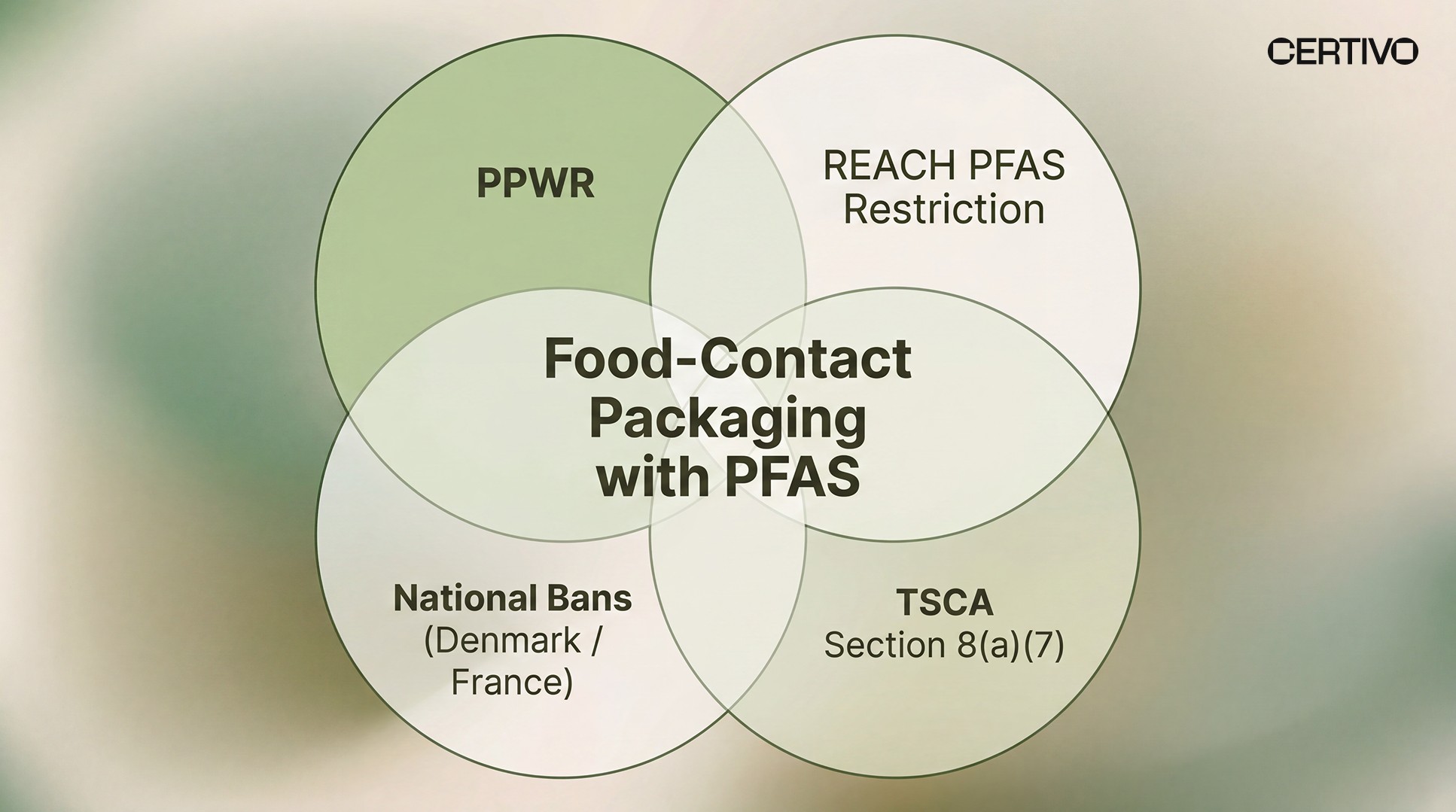
How Does the PPWR PFAS Ban Interact with REACH and Other Frameworks?
The PPWR PFAS ban does not exist in isolation. It intersects with multiple regulatory frameworks that manufacturers may already be tracking:
Framework | Overlap with PPWR PFAS Ban |
|---|---|
REACH | ECHA's universal PFAS restriction proposal covers broader uses; PPWR is sector-specific and earlier |
EU Food Contact Materials Regulation | Existing FCM rules govern migration limits; PPWR adds an outright PFAS ban |
National PFAS Bans (Denmark, France) | Some member states already restrict PFAS in food packaging; PPWR harmonizes at EU level |
TSCA (US) | EPA PFAS reporting under Section 8(a)(7) creates parallel US obligations |
Manufacturers operating across jurisdictions need regulatory intelligence and horizon scanning capabilities that map overlapping requirements to specific products and packaging components. Without this, compliance teams risk duplicating effort or—worse—missing jurisdiction-specific requirements that the PPWR alone does not cover.
For manufacturers already managing US PFAS obligations, see how Certivo handles TSCA PFAS reporting automation.
PPWR PFAS ban regulatory overlap with REACH TSCA and national restrictions
Click on image to view full
Reporting, Documentation, and Data Challenges for Manufacturers
The PPWR PFAS ban in food-contact packaging creates specific documentation and data management challenges:
Supplier Declaration Gaps
Most packaging suppliers have not historically been asked to declare PFAS-free status at the substance level. Existing supplier declarations may cover RoHS or REACH SVHC lists but not the full PFAS family. Manufacturers must issue new, targeted data requests through standardized supplier questionnaire frameworks that explicitly address PFAS in food-contact applications.
Multi-Tier Visibility
PFAS may be introduced at any tier—raw material suppliers, coating manufacturers, converters, or co-packers. Achieving multi-tier supply chain transparency for PFAS-free verification requires data collection far beyond Tier 1.
Testing and Analytical Verification
Supplier self-declarations alone may not satisfy auditor or customer requirements. Analytical testing (e.g., total organic fluorine testing) may be needed for high-risk materials. Managing test reports, certificates, and supplier evidence at scale requires AI document parsing and certificate validation infrastructure.
Version Control and Audit Trails
Packaging formulations change. A material that was PFAS-free last year may not be today if a supplier changed coatings or barrier treatments. Continuous audit-ready documentation systems must track formulation changes and re-validate compliance continuously.
📌 Struggling to collect PFAS-free declarations from packaging suppliers? Map your regulatory exposure in 60 seconds with Certivo's rapid risk assessment tool.
Compliance Risks, Penalties, and Enforcement Exposure
Non-compliance with the PPWR PFAS ban carries material consequences:
⚠ Market Access Denial — Non-compliant food-contact packaging cannot legally be placed on the EU market. This is a hard barrier, not a labeling issue.
⚠ Product Recalls and Withdrawal — Enforcement authorities in EU member states can mandate recall of non-compliant packaging already on the market.
⚠ Financial Penalties — Penalties are determined at the member state level but are expected to be proportionate and dissuasive under the PPWR framework.
⚠ Customer and Retailer Requirements — Major EU retailers and food brands are already imposing PFAS-free packaging requirements ahead of regulatory deadlines. Non-compliance risks supplier disqualification.
⚠ Reputational Exposure — PFAS is among the most publicly scrutinized chemical classes. Non-compliance creates ESG and investor risk.
Organizations maintaining centralized compliance data backbone infrastructure are better positioned to demonstrate due diligence and respond to enforcement inquiries with traceable, auditable records.
Supply Chain and Operational Impact
The PPWR PFAS ban forces operational changes across the packaging supply chain:
Upstream Impact
Packaging converters must reformulate or source PFAS-free barrier materials
Chemical suppliers must develop and qualify alternative coatings
Raw material suppliers must provide verifiable PFAS-free declarations
Downstream Impact
Brand owners must verify that all food-contact packaging meets PPWR requirements before EU market placement
Retailers may impose pre-compliance deadlines ahead of August 2026
Customer trust centers and self-service reporting must be updated to reflect PFAS-free packaging status
Operational Disruption Risks
Reformulation of packaging materials is not instantaneous. Alternative barrier technologies (e.g., aqueous coatings, bio-based barriers) require qualification testing, shelf-life validation, and production-line adjustments. Manufacturers that delay action risk production holds and shipment delays at the August 2026 cutoff.
For organizations managing PFAS compliance across broader product portfolios, see how Certivo automates PFAS compliance across multi-tier supply chains.
What Must Manufacturers Have Ready by August 2026?
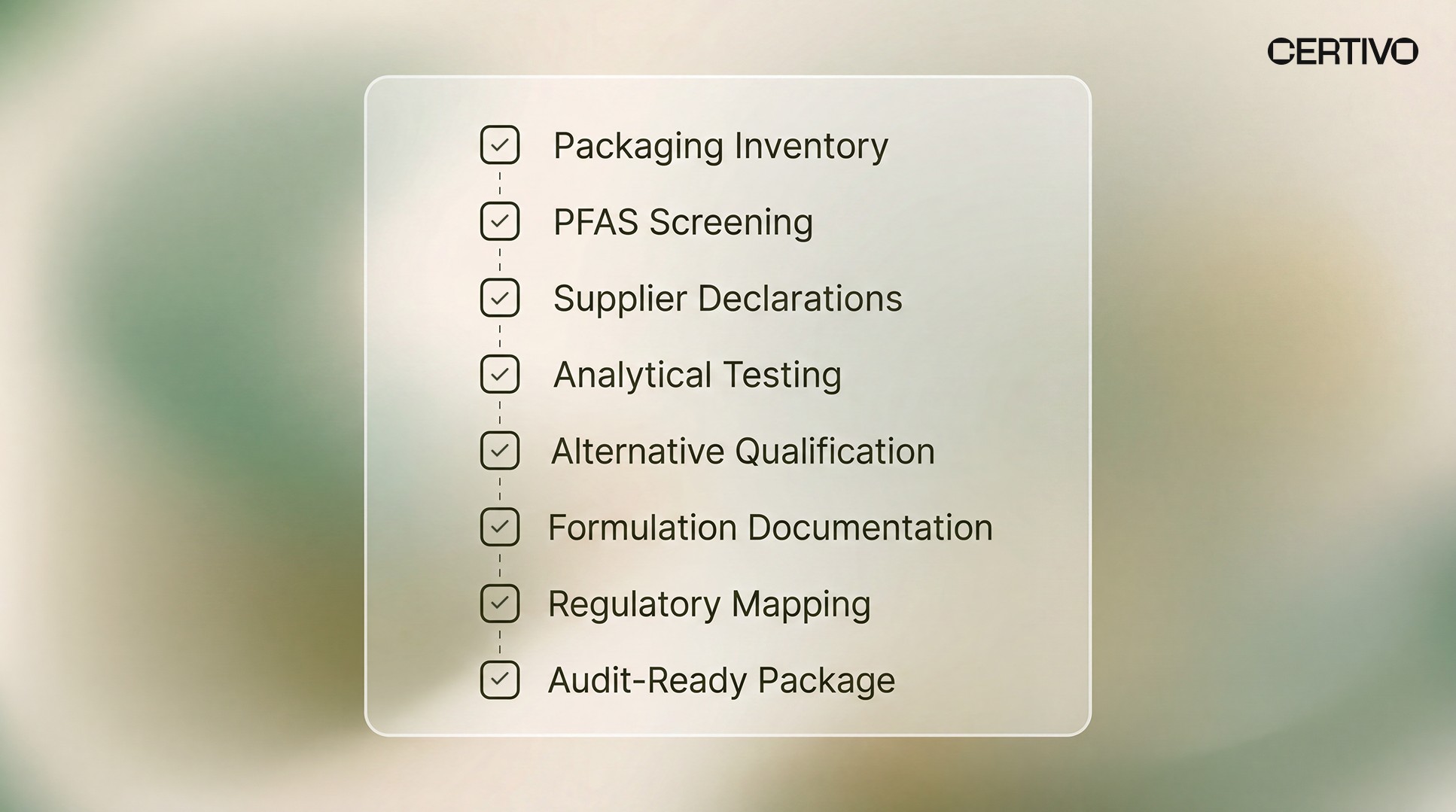
A compliance preparation checklist for the PPWR PFAS ban in food-contact packaging:
✅ 1. Packaging Material Inventory — Complete inventory of all food-contact packaging materials, including coatings, inks, adhesives, and barrier treatments.
✅ 2. PFAS Screening — Substance-level screening of all food-contact packaging components for intentionally added PFAS. Prioritize high-risk materials (grease-resistant papers, molded fiber, coated boards).
✅ 3. Supplier Declarations — Collect explicit PFAS-free declarations from all packaging material suppliers through supplier self-service compliance portals.
✅ 4. Analytical Testing Program — Establish total organic fluorine (TOF) or targeted PFAS testing for high-risk materials where supplier declarations alone are insufficient.
✅ 5. Alternative Material Qualification — Identify, test, and qualify PFAS-free alternative barrier and coating materials. Validate performance (grease resistance, moisture barrier, shelf life).
✅ 6. Formulation Change Documentation — Document all reformulations with full traceability from the old formulation to the PFAS-free replacement.
✅ 7. Regulatory Mapping — Map PPWR PFAS requirements alongside REACH, national PFAS bans, and customer-specific requirements to avoid duplicate effort.
✅ 8. Audit-Ready Evidence Package — Compile all supplier declarations, test reports, formulation records, and compliance assessments into a centralized, auditable system.
PPWR PFAS food-contact packaging compliance checklist for manufacturers 2026
Click on image to view full
How AI Helps Manufacturers Manage PPWR PFAS Compliance at Scale
Manual compliance processes cannot keep pace with the PPWR PFAS ban's requirements—particularly for manufacturers managing thousands of packaging SKUs across hundreds of suppliers.
Automated Supplier Data Collection
Certivo's automated supplier data collection portals enable packaging suppliers to submit PFAS-free declarations, test reports, and formulation data directly. Built-in validation ensures submissions are complete and current, eliminating the back-and-forth of email-based collection.
CORA-Powered Substance Screening
CORA-driven compliance intelligence screens packaging materials against the full PFAS substance family—over 12,000 compounds—flagging any intentionally added PFAS and cross-referencing against PPWR, REACH, and national restriction thresholds simultaneously.
BOM-Level Packaging Compliance
Certivo maps packaging material declarations to specific product BOMs, enabling compliance teams to answer the question: "Which of our products use food-contact packaging that may contain PFAS?" This BOM-level compliance intelligence is critical for prioritizing remediation efforts and customer audit response.
Regulatory Horizon Scanning
CORA's regulatory intelligence layer tracks PPWR implementation guidance, member state enforcement actions, and related PFAS regulatory developments globally. This ensures compliance teams receive alerts before changes take effect—shifting from reactive to continuous compliance monitoring and audit readiness.
For a broader view of AI in compliance, see AI Tools for Compliance Management: The Complete Guide.
Timeline and Future Enforcement Outlook
Date | Event |
|---|---|
2024 | PPWR adopted by EU co-legislators |
Q1–Q2 2026 | Manufacturer preparation window; retailer pre-compliance deadlines |
August 2026 | PPWR PFAS ban in food-contact packaging enforceable |
2027+ | ECHA universal PFAS restriction under REACH expected to broaden scope |
Ongoing | Member state enforcement actions; market surveillance intensifies |
Based on currently available regulatory guidance, the PPWR PFAS ban is the first binding EU-wide prohibition specifically targeting PFAS in food-contact packaging. The broader REACH PFAS restriction proposal—still under ECHA review—will extend restrictions to additional sectors, but the PPWR deadline arrives first.
Manufacturers that build PPWR compliance infrastructure now will be better positioned to absorb the broader REACH PFAS restriction when it arrives. Explore the EU REACH PFAS restriction proposal on Certivo for details.
Conclusion
The PPWR PFAS ban in food-contact packaging is a hard market-access requirement with an August 2026 enforcement date. It affects every manufacturer, importer, and converter placing food-contact packaging on the EU market. The requirement is clear: no intentionally added PFAS in food-contact packaging materials.
For compliance leaders at global manufacturers, the path forward requires substance-level packaging material visibility, verified supplier declarations, analytical testing programs for high-risk materials, and centralized audit-ready documentation. Organizations relying on manual, spreadsheet-based tracking face material risk of production holds, market access denial, and customer disqualification at the deadline.
Investing in AI-native compliance automation, PFAS and chemicals risk management platforms, and supplier self-service compliance portals is the most effective strategy for achieving and maintaining PPWR PFAS compliance without proportional increases in compliance headcount.
📌 Book a demo to see how Certivo automates PPWR PFAS compliance across your food-contact packaging portfolio and multi-tier supplier network—or get a free compliance risk assessment to understand your current PFAS exposure before August 2026.
FAQs
1. What types of packaging materials are most at risk under the PPWR PFAS ban?
Grease-resistant papers, molded fiber containers, coated paperboard, and any food-contact packaging using fluorinated coatings or barrier treatments are highest risk. Certivo's CORA intelligence screens packaging BOMs against the full PFAS substance family to identify affected materials before the deadline.
2. How can manufacturers verify that their packaging suppliers are PFAS-free?
Manufacturers should collect explicit PFAS-free supplier declarations, supported by total organic fluorine testing where risk is high. Certivo's supplier self-service portals automate this collection at scale with built-in validation and version tracking.
3. Does the PPWR PFAS ban apply to packaging manufactured outside the EU?
Yes. The ban applies to all food-contact packaging placed on the EU market, regardless of where it is manufactured. Importers and brand owners bear responsibility for compliance. CORA-powered regulatory intelligence maps these obligations across supply chains automatically.
4. How does the PPWR PFAS ban differ from the REACH universal PFAS restriction?
The PPWR targets intentionally added PFAS specifically in food-contact packaging and enforces from August 2026. The REACH PFAS restriction is broader in scope but is still under ECHA review and expected later. Certivo tracks both frameworks and maps overlapping obligations to avoid compliance gaps.
5. What happens if a manufacturer discovers PFAS in their food-contact packaging after August 2026?
Non-compliant packaging must be withdrawn from the EU market. Enforcement authorities can mandate product recalls and impose financial penalties at the member state level. Maintaining continuous compliance monitoring through platforms like Certivo ensures that formulation changes or supplier substitutions are flagged before they create market-access risk.
Hari prasanth
Hariprasanth is a Chemical Compliance Specialist with nearly four years of experience, underpinned by a degree in Chemical Engineering. He brings in-depth expertise in global product compliance, working across key regulations such as REACH, RoHS, TSCA, Proposition 65, POPs, FMD, and PFCMRT.