


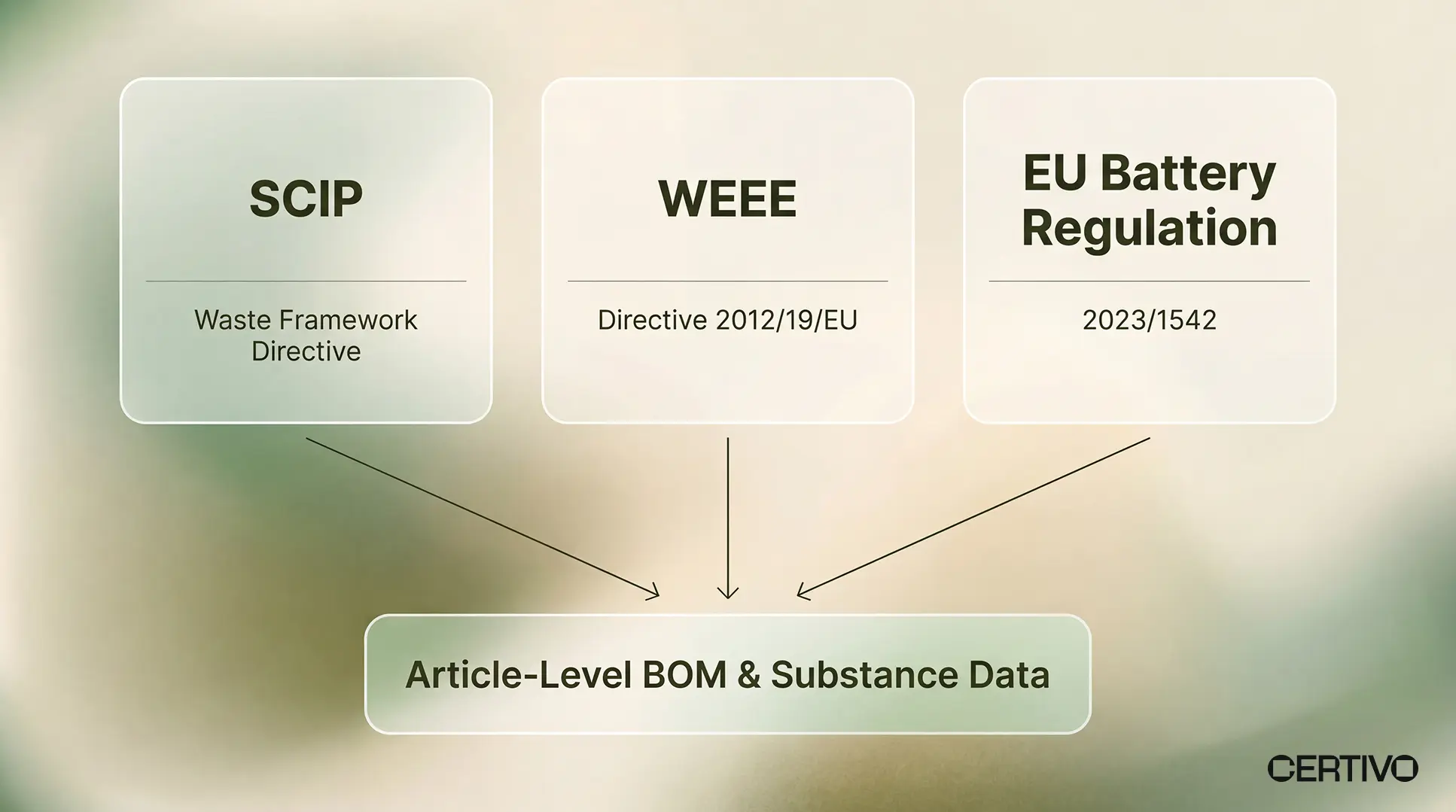
Three EU regulatory frameworks — SCIP database submissions under the Waste Framework Directive, WEEE Directive 2012/19/EU obligations, and EU Battery Regulation 2023/1542 requirements — converge on one shared problem: article-level substance and product data that manufacturers must report accurately, repeatedly, and across different submission systems. The underlying BOM and material data is often identical. Yet most compliance teams process each framework as a separate project, tripling workload without improving data quality.
For compliance directors, product stewardship leads, and operations teams managing SCIP database submission software and article-level reporting workflows, this guide breaks down each framework's requirements, identifies where they overlap, and outlines how specialized substance reporting solutions and AI-native compliance automation reduce the burden of multi-framework reporting.
📌 Book a free compliance assessment to evaluate your current SCIP, WEEE, and EU Battery Regulation reporting readiness across products and supply chains.
Why Article-Level Reporting Is the Central Challenge
The common thread connecting SCIP, WEEE, and the EU Battery Regulation is the requirement to report at the article level — not the finished product level, not the facility level, but the individual article as defined under REACH Article 3(3).
This distinction matters because:
⚠ The 0.1% w/w SVHC threshold under SCIP is calculated per article, not per product or assembly. A finished product containing multiple articles requires separate SVHC assessments for each component article. This is one of the most misunderstood compliance rules in the industry.
⚠ WEEE obligations attach to electrical and electronic equipment categories, but compliance data — substance content, recyclability, hazardous material declarations — must be traceable to specific components and sub-assemblies.
⚠ The EU Battery Regulation 2023/1542 introduces digital battery passports that require BOM-level material mapping and substance traceability down to raw material origin.
Organizations relying on spreadsheets and email to manage these three frameworks face exponential complexity. Each regulatory update — a new SVHC added to the REACH Candidate List, a revised WEEE category threshold, a new Battery Regulation milestone — triggers a cascade of data re-collection and re-submission that manual processes cannot absorb.
For a broader view of how substance-level compliance works, see the Complete Guide to Product Compliance Management on Certivo.
SCIP WEEE EU Battery Regulation article-level reporting data convergence diagram
Click on image to view full
How Do Global Manufacturers Manage SCIP Database Submissions Efficiently?
The SCIP database, maintained by ECHA, is the EU's centralized repository for information on Substances of Concern in articles, as supplied. The legal basis is Waste Framework Directive Article 9(1)(i), as amended by Directive 2018/851.
Who Must Submit
Any supplier of an article placed on the EU market that contains a Candidate List SVHC at a concentration above 0.1% weight by weight (w/w) must submit a SCIP notification. This includes:
EU manufacturers
EU importers
EU distributors and retailers (in specific circumstances)
What Makes SCIP Submission Complex
✓ IUCLID format requirement — All SCIP submissions must be in IUCLID format, the same data structure used for REACH registrations. Most compliance teams are not IUCLID-native, creating a format conversion bottleneck.
✓ Article-level granularity — A single finished product (e.g., a motor assembly) may contain dozens of individual articles under REACH Article 3(3), each requiring its own SVHC assessment and SCIP notification if the threshold is exceeded.
✓ Complex object handling — Multi-level article hierarchies (assemblies containing sub-assemblies containing individual articles) must be structured correctly in the submission. Errors in hierarchy definition are among the most common rejection reasons.
✓ Candidate List updates — Each time ECHA adds new substances to the REACH Candidate List, manufacturers must reassess their entire article portfolio against the updated list and submit new or amended SCIP notifications.
ECHA enforcement has intensified since 2024, with cross-referencing of SCIP submissions against import data becoming standard practice. Gaps between what is imported and what is declared in SCIP create direct enforcement exposure.
Organizations using centralized compliance data backbone infrastructure can automate the mapping from BOM substance data to IUCLID-formatted SCIP dossiers — eliminating the manual reformatting step that consumes weeks of compliance engineering time.
For a deeper look at SVHC obligations, see Certivo's guide on REACH SVHC and Annex XVII changes.
The Best Systems for Managing WEEE Compliance for Electronics Manufacturers
The Waste Electrical and Electronic Equipment Directive (WEEE — Directive 2012/19/EU) requires producers of electrical and electronic equipment to finance the collection, treatment, recovery, and disposal of WEEE.
The 27-Register Problem
WEEE is transposed nationally across all EU member states, meaning manufacturers must comply with 27 different national registration systems, each with:
Different fee structures
Different reporting cadences (monthly, quarterly, annually)
Different product category definitions and thresholds
Different Producer Responsibility Organization (PRO) requirements
This fragmentation is the single largest operational pain point in WEEE compliance. A manufacturer selling into 15 EU markets must maintain 15 separate registrations, file 15 sets of reports on different schedules, and pay 15 different fee structures.
What WEEE Compliance Software Must Handle
📊 Multi-register management — Tracking registration status, renewal dates, and reporting deadlines across all target markets
📊 Product categorization — Mapping products to the correct WEEE equipment categories per member state (categories may differ in how they interpret the directive)
📊 Volume reporting — Calculating placed-on-market quantities per country, per category, per reporting period
📊 EPR fee management — Tracking and reconciling Extended Producer Responsibility fees across PROs and jurisdictions
For electronics manufacturers managing large product portfolios across the EU, integrating WEEE reporting with SCIP submissions through a unified multi-jurisdiction EHS and ESG management platform eliminates the duplication of article-level data entry that occurs when each framework is managed separately.
Certivo's approach to WEEE compliance centralizes product registration data, automates placed-on-market volume calculations, and maps products to national category obligations through CORA-driven compliance intelligence.
See also: The Complete WEEE Compliance Guide for a detailed regulatory breakdown.
📌 Managing SCIP submissions and WEEE registrations across 27 markets? See how Certivo consolidates article-level reporting → Map your regulatory exposure in 60 seconds
Tracking Battery and Accumulator Regulations Worldwide: EU Battery Regulation 2023/1542 and Beyond
The EU Battery Regulation 2023/1542 repealed the 2006 Battery Directive (2006/66/EC) and introduced significantly expanded obligations for manufacturers, importers, and distributors of batteries placed on the EU market.
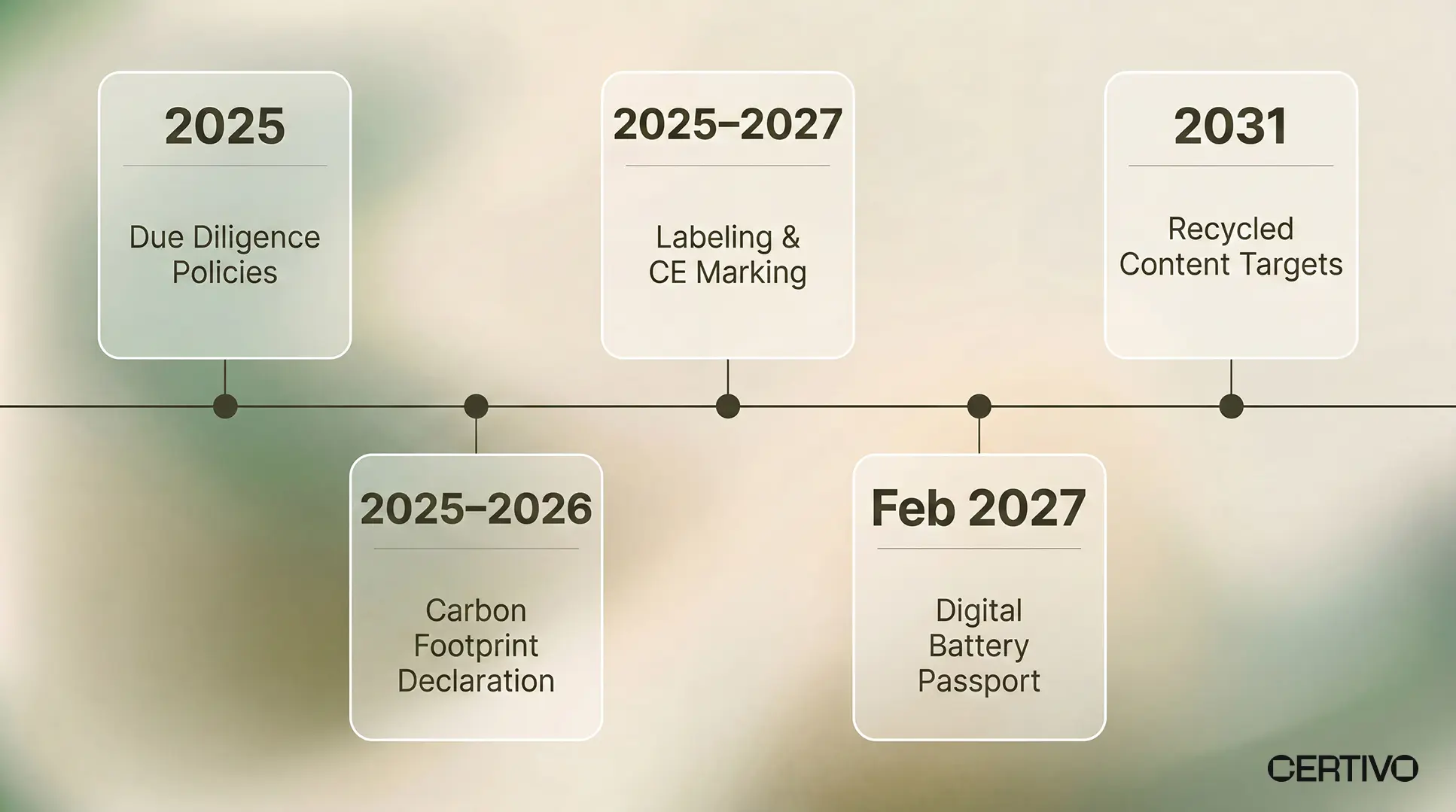
Key Dated Obligations
Milestone | Date | Requirement |
|---|---|---|
Due diligence policies | Mid-2025 onward | Economic operators must establish supply chain due diligence policies for raw materials |
Carbon footprint declaration | Phased from 2025 | Required for EV and industrial batteries above 2 kWh |
Labeling and CE marking | 2025–2027 | Phased labeling requirements including QR codes and battery chemistry identifiers |
Digital battery passport | February 2027 | Mandatory for LMT, industrial, and EV batteries — must contain BOM-level substance data, recycled content, carbon footprint |
Recycled content targets | 2031 onward | Minimum recycled content thresholds for cobalt, lithium, nickel, lead |
⚠ Note: Verify exact milestone dates at the time of publication, as implementing acts and delegated acts may adjust specific deadlines.
Digital Battery Passport Requirements
The digital battery passport is the most operationally complex requirement. It demands:
BOM-level substance and material data traceable to raw material origin
Carbon footprint data per battery model
Recycled content percentages for specified materials
Supply chain due diligence documentation
End-of-life and recyclability information
This is a digital passport and traceability system requirement that goes far beyond traditional compliance declarations. It requires multi-tier supply chain transparency — not just Tier 1 supplier data, but traceability through smelters, refiners, and raw material sources.
For manufacturers in automotive and energy infrastructure, the digital battery passport intersects directly with conflict minerals reporting obligations and the EU Battery Regulation framework on Certivo.
CORA's regulatory intelligence layer tracks each dated obligation under 2023/1542, alerting compliance teams to upcoming milestones and mapping them against current data readiness — enabling a shift from reactive compliance toward continuous audit-ready documentation.
EU Battery Regulation 2023/1542 compliance timeline milestones through 2031
Click on image to view full
Managing Compliance of Sub-Assemblies Shared Across Many Products
A motor controller sub-assembly used across 40 different finished products must maintain a single, authoritative compliance record that propagates across all parent BOMs. When a substance status changes — for example, a new SVHC listing affecting a component within that sub-assembly — the change must cascade to all 40 products simultaneously.
Manual systems fail here because they treat each product independently. A shared sub-assembly updated in one product's compliance file may remain outdated in 39 others.
Certivo's BOM-level compliance intelligence recognizes shared sub-assemblies and propagates compliance status changes across all product families automatically. CORA identifies affected BOMs when substance lists change, eliminating the manual reconciliation that creates audit gaps.
Mapping Compliance Requirements to HS Codes and Product Categories
Different EU regulations use different product classification systems. WEEE uses equipment categories defined in Directive 2012/19/EU. The EU Battery Regulation classifies by battery type (portable, LMT, industrial, EV, SLI). Customs authorities use HS codes.
Mapping a single product to the correct obligation set across SCIP, WEEE, and the Battery Regulation requires cross-referencing multiple classification systems. This is where regulatory intelligence and horizon scanning tools add measurable value — by automatically mapping product master data to regulatory obligations based on HS code, product category, and destination market.
For a broader look at how compliance maps to trade classification, explore trade and customs compliance solutions on Certivo.
EU Packaging and Packaging Waste Regulation: What Manufacturers Must Prepare for by August 2026
The EU Packaging and Packaging Waste Regulation (PPWR — Regulation EU 2025/40) introduces binding requirements on packaging sustainability, recyclability, and hazardous substance restrictions across the EU market. General application begins 12 August 2026.
Key Requirements Under PPWR
✓ Mandatory recyclability and reusability targets — All packaging placed on the EU market must meet recyclability criteria, with phased reuse targets by packaging type
✓ Reduction of excess and unnecessary packaging — Enforceable limits on void space and packaging-to-product ratios
✓ Restrictions on hazardous substances in packaging materials — This intersects directly with REACH and PFAS restrictions for packaging that contacts food or consumer products
✓ Labeling and information requirements — New mandatory labeling including material composition, recycling instructions, and sortability information
✓ Expanded Extended Producer Responsibility (EPR) — Strengthened EPR obligations with eco-modulation of fees based on recyclability and recycled content
Industries Affected
Industry | Impact Area |
|---|---|
Manufacturing & Industrial | Packaging producers, raw material suppliers |
Consumer Goods | FMCG, retail, food & beverage packaging |
E-commerce & Logistics | Shipping, transport, protective packaging |
Automotive & Electronics | Industrial and component packaging |
For manufacturers managing PFAS restrictions in packaging, the PPWR adds another layer of obligation that must be tracked alongside SCIP, WEEE, and Battery Regulation requirements. Certivo's materials and environmental compliance solution supports centralized tracking of packaging obligations integrated with article-level substance data.
The European Commission packaging waste page provides the official regulatory text and implementation guidance.
Reporting, Documentation, and Data Challenges Across SCIP, WEEE, and Battery Frameworks
The Triple-Processing Problem
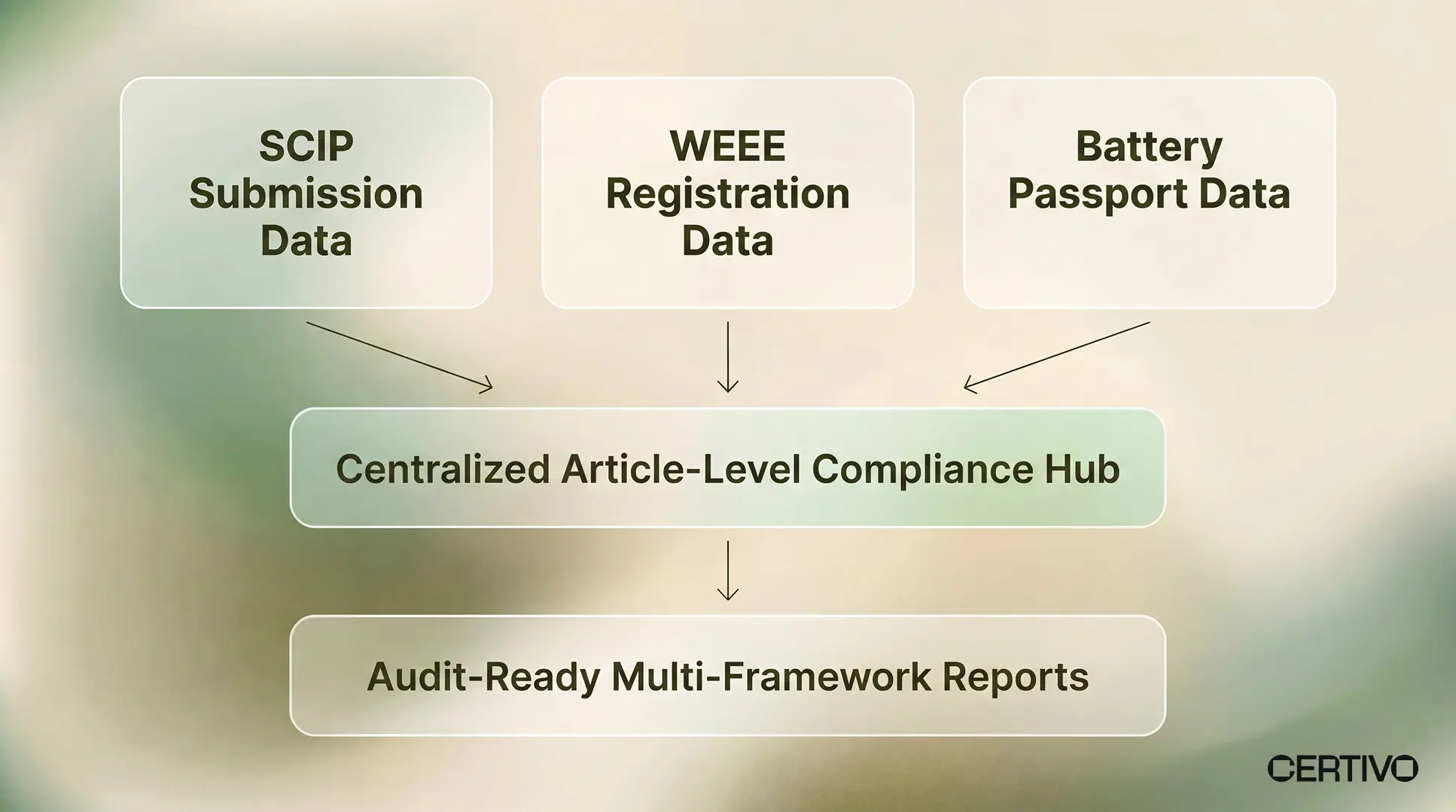
The core data challenge is that SCIP, WEEE, and the EU Battery Regulation all require overlapping article-level data — substance content, material composition, supplier declarations, product classifications — but each framework demands it in a different format, through a different submission system, on a different schedule.
Framework | Submission System | Format | Frequency |
|---|---|---|---|
SCIP | ECHA SCIP portal | IUCLID | Per article/update |
WEEE | 27 national registers | Varies by member state | Monthly/quarterly/annually |
EU Battery Regulation | Digital battery passport infrastructure (TBD) | Structured digital format | Continuous/per battery model |
Specific Data Challenges
⚠ Supplier data gaps — Many suppliers cannot provide article-level substance data at the granularity required for SCIP submissions or battery passport content. Organizations need automated supplier data collection portals that guide suppliers through structured data requests.
⚠ Format conversion — Converting internal BOM data to IUCLID format for SCIP, national register formats for WEEE, and digital passport schemas for batteries requires specialized tooling. Manual conversion is error-prone and time-intensive.
⚠ Version control — When the REACH Candidate List is updated, SCIP submissions must be amended. When WEEE categories are revised, product registrations must be updated. When Battery Regulation implementing acts are published, passport schemas may change. Maintaining continuous compliance monitoring and audit readiness requires automated change detection and propagation.
⚠ Complex object structures — SCIP requires structured multi-level article hierarchies. Battery passports require BOM-level traceability. WEEE requires product-to-category mapping. These are three different structural representations of the same underlying product data.
For organizations managing supplier and contractor management programs, the data collection challenge is compounded by the need to collect the same underlying information once and deploy it across multiple regulatory submission systems.
Compliance Risks, Penalties, and Enforcement Exposure
SCIP: ECHA has increased cross-referencing of SCIP data against customs import data. Non-submission or incomplete submissions create direct enforcement exposure. National authorities can impose penalties under their transposition of the Waste Framework Directive. Incomplete SCIP dossiers are increasingly flagged during customer audits.
WEEE: Non-registration in a target market can result in product seizure at the border, sales bans, and financial penalties. PRO membership lapses or incorrect volume reporting trigger immediate compliance exposure.
EU Battery Regulation: Non-compliance with labeling, carbon footprint declaration, or digital battery passport requirements will prevent market access for battery products in the EU. Given the phased timeline, early non-compliance creates compounding risk as additional obligations activate.
PPWR: After August 12, 2026, packaging that does not meet recyclability, labeling, and substance restriction requirements cannot be legally placed on the EU market.
Organizations maintaining continuous audit-ready documentation across all four frameworks are better positioned to absorb regulatory updates without disruption.
Supply Chain and Operational Impact
Upstream
Tier 1 suppliers must provide article-level substance data for SCIP, WEEE-relevant declarations, and battery raw material traceability data
Smelters and refiners enter scope through Battery Regulation due diligence requirements
Packaging suppliers face new data obligations under PPWR
Standardized supplier questionnaire frameworks must be updated to capture data for all four frameworks simultaneously
Downstream
Customer audits increasingly demand evidence of SCIP submission, WEEE registration, and battery passport readiness
Customer trust centers and self-service reporting must present compliance status across multiple frameworks in a unified view
OEM customers in automotive and electronics expect real-time compliance visibility at the component and sub-assembly level
SCIP WEEE Battery Regulation centralized article-level compliance data flow
Click on image to view full
Timeline and Future Enforcement Outlook
Date | Framework | Event |
|---|---|---|
Ongoing | SCIP | Submissions required for all articles with SVHCs >0.1% w/w; ECHA intensifying enforcement |
Ongoing | WEEE | 27 national registers with varying deadlines; EPR obligations enforceable now |
Mid-2025 onward | Battery Reg | Due diligence policies required for economic operators |
2025–2027 | Battery Reg | Phased labeling and CE marking requirements |
12 August 2026 | PPWR | General application of packaging recyclability, labeling, and substance restrictions |
February 2027 | Battery Reg | Digital battery passport mandatory for LMT, industrial, and EV batteries |
2031 | Battery Reg | Recycled content targets enforceable |
Based on currently available regulatory guidance, the next REACH Candidate List update will trigger a new wave of SCIP submission amendments. Manufacturers should plan for quarterly reassessment cycles.
Strategic Compliance Preparation Checklist
✅ 1. Audit current SCIP submission status — verify all articles with SVHCs >0.1% w/w have been notified using current IUCLID format
✅ 2. Confirm WEEE registrations are active and current across all EU target markets — verify PRO memberships and reporting schedules
✅ 3. Map battery products against EU Battery Regulation obligation timeline — identify which products require digital battery passports by February 2027
✅ 4. Assess packaging portfolio against PPWR requirements — identify packaging that will not meet recyclability or substance restrictions by August 2026
✅ 5. Establish article-level data collection from suppliers using centralized supplier self-service portals — collect substance, material, and origin data once and deploy across all frameworks
✅ 6. Implement automated REACH Candidate List monitoring — ensure SCIP submissions are amended within defined timeframes when new SVHCs are listed
✅ 7. Define complex object structures for SCIP — verify multi-level article hierarchies are correctly modeled and pass ECHA validation
✅ 8. Integrate compliance data with PLM/ERP systems through an integrated PLM ERP compliance thread to enable design-for-compliance workflows
How AI Reduces Multi-Framework Article-Level Reporting Burden
Automated SCIP Dossier Generation
CORA-powered regulatory intelligence enables automated generation of IUCLID-formatted SCIP dossiers from existing BOM and substance data. Instead of manually reformatting data for each article, compliance teams can direct CORA to identify all articles in a product family containing SVHCs above 0.1% w/w and generate submission-ready dossier files — plus an exception report for articles with incomplete data.
Multi-Register WEEE Management
CORA auto-maps products to national WEEE category obligations across EU member states, calculates placed-on-market volumes per country, and tracks registration renewal dates. This replaces the spreadsheet-based multi-register tracking that consumes disproportionate compliance engineering hours.
Battery Passport Readiness
CORA tracks each dated obligation under EU Battery Regulation 2023/1542 and maps them against current data completeness. Where gaps exist — missing recycled content data, incomplete supply chain due diligence documentation, absent carbon footprint calculations — CORA generates targeted supplier data collection campaigns to close them before deadlines.
AI Document Parsing and Certificate Validation
Supplier-submitted documents — test reports, material declarations, certificates of conformance — arrive in inconsistent formats. AI document parsing and certificate validation extracts relevant substance, concentration, and compliance data from these documents automatically, normalizing it into a single structured format that can feed SCIP, WEEE, and battery passport submissions.
For a complete view of AI in compliance, see AI Tools for Compliance Management: The Complete Guide.
Executive Conclusion
SCIP, WEEE, the EU Battery Regulation 2023/1542, and the new PPWR (Regulation EU 2025/40) collectively represent the most intensive article-level reporting requirements in the history of EU product compliance. The 0.1% w/w SVHC threshold under SCIP, 27 different national WEEE registration systems, digital battery passports by February 2027, and PPWR packaging requirements from August 2026 — these are not separate compliance projects. They are one integrated data challenge that requires a unified, article-level approach.
Manufacturers that continue to process each framework independently will face escalating labor costs, audit exposure, and enforcement risk. Those that invest in SCIP database submission software, centralized article-level compliance infrastructure, and AI-native automation will absorb current and future EU reporting obligations without proportional increases in headcount.
📌 Book a demo to see how Certivo automates SCIP dossier generation, WEEE multi-register management, and digital battery passport readiness from a single article-level compliance hub — or get a free compliance risk assessment to evaluate your current multi-framework reporting posture.
FAQs
1. How does Certivo auto-generate SCIP IUCLID dossiers from existing BOM data?
Certivo maps article-level BOM substance data against the current REACH Candidate List, identifies articles exceeding the 0.1% w/w SVHC threshold, structures multi-level article hierarchies, and generates IUCLID-formatted dossier files ready for ECHA submission. CORA flags articles with incomplete supplier data for targeted follow-up.
2. Can Certivo handle the EU Battery Regulation's digital battery passport requirements for industrial and EV batteries?
Certivo tracks each dated obligation under Regulation 2023/1542 and maps data readiness against digital battery passport requirements — including BOM-level substance traceability, carbon footprint data, recycled content metrics, and supply chain due diligence documentation. CORA identifies data gaps and triggers automated supplier collection campaigns.
3. What is the most efficient way to manage WEEE registrations across multiple EU member states?
The most efficient approach is a centralized platform that auto-maps products to national WEEE category obligations, tracks registration status and renewal dates across all target markets, and calculates placed-on-market volumes per country and reporting period. Certivo provides this through its multi-jurisdiction compliance management infrastructure.
4. How do manufacturers track SCIP submission obligations when new SVHCs are added to the REACH Candidate List?
Each REACH Candidate List update requires reassessment of all articles in the product portfolio. CORA-driven compliance intelligence monitors Candidate List changes, automatically identifies affected articles and product families, and generates amended SCIP dossiers for submission. This eliminates the manual reassessment cycle that can take weeks using spreadsheet methods.
5. What platforms help consolidate environmental, health, safety, and product compliance data for EU market access?
Certivo consolidates SCIP, WEEE, EU Battery Regulation, PPWR, and related environmental compliance data into a single centralized compliance data backbone. Article-level substance data is entered once and deployed across multiple framework submissions, eliminating duplicate data collection and reducing inconsistency across regulatory filings.
Hari Prasanth
Hariprasanth is a Chemical Compliance Specialist with nearly four years of experience, underpinned by a degree in Chemical Engineering. He brings in-depth expertise in global product compliance, working across key regulations such as REACH, RoHS, TSCA, Proposition 65, POPs, FMD, and PFCMRT.
Hariprasanth specializes in reviewing technical documentation, validating supplier inputs, and ensuring that products consistently meet regulatory standards. He works closely with cross-functional teams and suppliers to collect accurate material data and deliver clear, audit-ready compliance reports that stand up to scrutiny.
Through his strong analytical skills and regulatory insight, Hariprasanth enables organizations to navigate evolving compliance challenges while aligning with sustainability initiatives in an increasingly dynamic regulatory environment.