


The United States Environmental Protection Agency (EPA) has extended the reporting deadlines under TSCA Section 8(a)(7), giving manufacturers and importers additional time to submit retrospective PFAS data. The new deadline for most companies is January 31, 2027, with small business importers of PFAS-containing articles receiving an extension to April 13, 2027.
This extension does not reduce the scope of what must be reported. It acknowledges the operational difficulty of tracing PFAS substances across multi-tier supply chains going back to January 1, 2011. For compliance leaders at global manufacturers, the extended timeline is preparation time — not relief from obligation.
📌 Book a free compliance assessment to understand your TSCA PFAS reporting exposure across products and supply chains before the 2027 deadline.
Why EPA Extended the TSCA PFAS Reporting Deadline
The original TSCA Section 8(a)(7) PFAS reporting deadlines proved operationally unachievable for a significant number of affected companies. The extension to January 31, 2027 reflects three structural challenges that manufacturers and importers reported:
✓ Supply chain traceability gaps — Many companies lack visibility into whether PFAS substances were present in imported articles, raw materials, or intermediate components over a 15-year lookback period.
✓ Supplier data collection complexity — Gathering PFAS-related information from multi-tier global suppliers requires structured data collection campaigns that cannot be completed in compressed timelines.
✓ Historical reporting obligations — The rule requires retrospective data back to January 1, 2011, which predates many companies' current compliance management systems and document retention practices.
The extension is procedural, not substantive. Every requirement under the original rule remains intact. Companies that have not begun preparation face compounding risk as the new deadline approaches.
For organizations tracking this alongside other PFAS frameworks, Certivo's PFAS regulatory framework page provides a consolidated view of federal and state-level obligations.
TSCA PFAS reporting deadline 2027 EPA extension for manufacturers
Click on image to view full

What TSCA Section 8(a)(7) Requires from Manufacturers
Under the Toxic Substances Control Act, Section 8(a)(7) mandates that any entity that has manufactured (including imported) PFAS substances or PFAS-containing articles at any point since January 1, 2011 must submit detailed retrospective reports to EPA.
Scope of "Manufacture"
⚠ Under TSCA, "manufacture" includes import. Any company that has imported articles containing PFAS — even as trace contaminants or functional coatings — is within scope. This includes:
Direct PFAS chemical manufacturers
Importers of PFAS-containing finished goods
Importers of components, sub-assemblies, or articles with PFAS coatings, treatments, or additives
Companies that used PFAS in manufacturing processes (e.g., mold release agents, anti-stick coatings)
The broad definition of "manufacture" under TSCA means that companies across electronics manufacturing, automotive supply chains, consumer goods, and medical devices are within scope — whether or not they directly handle PFAS chemicals.
Updated Reporting Deadlines for 2027
The EPA's updated timeline provides two distinct deadlines:
Category | Original Context | New Deadline |
|---|---|---|
Most manufacturers and importers | General reporting obligation | January 31, 2027 |
Small business importers of PFAS-containing articles | Extended accommodation | April 13, 2027 |
⚠ These are submission deadlines, not "start preparation" dates. The data required — covering PFAS chemical identities, production volumes, uses, exposure data, and disposal information across 15+ years — demands months of structured supplier engagement and internal data gathering.
Companies managing PFAS compliance alongside REACH, RoHS, and Prop 65 obligations should treat this as a parallel workstream within their centralized compliance data backbone rather than an isolated project.
Which Industries Must Report Under TSCA PFAS Rules
The scope of TSCA Section 8(a)(7) extends across virtually every manufacturing and import sector where PFAS substances have been used as functional chemicals, coatings, additives, or process aids.
📊 Electronics & Electrical Equipment — PFAS is present in circuit board coatings, wire insulation, semiconductor processing chemicals, and thermal management materials. See Certivo's guide on PFAS in electronics manufacturing.
📊 Automotive & Transportation — Fuel system seals, brake fluids, anti-corrosion coatings, and EV battery components frequently contain PFAS.
📊 Textiles, Apparel & Footwear — Water-repellent and stain-resistant treatments are common PFAS applications.
📊 Medical Devices & Healthcare Products — PFAS coatings on implants, tubing, and diagnostic equipment components.
📊 Food Packaging & Food Contact Materials — Grease-resistant coatings on packaging substrates.
📊 Chemicals & Plastics — Direct PFAS manufacturers and processors.
📊 Construction & Building Materials — Waterproofing membranes, roofing materials, and cable insulation.
📊 Industrial Manufacturing — Mold release agents, hydraulic fluids, and industrial coatings across industrial machinery and heavy equipment operations.
📊 Consumer Goods & Household Products — Non-stick cookware, cleaning products, and personal care items.
📊 Importers & Distributors — Any entity importing PFAS-containing articles into the United States.
What Data Must Be Submitted to EPA
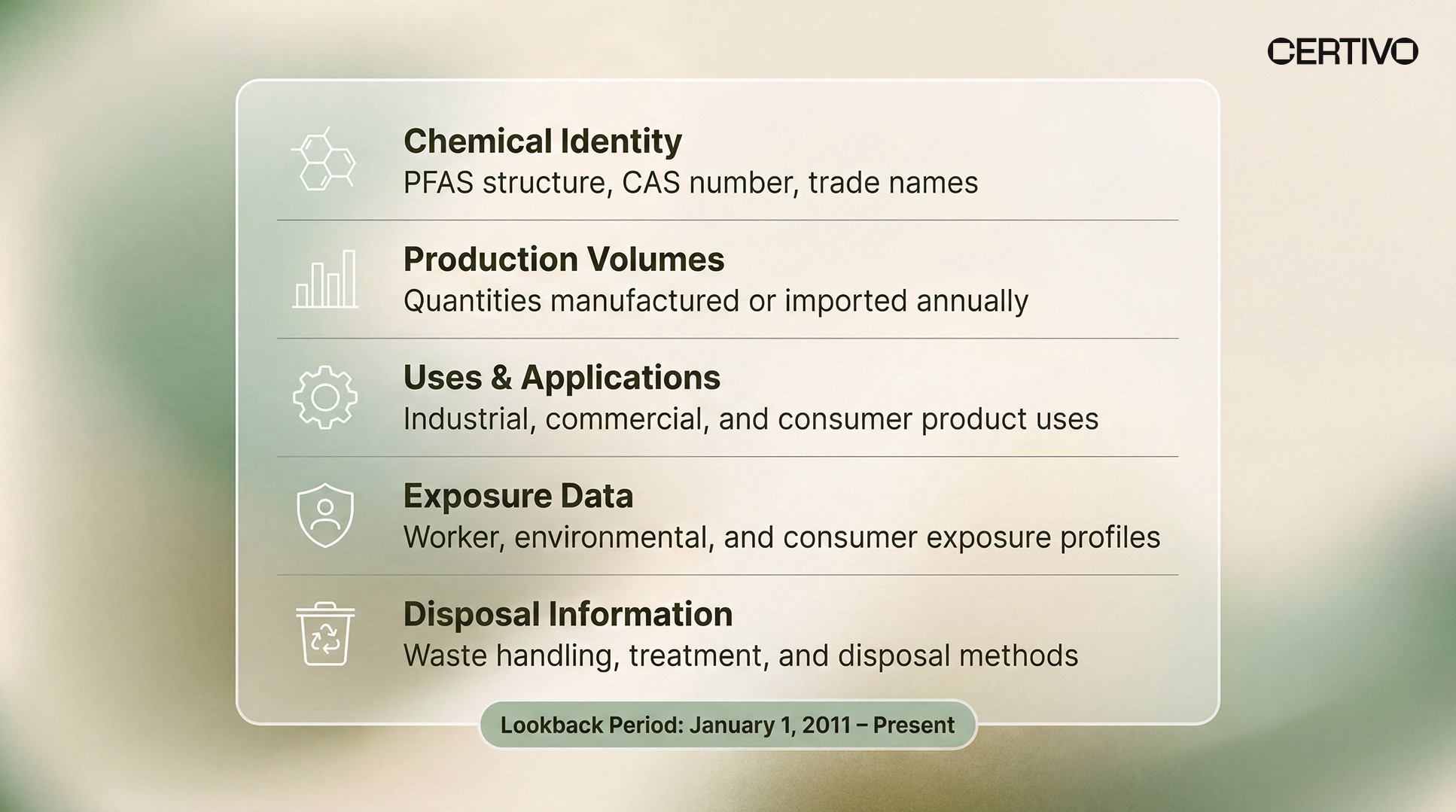
The TSCA Section 8(a)(7) reporting rule requires submission of the following data elements for each PFAS substance manufactured or imported since January 1, 2011:
✓ Chemical identity — Specific PFAS substance identification, including CAS numbers where available
✓ Production and import volumes — Quantities manufactured or imported, by year and by PFAS substance
✓ Uses and applications — How PFAS substances were used in products, processes, or articles
✓ Exposure data — Information on worker exposure, environmental release, and consumer exposure pathways
✓ Disposal information — How PFAS-containing waste, byproducts, or end-of-life materials were managed
⚠ The rule covers an estimated 12,000+ PFAS compounds. Many manufacturers will discover PFAS presence in their supply chains that they were not previously tracking. For context on managing this volume, see Managing 12,000 PFAS Compounds: How AI Automates TSCA Section 8(a)(7) Compliance.
The data must be reported per substance, per year, per use — creating a combinatorial reporting burden that scales rapidly for companies with diverse product portfolios and global supply chains.
TSCA PFAS reporting data requirements for manufacturers under Section 8a7
Click on image to view full
Reporting Challenges: Supply Chain Traceability and Historical Data
For compliance engineers, the TSCA PFAS reporting obligation is fundamentally a data problem. The challenges are structural:
Historical Data Gaps
The 15-year lookback period (2011–present) predates most companies' current compliance management systems. Records from 2011–2018 may exist only in archived spreadsheets, legacy ERP systems, or email threads. Reconstructing PFAS production and import data for this period requires:
Mining archived procurement records
Contacting former suppliers who may no longer be in business
Cross-referencing historical BOMs with PFAS substance databases
Managing evidence chain integrity — who provided data, when, and with what authority
Supplier Data Collection at Scale
Most manufacturers do not directly handle PFAS chemicals. Their exposure comes through imported articles and components where PFAS is present as a functional additive or coating. Collecting PFAS declarations from hundreds or thousands of suppliers — many of whom may not know whether their products contain PFAS — is the operational bottleneck.
Organizations that have not yet implemented automated supplier data collection portals face a manual, email-driven process that cannot meet the January 2027 deadline at enterprise scale.
Substance Identification Complexity
With 12,000+ PFAS compounds, identifying which specific substances are present in products requires analytical testing, supplier disclosures, or AI-assisted document parsing to extract substance data from certificates, test reports, and safety data sheets.
📌 Struggling with PFAS supplier data collection? See how Certivo automates this at scale → Book a Demo
Compliance Risks and Enforcement Exposure
Failure to comply with TSCA Section 8(a)(7) carries significant consequences:
⚠ Civil penalties — TSCA violations can result in civil penalties of up to $25,000+ per day per violation (adjusted for inflation). Each unreported PFAS substance, each missing data element, and each late submission constitutes a separate violation.
⚠ Criminal enforcement — Knowing or willful violations of TSCA reporting obligations can trigger criminal penalties.
⚠ Audit trail exposure — EPA can request documentation proving the completeness of a company's PFAS inventory. Without immutable audit logs, time-stamped declarations, and point-in-time query capability, companies cannot demonstrate due diligence.
⚠ Downstream customer risk — OEM customers conducting their own PFAS compliance programs will increasingly require suppliers to demonstrate TSCA reporting completion. Non-compliance creates supply chain disqualification risk.
No compliance platform eliminates audit findings. The objective is to reduce surprises and response time. Organizations maintaining continuous audit-ready documentation through centralized systems are better positioned to respond to EPA inquiries and customer audits.
How to Prepare for TSCA PFAS Reporting Before the 2027 Deadline
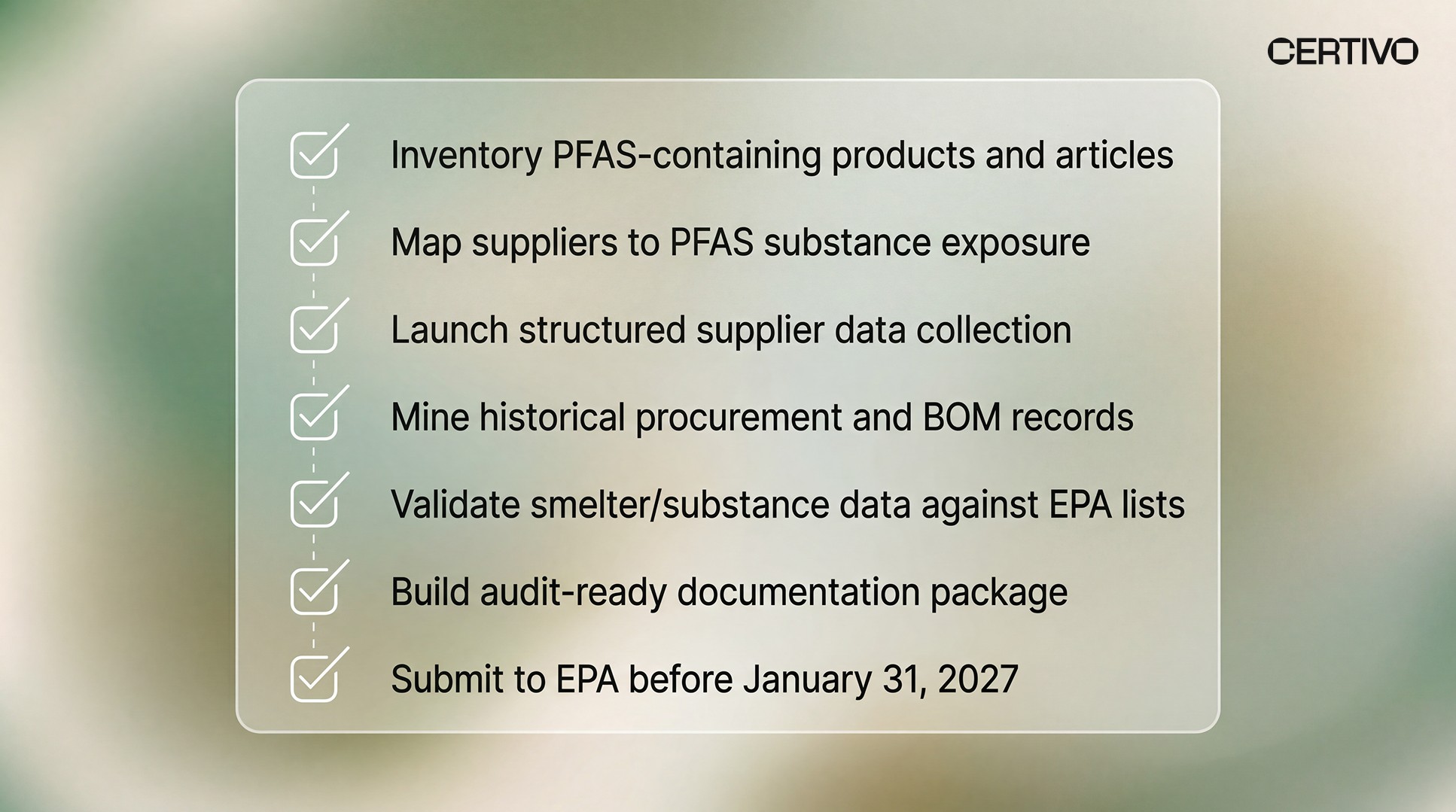
TSCA PFAS reporting 2027 preparation checklist for manufacturers and importers
Click on image to view full
Step-by-Step Preparation
1. Inventory PFAS Exposure Across Your Product Portfolio
Identify every product, component, and article that may contain PFAS substances. This includes direct PFAS use in manufacturing processes and indirect exposure through imported articles. Use BOM-level material mapping to trace PFAS presence to specific product families.
2. Map Suppliers to PFAS Substance Risk
Identify which suppliers provide PFAS-containing materials, components, or articles. Prioritize Tier 1 suppliers with the highest PFAS exposure probability. Implement supplier risk scoring and due diligence protocols to focus data collection efforts.
3. Launch Structured Supplier Data Collection Campaigns
Issue standardized PFAS questionnaires to all in-scope suppliers. Use centralized supplier self-service portals to reduce email chaos and enable suppliers to submit data directly with built-in validation.
4. Mine Historical Records (2011–Present)
Reconstruct PFAS production, import, and use data from archived systems. This is the most labor-intensive step. Establish evidence chain integrity for all recovered data — document who provided it, when, and with what authority.
5. Validate Substance Data
Cross-reference supplier-reported PFAS substances against EPA's PFAS substance list. Ensure CAS numbers, chemical identities, and production volumes are accurate and complete.
6. Build Audit-Ready Documentation
Compile all PFAS data into a structured, version-controlled documentation package with immutable audit logs and time-stamped declarations. Enable point-in-time queries so that EPA can verify reporting completeness at any historical date.
7. Submit Before the Deadline
File reports through EPA's CDR (Chemical Data Reporting) system before January 31, 2027 (or April 13, 2027 for qualifying small business importers).
How AI Automation Reduces TSCA PFAS Reporting Burden
The scale of TSCA PFAS reporting — 12,000+ substances, 15 years of data, multi-tier supplier networks — exceeds what manual processes can handle at enterprise level. AI-native compliance automation addresses the structural bottlenecks:
Automated Supplier Data Collection
Certivo's supplier self-service compliance portals enable suppliers to submit PFAS declarations directly, with built-in validation that checks completeness and flags inconsistencies at intake. This eliminates email-driven follow-up cycles.
AI Document Parsing and Certificate Validation
CORA-powered regulatory intelligence automates extraction of PFAS substance data from supplier certificates, test reports, safety data sheets, and material declarations. CORA identifies missing data fields, validates CAS numbers, and cross-references substance lists — reducing manual review from weeks to hours.
Regulatory Intelligence and Horizon Scanning
CORA's regulatory intelligence layer tracks TSCA PFAS reporting rule changes, EPA guidance updates, and related state-level PFAS requirements — ensuring compliance teams are alerted before deadlines shift or requirements expand. For a broader view of PFAS regulatory developments, see The Global PFAS Reckoning: How to Prepare for Bans, Thresholds, and Substitution Requirements.
Multi-Tier Supply Chain Transparency
Certivo enables multi-tier supply chain transparency for PFAS substances, tracing material declarations from Tier 1 through sub-tier suppliers. This is essential for importers who must report on PFAS presence in articles manufactured overseas. See how this works in practice: How Certivo Automates PFAS Compliance Across Multi-Tier Supply Chains.
Conclusion
The EPA's extension of the TSCA PFAS reporting deadline to January 31, 2027 provides additional preparation time — not reduced obligation. Every manufacturer and importer that has handled PFAS substances or PFAS-containing articles since 2011 must submit detailed retrospective reports covering chemical identities, production volumes, uses, exposure data, and disposal information.
The structural challenge is not regulatory interpretation. It is data: tracing 12,000+ PFAS compounds across 15 years of supply chain history, collecting substance-level declarations from global suppliers, and building audit-ready documentation that can withstand EPA scrutiny.
Organizations that invest now in PFAS and chemicals risk management infrastructure — including automated supplier data collection, AI document parsing, and centralized compliance data management — will be positioned to meet the 2027 deadline without proportional increases in headcount or manual effort.
📌 Book a demo to see how Certivo automates TSCA PFAS reporting across your product portfolio and multi-tier supply chain — or get a free compliance risk assessment to evaluate your current PFAS reporting readiness before the January 2027 deadline.
FAQs
1. Who is required to report under TSCA Section 8(a)(7) PFAS rules?
Any entity that has manufactured or imported PFAS substances or PFAS-containing articles since January 1, 2011 must report. Under TSCA, "manufacture" includes import. This covers direct chemical producers, article importers, and companies using PFAS in manufacturing processes. Certivo's CORA intelligence helps identify PFAS exposure across product portfolios and supplier networks.
2. What is the difference between the January 2027 and April 2027 deadlines?
Most manufacturers and importers must submit PFAS reports by January 31, 2027. Small business importers of PFAS-containing articles receive an extended deadline of April 13, 2027. Both deadlines apply to the same reporting requirements — the difference is eligibility-based.
3. How far back must PFAS reporting data cover?
The lookback period extends to January 1, 2011. Companies must report PFAS chemical identities, production volumes, uses, exposure data, and disposal information for every year they manufactured or imported PFAS since that date. This creates significant historical data reconstruction challenges for organizations without centralized compliance records.
4. Can companies use estimated data if exact historical records are unavailable?
Based on currently available regulatory guidance, EPA allows reasonable estimates where exact data is not available, provided companies document their estimation methodology. However, the quality and defensibility of estimates directly affects audit readiness. AI document parsing tools can help extract and validate historical data from archived records.
5. How does the TSCA PFAS rule interact with state-level PFAS regulations?
TSCA Section 8(a)(7) is a federal reporting obligation that exists alongside state-level PFAS restrictions in states like California, Minnesota, Massachusetts, and others. Compliance with the federal rule does not satisfy state requirements, and vice versa. Certivo provides a consolidated view of federal and state PFAS obligations through its PFAS regulatory framework page.
Lavanya
Lavanya is an accomplished Product Compliance Engineer with over four years of expertise in global environmental and regulatory frameworks, including REACH, RoHS, Proposition 65, POPs, TSCA, PFAS, CMRT, FMD, and IMDS. A graduate in Chemical Engineering from the KLE Institute, she combines strong technical knowledge with practical compliance management skills across diverse and complex product portfolios.