


The European Chemicals Agency (ECHA) has taken a decisive step toward the broadest chemical restriction in EU regulatory history. In March 2026, ECHA published the final opinion of its Committee for Risk Assessment (RAC) and the draft opinion of its Committee for Socio-Economic Analysis (SEAC), both supporting an EU-wide, class-based restriction on per- and polyfluoroalkyl substances (PFAS) under the REACH Regulation. The restriction proposal covers more than 10,000 distinct PFAS substances and targets their manufacture, use, and placing on the EU/EEA market. A 60-day public consultation on the SEAC draft opinion is open until May 25, 2026, with SEAC expected to adopt its final opinion by the end of 2026.
For global manufacturers, importers, and supply chain leaders, this EU PFAS restriction under REACH represents a regulatory inflection point. Organizations that lack substance-level visibility into their product portfolios and supply chains face material compliance risk, market access disruption, and enforcement exposure. This guide provides a comprehensive breakdown of what the restriction entails, which industries face the highest impact, and how to prepare operationally before enforcement begins.
📌 Book a free compliance assessment to understand your PFAS exposure across products and supply chains before the EU restriction takes effect.
Table of Contents
Executive Regulatory Overview
Background: The REACH PFAS Restriction Proposal
Key Requirements, Thresholds, and Scope
Industries and Product Categories Affected
Reporting, Documentation, and Data Challenges
Compliance Risks, Penalties, and Enforcement Exposure
Supply Chain and Operational Impact
Timeline and Future Enforcement Outlook
How Does the EU PFAS Restriction Align with Global PFAS Regulations?
Strategic Compliance Preparation Checklist
How AI Enables Scalable PFAS Compliance Under REACH
Executive Conclusion
FAQs
Executive Regulatory Overview
The EU PFAS restriction under REACH is the culmination of a multi-year regulatory effort initiated in January 2023, when the competent authorities of Denmark, Germany, the Netherlands, Norway, and Sweden submitted a comprehensive restriction proposal to ECHA. The proposal targets all PFAS as a chemical class — defined as any substance containing at least one fully fluorinated methyl (CF3-) or methylene (-CF2-) carbon atom — aligned with the OECD's 2021 definition. Based on currently available regulatory guidance, this encompasses more than 10,000 individual substances.
RAC adopted its final opinion on March 2, 2026, confirming that the persistence, bioaccumulation potential, and environmental risks of PFAS warrant a group-wide restriction. SEAC's draft opinion, agreed at its March 2026 meeting, supports EU-wide action but concludes that an immediate full ban would not be proportionate given current technical and economic constraints. SEAC favors a general prohibition combined with use-specific, time-limited derogations where alternatives are not yet available.
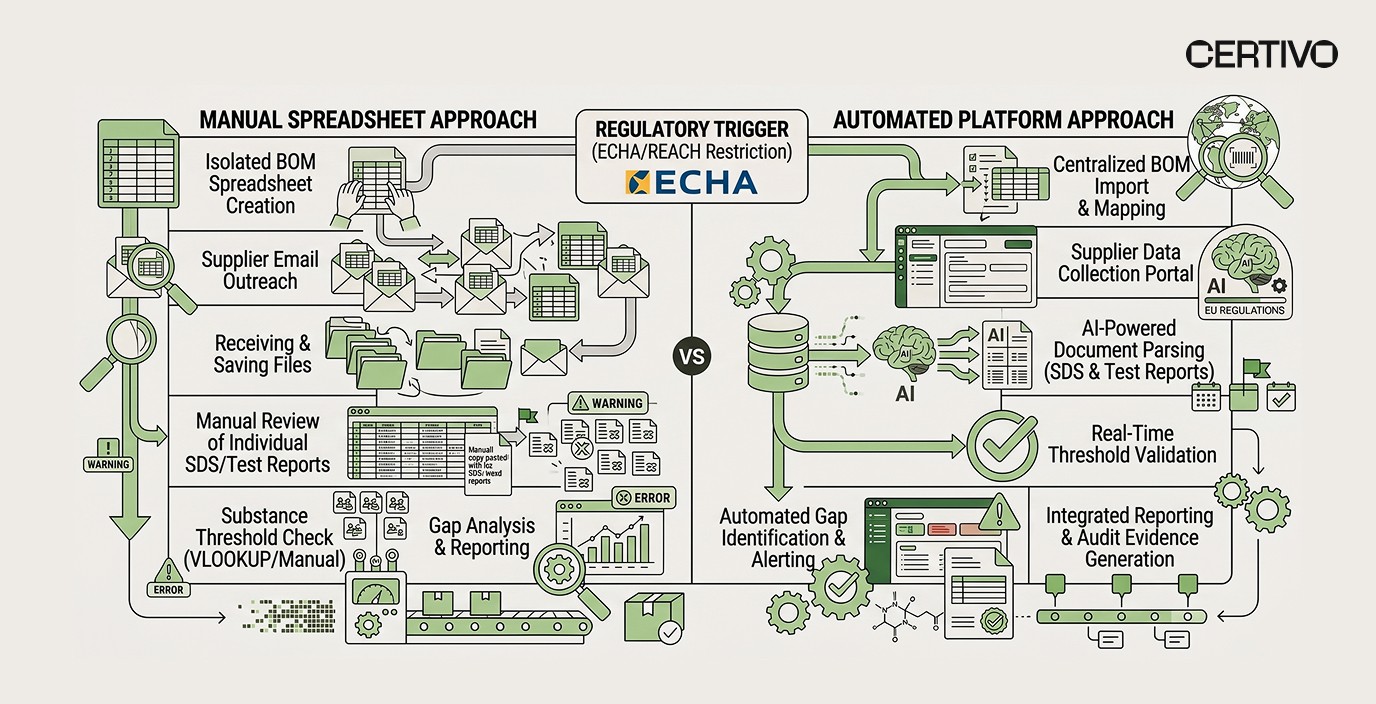
This regulatory development directly impacts how manufacturers manage PFAS and chemicals risk across their product portfolios. Organizations relying on spreadsheets or manual supplier surveys to track PFAS presence face a structural gap between their current capabilities and upcoming obligations.
Background: The REACH PFAS Restriction Proposal
REACH (Registration, Evaluation, Authorisation and Restriction of Chemicals) — Regulation (EC) No. 1907/2006 — is the EU's cornerstone chemicals regulation. Restrictions under REACH Annex XVII impose legally binding limits on the manufacture, placing on the market, and use of specified substances.
The PFAS restriction proposal was submitted to ECHA on January 13, 2023. It is the most extensive restriction dossier ever filed under REACH, both in scope and in the number of affected industries. The original proposal analyzed 15 sectors, and following over 5,600 comments received during the initial six-month consultation (March–September 2023), the Dossier Submitters added eight additional sectors in August 2025, expanding the scope to cover printing, sealing, machinery, military, explosives, technical textiles, other medical applications, and broader industrial uses.
Why a Class-Based Approach?
RAC has confirmed that a group restriction based on structural similarity and equivalent hazard prevents regrettable substitution — the practice of replacing one restricted PFAS with another that poses similar risks. The class-based approach ensures manufacturers cannot simply switch between individual PFAS compounds to circumvent restrictions.
Scope Definition
The restriction applies to any substance meeting the OECD structural definition, including:
Legacy long-chain PFAS (e.g., PFOA, PFOS)
Short-chain alternatives adopted as replacements
Fluoropolymers used in coatings, seals, and membranes
Side-chain fluorinated polymers in water-repellent treatments
A few fully degradable PFAS subgroups that do not exhibit high persistence have been excluded from the scope by the Dossier Submitters. However, the exclusion list remains narrow.
Understanding this scope is critical for compliance teams using BOM-level compliance intelligence to map substance exposure across product portfolios.
Key Requirements, Thresholds, and Scope
Based on currently available regulatory guidance, the EU PFAS restriction under REACH is structured around the following core elements:
General Prohibition
The restriction proposes a prohibition on the manufacture, placing on the market, and use of PFAS — both as substances on their own and in mixtures and articles. The prohibition applies 18 months after the regulation enters into force.
Derogations and Transition Periods
SEAC's draft opinion supports use-specific derogations where technically and economically viable alternatives are not yet available. The updated restriction proposal identifies 74 derogated uses (expanded from 26 in the original 2023 proposal), with transition periods of up to 13.5 years. For PFAS-containing spare parts used in the maintenance of complex objects with long service life (e.g., aircraft, industrial machinery), derogations of up to 20 years — or time-unlimited — are envisaged.
Restriction Element | Details |
|---|---|
Scope | All PFAS (OECD definition); 10,000+ substances |
Prohibition | Manufacture, use, placing on the market |
Standard Transition | 18 months from entry into force |
Use-Specific Derogations | 74 uses identified; up to 13.5 years |
Spare Parts Derogation | Up to 20 years or time-unlimited |
Additional Obligations | Emissions monitoring, reporting, labeling, supply chain communication |
Additional Risk Mitigation Measures
RAC recommends that where derogations are granted, additional requirements should apply:
⚠ Emissions monitoring obligations
⚠ Periodic reporting to regulatory authorities
⚠ Product labeling requirements
⚠ Supply chain communication of PFAS presence
These obligations mean that even manufacturers operating under derogations will need continuous compliance monitoring and audit readiness capabilities — not just one-time declarations.
Industries and Product Categories Affected
The EU PFAS restriction under REACH affects virtually every manufacturing sector that uses fluorinated chemistries. Based on currently available regulatory guidance, the restriction proposal evaluates PFAS use across 23 major sectors (15 original plus 8 added in the 2025 update).
High-Impact Industries
Electronics and Semiconductors: PFAS are integral to semiconductor fabrication, printed circuit board manufacturing, and component coatings. SEAC has reached provisional conclusions specifically on this sector, recognizing the technical challenges in finding alternatives. Manufacturers in electronics manufacturing and semiconductor and high-tech must begin mapping PFAS exposure at the component and material level.
Medical Devices: Specialized applications require PFAS for performance, biocompatibility, and safety. Extended derogations are anticipated for certain medical applications, but manufacturers in the medical devices and equipment sector will still need to document PFAS presence and justify continued use.
Automotive and Aerospace: High-performance materials, seals, coatings, and lubricants in automotive manufacturing and aerospace and defense rely heavily on PFAS. The spare parts derogation is particularly relevant for these sectors given long product service lives.
Energy and Industrial Equipment: Batteries, renewable energy systems, and industrial sealing applications use PFAS-based materials. The energy and infrastructure sector faces both restriction obligations and sustainability reporting intersections under the EU CSRD and EU Taxonomy.
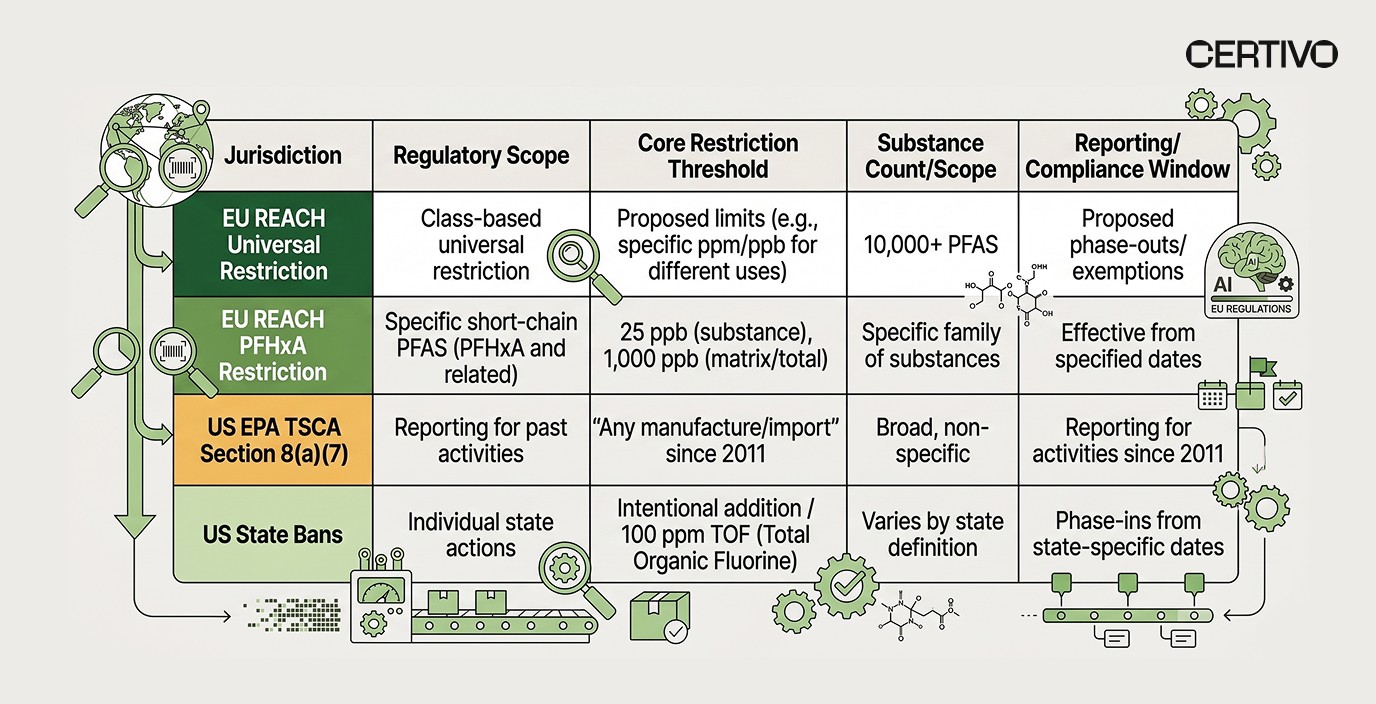
Textiles and Packaging: Water-resistant and non-stick coatings are already subject to the PFHxA restriction under REACH Annex XVII (effective October 2026 for textiles in clothing). The universal PFAS restriction will expand these obligations significantly. Consumer goods manufacturers should expect accelerated phase-out requirements.
Chemical Manufacturing: Companies in the chemical manufacturing sector producing PFAS or PFAS-containing formulations face the most direct impact, including potential restrictions on PFAS manufacturing itself.
Reporting, Documentation, and Data Challenges
The EU PFAS restriction under REACH creates documentation obligations that exceed what most manufacturers currently manage. The core challenge is substance-level data visibility across multi-tier supply chains.
Why PFAS Data Collection Is Uniquely Difficult
PFAS are not always declared at the finished product level. They appear as processing aids, surface treatments, mold release agents, adhesive components, and coating additives — materials that suppliers may not associate with chemical compliance risk. Unlike SVHCs tracked under the REACH Candidate List, PFAS identification requires CAS-number-level data extraction from technical documentation that many suppliers have never reviewed.
The sheer number of substances — more than 10,000 — means that standardized supplier questionnaires designed for a fixed list of chemicals are insufficient. Manufacturers need dynamic questionnaire frameworks that adapt as regulatory definitions and substance lists evolve.
Documentation Requirements Under Derogations
Even where derogations apply, manufacturers must demonstrate:
✓ That the specific PFAS use falls within a derogated category
✓ Emissions monitoring data and controls
✓ Periodic reporting to authorities
✓ Labeling and supply chain communication records
✓ Evidence of progress toward alternatives
This requires a centralized compliance data backbone — not fragmented spreadsheets scattered across departments and regions.
Struggling with PFAS data collection at scale? See how Certivo automates supplier evidence collection across multi-tier supply chains → Book a Demo
The Role of AI in Document Parsing
Technical documents — safety data sheets, material specifications, test reports, certificates of conformance — contain PFAS information that manual review processes consistently miss. AI document parsing and certificate validation capabilities extract substance-level data at scale, identifying PFAS presence in documents that compliance teams would otherwise need weeks to review manually.
Compliance Risks, Penalties, and Enforcement Exposure
Non-compliance with REACH Annex XVII restrictions carries significant consequences across multiple dimensions.
Regulatory Enforcement
REACH restrictions are enforced by national authorities in each EU/EEA member state. Penalties vary by jurisdiction but may include:
⚠ Product withdrawal orders and recalls
⚠ Market access revocation
⚠ Administrative fines (amounts set by member state law)
⚠ Criminal liability in certain jurisdictions
⚠ Import bans for non-compliant articles
Market Access Risk
The practical consequence for manufacturers is market exclusion. Products containing restricted PFAS — without a valid derogation — cannot legally be placed on the EU/EEA market. For organizations managing product launches across multiple jurisdictions, understanding the intersection of EU PFAS restrictions with US state-level PFAS bans and TSCA Section 8(a)(7) reporting obligations is essential to launching new products faster without compliance gaps.
Customer and Supply Chain Consequences
Enterprise buyers increasingly require PFAS compliance evidence as a condition of procurement. Failure to provide substance-level documentation results in disqualification from RFQs, supplier audits, and approved vendor lists. Supplier risk scoring and due diligence processes now routinely include PFAS exposure as a risk dimension.
Supply Chain and Operational Impact
The EU PFAS restriction under REACH fundamentally changes how manufacturers must engage with their supply chains.
Multi-Tier Visibility Requirements
PFAS exposure rarely originates at Tier 1. Coatings, treatments, and processing aids are introduced at Tier 2, Tier 3, or deeper in the supply chain. Manufacturers need multi-tier supply chain transparency capabilities that extend beyond direct supplier relationships.
Supplier Engagement at Scale
With 10,000+ substances in scope, supplier engagement cannot be managed through manual email chains. Automated supplier data collection and portals enable manufacturers to issue structured data requests, track response rates, validate submissions, and escalate non-compliance — all without burdening procurement teams.
Reformulation and Alternatives Assessment
Where PFAS must be eliminated, manufacturers face reformulation timelines that can extend 12–36 months depending on application complexity. Early identification of PFAS-containing materials through BOM-level material mapping allows engineering and procurement teams to begin alternatives assessment before enforcement deadlines arrive.
Timeline and Future Enforcement Outlook
Understanding the regulatory timeline is critical for resource planning and compliance prioritization.
Date | Milestone |
|---|---|
January 2023 | Restriction proposal submitted to ECHA |
March–September 2023 | First public consultation (5,600+ comments received) |
August 2025 | Updated Background Document published; 8 sectors added |
March 2, 2026 | RAC adopts final opinion supporting restriction |
March 10–13, 2026 | SEAC agrees draft opinion |
March 26, 2026 | 60-day public consultation opens |
May 25, 2026 | Public consultation closes |
End of 2026 | SEAC expected to adopt final opinion |
2027 | ECHA submits opinions to European Commission |
2027–2028 | Commission prepares draft Annex XVII amendment; REACH Committee vote |
18 months after EIF | General prohibition takes effect |
Up to 13.5 years | Use-specific derogations expire |
Based on currently available regulatory guidance, the earliest that the general prohibition could take effect is late 2028 or 2029, depending on the pace of the legislative process. However, manufacturers operating in derogated sectors must comply with additional obligations (monitoring, reporting, labeling) from the date of entry into force.
The parallel enforcement of the PFHxA restriction (October 2026 for textiles; October 2027 for other articles), EU POPs regulation updates, and the upcoming Digital Product Passport requirements create a convergence of obligations that demands integrated regulatory intelligence and horizon scanning capabilities.
How Does the EU PFAS Restriction Align with Global PFAS Regulations?
The EU PFAS restriction under REACH does not exist in isolation. Manufacturers operating globally face simultaneous PFAS compliance obligations across multiple jurisdictions.
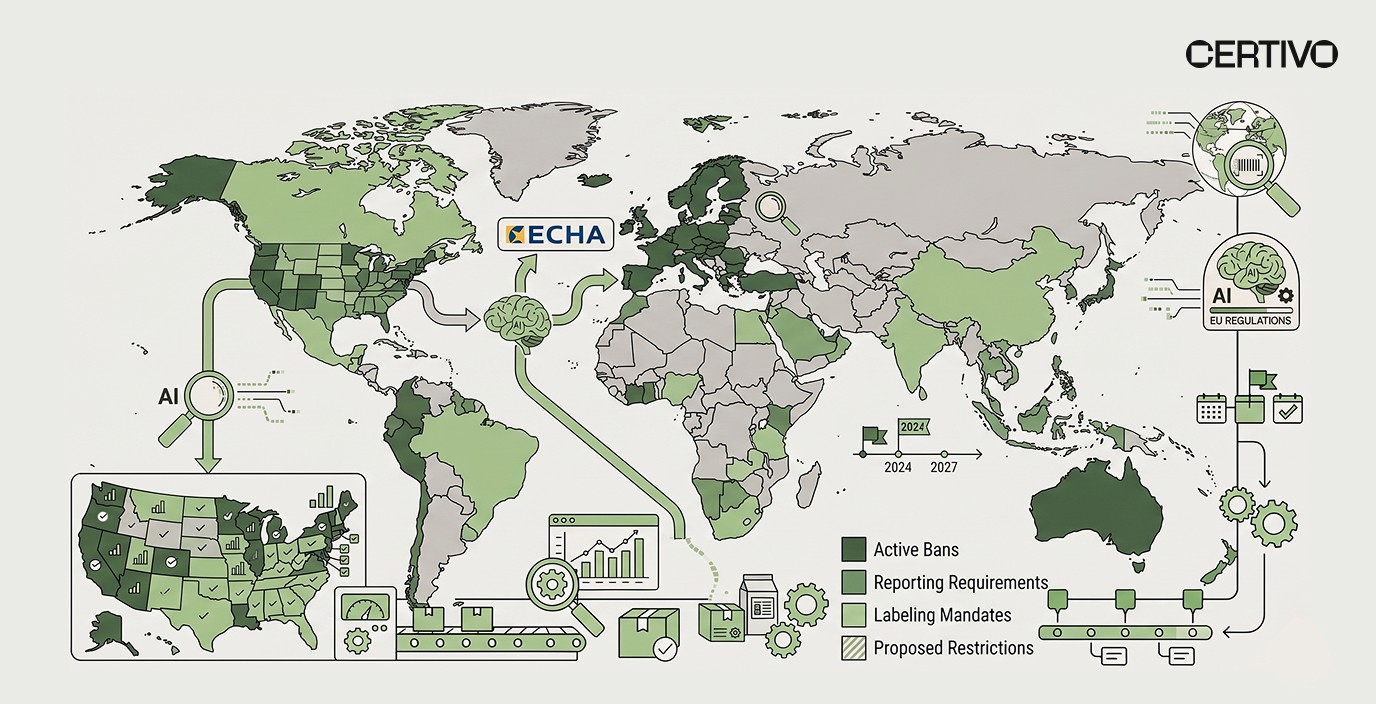
In the United States, the EPA TSCA Section 8(a)(7) reporting rule requires manufacturers and importers to report detailed PFAS data for substances manufactured or imported since 2011, with a reporting deadline in October 2026. Over 20 US states have enacted their own PFAS product bans, reporting requirements, or labeling mandates — each with different scopes, thresholds, and timelines.
This fragmented landscape makes multi-jurisdiction EHS and ESG management a baseline requirement rather than a best practice. Organizations need systems capable of mapping a single product's PFAS exposure against all applicable jurisdictions simultaneously, determining compliance status across the EU, individual US states, and other markets in a unified view.
The EU's approach — as with previous REACH restrictions — is expected to influence regulatory action in other jurisdictions, including parties to the Stockholm Convention. Companies that build compliance infrastructure now position themselves to adapt as additional jurisdictions adopt similar frameworks.
Strategic Compliance Preparation Checklist
Organizations should begin executing against the following priorities:
✅ Inventory PFAS exposure: Conduct a product-by-product and BOM-level assessment to identify where PFAS are present — including in processing aids, coatings, and treatments that may not appear in standard material declarations.
✅ Map supply chain depth: Identify which suppliers at Tier 2 and beyond introduce PFAS-containing materials. Deploy centralized supplier self-service portals to collect substance data at scale.
✅ Classify derogation eligibility: For each PFAS-containing application, determine whether it falls within one of the 74 identified derogated uses and document the justification.
✅ Establish emissions monitoring: Where derogations apply, prepare to implement emissions monitoring protocols and periodic reporting capabilities.
✅ Participate in the SEAC consultation: Submit comments before May 25, 2026. This is the final opportunity for stakeholders to influence the scope of the restriction, including derogation terms and transition periods.
✅ Align with parallel obligations: Ensure PFAS compliance efforts also address TSCA Section 8(a)(7), US state-level requirements, and the EU POPs Regulation updates.
✅ Initiate alternatives assessment: For applications where PFAS elimination is required, begin reformulation programs now. Lead times for material qualification, testing, and customer approval can exceed 24 months.
✅ Build audit-ready documentation: Implement continuous audit-ready documentation systems that organize evidence by product, by regulation, and by reporting period.
How AI Enables Scalable PFAS Compliance Under REACH
Managing compliance for 10,000+ PFAS substances across a global supply chain is not operationally feasible through manual processes. The volume of substances, the complexity of multi-tier data collection, and the pace of regulatory change require technology infrastructure purpose-built for chemical compliance.
Regulatory Intelligence and Horizon Scanning
CORA-powered regulatory intelligence within Certivo continuously monitors PFAS regulatory developments across jurisdictions — including ECHA updates, US EPA rule changes, and state-level enactments. When a new restriction enters force or a derogation expires, the system assesses product portfolio impact automatically, enabling regulatory intelligence and horizon scanning at enterprise scale.
Automated Supplier Evidence Collection
Certivo's automated supplier data collection portals issue structured PFAS questionnaires to suppliers, track response rates, validate submissions against regulatory thresholds, and escalate non-responses. This replaces manual email-based data collection with a systematic, auditable process.
BOM-Level Substance Mapping
CORA-driven compliance intelligence maps PFAS presence at the BOM component level, cross-referencing supplier declarations against the full OECD-definition PFAS list. This enables manufacturers to identify exposure at the material and component level — not just at the finished product level.
AI Document Parsing
CORA's AI document parsing capabilities extract PFAS-relevant data from safety data sheets, test reports, mill test reports, and certificates of conformance. With extraction accuracy rates supporting enterprise-grade decision-making, this capability eliminates the manual bottleneck that prevents most compliance teams from reviewing technical documents at the volume required for a 10,000+ substance scope.
Executive Conclusion
The EU PFAS restriction under REACH represents the most significant class-based chemical restriction in European regulatory history. With RAC and SEAC both supporting EU-wide action, the direction is clear: broad restrictions on PFAS manufacture, use, and market placement are advancing toward legislative adoption. The public consultation closing May 25, 2026 is the final opportunity for industry input before SEAC finalizes its opinion.
For manufacturers, importers, and supply chain leaders, the preparation window is now. Organizations that build substance-level PFAS visibility, establish multi-tier supplier data collection processes, and deploy continuous compliance monitoring infrastructure will navigate this transition with minimal disruption. Those that wait until enforcement begins will face simultaneous data collection, system implementation, and reporting obligations — the most expensive and highest-risk scenario.
The EU PFAS restriction under REACH is not an isolated obligation. It intersects with TSCA reporting, US state-level bans, EU POPs requirements, and emerging Digital Product Passport frameworks. The only viable approach is a unified compliance infrastructure that manages PFAS exposure across all applicable frameworks from a single source of truth.
📌 Book a demo to see how Certivo automates PFAS compliance across your product portfolio and supply chain — or get a free compliance risk assessment to understand your current PFAS exposure across products and jurisdictions.
FAQs
1. When will the EU PFAS restriction under REACH take effect?
Based on currently available regulatory guidance, SEAC is expected to adopt its final opinion by the end of 2026. The European Commission will then prepare a draft Annex XVII amendment for consideration by EU member states. The earliest the general prohibition could take effect is late 2028 or 2029, with use-specific derogations extending further. Certivo's CORA-powered regulatory intelligence continuously tracks these milestones and automatically assesses product portfolio impact as enforcement dates are confirmed.
2. How many PFAS substances are covered by the proposed REACH restriction?
The restriction uses the OECD structural definition, encompassing more than 10,000 distinct PFAS substances. This includes legacy long-chain PFAS, short-chain alternatives, fluoropolymers, and side-chain fluorinated polymers. Certivo's BOM-level substance mapping cross-references supplier data against the full PFAS list to identify exposure that manual processes consistently miss.
3. What derogations are available for manufacturers under the EU PFAS restriction?
The updated restriction proposal identifies 74 derogated uses with transition periods of up to 13.5 years. Spare parts for complex objects may receive derogations of up to 20 years or time-unlimited. However, derogations come with additional obligations including emissions monitoring, periodic reporting, and labeling. Manufacturers must document that their specific use falls within a derogated category and demonstrate progress toward alternatives.
4. How should manufacturers prepare for PFAS supplier data collection under REACH?
Start by mapping PFAS exposure at the BOM and component level across your product portfolio. Deploy automated supplier data collection portals — such as Certivo's centralized supplier self-service portals — to issue structured PFAS questionnaires, track response rates, and validate submissions. AI document parsing capabilities can extract PFAS-relevant data from technical documents at scale, addressing the data gap that manual processes cannot close for 10,000+ substances.
5. Does the EU PFAS restriction affect companies outside the EU?
Yes. Any company placing articles containing PFAS on the EU/EEA market is subject to the restriction — regardless of where the product is manufactured. Non-EU manufacturers selling through EU importers or authorized representatives face the same obligations. Additionally, enterprise buyers in the EU are increasingly requiring PFAS compliance evidence as a procurement condition, making multi-jurisdiction compliance infrastructure essential even for companies that do not directly import into the EU.
Lavanya
Lavanya is an accomplished Product Compliance Engineer with over four years of expertise in global environmental and regulatory frameworks, including REACH, RoHS, Proposition 65, POPs, TSCA, PFAS, CMRT, FMD, and IMDS. A graduate in Chemical Engineering from the KLE Institute, she combines strong technical knowledge with practical compliance management skills across diverse and complex product portfolios.