

Illinois enacted new legislation in May 2026 establishing expanded monitoring requirements for per- and polyfluoroalkyl substances (PFAS) in wastewater discharges, biosolids, and sewage sludge. The law targets improved identification, tracking, and management of PFAS contamination entering Illinois water systems and the broader environment.
For manufacturers, wastewater treatment facilities, and industrial operators across Illinois, this law introduces new monitoring, sampling, and reporting obligations that require operational changes. The Illinois Environmental Protection Agency (Illinois EPA) has also confirmed it will continue to maintain and enforce state PFAS drinking water standards, regardless of any federal actions that may reduce or modify national PFAS regulatory requirements. This positions Illinois among the most proactive states for PFAS compliance enforcement.
📌 Book a free compliance assessment to evaluate your Illinois PFAS wastewater monitoring readiness and identify gaps before enforcement actions begin.
Key Takeaways
📌 Illinois enacted PFAS wastewater discharge monitoring legislation in May 2026, expanding oversight of PFAS in wastewater, biosolids, and sewage sludge.
⚠️ The Illinois EPA will enforce state PFAS drinking water standards independently, even if federal PFAS requirements are weakened or delayed.
📊 Regulated facilities face new PFAS testing, sampling, recordkeeping, and reporting obligations across wastewater streams and residual waste materials.
🏭 Manufacturers in chemical, electronics, textile, and food and beverage sectors face indirect exposure as potential PFAS contributors to wastewater systems.
⏳ Organizations should begin assessing PFAS sources now, as expanded monitoring programs and potential future discharge limits are expected to follow.
🔗 Multi-tier supply chain visibility into PFAS-containing materials is essential for identifying which products or processes contribute PFAS to wastewater.
🤖 AI-driven compliance systems help manufacturers track PFAS obligations across state and federal jurisdictions simultaneously.
Illinois PFAS wastewater monitoring compliance law 2026 for manufacturers
Click on image to view full
Why Illinois PFAS Wastewater Monitoring Matters for Manufacturers
PFAS contamination in wastewater systems is no longer treated as an isolated environmental issue. State legislatures are increasingly holding both direct dischargers and upstream contributors accountable for PFAS entering water treatment infrastructure.
Illinois' May 2026 legislation signals a clear escalation in state-level PFAS enforcement. While the federal EPA has faced delays and rollbacks on national PFAS rulemaking, Illinois has committed to maintaining its own standards and expanding monitoring requirements. This creates a regulatory environment where manufacturers operating in Illinois, or discharging into Illinois wastewater systems, face obligations that exceed current federal requirements.
For compliance teams managing PFAS regulations across the US and EU, the Illinois law adds another jurisdiction-specific layer to an already complex compliance landscape. Organizations already tracking state PFAS regulations in Minnesota, Massachusetts, Connecticut, and Washington must now add Illinois wastewater monitoring to their compliance programs.
What the Illinois PFAS Wastewater Law Requires
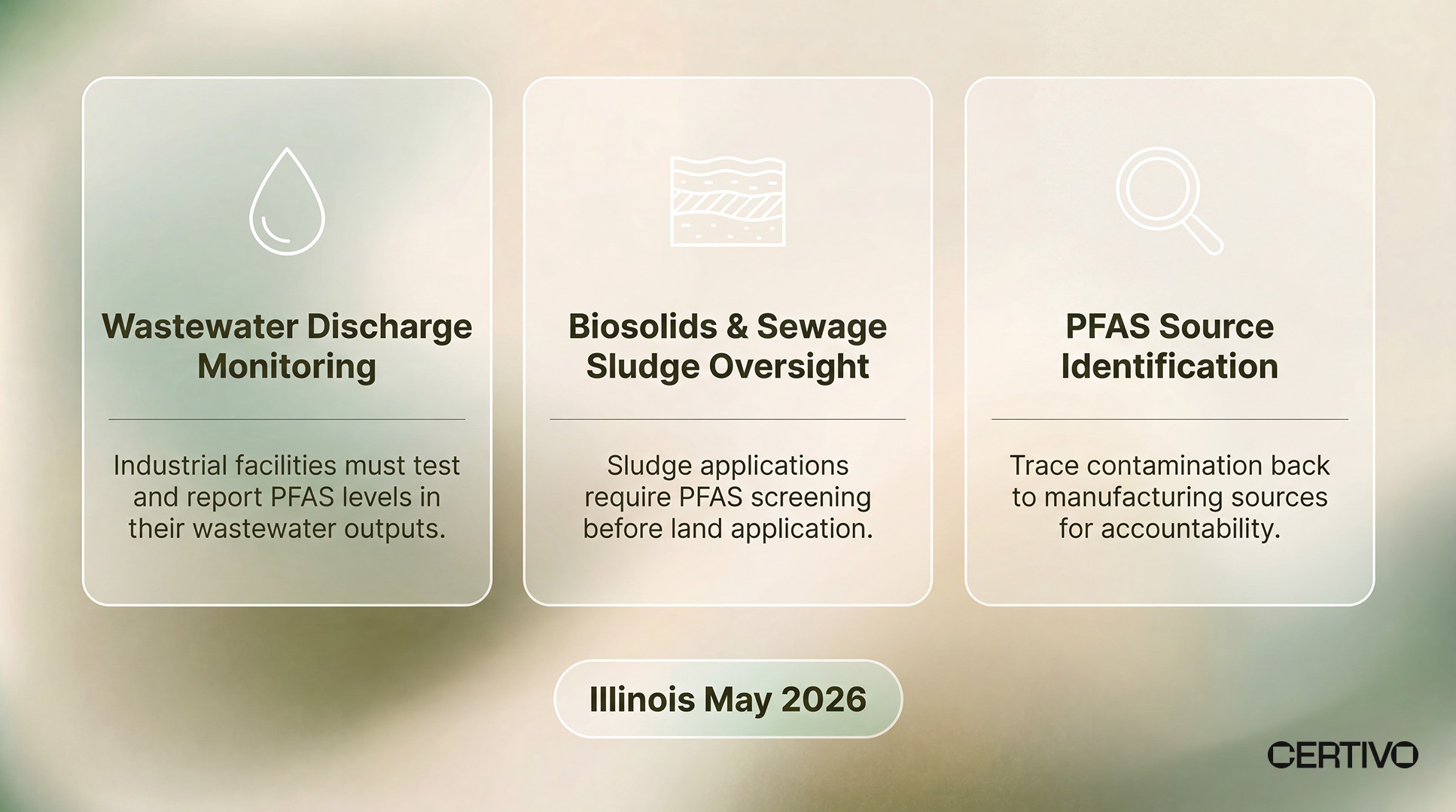
The legislation establishes enhanced monitoring requirements across three primary areas:
Wastewater Discharge Monitoring
Regulated facilities must increase monitoring and reporting of PFAS concentrations in wastewater discharge streams. This includes sampling protocols, analytical testing, and data submission to the Illinois EPA.
Biosolids and Sewage Sludge Oversight
PFAS concentrations in biosolids and sewage sludge are now subject to expanded monitoring. Facilities that process, apply, or dispose of these materials face new obligations to measure and report PFAS content.
Source Identification
The law places greater focus on identifying PFAS sources entering wastewater treatment systems. This means that industrial manufacturers and commercial facilities contributing PFAS-containing effluent may face additional scrutiny from treatment operators and regulators seeking to trace contamination to its origin.
Based on currently available regulatory guidance, potential future development of PFAS discharge limits and permit requirements is expected as monitoring data is collected and analyzed by the Illinois EPA.
Industries and Facilities Affected
The Illinois PFAS wastewater monitoring law affects a broad range of sectors:
Sector | Exposure Type |
|---|---|
Wastewater Treatment Facilities | Direct monitoring and reporting obligations |
Municipal Water Utilities | PFAS drinking water standard enforcement |
Industrial Manufacturing | PFAS contribution to wastewater systems |
PFAS production, processing, and discharge | |
Environmental Remediation Services | PFAS contamination management and treatment |
Waste Management & Biosolids Processors | Biosolids and sewage sludge monitoring |
Food & Beverage Manufacturing | Potential PFAS contributors via packaging and processing |
PFAS in coatings, films, and manufacturing processes | |
Textile and Consumer Products Manufacturing | PFAS in water-repellent treatments and coatings |
Manufacturers that do not directly operate wastewater treatment infrastructure are not exempt. If manufacturing processes contribute PFAS to wastewater systems, whether through cleaning operations, surface treatments, or material processing, the source identification provisions of this law create indirect compliance exposure.
Illinois PFAS wastewater compliance three monitoring areas for regulated facilities
Click on image to view full
PFAS Monitoring, Reporting, and Documentation Obligations
Compliance teams at affected facilities should prepare for the following operational requirements:
✓ PFAS Testing and Sampling Programs — Facilities must implement structured PFAS sampling protocols for wastewater discharges and residual waste materials. This requires analytical laboratory partnerships capable of EPA Method 1633 or equivalent testing.
✓ Recordkeeping and Data Management — Monitoring data must be maintained in auditable records. Organizations managing continuous audit-ready documentation across multiple compliance frameworks will need to integrate Illinois PFAS wastewater data into their compliance management systems.
✓ Reporting to Illinois EPA — Data collection obligations include submission of PFAS concentration data to the Illinois EPA. Reporting frequency and format requirements are expected to be specified through implementing regulations.
✓ Source Identification Documentation — Facilities may need to document and report on upstream PFAS sources entering their wastewater treatment systems, creating cascading data requests to industrial contributors.
For manufacturers tracking PFAS obligations across multiple states, a centralized compliance data backbone is essential to avoid duplication of effort and ensure consistent reporting across jurisdictions.
Compliance Risks and Enforcement Exposure
Failure to comply with the Illinois PFAS wastewater monitoring law exposes organizations to several risk categories:
⚠️ Regulatory Enforcement — The Illinois EPA's explicit commitment to enforce state PFAS standards independently of federal changes means that facilities cannot rely on federal rollbacks to reduce their state-level obligations.
⚠️ Permit Risk — Monitoring data collected under this law may inform future PFAS discharge limits embedded in NPDES permits. Facilities with high PFAS concentrations in current discharges face long-term permitting risk.
⚠️ Liability Exposure — PFAS contamination liability is expanding rapidly. Documented monitoring data that reveals PFAS discharges could become evidence in future enforcement actions or civil litigation.
⚠️ Supply Chain Pressure — Wastewater treatment facilities receiving industrial effluent may begin requiring PFAS source documentation from manufacturers, creating new supplier compliance obligations.
Organizations that have already invested in PFAS compliance management infrastructure are better positioned to absorb these requirements.
Illinois vs. Federal PFAS Regulatory Landscape
A critical element of this legislation is Illinois' independent stance on PFAS enforcement. While federal PFAS rulemaking has experienced delays, including changes to TSCA PFAS reporting timelines and rescission of certain PFAS maximum contaminant levels (MCLs), Illinois has affirmed that its state-level PFAS drinking water standards remain in effect and enforceable.
This divergence between state and federal PFAS requirements is a broader national trend. States including Minnesota, Massachusetts, Connecticut, New Jersey, and Washington have enacted their own PFAS restrictions that exceed federal baselines. For manufacturers operating across multiple states, regulatory intelligence and horizon scanning capabilities are necessary to track jurisdiction-specific obligations in real time.
Certivo's PFAS regulatory tracking resources provide a comprehensive view of federal and state-level PFAS compliance requirements.
📌 Managing PFAS compliance across multiple states? Book a demo to see how Certivo tracks jurisdiction-specific PFAS obligations across your product portfolio and operations.
Supply Chain and Operational Impact for Manufacturers
Even manufacturers that do not directly discharge wastewater into Illinois systems face indirect compliance exposure through several mechanisms:
Supplier Data Requests — Wastewater treatment operators will increasingly require upstream contributors to disclose PFAS content in their effluent. Manufacturers should expect new supplier questionnaires and data collection campaigns focused on PFAS in process water.
Material Substitution Pressure — As monitoring data reveals which industrial processes contribute the most PFAS to wastewater systems, pressure to reformulate products or substitute PFAS-containing materials will increase.
Multi-Jurisdiction Complexity — Illinois joins a growing list of states with PFAS-specific wastewater and discharge requirements. Manufacturers operating across multiple states need multi-tier supply chain transparency to understand where PFAS enters their operations and which jurisdictions are affected.
Customer and Investor Scrutiny — ESG reporting and customer compliance programs increasingly ask for PFAS management disclosures. Documented wastewater monitoring programs strengthen customer trust center responses and audit readiness.
Illinois PFAS wastewater compliance preparation workflow for manufacturers
Click on image to view full
How to Prepare for Illinois PFAS Wastewater Compliance
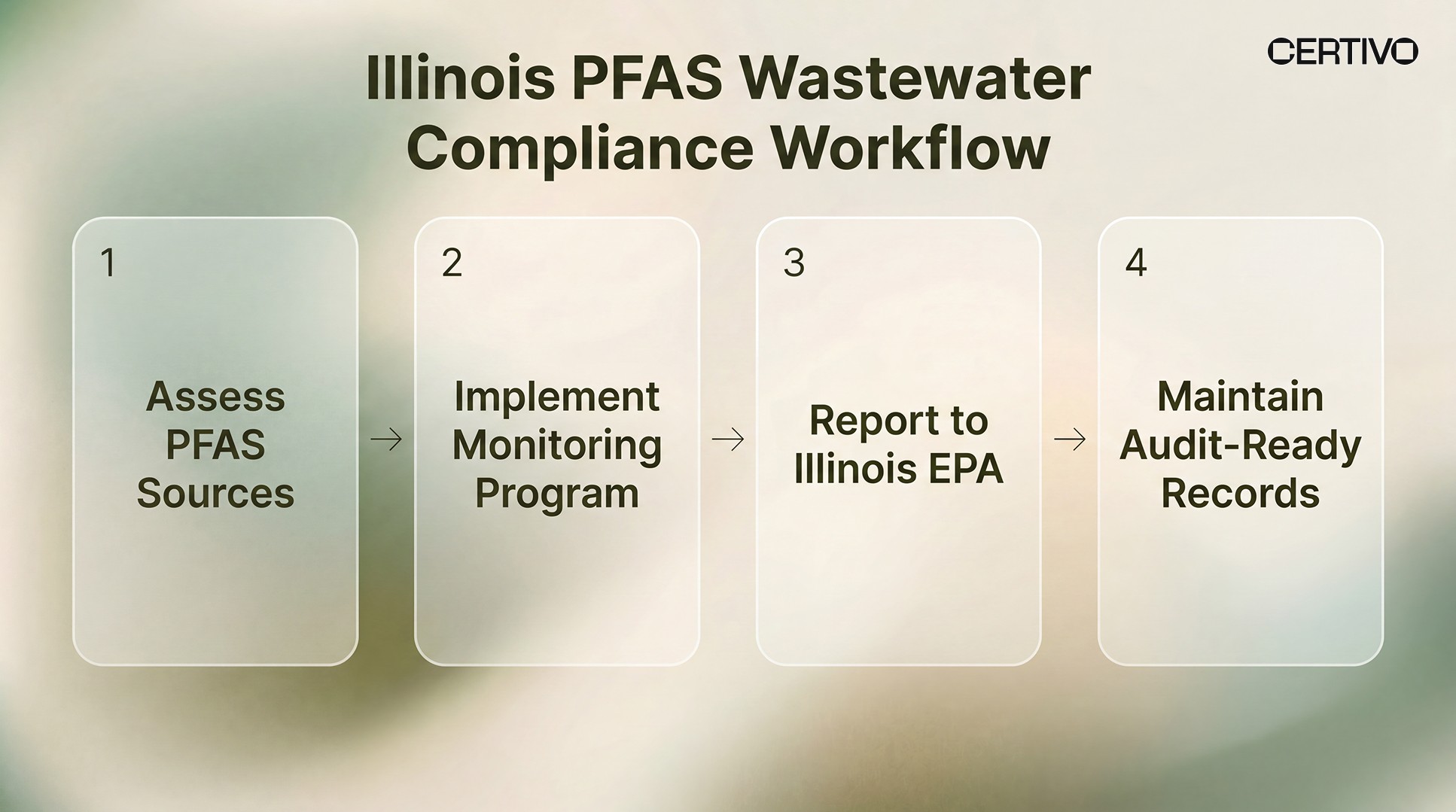
Compliance teams should prioritize the following actions:
✅ 1. Conduct PFAS Source Assessment — Identify all processes, materials, and products that may contribute PFAS to wastewater streams. Map PFAS-containing inputs across manufacturing operations.
✅ 2. Establish PFAS Sampling and Testing Protocols — Partner with accredited analytical laboratories for PFAS testing using EPA Method 1633 or equivalent. Define sampling locations, frequency, and chain-of-custody procedures.
✅ 3. Integrate Illinois Requirements into Compliance Systems — Add Illinois PFAS wastewater monitoring obligations to your compliance management platform alongside existing federal and state requirements. A centralized compliance system prevents fragmented tracking across jurisdictions.
✅ 4. Update Supplier and Internal Documentation — Ensure that PFAS-related data from suppliers and internal processes is captured, stored, and retrievable for regulatory reporting and audits.
✅ 5. Monitor for Implementing Regulations — The Illinois EPA is expected to issue additional guidance on reporting formats, monitoring frequencies, and potential discharge limits. Maintain regulatory intelligence tracking to stay ahead of these developments.
✅ 6. Evaluate Treatment Technologies — Facilities with identified PFAS discharge risks should assess treatment options, including granular activated carbon (GAC), ion exchange, and reverse osmosis, as part of long-term compliance planning.
How AI Supports PFAS Compliance Across Jurisdictions
Managing PFAS compliance across Illinois, other states, and federal requirements simultaneously is a data management challenge that exceeds what manual processes can handle. AI-native compliance automation addresses this at several levels.
CORA-powered regulatory intelligence continuously monitors PFAS regulatory developments across all 50 states and federal agencies, alerting compliance teams to new requirements before they take effect. This is critical as state-level PFAS laws proliferate faster than most compliance teams can manually track.
Certivo's automated supplier data collection capabilities enable manufacturers to request, collect, and validate PFAS-related data from suppliers at scale. CORA's AI document parsing identifies relevant PFAS data from supplier certificates, test reports, and material declarations, reducing manual review effort.
For organizations managing PFAS compliance across multi-tier supply chains, Certivo provides a single platform that maps PFAS obligations to products, suppliers, and jurisdictions simultaneously.
Executive Conclusion
Illinois' May 2026 PFAS wastewater monitoring law represents a significant expansion of state-level PFAS enforcement at a time when federal PFAS rulemaking faces uncertainty. The legislation creates new monitoring, reporting, and source identification obligations for wastewater treatment facilities, and indirect compliance exposure for manufacturers contributing PFAS to wastewater systems.
The Illinois EPA's commitment to maintaining state PFAS drinking water standards independent of federal changes reinforces that compliance teams cannot treat federal rollbacks as risk reduction. State-level PFAS enforcement will continue to expand.
Organizations that invest now in PFAS source identification, structured monitoring programs, and centralized compliance data management will be best positioned to meet current Illinois requirements and absorb future obligations as PFAS discharge limits and permit conditions evolve.
📌 Book a demo to see how Certivo automates PFAS compliance tracking across state and federal jurisdictions, or request a compliance risk assessment to evaluate your current PFAS wastewater monitoring readiness.
FAQs
1. Does the Illinois PFAS wastewater law apply to manufacturers who do not operate wastewater treatment facilities?
Yes, indirectly. The law's source identification provisions mean that wastewater treatment operators may require upstream industrial contributors to disclose PFAS content in their effluent. Manufacturers whose processes contribute PFAS to wastewater systems should prepare for data requests and potential monitoring requirements. Certivo helps track these obligations across operations and supply chains.
2. How does Illinois PFAS enforcement differ from federal EPA PFAS requirements?
Illinois has committed to maintaining and enforcing its own state PFAS drinking water standards regardless of changes at the federal level. The May 2026 law adds wastewater-specific monitoring requirements that currently have no direct federal equivalent. CORA-powered regulatory intelligence tracks both state and federal PFAS requirements to ensure no obligations are missed.
3. What PFAS testing methods are required under the Illinois wastewater monitoring law?
Based on currently available regulatory guidance, facilities should prepare to implement EPA Method 1633 or equivalent analytical methods for PFAS testing in wastewater and biosolids. Specific method requirements may be further defined through implementing regulations issued by the Illinois EPA.
4. Will Illinois set specific PFAS discharge limits for wastewater facilities?
Based on currently available regulatory guidance, the potential future development of PFAS discharge limits and permit requirements is anticipated as monitoring data is collected and analyzed. Manufacturers should treat current monitoring requirements as a precursor to more prescriptive discharge standards.
5. How should manufacturers prioritize Illinois PFAS wastewater compliance alongside other state PFAS laws?
Illinois should be integrated into a comprehensive multi-state PFAS compliance program that also covers Minnesota, Massachusetts, Connecticut, New Jersey, Washington, and other states with active PFAS legislation. Certivo's centralized platform enables tracking of jurisdiction-specific PFAS obligations across all relevant states simultaneously.
Lavanya
Lavanya is an accomplished Product Compliance Engineer with over four years of expertise in global environmental and regulatory frameworks, including REACH, RoHS, Proposition 65, POPs, TSCA, PFAS, CMRT, FMD, and IMDS. A graduate in Chemical Engineering from the KLE Institute, she combines strong technical knowledge with practical compliance management skills across diverse and complex product portfolios.
She has extensive experience in product compliance engineering, ensuring that materials, components, and finished goods consistently meet evolving international regulatory requirements. Her expertise spans BOM analysis, material risk assessments, supplier declaration management, and test report validation to guarantee conformity. Lavanya also plays a key role in design-for-compliance initiatives, guiding engineering teams on regulatory considerations early in the product lifecycle to reduce risks and streamline market access.