


The EPA has officially delayed the TSCA Section 8(a)(7) PFAS reporting period. Originally set to open on April 13, 2026, the reporting window will now begin 60 days after the publication of a forthcoming revised rule. For compliance leaders, supply chain directors, and executives managing PFAS exposure across global operations, this delay is not a reprieve — it is a compressed preparation window.
This regulatory shift affects every company that manufactures, imports, or processes PFAS substances in the United States. The scope is broad: over 12,000 PFAS compounds fall under the reporting obligation, spanning chemicals, electronics, automotive, aerospace, consumer goods, and import-distribution operations.
📌 Book a free compliance assessment to understand your PFAS reporting exposure across products and supply chains before the revised rule takes effect.
This guide covers the regulatory background, revised timeline, reporting requirements, industry impact, supply chain challenges, and strategic steps every manufacturer and importer should take now — while there is still time to build a defensible compliance position.
Table of Contents
What Is the TSCA Section 8(a)(7) PFAS Reporting Rule?
Why Did the EPA Delay the PFAS Reporting Deadline?
What Is the New TSCA PFAS Reporting Timeline?
Who Must Report Under TSCA Section 8(a)(7)?
Key PFAS Reporting Requirements and Data Obligations
Which Industries Are Most Affected?
Supply Chain and Operational Impact of PFAS Reporting
Compliance Risks and Enforcement Exposure
How Small Manufacturers and Article Importers Are Affected
Strategic Compliance Preparation Checklist
How AI and Automation Reduce PFAS Reporting Burden
How Certivo Supports TSCA PFAS Compliance at Scale
Executive Summary and Next Steps
Frequently Asked Questions
What Is the TSCA Section 8(a)(7) PFAS Reporting Rule?
The Toxic Substances Control Act (TSCA) Section 8(a)(7) requires any entity that has manufactured (including imported) or processed PFAS substances in the United States to submit detailed data to the EPA. This is a one-time, retrospective reporting obligation that covers PFAS activity since January 1, 2011.
PFAS — per- and polyfluoroalkyl substances — are a large class of persistent synthetic chemicals used across thousands of industrial applications. The EPA's rule mandates disclosure of manufacturing volumes, chemical identities, categories of use, byproducts, environmental and health effects data, and disposal practices.
This is one of the most comprehensive substance-level reporting mandates ever issued under TSCA. It does not apply only to PFAS manufacturers. Any company importing finished goods or components containing PFAS is within scope.
For companies managing complex product portfolios, BOM-level compliance intelligence is essential to determine which products trigger reporting obligations. Without substance-level visibility into bills of materials, compliance teams face significant blind spots.
Why Did the EPA Delay the PFAS Reporting Deadline?
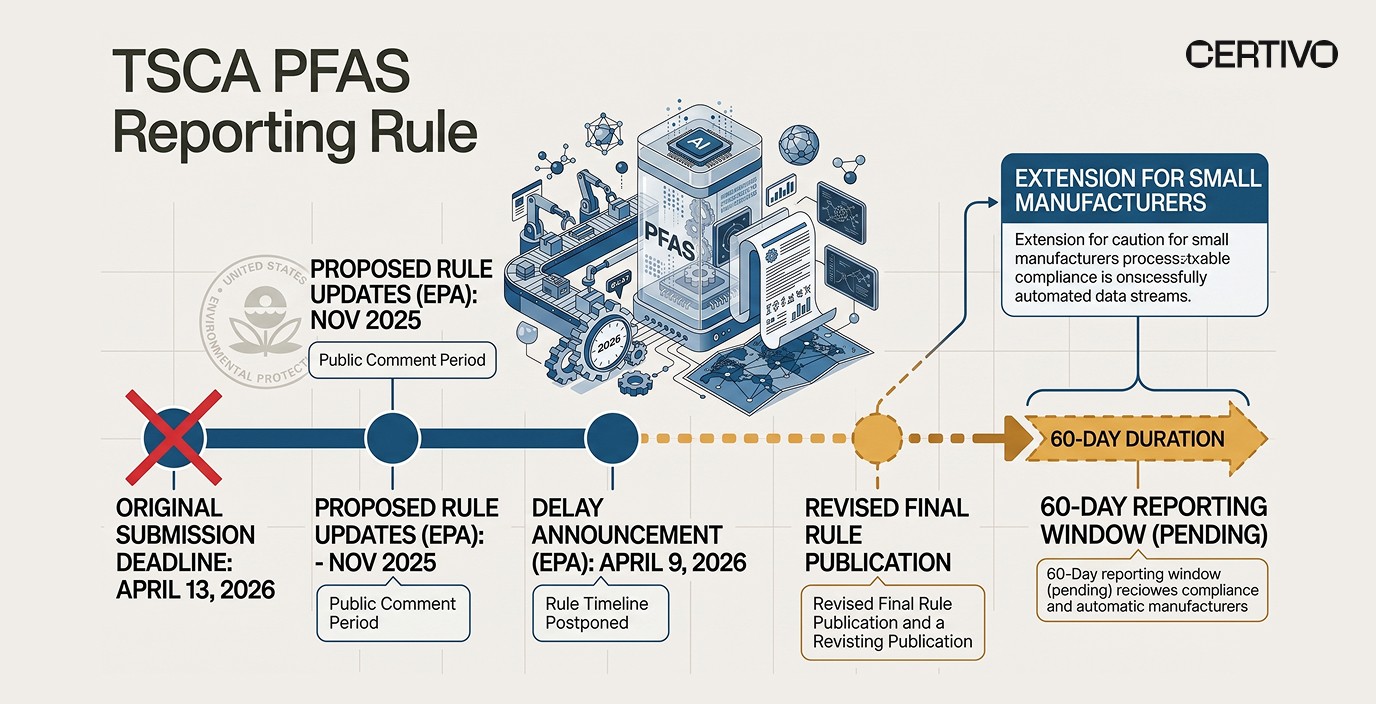
On April 9, 2026, the EPA announced a delay to the TSCA Section 8(a)(7) PFAS reporting period. The agency cited the need to review extensive public feedback received on the proposed updates issued in November 2025.
Based on currently available regulatory guidance, the EPA is evaluating comments related to reporting scope, exemptions for certain categories of manufacturers, and data submission requirements. The revised rule, once published, will trigger a 60-day countdown before the reporting window officially opens.
This means the original April 13, 2026 start date is no longer operative. Companies that had been preparing against that deadline must now recalibrate — but should not stop preparing. The delay signals regulatory refinement, not withdrawal.
For teams tracking regulatory changes across jurisdictions, regulatory intelligence and horizon scanning capabilities are critical. The TSCA PFAS rule is just one of several PFAS-related mandates converging in 2026, including state-level PFAS bans and the EU REACH PFAS restriction proposal.
What Is the New TSCA PFAS Reporting Timeline?
The revised timeline is straightforward but conditional:
Milestone | Status |
|---|---|
Original reporting start date | April 13, 2026 — no longer operative |
EPA publishes revised final rule | Pending — date not yet announced |
New reporting window opens | 60 days after revised rule publication |
Small manufacturer / article importer deadline | Extended (specific date pending revised rule) |
⚠ The EPA has not announced a firm date for the revised rule. Companies should monitor the Federal Register for publication updates.
This uncertainty makes it essential to maintain continuous audit-ready documentation rather than scrambling to meet a fixed deadline. Companies that have already mapped their PFAS substance exposure and supplier data will be in the strongest position when the window opens.
Organizations tracking multiple frameworks simultaneously — TSCA, REACH, RoHS, Prop 65 — benefit from a centralized compliance data backbone that consolidates substance data, supplier evidence, and reporting obligations in a single system.
Who Must Report Under TSCA Section 8(a)(7)?
The reporting obligation applies to any person who has manufactured (including imported) or processed PFAS for commercial purposes at any point since January 1, 2011. This includes:
✓ Domestic PFAS manufacturers and processors
✓ Companies importing raw PFAS chemicals
✓ Importers of finished articles containing PFAS
✓ Toll manufacturers and contract processors
✓ Companies that have used PFAS as processing aids, coatings, or additives
The breadth of this rule is significant. Many companies importing electronics, automotive components, textiles, or packaging materials may not realize their products contain PFAS compounds. Without multi-tier supply chain transparency, these obligations can go undetected until enforcement action.
What Data Must Be Reported?
Each reporting entity must submit:
Chemical identity of each PFAS substance manufactured, imported, or processed
Production and import volumes by year
Categories of use and application
Byproducts generated during manufacturing
Known environmental and health effects data
Worker exposure information
Disposal methods and practices
This is not a checkbox exercise. The data granularity required demands substance-level traceability across every tier of the supply chain. Automated supplier data collection portals are the most efficient way to gather this information at scale.
Which Industries Are Most Affected?
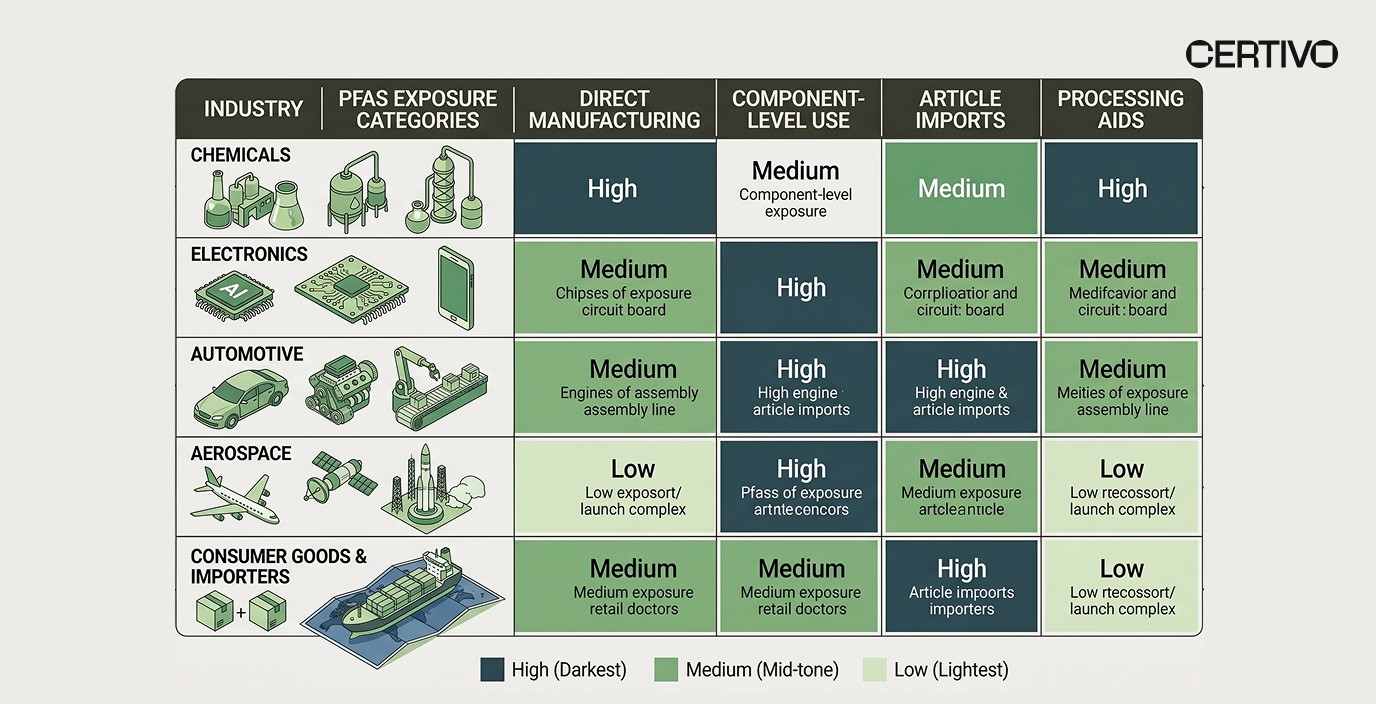
The TSCA PFAS reporting rule cuts across virtually every manufacturing sector. Based on the regulatory scope defined by the EPA, the most affected industries include:
Industry | PFAS Exposure Points |
|---|---|
Chemicals & Manufacturing | Direct PFAS production, processing, and formulation |
Electronics & Semiconductors | PFAS in coatings, etching agents, thermal management materials |
Automotive & Aerospace | High-performance lubricants, seals, fuel system components |
Consumer Goods | Packaging coatings, textile treatments, non-stick applications |
Importers & Distributors | PFAS-containing articles imported into the US market |
For electronics manufacturers, PFAS exposure is deeply embedded in component-level materials. Fluoropolymers used in wire insulation, circuit board coatings, and semiconductor fabrication all fall within scope. PFAS tracking across the electronics supply chain requires specialized substance reporting solutions that go beyond conventional compliance tools.
Automotive manufacturers face similar challenges. PFAS compounds are present in fuel hoses, brake fluids, gaskets, and advanced coatings. The reporting obligation extends to every PFAS-containing component sourced from upstream suppliers.
Aerospace and defense organizations must account for PFAS in fire-suppression foams, hydraulic fluids, and specialized coatings — many of which are procured through multi-tier supply chains with limited substance-level visibility.
Supply Chain and Operational Impact of PFAS Reporting
The operational burden of TSCA PFAS reporting is concentrated in supply chain data collection. Most manufacturers do not synthesize PFAS themselves — they procure components and materials that contain PFAS from upstream suppliers. This means compliance teams must:
Identify which products and BOMs contain PFAS substances
Trace PFAS presence back through multi-tier supplier networks
Collect substance-level data from suppliers who may not have it readily available
Validate and reconcile data across thousands of SKUs and components
Aggregate reporting-ready data in the format required by the EPA
For companies managing thousands of supplier relationships, this is not achievable through spreadsheets or manual outreach. Replacing spreadsheets with a scalable compliance system is a prerequisite for meeting TSCA PFAS reporting obligations at enterprise scale.
The Supplier Data Challenge
Suppliers — particularly Tier 2 and Tier 3 — often lack the technical infrastructure to provide granular PFAS substance data on demand. Common challenges include:
⚠ Suppliers unfamiliar with PFAS classification systems
⚠ Incomplete or inconsistent material declarations
⚠ Resistance to disclosing proprietary formulation details
⚠ Language and regional barriers in global supply chains
⚠ Lack of standardized questionnaire frameworks
Standardized supplier questionnaire frameworks and supplier self-service compliance portals significantly reduce friction in this process. When suppliers can submit data through guided, structured portals rather than responding to ad-hoc email requests, data quality and response rates improve dramatically.
📌 Struggling with supplier PFAS data collection? See how Certivo automates this at scale — Book a Demo.
Compliance Risks and Enforcement Exposure
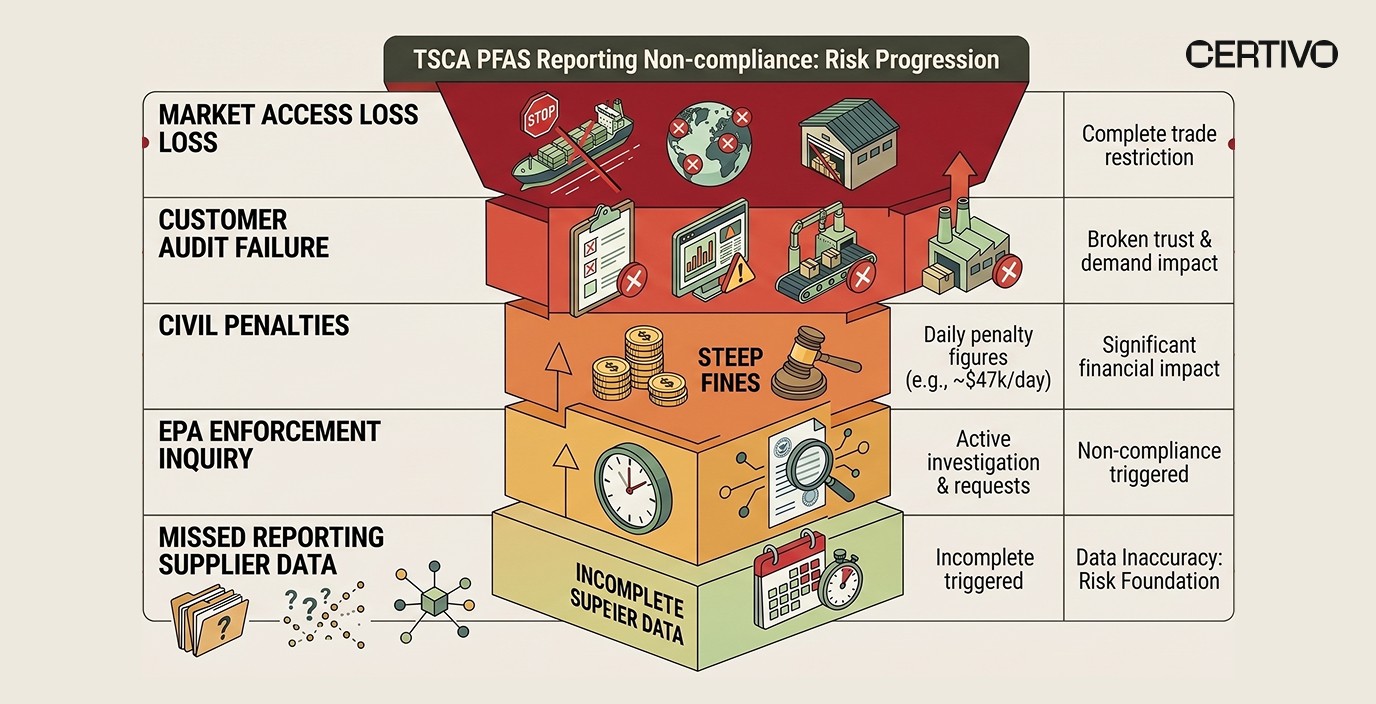
Failure to comply with TSCA Section 8(a)(7) carries significant legal and financial consequences. Under TSCA, the EPA has authority to impose:
Civil penalties of up to $25,000+ per day per violation (adjusted for inflation)
Criminal penalties for knowing or willful violations
Mandatory corrective action orders
Public disclosure of non-compliance through enforcement databases
Beyond direct penalties, non-compliance creates downstream risks:
⚠ Customer audit failures — OEMs and Tier 1 buyers increasingly require PFAS compliance evidence as a procurement condition
⚠ Market access restrictions — Non-reporting companies may face exclusion from government contracts and regulated supply chains
⚠ Reputational damage — EPA enforcement actions are public record and increasingly monitored by investors, ESG rating agencies, and media
For companies operating under multiple frameworks, managing compliance risk proactively is the only defensible strategy. Reactive approaches — waiting for enforcement actions before investing in compliance infrastructure — expose organizations to compounding regulatory, financial, and reputational risk.
Supplier risk scoring and due diligence processes should incorporate PFAS reporting readiness as a scoring criterion. Suppliers unable to provide PFAS substance data represent a direct compliance risk to downstream manufacturers and importers.
How Small Manufacturers and Article Importers Are Affected
The EPA has indicated that small manufacturers who import PFAS only as part of articles will benefit from an extended reporting deadline under the revised rule. This is a meaningful accommodation, but it does not eliminate the reporting obligation.
Small manufacturers should note:
✓ The extended deadline applies specifically to those importing PFAS as components of finished articles — not to those manufacturing or processing PFAS directly
✓ The definition of "small manufacturer" follows existing TSCA thresholds
✓ Even with an extended deadline, the same data requirements apply
✓ Companies must still identify and document PFAS presence in imported articles
For importers handling diverse product catalogs — electronics components, automotive parts, consumer goods — the challenge is identifying which articles contain PFAS in the first place. Many imported articles arrive without adequate material declarations. AI document parsing and certificate validation tools can accelerate the review of supplier documentation, certificates of conformance, and material test reports to flag PFAS-containing articles.
How Certivo automates PFAS supplier data collection for article importers at scale provides a detailed walkthrough of how importers can systematically address this challenge.
Strategic Compliance Preparation Checklist
The EPA's delay does not reduce the compliance workload — it compresses the preparation window. Companies that use this time wisely will be positioned to report efficiently when the revised rule is published.
Immediate Actions (Now Through Revised Rule Publication)
Conduct a PFAS substance inventory — Map all PFAS compounds across BOMs, raw materials, components, and finished goods using BOM-level material mapping tools
Assess supplier readiness — Identify which suppliers can provide PFAS substance data and which require guided collection workflows
Deploy supplier data collection portals — Activate automated supplier data collection to begin gathering PFAS declarations systematically
Establish internal reporting workflows — Define roles, data ownership, and review processes for TSCA reporting
Monitor the Federal Register — Track EPA publications for the revised final rule and new reporting timeline
Pre-Reporting Window Actions
Validate data completeness — Cross-reference collected supplier data against reporting requirements
Reconcile historical records — The rule requires retrospective data back to 2011; ensure historical manufacturing and import records are accessible
Conduct gap analysis — Identify missing data points and initiate targeted supplier outreach
Prepare EPA submission data packages — Structure data in the format required for electronic submission to the EPA
Ongoing Compliance Posture
Implement continuous compliance monitoring — PFAS regulations are evolving rapidly at federal, state, and international levels; a one-time reporting exercise is not sufficient
Integrate PFAS tracking into PLM/ERP workflows — Embed substance compliance checks into product design and procurement processes through an integrated PLM-ERP compliance thread
How AI and Automation Reduce PFAS Reporting Burden
Managing reporting obligations for over 12,000 PFAS compounds across multi-tier supply chains is beyond the capacity of manual processes. AI-native compliance automation transforms this challenge from an overwhelming data exercise into a structured, scalable workflow.
Where AI Delivers the Most Value
📊 Substance identification and classification — CORA-powered regulatory intelligence can parse supplier documentation, safety data sheets, and material declarations to identify PFAS compounds automatically, even when suppliers use non-standard naming conventions or CAS numbers.
📊 Supplier data collection at scale — CORA-driven compliance intelligence automates outreach, tracks response status, and validates incoming supplier data against TSCA reporting requirements. This eliminates the manual follow-up cycles that consume compliance team bandwidth.
📊 BOM-level compliance intelligence — AI maps substance data against product BOMs to determine which finished goods trigger PFAS reporting obligations. This is critical for companies with product catalogs spanning thousands of SKUs.
📊 Regulatory horizon scanning — CORA's regulatory intelligence layer continuously monitors PFAS regulatory developments across federal, state, and international jurisdictions, ensuring compliance teams are not blindsided by converging deadlines.
📊 Gap detection and risk scoring — AI identifies missing data points, flags incomplete supplier responses, and scores suppliers based on PFAS compliance readiness — enabling targeted follow-up rather than blanket outreach.
For companies managing PFAS compliance across multi-tier supply chains, CORA-enabled analysis reduces time-to-compliance by orders of magnitude compared to spreadsheet-based approaches.
How Certivo Supports TSCA PFAS Compliance at Scale
Certivo operates as the centralized system of record for product and supply chain compliance. For TSCA PFAS reporting specifically, Certivo provides:
✓ Substance-level PFAS tracking across 12,000+ compounds mapped to product BOMs
✓ Automated supplier evidence collection through self-service portals with guided PFAS questionnaires
✓ CORA intelligence for parsing supplier documents, identifying PFAS substances, and validating compliance data
✓ Multi-framework coverage — TSCA, REACH, RoHS, Prop 65, state PFAS bans managed in a single platform
✓ Continuous audit-ready documentation that keeps reporting data current, not just deadline-driven
✓ Supplier risk scoring based on PFAS data completeness and responsiveness
Certivo shifts organizations from reactive, deadline-driven compliance to continuous regulatory readiness. When the EPA publishes the revised TSCA PFAS reporting rule, Certivo users will have their data organized, validated, and ready for submission — not starting from scratch.
Explore how Certivo automates TSCA PFAS reporting for article importers before the compliance window opens.
Executive Summary and Next Steps
The EPA's delay of the TSCA Section 8(a)(7) PFAS reporting period is a recalibration, not a cancellation. The reporting obligation remains in effect. The data requirements remain unchanged. The scope — covering every company that has manufactured, imported, or processed PFAS since 2011 — remains the broadest substance reporting mandate in TSCA history.
What has changed is the timeline. The reporting window will now open 60 days after the EPA publishes a revised final rule. Small manufacturers importing PFAS-containing articles will receive an extended deadline. But the underlying compliance workload — substance inventory, supplier data collection, BOM-level mapping, historical record reconciliation — is identical.
Companies that treat this delay as a preparation opportunity will file complete, defensible reports. Companies that treat it as a reason to postpone will face compressed timelines, incomplete data, and elevated enforcement risk.
The strategic imperative is clear: build your PFAS compliance infrastructure now.
📌 Book a demo to see how Certivo automates PFAS compliance across your product portfolio and supply chain — or get a free compliance risk assessment to understand your current PFAS reporting exposure across products and jurisdictions.
Frequently Asked Questions
What triggered the EPA's delay of the TSCA PFAS reporting deadline?
The EPA delayed the TSCA Section 8(a)(7) reporting period to review extensive public feedback received on proposed updates issued in November 2025. The original April 13, 2026 start date is no longer operative. The reporting window will begin 60 days after publication of a revised final rule. Companies should use this period to advance PFAS substance mapping and supplier data collection through platforms like Certivo that support specialized substance reporting solutions.
How many PFAS substances are covered under the TSCA reporting rule?
The rule covers the full class of per- and polyfluoroalkyl substances — over 12,000 individual compounds. Reporting applies to any PFAS manufactured, imported, or processed since January 1, 2011. CORA intelligence within Certivo helps compliance teams identify and classify PFAS compounds across supplier documentation and BOMs, even when non-standard naming conventions are used.
Do article importers need to report PFAS under TSCA Section 8(a)(7)?
Yes. Companies importing finished articles containing PFAS are within scope of the reporting obligation. Small manufacturers importing PFAS only as part of articles will receive an extended deadline under the revised rule, but the data requirements remain the same. Certivo's automated supplier data collection for article importers addresses this challenge systematically.
What are the penalties for failing to report PFAS under TSCA?
Based on currently available regulatory guidance, TSCA violations can result in civil penalties exceeding $25,000 per day per violation, criminal penalties for willful non-compliance, and mandatory corrective actions. Beyond direct penalties, non-reporting companies risk customer audit failures, exclusion from government contracts, and reputational damage.
How should manufacturers prepare for TSCA PFAS reporting during the delay period?
Manufacturers should immediately conduct a PFAS substance inventory across all BOMs and product lines, assess supplier readiness to provide PFAS data, deploy automated supplier data collection portals, and establish internal reporting workflows. Certivo's CORA-driven compliance intelligence automates substance identification, supplier outreach, and gap analysis — ensuring organizations are submission-ready when the revised rule is published.
Lavanya
Lavanya is an accomplished Product Compliance Engineer with over four years of expertise in global environmental and regulatory frameworks, including REACH, RoHS, Proposition 65, POPs, TSCA, PFAS, CMRT, FMD, and IMDS. A graduate in Chemical Engineering from the KLE Institute, she combines strong technical knowledge with practical compliance management skills across diverse and complex product portfolios.