


California's regulatory reach is expanding again — and this time, it targets an entire chemical class. The Office of Environmental Health Hazard Assessment (OEHHA) has initiated a formal review of p,p'-bisphenol chemicals under Proposition 65, including substitutes for Bisphenol A (BPA) and Bisphenol S (BPS). The Proposition 65 bisphenol class review signals a fundamental shift from individual substance regulation to class-based listing — a change that could dramatically expand compliance obligations for manufacturers across packaging, medical devices, electronics, automotive, and consumer products.
For compliance leaders, procurement teams, and executives managing product portfolios sold into California, this is not a routine chemical update. If OEHHA's Developmental and Reproductive Toxicant Identification Committee (DARTIC) determines that the p,p'-bisphenol class causes reproductive toxicity, every structurally similar bisphenol analogue could be listed under Proposition 65 — including chemicals that companies adopted specifically as "safer" alternatives to BPA.
The message is clear: substitution alone is no longer a compliance strategy. Understanding what this review means — and acting before listings are finalized — is now a board-level priority for CEOs and compliance leaders.
📌 Table of Contents
What Is Happening: OEHHA's p,p'-Bisphenol Class Review
Why This Is Different: Class-Based vs. Individual Substance Regulation
Chemicals Under Review: BPA, BPS, BPAF, and Analogues
Industries and Products at Risk
What a Prop 65 Listing Means for Your Business
Supply Chain and Product Reformulation Impact
What Manufacturers Should Do Right Now
Compliance Readiness Checklist
How AI Accelerates Bisphenol Compliance Monitoring
FAQs
Executive Conclusion
What Is Happening: OEHHA's p,p'-Bisphenol Class Review
In March 2026, OEHHA formally initiated the review of p,p'-bisphenol chemicals for potential listing under Proposition 65 as substances known to cause reproductive toxicity. The review is being conducted by the Developmental and Reproductive Toxicant Identification Committee (DARTIC), the scientific body responsible for evaluating chemicals for Prop 65 listing based on reproductive and developmental harm evidence.
This review is significant because it does not target a single chemical. It evaluates the entire p,p'-bisphenol class — meaning that BPA, BPS, BPAF, and all structurally similar bisphenol analogues are under simultaneous evaluation. The DARTIC meeting date has not yet been announced, but the review process is actively underway.
⚠ BPS is already listed under Proposition 65. This review could extend listing to the full class of bisphenol analogues, including chemicals companies have adopted as BPA replacements.
For manufacturers currently selling products into California, this creates immediate uncertainty around substances that may have been considered "compliant alternatives." Organizations managing materials and environmental compliance must assess their exposure to the entire bisphenol class — not just BPA.
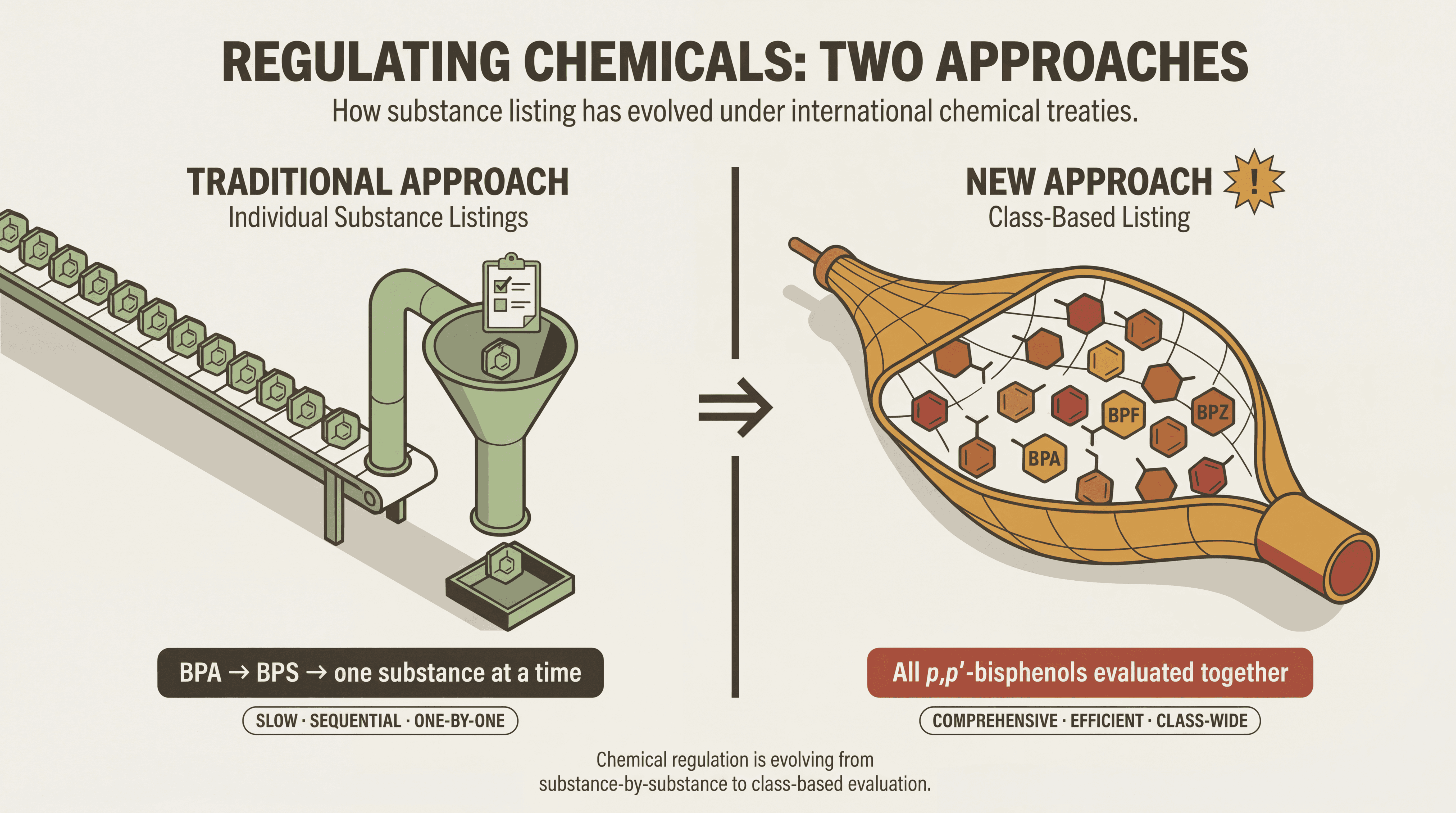
Why This Is Different: Class-Based vs. Individual Substance Regulation
Traditionally, Proposition 65 listings target individual chemicals. A substance is reviewed, evidence is assessed, and — if the scientific committee determines it meets the listing criteria — that specific chemical is added to the Prop 65 list. Manufacturers then reformulate to avoid the listed substance, often switching to a structural analogue.
The bisphenol class review breaks this pattern.
By evaluating the entire p,p'-bisphenol class together, OEHHA is signaling that structural analogues used as substitutes may carry similar toxicological profiles — and therefore should be regulated as a group. This approach mirrors the class-based regulatory philosophy already seen in PFAS regulation globally, where thousands of structurally related substances are treated as a single regulatory class.
📊 Why this matters for manufacturers:
Companies that replaced BPA with BPS or BPAF may find their "compliant" alternatives newly listed
Reformulation cycles that took years and cost millions could be invalidated overnight
Products marketed as "BPA-free" may still contain listed bisphenol analogues
Warning label requirements under Prop 65 would apply to any product containing listed substances sold in California
This class-based shift means compliance teams should be driving strategic product decisions, not reacting to listings after the fact.
Chemicals Under Review: BPA, BPS, BPAF, and Analogues
The OEHHA review covers specific named chemicals as well as the broader class of structurally similar substances. Understanding which chemicals are included is essential for assessing product exposure.
Chemical Name | EC Number | CAS Number | Current Status | Review Reason |
|---|---|---|---|---|
Bisphenol A (BPA) | 201-245-8 | 80-05-7 | Under review | Potential reproductive toxicity |
Bisphenol S (BPS) | 201-250-5 | 80-09-1 | Already listed under Prop 65 | Potential reproductive toxicity |
Bisphenol AF (BPAF) | 216-036-7 | 1478-61-1 | Under review | Structural analogue with suspected reproductive toxicity |
Other p,p'-bisphenol analogues | N/A | N/A | Under review | Class-based evaluation for reproductive toxicity |
⚠ Key risk: The "other p,p'-bisphenol analogues" category is intentionally broad. It could capture any structurally similar bisphenol substance, including chemicals not yet individually evaluated. Manufacturers that have switched from BPA to lesser-known bisphenol alternatives face the highest uncertainty.
Organizations need BOM-level substance tracking capable of identifying not just BPA, but every bisphenol-class substance present in their product compositions and supply chain inputs.
For context on how ECHA has recently expanded its own substance-class evaluations, see ECHA adds two chemicals to SVHC candidate list — notably, BPAF is already flagged under EU REACH as well.
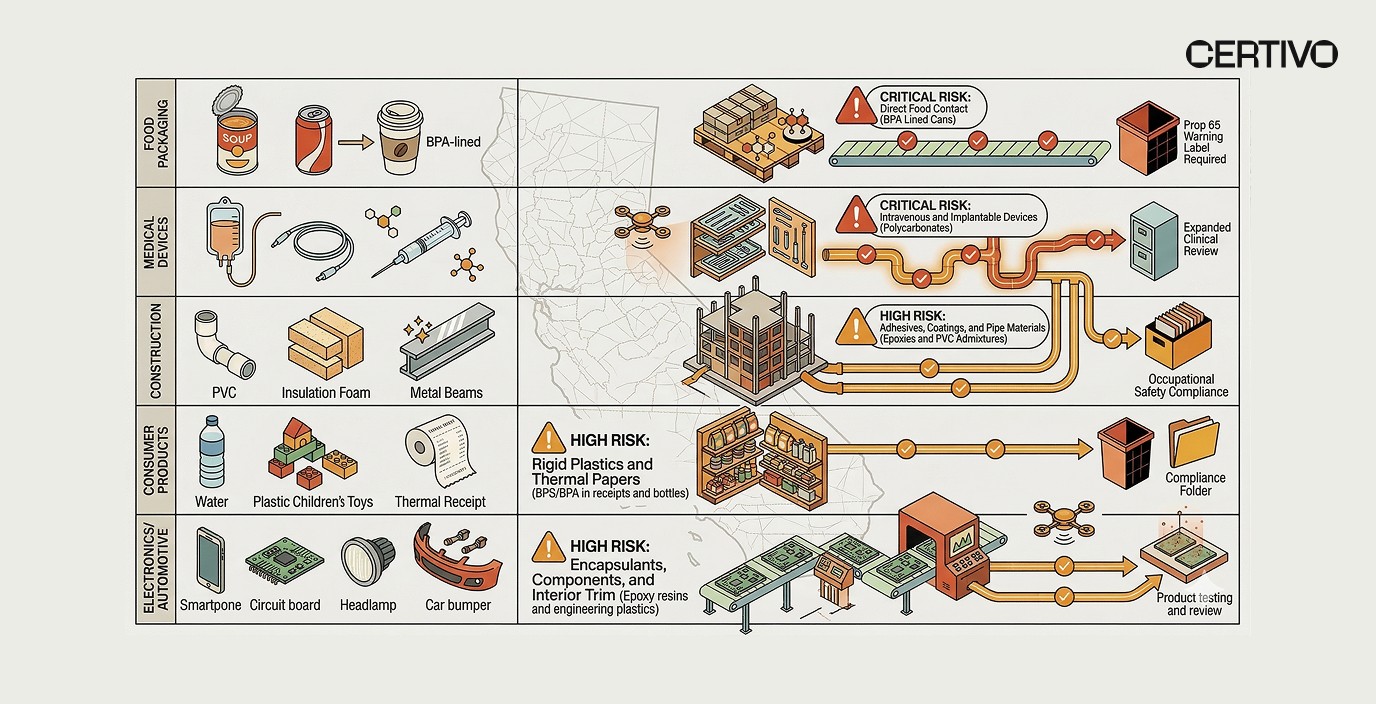
Industries and Products at Risk
The ubiquity of bisphenol chemicals in modern manufacturing means this review affects a wide range of sectors. If your products contain polycarbonate plastics, epoxy resins, thermal coatings, or polymer-based components, your exposure is real.
Industry | Common Bisphenol Uses | Risk Level |
|---|---|---|
Food & Beverage Packaging | Can linings, plastic containers, protective coatings | ⚠ Critical |
Medical Devices | Polymer-based components, device housings, tubing | ⚠ High |
Construction Materials | Resins, adhesives, sealants, pipe linings | ⚠ High |
Consumer Products | Hard plastics, thermal receipt papers, coatings | ⚠ Critical |
Electronics & Automotive | Plastic housings, epoxy resins, circuit board materials | ⚠ High |
Consumer goods manufacturers face the most immediate exposure because Proposition 65 warning requirements apply at the point of sale in California. Products already on retail shelves may require reformulation or warning label updates if new bisphenol substances are listed.
Medical device manufacturers face a dual challenge: bisphenol analogues are used in critical polymer components where substitution must meet stringent biocompatibility and performance requirements.
Electronics manufacturers using epoxy resins and polycarbonate housings should evaluate bisphenol content across their product lines. For a detailed look at electronics-specific compliance complexity, see electronics supply chains in 2026: automating multi-tier compliance.
Automotive manufacturers should assess bisphenol presence in interior plastics, adhesives, and coating materials — particularly for vehicles and components sold in California.
What a Prop 65 Listing Means for Your Business
If DARTIC determines that the p,p'-bisphenol class meets the criteria for reproductive toxicity, the consequences for manufacturers are immediate and operationally significant.
Proposition 65 requires businesses to:
✓ Provide a "clear and reasonable warning" before exposing any person in California to a listed chemical
✓ Apply warnings on product labels, packaging, shelf tags, or online product pages
✓ Ensure warnings are compliant with specific formatting, content, and placement requirements under Prop 65 regulations
Non-compliance consequences:
⚠ Private enforcement lawsuits — Prop 65 is enforced through private right-of-action, meaning any individual or organization can file suit against non-compliant businesses
⚠ Penalties up to $2,500 per violation per day — with "per violation" interpreted as per product, per unit, or per exposure instance
⚠ Settlement costs — the vast majority of Prop 65 cases settle, but settlements frequently include five- and six-figure payments plus ongoing compliance obligations
⚠ Brand and market risk — Prop 65 warnings on consumer products create negative market perception and competitive disadvantage
For organizations already managing Prop 65 compliance across multiple substances, adding an entire chemical class creates exponential complexity. Managing compliance risk proactively is essential to avoid both legal exposure and warning label proliferation.
Companies handling Prop 65 alongside other California-specific rules should review California Proposition 65 compliance 2026: new listings and warning requirements for a broader compliance picture.
Supply Chain and Product Reformulation Impact
The class-based nature of this review creates supply chain challenges that single-substance listings do not.
Why class-based listings are harder to manage:
⚠ Substitute substances are now at risk — Companies that invested in BPA-to-BPS reformulation may need to reformulate again
⚠ Supplier data gaps — Most suppliers provide BPA-specific declarations but do not routinely disclose other bisphenol analogues
⚠ Extended qualification timelines — Alternative materials for food contact, medical, and electronics applications require extensive testing and regulatory approval
⚠ Multi-tier visibility required — Bisphenol substances may be present in sub-components, coatings, or adhesives sourced from tier-2 and tier-3 suppliers
Organizations relying on basic supplier declarations that only address BPA will need to expand data collection to cover the full bisphenol class. Centralizing supplier documentation through self-service portals reduces manual follow-up cycles and ensures data requests capture all relevant substances.
For companies managing reformulation across multiple product lines, the ability to launch new products faster while maintaining compliance becomes a competitive advantage. Product development teams should be evaluating non-bisphenol alternatives now rather than waiting for a final listing decision.
The complete guide to product compliance management provides a broader framework for coordinating reformulation, supplier engagement, and regulatory tracking across jurisdictions.
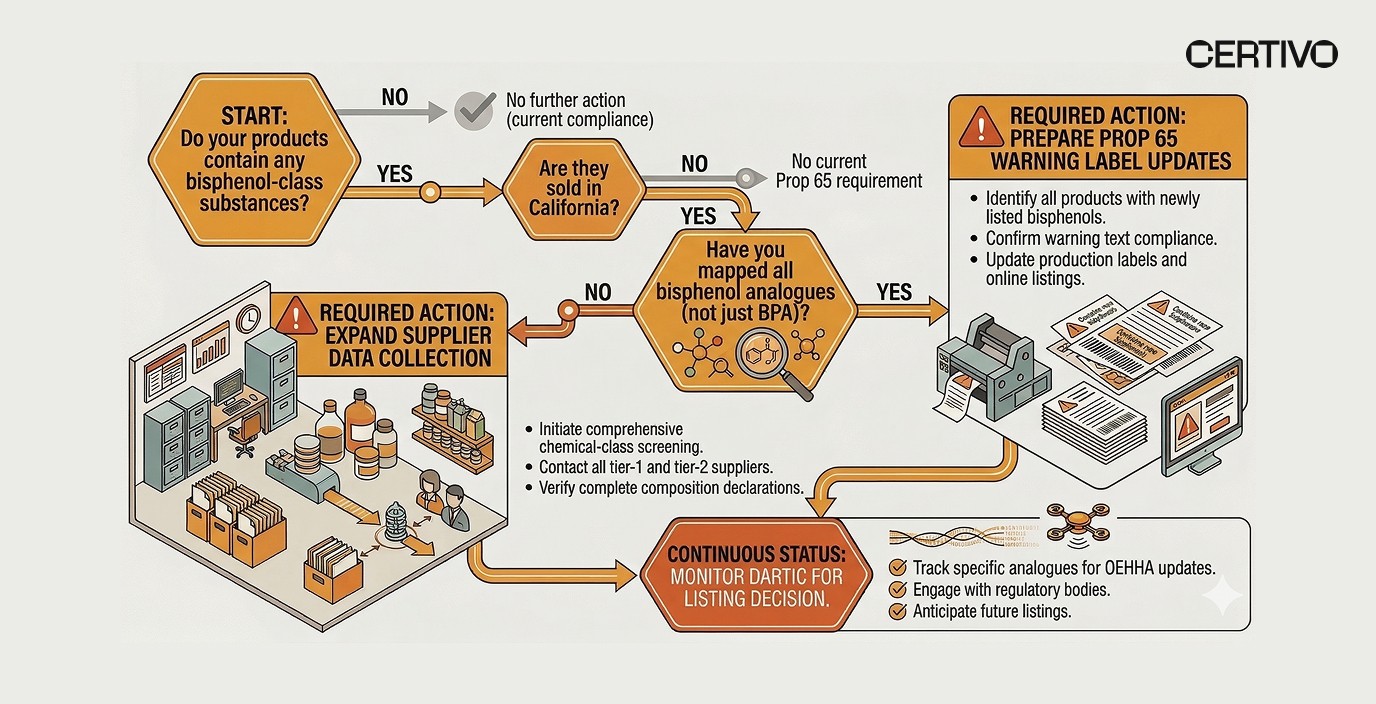
What Manufacturers Should Do Right Now
The DARTIC meeting date has not yet been announced, but the review is active. Waiting for a final listing decision before taking action is the highest-risk strategy available. Compliance regulation managers should initiate the following steps immediately.
📌 Immediate action items:
Step 1: Identify all bisphenol substances in your products
Map BPA, BPS, BPAF, and all bisphenol analogues present in product BOMs, raw materials, coatings, adhesives, and packaging materials
Do not limit this assessment to BPA — the review covers the entire p,p'-bisphenol class
Step 2: Expand supplier data requests beyond BPA
Issue updated substance data requests to suppliers that specifically ask about BPS, BPAF, and all structurally similar bisphenol substances
Collaborating with suppliers through structured questionnaire frameworks ensures comprehensive, auditable responses
Step 3: Assess warning label requirements
Determine which products sold in California may require Prop 65 warnings if new bisphenol substances are listed
Evaluate current warning label inventory and identify gaps
Step 4: Begin alternative material evaluation
Identify non-bisphenol alternatives for critical applications
Prioritize product lines with the highest California sales volume and the greatest bisphenol exposure
Step 5: Monitor OEHHA for DARTIC meeting announcements
Track the OEHHA website and regulatory feeds for the DARTIC meeting date, agenda, and preliminary findings
Regulatory intelligence and horizon scanning capabilities ensure compliance teams receive real-time alerts when the meeting is scheduled
Compliance Readiness Checklist
📌 Use this checklist to assess your organization's preparedness for the Proposition 65 bisphenol class review:
# | Action Item | Owner | Status |
|---|---|---|---|
1 | Inventory all bisphenol-class substances (BPA, BPS, BPAF, analogues) across product BOMs | Compliance + Engineering | ☐ |
2 | Map bisphenol presence in supply chain inputs (coatings, adhesives, resins, packaging) | Procurement + Compliance | ☐ |
3 | Issue expanded supplier data requests covering full bisphenol class | Procurement | ☐ |
4 | Audit current Prop 65 warning labels for completeness | Regulatory Affairs + Legal | ☐ |
5 | Identify products with highest California sales exposure | Sales + Compliance | ☐ |
6 | Evaluate non-bisphenol alternative materials by application | R&D + Engineering | ☐ |
7 | Assess overlap with EU REACH bisphenol restrictions (BPAF SVHC listing) | Compliance | ☐ |
8 | Monitor OEHHA for DARTIC meeting date and outcomes | Regulatory Affairs | ☐ |
9 | Brief executive team on class-based listing risk and potential market impact | Compliance → C-Suite | ☐ |
10 | Document all assessment evidence for audit-readiness | Compliance | ☐ |
For companies managing Prop 65 obligations alongside REACH, RoHS, and TSCA, the ability to stay audit-ready across multiple frameworks prevents duplication and ensures substance-level data is consistent across jurisdictions.
VP and Directors of Quality should own items 4, 6, and 10, coordinating between compliance, engineering, and legal teams.
How AI Accelerates Bisphenol Compliance Monitoring
The shift to class-based chemical evaluation under Proposition 65 creates compliance challenges that manual processes cannot scale to meet. When an entire chemical class is under review — rather than a single named substance — the data collection, substance identification, and supplier engagement burden multiplies exponentially.
Core challenges requiring AI-driven solutions:
Identifying bisphenol-class substances across thousands of SKUs, BOMs, and supplier inputs
Expanding substance data requests from BPA-only to the full p,p'-bisphenol class
Monitoring OEHHA regulatory actions, DARTIC meeting schedules, and listing decisions in real time
Mapping multi-tier supply chain exposure to substances that suppliers may not routinely disclose
AI-native compliance platforms address these challenges through:
✓ Automated BOM scanning that identifies bisphenol-class substances at the component and material level — not just BPA
✓ AI document parsing that extracts substance data from supplier safety data sheets, certificates, and material declarations
✓ Supplier risk scoring that prioritizes high-bisphenol-exposure suppliers for immediate engagement
✓ Regulatory horizon scanning that provides real-time alerts when DARTIC meeting dates are announced or listing decisions are published
✓ Standardized supplier questionnaire frameworks that capture bisphenol-class data in structured, auditable formats
For a comprehensive overview of how AI transforms compliance operations, see AI tools for compliance management: the complete guide. Organizations managing chemical compliance across California, EU, and federal U.S. jurisdictions should also evaluate AI in supply chain compliance management as a framework for consolidating substance-level data across regions.
IT and systems leaders evaluating compliance platforms should prioritize solutions that support class-based substance tracking — not just individual chemical lookups. The features overview provides a detailed view of how platform capabilities map to these requirements.
Frequently Asked Questions (FAQs)
Q1: Is the p,p'-bisphenol class already listed under Proposition 65?
Not yet. Bisphenol S (BPS) is already listed under Prop 65. However, the current OEHHA review could result in the listing of the entire p,p'-bisphenol class — including BPA, BPAF, and all structurally similar analogues — as causing reproductive toxicity. The DARTIC meeting date has not yet been announced. Monitor the Prop 65 framework page for updates.
Q2: My products are labeled "BPA-free." Am I still at risk?
Yes. "BPA-free" products often contain substitute bisphenols such as BPS or BPAF. If the class-based review results in listing these analogues, products marketed as BPA-free may still contain listed substances and require Prop 65 warnings. Organizations should conduct full bisphenol-class substance assessments rather than relying on BPA-only certifications.
Q3: What penalties apply if my products contain a newly listed bisphenol and I don't provide warnings?
Proposition 65 allows private enforcement lawsuits with penalties of up to $2,500 per violation per day. Violations can be interpreted per product, per unit, or per exposure instance. Most cases settle, but settlements typically include significant financial payments plus ongoing compliance monitoring. Proactive compliance risk management is far less costly than reactive litigation.
Q4: How does this relate to EU REACH restrictions on bisphenols?
BPAF has already been identified as a Substance of Very High Concern (SVHC) under EU REACH. The Prop 65 class-based review and EU REACH evaluations are separate regulatory actions, but they target overlapping substances. Companies operating in both markets should coordinate their bisphenol compliance strategies. For EU-specific context, see REACH SVHC and Annex XVII changes.
Q5: When will the DARTIC make its determination?
The DARTIC meeting date has not yet been announced. The review was initiated in March 2026 and is ongoing. Organizations should not wait for the meeting outcome to begin preparing — substance identification, supplier engagement, and alternative evaluation should start now. Regulatory intelligence tools can provide automated alerts when the meeting is scheduled.
Executive Conclusion
The Proposition 65 bisphenol class review represents a pivotal moment in chemical compliance strategy. OEHHA's decision to evaluate the entire p,p'-bisphenol class — rather than individual substances one at a time — signals that "regrettable substitution" (replacing one hazardous chemical with a structurally similar analogue) is no longer an acceptable compliance approach.
For manufacturers selling products into California across food packaging, medical devices, construction materials, consumer goods, electronics, and automotive sectors, the Proposition 65 bisphenol class review demands immediate action: identify all bisphenol-class substances in your products and supply chain, expand supplier data collection beyond BPA, evaluate non-bisphenol alternatives, and prepare for potential warning label requirements.
📌 The OEHHA review is documented at JD Supra's Prop 65 Roundup — March 2026.
The class-based regulatory trend is accelerating — from PFAS under EU REACH to bisphenols under Prop 65. Organizations that build the substance-level intelligence, supplier transparency, and regulatory monitoring infrastructure to respond to class-based listings will be positioned for compliance. Those that continue managing chemicals one at a time will not.
To explore how AI-driven compliance platforms like Certivo support continuous regulatory readiness for class-based chemical compliance, connect with the Certivo team.
Lavanya
Lavanya is an accomplished Product Compliance Engineer with over four years of expertise in global environmental and regulatory frameworks, including REACH, RoHS, Proposition 65, POPs, TSCA, PFAS, CMRT, FMD, and IMDS. A graduate in Chemical Engineering from the KLE Institute, she combines strong technical knowledge with practical compliance management skills across diverse and complex product portfolios.
She has extensive experience in product compliance engineering, ensuring that materials, components, and finished goods consistently meet evolving international regulatory requirements. Her expertise spans BOM analysis, material risk assessments, supplier declaration management, and test report validation to guarantee conformity. Lavanya also plays a key role in design-for-compliance initiatives, guiding engineering teams on regulatory considerations early in the product lifecycle to reduce risks and streamline market access.
Her contributions further extend to compliance documentation, certification readiness, and preparation of customer deliverables, ensuring transparency and accuracy for global stakeholders. She is adept at leveraging compliance tools and databases to efficiently track regulatory changes and implement proactive risk mitigation strategies.
Recognized for her attention to detail, regulatory foresight, and collaborative approach, Lavanya contributes significantly to maintaining product compliance, safeguarding brand integrity, and advancing sustainability goals within dynamic, globally integrated manufacturing environments.