


The 21st Century ROAD to Housing Act is now federal law, and for contractors and manufacturers the headline is not just more housing. It is more federally funded projects that carry Build America, Buy America (BABA) obligations. Efforts to carve BABA exemptions into the bill did not prevail, so domestic-content tracking stays firmly in place. That matters right now because a separate, hard deadline lands on October 1, 2026, when the Federal Highway Administration's 55% domestic-content test takes effect. BABA compliance in 2026 will be decided by documentation, and most teams are not ready.
If your projects touch federal funding, you can book a compliance risk assessment to see where your domestic-content documentation gaps sit before your next obligation date.
Key Takeaways
📌 New law, same BABA: The 21st Century ROAD to Housing Act became law on July 11, 2026. Attempts to add BABA exemptions failed, so Buy America obligations remain.
🏛️ Strong bipartisan passage: The Senate passed it 85-5 on June 22, 2026, and the House 358-32 on June 23, 2026, signaling durable political support.
🏭 Bigger federal footprint: The Act aims to close a housing shortage widely estimated at 4 to 7 million homes, meaning more federally assisted projects subject to domestic-content rules.
⏳ Hard deadline ahead: For FHWA-funded projects obligated on or after October 1, 2026, manufactured products must be U.S.-assembled and meet a greater-than-55% domestic component-cost test.
📄 Documentation is the burden: BABA compliance requires component-level origin and cost evidence gathered across subcontractors and manufacturers.
⚠️ Audit exposure is real: Missing or inconsistent domestic-content records lead to project holds, waiver denials, and payment delays.
🤖 Automation closes the gap: Spreadsheet tracking cannot scale to component-level evidence across hundreds of parts and multiple supplier tiers.
What the 21st Century ROAD to Housing Act Actually Does
The Act is the most significant federal housing legislation in a generation. According to The New York Times, it is the most significant housing bill since the Cranston-Gonzalez National Affordable Housing Act in 1990. Its purpose is supply. The United States faces a housing shortage widely estimated at 4 to 7 million homes, and the shortage, measured in the millions of units, has contributed to rising home prices and rents nationwide. WikipediaMaria Salazar
It passed with rare cross-party strength. On June 22, 2026, the Senate passed the bill 85-5, and the following day the House passed it 358-32. President Trump declined to sign it, and the 10-day clock started on June 29 when the bill was delivered to the White House; without a signature or veto, it became law automatically. It automatically became law on July 11, 2026, after the President neither signed nor vetoed it within the set timeframe. You can read the enacted text at Congress.gov (H.R. 6644). Bipartisan Policy Center + 2
For compliance leaders, the operative point is scope. More federal housing activity means more projects flowing through HUD and USDA programs, and those programs carry domestic-content obligations. Teams that treat supplier and contractor management as a repeatable process will absorb that demand without adding headcount, unlike teams still reacting project by project through Buy America compliance for public infrastructure.
Why BABA Stayed In, and Why That Matters
Several industry groups pushed to build BABA exemptions into the legislation. That effort did not succeed in the way many hoped. The final Act did not adopt a blanket exemption for federally assisted housing. Its only BABA-specific provision is narrow and forward-looking. The Act directs HUD to review how BABA requirements apply to HOME-funded projects and to issue updated guidance, with the implementation review due within roughly 180 days of enactment. A standalone bill would have fully exempted the HOME program from BABA, but the enacted version instead requires HUD to review and issue guidance. Bipartisan Policy CenterNAAHL
Two facts should shape your planning. First, BABA obligations do not originate in this Act. They flow from the 2021 Infrastructure Investment and Jobs Act (Pub. L. 117-58) and the Buy America Preference at 2 CFR 184. Second, the Act itself authorizes no new implementation funds, so it is primarily a structural reform. The practical result is that BABA stays in force for federally assisted infrastructure and housing, and the documentation obligation stays with contractors and their suppliers. Understanding the distinctions between Buy American, Buy America, and BABA is the starting point for scoping which rule applies to which project.
The October 1, 2026 FHWA Deadline
The most urgent BABA change in 2026 sits in the highway program. The Federal Highway Administration is phasing in Buy America for manufactured products in two steps, ending a manufactured-products waiver that had stood for roughly four decades.
Two Effective Dates
For federal-aid projects obligated on or after October 1, 2025, final assembly of all manufactured products must occur in the United States. For projects obligated on or after October 1, 2026, more than 55 percent of a manufactured product's component cost must also be U.S.-sourced. The rule is documented in the FHWA Buy America final rule in the Federal Register and summarized on FHWA's announcement page. ACEC Arizona
The jump in evidence is the real story. A finished-in-the-USA claim is one document. A 55% component-cost calculation requires cost and origin data for every component inside every manufactured product. That is where Build America Buy America compliance becomes a data problem, not a paperwork problem, and where reshoring is increasing documentation workloads faster than teams can keep up manually.
BABA compliance deadline timeline showing October 2026 domestic content rule
Click on image to view full
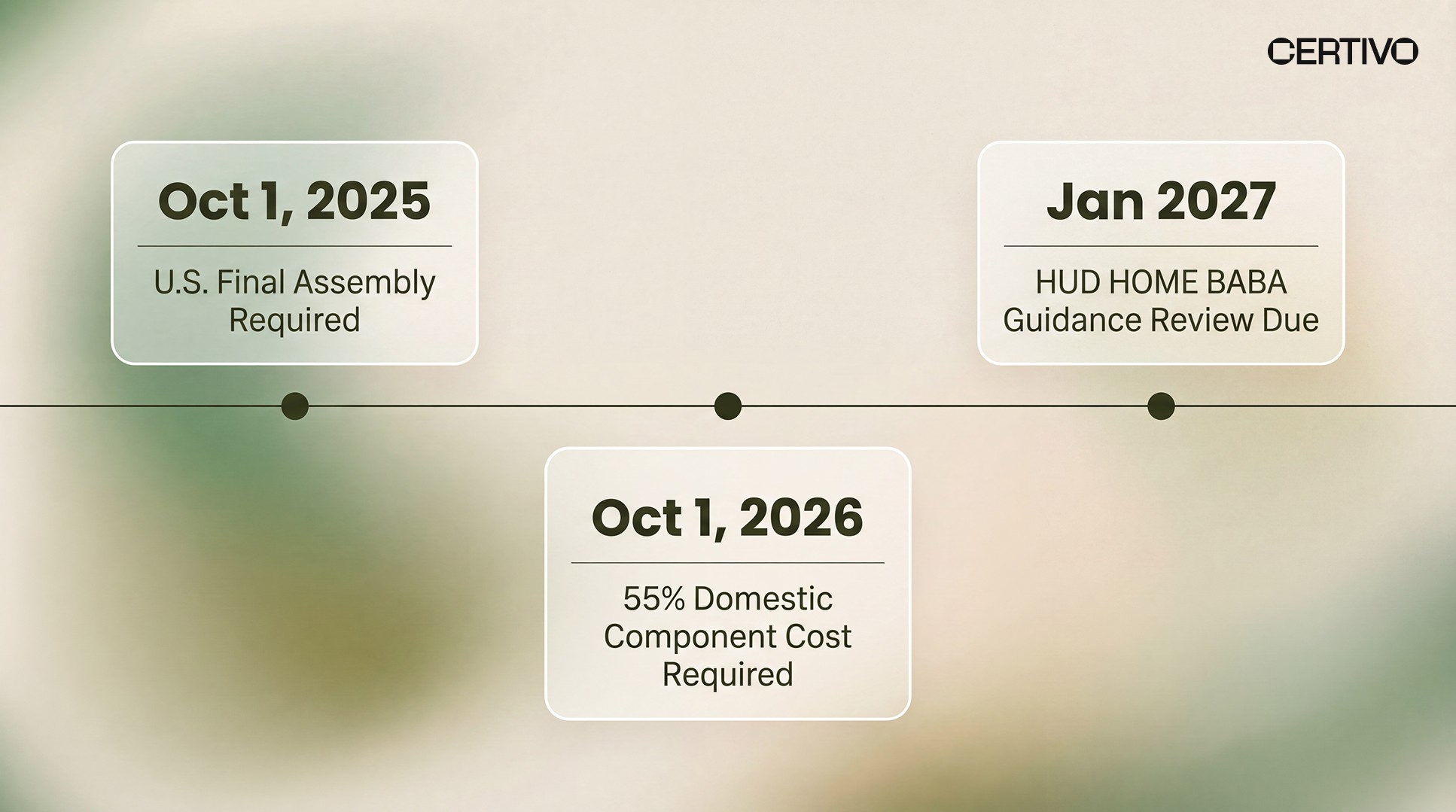
How the Housing Act and FHWA Rule Fit Together
It is easy to conflate these two, so here is the clean separation. The 21st Century ROAD to Housing Act is a housing-supply law that leaves BABA intact and orders a HUD review of HOME-program treatment. The FHWA rule is a highway-program rule with a fixed October 1, 2026 domestic-content threshold. They are different tracks with different agencies, but they point in the same direction: more federally funded work, and a higher bar for proving domestic content.
For a contractor working across both worlds, the overlap is the supply base. The same manufacturers and distributors supply highway projects and housing projects, and both now demand domestic-content evidence. A single centralized compliance data backbone removes the duplicate effort of chasing the same suppliers for different programs and keeps one source of truth across agencies.
Who Is Affected by BABA in 2026
BABA reaches any organization that builds, supplies, or certifies materials for federally funded projects. Three groups feel the 2026 changes most.
Infrastructure and FHWA-Funded Contractors
General contractors and infrastructure firms building bridges, highways, transit, dams, and water treatment facilities carry primary responsibility for domestic-content compliance. They collect evidence from subcontractors and manufacturers and present it during federal reviews. This is the most time-sensitive group because the 55% test attaches to project obligation dates. Getting ahead of it means treating collaboration with suppliers as a managed workflow rather than a series of one-off requests.
HUD and USDA Housing Developers
Developers and grantees on HUD-assisted and USDA Rural Housing projects also fall under BABA. HUD has waived application of the Buy America Preference until program- and product-specific effective dates under its Phased Implementation Waiver. Even under waivers, the evidence burden persists, because waiver requests rely on the same underlying supplier data. As federal housing activity rises under the new Act, this group's documentation load grows with it, which is why procurement and supply teams are the natural owners of a standardized process. HUD
Manufacturers and Suppliers
Manufacturers supplying either track must now produce component-level origin and cost data on demand. Buyers will increasingly make domestic-content documentation a condition of award, so suppliers that can respond quickly gain an advantage. Firms in building materials and construction and the broader government and public sector supply base should expect these requests to become routine.
The Real Problem Is Documentation, Not the Rule
The BABA rule text is short. Proving compliance is not. The obligation is to demonstrate, with defensible records, that specific products meet U.S.-manufacturing and domestic-content tests at the component level.
Why Spreadsheets Break Down
Most teams still track domestic content in spreadsheets and email threads. That approach fails as scope grows. A single infrastructure project can involve hundreds of manufactured products, each with multiple components and cost inputs. Version control breaks, certificates expire unnoticed, and no one can quickly answer which finished assemblies contain a non-compliant part. Moving from spreadsheets to a scalable compliance system is the difference between reacting to a review and being ready for one.
The Subcontractor and Manufacturer Data Gap
Domestic-content evidence lives with parties you do not control. Subcontractors forward requests to distributors, distributors ask manufacturers, and responses arrive in inconsistent formats or not at all. Manual follow-up does not scale, and missing data becomes your risk at audit. Automated data collection and structured supplier documentation workflows convert that scramble into a tracked, repeatable process with clear ownership and status.
BABA domestic content documentation workflow for federally funded projects
Click on image to view full

BABA Audit Readiness: What Reviewers Ask For
No software eliminates audit findings. The realistic goal is audit-ready, not audit-proof: fewer surprises and faster response when a reviewer, funding agency, or prime contractor requests proof. The scrutiny is real and coming from the top. A U.S. Senator recently described HUD's BABA waiver process on the record as "the black hole where affordable housing dies," which tells you how much pressure sits on getting the documentation right. NCSHA
Reviewers generally want three things from your domestic-content records:
✓ Who provided the evidence: the subcontractor or manufacturer of record
✓ When it was provided: time-stamped and tied to the project obligation date
✓ What it certifies: the specific product, its components, and the cost basis
Strong records also support point-in-time retrieval. If a project was obligated before a threshold changed, you need the version of the evidence that applied then. Treating this as a data-versioning problem, with immutable logs and historic-state tracking, keeps audit readiness across frameworks intact under FAR, BABA, and related rules, and it connects naturally to broader trade and customs compliance.
A BABA Compliance Checklist for 2026
If your current process cannot produce this evidence on demand, request a compliance review to pressure-test your readiness before the deadline.
How Certivo Automates BABA Documentation
Certivo is a compliance data backbone for manufacturers and contractors, not a legal advisor. It automates the operational work that BABA compliance actually requires: collecting supplier data, validating certificates, tracking domestic content, and keeping audit-ready records in one system.
Automated supplier and subcontractor outreach. Certivo runs structured data-collection campaigns so subcontractors and manufacturers submit domestic-content evidence through guided portals instead of ad hoc email. This targets the biggest failure point on federal projects, and it reduces the manual follow-up that makes global supply chains hard to document.
AI document parsing and validation with CORA. CORA, Certivo's embedded compliance intelligence, extracts data from certificates and test reports, flags incomplete or inconsistent submissions, and validates them against requirements. CORA-powered regulatory intelligence reduces manual review time and catches gaps at intake rather than at audit.
BOM-level domestic-content tracking. Certivo maps evidence to specific products and assemblies, so you can answer which finished items contain a non-compliant component. That visibility is central to proactive compliance risk management for infrastructure and construction teams.
Continuous, audit-ready documentation. Records are time-stamped, project-linked, and retrievable on demand, which shortens the hours-to-audit-pack for any federal review or prime-contractor request. For teams reading up on Buy America Act compliance in 2026, this is the operational layer that turns the rule into a repeatable process.
The Bottom Line
The 21st Century ROAD to Housing Act is now law, it enjoys durable bipartisan support, and it leaves BABA firmly in place. Combined with the FHWA 55% domestic-content threshold arriving October 1, 2026, the direction is clear: more federally funded projects, and a higher bar for proving domestic content. Contractors who still track this in spreadsheets will feel it first, in project holds and slow reviews.
The teams that stay ahead treat supplier data collection, domestic-content tracking, and audit-ready documentation as an automated, continuous process. That is exactly what Certivo is built to run. To see where your gaps are before your next obligation date, book a compliance risk assessment.
Kunal Chopra
Kunal Chopra is the CEO of Certivo, an AI-driven compliance management platform revolutionizing how manufacturers navigate regulatory challenges. With a career spanning over two decades, Kunal is a seasoned technology leader, 3x tech CEO, product innovator, and board member with a passion for driving transformative growth and innovation.
Before leading Certivo, Kunal spearheaded successful transformations at renowned companies like Beckett Collectibles, Kaspien, Amazon, and Microsoft. His strategic vision and operational excellence have led to achievements such as a 25x EBITDA valuation increase at Beckett Collectibles and a 450% shareholder return at Kaspien. He has a track record of turning challenges into opportunities, delivering operational efficiencies, and driving market expansions.