


The European Chemicals Agency (ECHA) has taken its most consequential step yet toward a class-based EU PFAS restriction under REACH. In March 2026, ECHA's Committee for Risk Assessment (RAC) released its final opinion supporting EU-wide restrictions on per- and polyfluoroalkyl substances. Concurrently, the Committee for Socio-Economic Analysis (SEAC) published a draft opinion endorsing the same direction — now open for public consultation through May 25, 2026.
Under this proposal, PFAS is defined structurally: any substance containing at least one fully fluorinated methyl (CF₃) or methylene (CF₂) carbon atom, without any hydrogen, chlorine, bromine, or iodine attached to it. This structural definition is critical for compliance engineers — it determines whether a substance in your product portfolio falls within the restriction's scope, regardless of commercial name or common classification.
This is no longer a proposal under evaluation. It is a restriction advancing through the final stages of the REACH regulatory process, with the potential to reshape how manufacturers, importers, and supply chain operators across every sector manage chemical compliance in the EU market.
For compliance leaders, regulatory directors, and supply chain executives, the question is no longer whether PFAS will be restricted across the EU — it is how quickly your organization can map its PFAS exposure, assess derogation eligibility, and build the infrastructure for continuous compliance monitoring and audit readiness.
📌 Book a free compliance assessment to map your EU PFAS exposure across products and supply chains before the restriction framework finalizes.
📖 Table of Contents
Why the March 2026 ECHA Announcement Changes Everything
Background: How the EU PFAS Restriction Evolved Under REACH
What RAC and SEAC Concluded — Key Findings
How Derogations Work: Mechanism, Timelines, and the Tiered Structure
Which Industries and Sectors Face the Greatest Impact?
Emissions Minimization and Operational Compliance Obligations
Reporting, Labeling, and Supply Chain Communication Requirements
How the REACH PFAS Restriction Intersects With Existing Article 33 Obligations
How This EU Restriction Intersects With Global PFAS Regulations
Timeline: From Consultation to Annex XVII Amendment
Compliance Risks and EU Market Access Implications
How to Participate in the SEAC Consultation Before May 25, 2026
Strategic Compliance Preparation Checklist
How AI-Native Compliance Automation Supports EU PFAS Readiness
Conclusion
FAQs
Why the March 2026 ECHA Announcement Changes Everything
The simultaneous release of RAC's final opinion and SEAC's draft opinion represents a regulatory inflection point. Until now, the broad EU PFAS restriction proposal — originally submitted in January 2023 by authorities in Denmark, Germany, the Netherlands, Norway, and Sweden — was under scientific and economic evaluation. That evaluation phase is now substantially complete.
RAC has concluded that PFAS pose risks to human health and the environment due to their persistence, mobility, and accumulation potential. RAC further determined that a comprehensive EU-wide restriction on the manufacture, use, and placing on the market of PFAS is the most appropriate risk management measure — estimating that such a restriction could reduce PFAS emissions by approximately 96% over a 30-year period. It is important to note that this is a modeled projection based on scenario analysis, not a guaranteed outcome — compliance engineers presenting this figure to leadership should frame it accordingly.
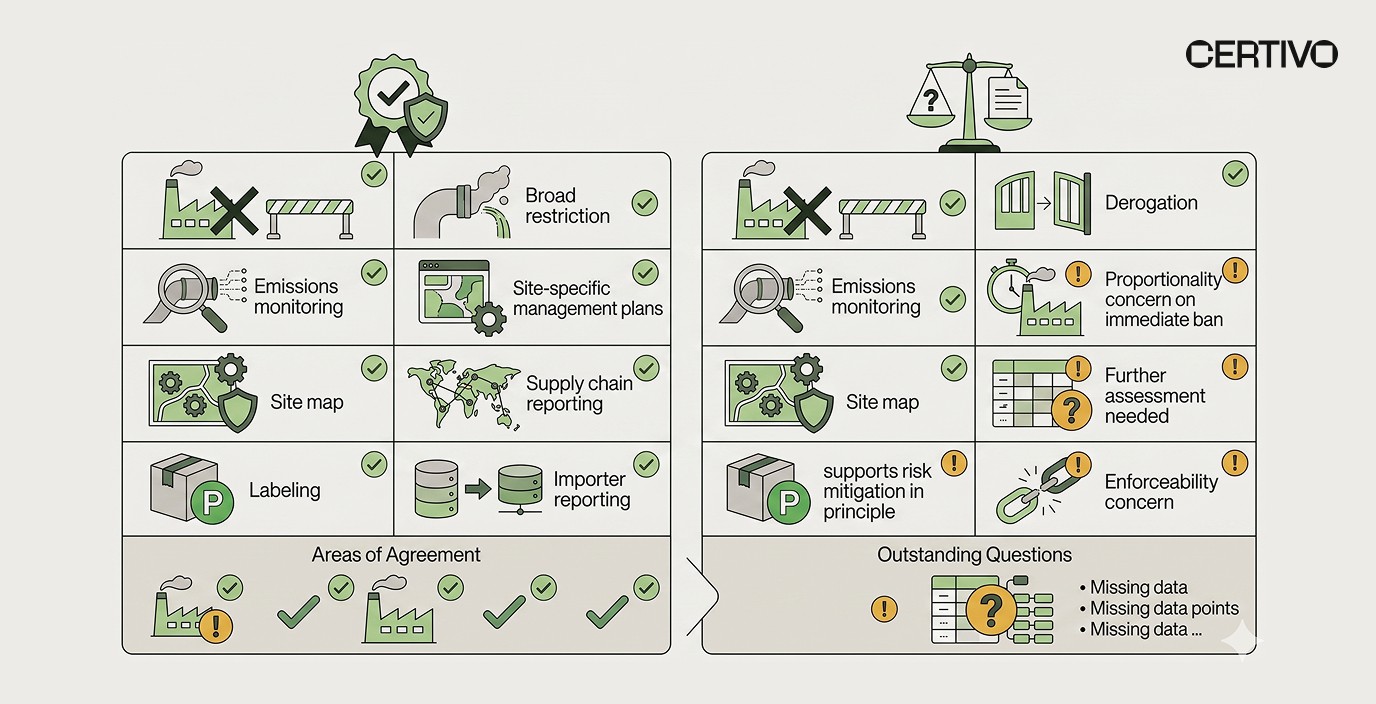
SEAC's draft opinion supports the restriction but emphasizes that an immediate, full ban would not be proportionate given current technical and economic constraints. SEAC instead favors a framework combining a general prohibition with use-specific derogations.
This dual-opinion alignment — restriction supported by both committees, with derogations as the mechanism for managing transition — establishes the regulatory architecture that manufacturers must now prepare for. Organizations still treating this as a future concern are already behind.
Certivo's PFAS framework page provides a structured overview of how this regulation fits within the broader global PFAS compliance landscape.
Background: How the EU PFAS Restriction Evolved Under REACH
The Shift From Substance-Specific to Class-Based Regulation
Historically, REACH restrictions have targeted individual substances or narrowly defined chemical groups. The EU PFAS restriction under REACH represents a fundamental departure from this approach. Instead of restricting PFAS one substance at a time, the proposal treats PFAS as a class — encompassing an estimated 10,000+ distinct substances.
The Structural Definition That Determines Scope
The proposal defines PFAS based on molecular structure: any substance containing at least one fully fluorinated methyl or methylene carbon atom. This means:
✓ Substances with a –CF₃ or –CF₂– group fall within scope ✓ The definition does not depend on commercial name, trade designation, or current regulatory listing ✓ Substances not currently listed as SVHCs or restricted under other REACH provisions may still fall within scope if they meet the structural definition
For compliance engineers, this means that checking your products against existing SVHC lists is insufficient. You must evaluate the chemical structure of every fluorinated substance in your product portfolio against this definition.
Rationale for the Class-Based Approach
The rationale rests on presumed shared characteristics of PFAS, including:
Environmental persistence — PFAS do not break down under normal environmental conditions
Mobility — PFAS migrate through water, soil, and air
Bioaccumulation potential — Certain PFAS accumulate in human tissues and environmental media
The class-based approach is also designed to prevent "regrettable substitution" — the practice of replacing one restricted PFAS with a structurally similar PFAS that has not yet been individually restricted. This means manufacturers cannot rely on switching to alternative PFAS compounds as a compliance strategy.
For organizations tracking substance-level changes, Certivo's analysis of REACH SVHC and Annex XVII updates provides additional context on how REACH restrictions are evolving beyond PFAS.
Scope of the Proposed Restriction
The proposed restriction applies to:
✓ Manufacture of PFAS within the EU ✓ Placing on the market (including import) of PFAS-containing substances, mixtures, and articles ✓ Use of PFAS across all sectors
"Placing on the market" under REACH means making a substance, mixture, or article available to a third party within the EU, whether for payment or free of charge. For importers, placing on the market occurs at the point of customs release for free circulation. For manufacturers and distributors, it occurs at the point of first supply to another legal entity. This distinction is operationally critical — it determines when the compliance obligation attaches and which entity bears primary responsibility.
This scope covers not only pure PFAS chemicals but also finished products and components that contain PFAS in any form. For manufacturers with complex, multi-tier supply chains, this creates a compliance obligation that extends far beyond direct chemical purchasing decisions.
Multi-tier supply chain transparency becomes essential when the restriction applies at the article level — meaning every component within a finished product must be assessed for PFAS content.
What RAC and SEAC Concluded — Key Findings
RAC Final Opinion
RAC's conclusions establish the scientific and risk basis for the restriction:
Finding | Implication for Manufacturers |
|---|---|
PFAS pose risks due to persistence, mobility, and accumulation | Scientific justification for class-based restriction confirmed — no further scientific review expected to reverse this finding |
EU-wide restriction is the most appropriate measure | No alternative regulatory approach (voluntary phase-out, individual substance restrictions) deemed sufficient |
Estimated 96% PFAS emission reduction over 30 years (modeled) | Quantified environmental benefit supports regulatory proportionality assessment — note this is a scenario projection |
Derogations will result in continued emissions | Even exempted uses face additional operational compliance obligations |
SEAC Draft Opinion
SEAC's conclusions add the socio-economic dimension:
Finding | Implication for Manufacturers |
|---|---|
Full immediate ban would not be proportionate | Time-limited derogations will be part of the final framework — immediate full removal is not required |
Use-specific derogations justified where alternatives unavailable | Manufacturers must document lack of alternatives to qualify for derogation |
Further information needed on certain risk management measures | Some operational requirements may be adjusted before finalization — opportunity for input during consultation |
Enforceability concerns noted for certain RAC proposals | Final operational requirements may differ from RAC recommendations |
The alignment between both committees on the fundamental direction — restriction supported, with managed derogations — eliminates significant regulatory uncertainty about whether the restriction will proceed. What remains uncertain is the precise scope of derogations, transition periods, and operational requirements.
Certivo's CORA-powered regulatory intelligence monitors these developments continuously, enabling compliance teams to adjust their preparation as the restriction framework evolves through its remaining legislative stages.
RAC and SEAC opinion comparison on EU PFAS restriction under REACH for manufacturers
Click on image to view full
How Derogations Work: Mechanism, Timelines, and the Tiered Structure
Understanding the Derogation Mechanism
The proposed restriction does not implement an immediate, universal PFAS ban. Instead, it establishes a general prohibition with use-specific derogations. A critical distinction for compliance engineers: derogations under this proposal are use-based, not sector-based. This means:
⚠ A medical device manufacturer does not automatically receive a derogation for all products ⚠ Each specific PFAS use within a product must be evaluated against derogation criteria ⚠ A single product may contain some PFAS uses that qualify for derogation and others that do not
The Tiered Transition Structure
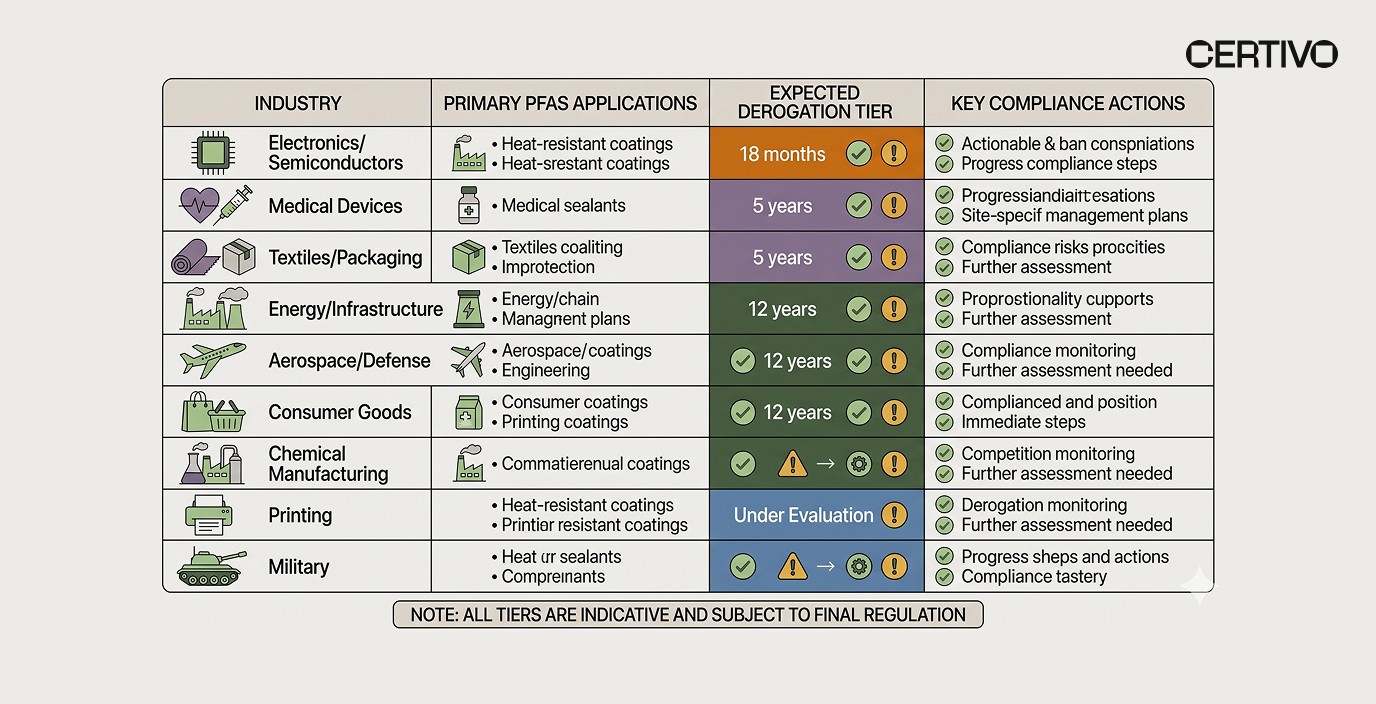
The restriction proposal contemplates a tiered timeline for phasing in restrictions, based on the availability of alternatives:
Tier | Indicative Timeline | Criteria | Example Applications |
|---|---|---|---|
Immediate restriction | 18 months from entry into force | Alternatives are readily available | Consumer textiles, certain packaging |
Medium-term derogation | ~5 years | Alternatives are emerging but not fully qualified | Some industrial coatings, sealing applications |
Extended derogation | Up to 12 years | Alternatives are not technically feasible | Semiconductor manufacturing, certain medical devices, specific defense applications |
Time-unlimited / exclusion | Potentially permanent | Essential use with no foreseeable alternative | Under evaluation; limited scope expected |
Based on currently available regulatory guidance, the exact transition periods will be defined in the final regulation. The tiered structure presented above reflects the framework discussed in the committee evaluations and is subject to change during the remaining legislative process.
Sectors Requiring Further Evaluation
SEAC has identified eight additional sectors where evaluation has not progressed sufficiently to assess proportionality:
Printing applications
Sealing applications
Machinery applications
Other medical applications
Military applications
Explosives
Technical textiles
Broader industrial uses
Manufacturers in these sectors face elevated uncertainty. The derogation framework for these applications will depend on additional data submitted during the SEAC consultation period — making participation in the consultation strategically important.
For organizations needing to assess whether their specific PFAS uses may qualify for derogation, BOM-level compliance intelligence is essential. Mapping PFAS at the substance, component, and product level — and linking each PFAS use to its specific technical function — enables manufacturers to build the evidentiary basis for derogation eligibility.
Certivo's approach to PFAS compliance across multi-tier supply chains supports precisely this type of substance-level, use-specific assessment at enterprise scale.
Which Industries and Sectors Face the Greatest Impact?
The EU PFAS restriction under REACH applies across virtually every manufacturing sector. However, the nature and scale of impact varies significantly by industry — and critically, by the specific PFAS uses within each industry.
High-Impact Sectors
📊 Electronics and semiconductors — PFAS used in photoresists, etchants, thermal management materials, and surface coatings. Semiconductor manufacturing has been specifically identified as requiring longer derogation periods. Manufacturers should review Certivo's guide on PFAS in electronics manufacturing for sector-specific compliance strategies.
📊 Medical devices — PFAS in fluoropolymer tubing, seals, membranes, and coatings. Medical device manufacturers face dual compliance pressure from both REACH restrictions and sector-specific safety standards (e.g., MDR). Certivo's medical devices industry page outlines how compliance teams can manage this intersection.
📊 Textiles and packaging — Consumer-facing products with PFAS-based water and stain resistance. Many of these applications are expected to face shorter derogation periods or no derogation, given the availability of alternatives in consumer applications.
📊 Energy and infrastructure — PFAS in electrical insulation, cables, and renewable energy components. The energy infrastructure sector faces particular challenges where PFAS performance characteristics in high-voltage or extreme-temperature applications are difficult to replicate.
📊 Aerospace and defense — PFAS in hydraulic fluids, fire suppression systems, and protective coatings. Certivo's aerospace and defense compliance resources address the unique regulatory considerations for this sector.
📌 Uncertain about your sector's PFAS exposure under the EU restriction? → Get a compliance risk assessment
Industry impact matrix for EU PFAS restriction under REACH showing derogation tiers by sector
Click on image to view full
Emissions Minimization and Operational Compliance Obligations
Both RAC and SEAC emphasize that the EU PFAS restriction under REACH will not end compliance obligations for sectors receiving derogations. Continued PFAS use under derogation will likely require enhanced operational controls — transforming PFAS compliance from a product-composition question into a comprehensive environmental management obligation.
Anticipated Operational Requirements
RAC has recommended that derogated uses be subject to:
✓ Site-specific PFAS management plans — Documenting how PFAS are handled, stored, processed, and contained at manufacturing facilities, including waste streams ✓ Emissions monitoring and reporting — Tracking PFAS releases to air, water, and waste streams with quantified data ✓ Supply chain communication — Ensuring downstream users and customers are informed of PFAS presence, handling requirements, and end-of-life considerations ✓ Labeling and safe use instructions — Providing guidance on use, maintenance, and disposal on product packaging and documentation ✓ Import-side reporting — Extending emissions reporting obligations to importers of PFAS-containing products, not only EU-based manufacturers
RAC has also called for emissions reporting directly to ECHA, creating a centralized oversight mechanism for ongoing PFAS use across the EU.
SEAC supports these measures in principle but has raised enforceability concerns for certain requirements — meaning the final operational obligations may be modified from RAC's recommendations.
What This Means for Compliance Infrastructure
Manufacturers receiving derogations will need:
Centralized compliance data backbone — A single system connecting product composition data, supplier declarations, emissions records, site management plans, and regulatory submissions
Continuous audit-ready documentation — Records that demonstrate ongoing compliance with management plans, monitoring obligations, and reporting requirements, maintained in real time rather than assembled retroactively
Automated supplier data collection and portals — Mechanisms to gather PFAS-related information from suppliers across multiple tiers, including substance identity, concentration, and use data
This level of operational compliance is not achievable through manual processes or spreadsheet-based tracking. Certivo's platform provides the centralized supplier self-service portals and AI document parsing and certificate validation capabilities needed to manage these requirements at scale.
Reporting, Labeling, and Supply Chain Communication Requirements
The Expanding Scope of PFAS Transparency
The committee opinions signal that the final restriction will include significant transparency and communication obligations beyond standard REACH compliance requirements.
Requirement | Who It Applies To | Key Obligation |
|---|---|---|
Emissions reporting to ECHA | Manufacturers and importers using PFAS under derogation | Quantify and report PFAS releases by substance and medium |
Supply chain communication | All entities in the PFAS supply chain | Inform downstream users of PFAS presence, safe handling, and disposal |
Product labeling | Manufacturers of PFAS-containing articles | Provide use, disposal, and safety instructions on product or packaging |
Import reporting | Importers of PFAS-containing products | Report PFAS content in imported articles to ECHA |
Data Challenges at Scale
For manufacturers with hundreds or thousands of products containing PFAS — many sourced from multi-tier global supply chains — these requirements create a data management challenge of significant proportions:
Substance identification across 10,000+ PFAS — Determining which specific PFAS are present in each product and component, mapped against the structural definition
Supplier transparency barriers — Trade secrecy and limited chemical disclosure from upstream suppliers, particularly at Tier 2 and Tier 3
Multi-format data normalization — Supplier data arriving in inconsistent formats, languages, and levels of specificity across jurisdictions
Emissions quantification — Moving from binary PFAS presence/absence data to quantified release data for site management plans
CORA-driven compliance intelligence addresses these challenges by extracting substance data from supplier documentation, normalizing it into a consistent reporting structure, and mapping it against the evolving REACH restriction framework.
For organizations already managing REACH SVHC obligations, Certivo's REACH compliance automation provides a foundation that can be extended to cover the broader PFAS restriction requirements.
How the REACH PFAS Restriction Intersects With Existing Article 33 Obligations
Compliance engineers at manufacturers already managing REACH obligations will ask: how does this broad PFAS restriction interact with existing REACH Article 33 SVHC communication requirements?
Current Article 33 Obligations for PFAS
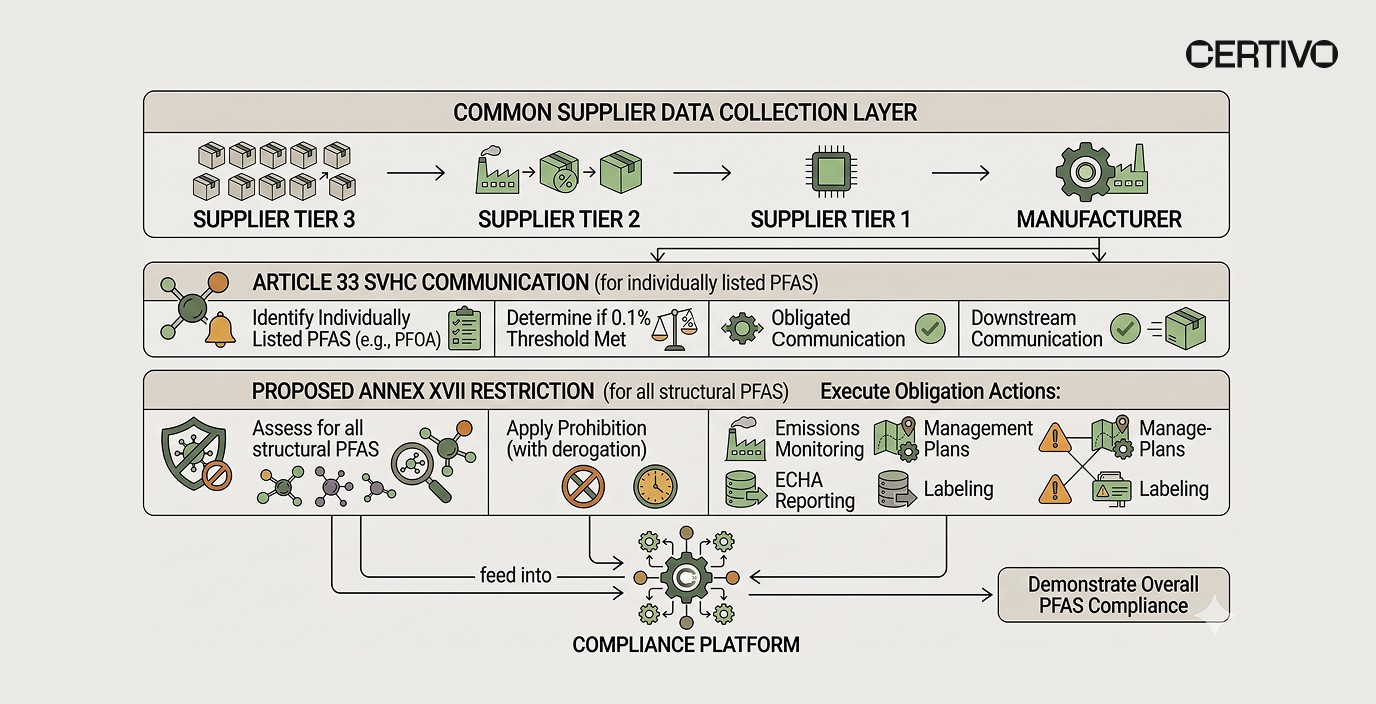
Several PFAS substances are already listed on the REACH SVHC Candidate List (e.g., PFOA, PFOS, PFHxS, and their salts). Under Article 33, manufacturers and importers of articles containing these substances above 0.1% w/w must:
✓ Communicate information to downstream recipients ✓ Provide sufficient information for safe use ✓ Respond to consumer requests within 45 days
How the Broad Restriction Changes the Landscape
The proposed Annex XVII restriction will operate in parallel with — not replace — existing Article 33 obligations. Practically, this means:
Obligation | Article 33 (SVHC) | Proposed Annex XVII (Broad PFAS Restriction) |
|---|---|---|
Trigger | PFAS listed individually on SVHC Candidate List above 0.1% w/w | All PFAS meeting the structural definition, regardless of SVHC listing |
Scope | Communication obligation | Manufacture, placing on market, and use prohibition (with derogations) |
Timeline | Already in effect for listed substances | Will take effect upon Annex XVII amendment entry into force |
Data requirement | Substance identity and safe use information | Substance identity, concentration, use, emissions, and management plans |
Operational Implication
Manufacturers who have built Article 33 communication processes for SVHC-listed PFAS have a foundation to build on — but the broad restriction dramatically expands both the substance scope (from individually listed PFAS to the entire class) and the compliance obligation (from communication to prohibition with operational derogation requirements).
BOM-level material mapping capabilities become essential for tracking both Article 33 and Annex XVII obligations simultaneously, ensuring that every PFAS substance in a product is mapped against the applicable compliance requirement.
EU PFAS compliance dual-obligation workflow for REACH Article 33 and Annex XVII restriction
Click on image to view full
How This EU Restriction Intersects With Global PFAS Regulations
The EU PFAS restriction under REACH does not operate in isolation. ECHA's approach to class-based PFAS regulation is expected to influence regulatory developments in other jurisdictions — consistent with how previous REACH restrictions have shaped global chemical regulation.
Key Intersections and Operational Overlaps
📊 U.S. TSCA PFAS reporting — The EPA's TSCA Section 8(a)(7) rule creates federal PFAS reporting obligations for U.S. manufacturers and importers. A critical question for compliance engineers: can the same substance identification data serve both REACH and TSCA? In principle, CAS-level substance mapping overlaps. However, the data formats, reporting scopes, and submission mechanisms differ significantly. TSCA requires retrospective reporting on manufacturing and import since 2011, while REACH focuses on current and future use. Certivo's TSCA PFAS reporting automation and REACH compliance capabilities share a common data backbone, enabling organizations to serve both from a single substance mapping effort.
📊 U.S. state-level PFAS laws — States including Minnesota, Massachusetts, Connecticut, and Kentucky have enacted or proposed their own PFAS reporting and restriction frameworks with varying deadlines, data requirements, and scope. Certivo's comprehensive analysis of state PFAS regulations in 2026 maps these requirements across jurisdictions.
📊 Stockholm Convention (POPs) — The committees' opinions note potential overlap between a broad REACH PFAS restriction and obligations under persistent organic pollutants legislation. Certivo's POPs compliance resources address this intersection.
📊 EU packaging and waste legislation — The EU PFAS restriction may overlap with PPWR requirements for packaging materials, creating dual compliance obligations for food contact and packaging manufacturers.
📊 Sector-specific environmental assessments — Certain sectors, including pharmaceuticals, face additional PFAS-related obligations under environmental risk assessment frameworks that intersect with REACH.
Manufacturers operating across multiple jurisdictions need regulatory intelligence and horizon scanning capabilities to track these intersecting requirements. CORA's regulatory intelligence layer monitors PFAS regulatory developments across all relevant jurisdictions, alerting compliance teams to new obligations, deadline changes, and scope modifications as they emerge.
Timeline: From Consultation to Annex XVII Amendment
Understanding the remaining legislative pathway helps compliance leaders plan resource allocation and program milestones.
Date | Milestone | Status | Manufacturer Action |
|---|---|---|---|
January 2023 | PFAS restriction proposal submitted by five national authorities | Complete | — |
2023–2025 | RAC and SEAC evaluation period | Complete | Begin initial PFAS mapping |
March 2026 | RAC final opinion and SEAC draft opinion released | Complete | Assess derogation eligibility; accelerate substance mapping |
May 25, 2026 | SEAC public consultation closes | Action deadline | Submit consultation comments |
Late 2026 | SEAC expected to finalize opinion | Pending | Finalize substance mapping and supplier data collection |
Post-2026 | ECHA transmits both opinions to European Commission | Pending | Prepare reformulation programs for non-derogated uses |
TBD (~2027–2028) | European Commission drafts Annex XVII amendment | Pending | Build emissions monitoring infrastructure for derogated uses |
TBD | EU Member State review, European Parliament and Council scrutiny | Pending | Finalize supply chain communication protocols |
TBD (~2028–2029) | Final regulation published with restriction scope, transition periods, and derogations | Pending | Execute compliance programs aligned with final requirements |
Based on currently available regulatory guidance, the full legislative process from SEAC final opinion to Annex XVII amendment could take 2–3 years. Manufacturers should not interpret this timeline as a reason to delay preparation — the substance mapping, supplier engagement, and infrastructure development required for compliance demand significant lead time.
Compliance Risks and EU Market Access Implications
The Market Access Equation
Once the PFAS restriction is incorporated into REACH Annex XVII, non-compliant products will be prohibited from being manufactured, placed on the market, or used within the EU. This is not a labeling requirement or a reporting obligation — it is a market access barrier.
For manufacturers exporting to the EU, this means:
⚠ Products containing PFAS without a valid derogation cannot be sold in the EU ⚠ Importers bear primary responsibility for ensuring PFAS compliance of imported articles at the point of customs release ⚠ Retailers and distributors may require PFAS compliance documentation as a procurement condition, potentially years before the restriction takes formal effect ⚠ EU subsidiaries of global manufacturers may face direct enforcement action
Financial and Operational Risk
The financial exposure extends beyond lost EU market access:
Product reformulation costs — Developing and qualifying non-PFAS alternatives, including revalidation of performance specifications
Supply chain restructuring — Qualifying new suppliers and materials, potentially across multiple product lines simultaneously
Derogation compliance costs — Emissions monitoring equipment, management plan development, ECHA reporting infrastructure, and labeling changes
Enforcement penalties — REACH enforcement varies by EU Member State, with penalties set at the national level. In some Member States, penalties for non-compliance with REACH restrictions include fines, product seizure, and criminal liability for responsible individuals.
Customer and investor expectations — EU customers and ESG-focused investors may require PFAS compliance documentation before the restriction takes formal effect
Manufacturers using supplier risk scoring and due diligence can identify which suppliers present the highest PFAS-related compliance risk and prioritize data collection accordingly.
How to Participate in the SEAC Consultation Before May 25, 2026
The SEAC consultation, open until May 25, 2026, represents the last structured opportunity for manufacturers to influence the restriction framework before SEAC finalizes its opinion.
What Types of Comments Are Most Valuable
Based on currently available regulatory guidance, SEAC is seeking input on:
✓ Socio-economic data — Cost of compliance, cost of reformulation, market impact data for specific uses ✓ Alternative availability assessments — Evidence on whether technically viable non-PFAS alternatives exist for specific applications ✓ Derogation justifications — Data supporting the need for longer transition periods in specific use categories ✓ Proportionality assessments — Evidence on whether proposed risk management measures (emissions monitoring, management plans) are proportionate and enforceable for specific sectors
How to Submit
Comments are submitted through ECHA's consultation portal. Manufacturers should coordinate submissions through their regulatory affairs teams and consider industry association submissions for sector-wide positions.
For organizations tracking multiple REACH consultations, regulatory intelligence and horizon scanning tools can flag relevant consultation windows and deadlines automatically.
Strategic Compliance Preparation Checklist
Immediate Actions (Q2 2026)
✓ Submit SEAC consultation comments by May 25, 2026 — Provide use-specific data, alternative availability evidence, and socio-economic impact assessments ✓ Conduct enterprise-wide PFAS substance mapping — Identify all PFAS across products, components, and raw materials using the structural definition (CF₃/CF₂ criteria) through BOM-level material mapping ✓ Activate supplier data collection — Deploy automated supplier data collection portals to gather substance-level PFAS information across the supply chain ✓ Assess derogation eligibility by use — Map each specific PFAS use to the derogation tier framework (18 months / 5 years / 12 years) and begin documentation
Medium-Term Actions (H2 2026–2027)
✓ Build emissions monitoring infrastructure — Prepare for site-specific PFAS management plans and emissions reporting requirements for derogated uses ✓ Establish supply chain communication protocols — Ensure downstream customers can receive PFAS content information and safe handling instructions compliant with both Article 33 and future Annex XVII requirements ✓ Begin reformulation programs — Initiate alternative material qualification for PFAS applications in the 18-month and 5-year derogation tiers ✓ Integrate PFAS compliance with existing REACH obligations — Connect PFAS restriction tracking with SVHC, existing Annex XVII, and authorization requirements through a centralized compliance data backbone
Long-Term Actions (2027–2030)
✓ Prepare for derogation expiry — Even sectors receiving 12-year derogations should begin alternative development immediately, as qualification timelines for replacement materials in high-technology applications can exceed 5 years ✓ Align with global PFAS requirements — Build infrastructure that serves EU REACH, U.S. TSCA, state-level, and international PFAS obligations simultaneously from a single substance database ✓ Implement digital product passport readiness — As digital passport and traceability systems become standard under EU ESPR, substance-level PFAS data will become a permanent compliance asset linked to product identifiers
How AI-Native Compliance Automation Supports EU PFAS Readiness
The scale of the EU PFAS restriction — covering 10,000+ substances across every manufacturing sector, with complex tiered derogation frameworks and operational compliance requirements — exceeds the capacity of manual compliance management at any enterprise manufacturer.
Where AI Delivers Measurable Value
📊 Substance mapping against the structural definition: CORA-powered regulatory intelligence can evaluate substances in product BOMs against the CF₃/CF₂ structural definition, identifying PFAS that may not appear on existing restricted substance lists but fall within the restriction's scope.
📊 Supplier data normalization: When suppliers provide PFAS data in different formats — safety data sheets, test reports, material declarations, certificates across multiple languages — CORA-enabled analysis normalizes this data into a consistent structure aligned with REACH reporting requirements.
📊 Derogation eligibility assessment: CORA-driven compliance intelligence helps manufacturers evaluate whether specific PFAS uses meet the criteria for time-limited derogations by cross-referencing product applications, technical functions, and alternative availability against the committee-defined tier framework.
📊 Multi-jurisdictional tracking: As PFAS regulations evolve simultaneously across the EU, U.S. federal, U.S. state, and international frameworks, CORA's regulatory intelligence layer provides a unified view of compliance obligations across all jurisdictions — enabling organizations to identify where a single substance mapping effort can serve multiple obligations.
📊 Emissions data management: For manufacturers operating under derogations, Certivo's platform can serve as the centralized system for managing emissions monitoring data, site management plans, and ECHA reporting submissions — maintaining continuous audit-ready documentation rather than assembling records retroactively.
Certivo's platform functions as the system of record for PFAS compliance — connecting substance data, supplier responses, product structures, derogation documentation, emissions records, and regulatory requirements in a single platform that supports compliance across the entire PFAS regulatory lifecycle.
Conclusion
The March 2026 ECHA committee opinions confirm that the EU PFAS restriction under REACH is no longer a regulatory possibility — it is an advancing regulatory certainty. Both RAC and SEAC support the restriction. The remaining questions concern derogation scope, transition periods, and operational requirements — not whether PFAS will be restricted.
For manufacturers, importers, and supply chain operators, this means the time for passive monitoring has ended. The organizations that will maintain EU market access through this transition are those building PFAS compliance infrastructure now: structural-definition-based substance mapping, multi-tier supply chain transparency, use-specific derogation documentation, emissions management capabilities, and the AI-native compliance automation systems needed to manage these requirements at scale across jurisdictions.
The May 25, 2026 SEAC consultation deadline represents an immediate action point. Beyond that, every quarter of delay in building compliance infrastructure increases the operational and financial risk of EU market disruption.
📌 Book a demo to see how Certivo automates EU PFAS restriction compliance across your product portfolio and supply chain — or get a free compliance risk assessment to understand your current PFAS exposure across products and jurisdictions before the restriction framework finalizes.
FAQs
How does the ECHA structural definition determine whether my products contain restricted PFAS?
The restriction defines PFAS as any substance with at least one fully fluorinated methyl (CF₃) or methylene (CF₂) carbon atom. This structural definition means substances not currently on any SVHC list may still fall within scope. Compliance engineers should evaluate every fluorinated substance in their product portfolio against this definition rather than relying solely on existing restricted substance lists. Certivo's CORA-powered analysis maps substances against the structural criteria at the BOM level.
Are derogations under the EU PFAS restriction automatic for sectors like medical devices and semiconductors?
No. Derogations are use-specific, not sector-wide. A semiconductor manufacturer may receive derogation for PFAS in fabrication processes but not for PFAS in product packaging. Each specific PFAS use must be individually evaluated against availability-of-alternatives criteria. Manufacturers must document the technical necessity and absence of viable alternatives for each use to qualify. Certivo's platform supports use-level derogation eligibility assessment across product portfolios.
Will the broad PFAS restriction replace existing REACH Article 33 obligations for SVHC-listed PFAS?
No. The proposed Annex XVII restriction operates in parallel with existing Article 33 SVHC communication obligations. Manufacturers will need to maintain compliance with both: Article 33 for individually listed PFAS SVHCs above 0.1% w/w, and the new Annex XVII prohibition for all structural PFAS. Certivo's centralized compliance data backbone manages both obligation tracks from a single substance database.
Can substance data collected for EU REACH PFAS compliance be reused for U.S. TSCA reporting?
The CAS-level substance identification overlaps significantly between REACH and TSCA obligations. However, the reporting scope, data formats, and submission mechanisms differ — TSCA requires retrospective manufacturing and import data since 2011, while REACH focuses on current and future use. Certivo's platform shares a common substance data backbone across both frameworks, enabling organizations to avoid duplicating data collection while producing jurisdiction-specific reporting outputs.
What is the most effective way to participate in the SEAC consultation before the May 25, 2026 deadline?
Manufacturers should submit comments through ECHA's consultation portal, focusing on socio-economic impact data, alternative availability evidence for specific PFAS uses, and proportionality assessments for proposed operational requirements. Industry associations often coordinate sector-wide submissions for greater impact. CORA's regulatory intelligence layer monitors consultation timelines and flags relevant deadlines automatically.
Vasanth
Vasanth is a skilled Compliance Engineer with over five years of experience specializing in global environmental regulations, including REACH, RoHS, Proposition 65, POPs, TSCA, PFAS, CMRT, EMRT, FMD, and IMDS. With a strong academic foundation in Chemical Engineering from Anna University, he brings a deep technical understanding to compliance processes across complex product lines.
Vasanth excels in analyzing Bills of Materials (BOMs), evaluating supplier declarations, and ensuring regulatory conformity through meticulous review and risk assessment. He is highly proficient in supplier engagement, adept at interpreting material disclosures, and experienced in preparing customer-ready compliance documentation tailored to diverse global standards.