

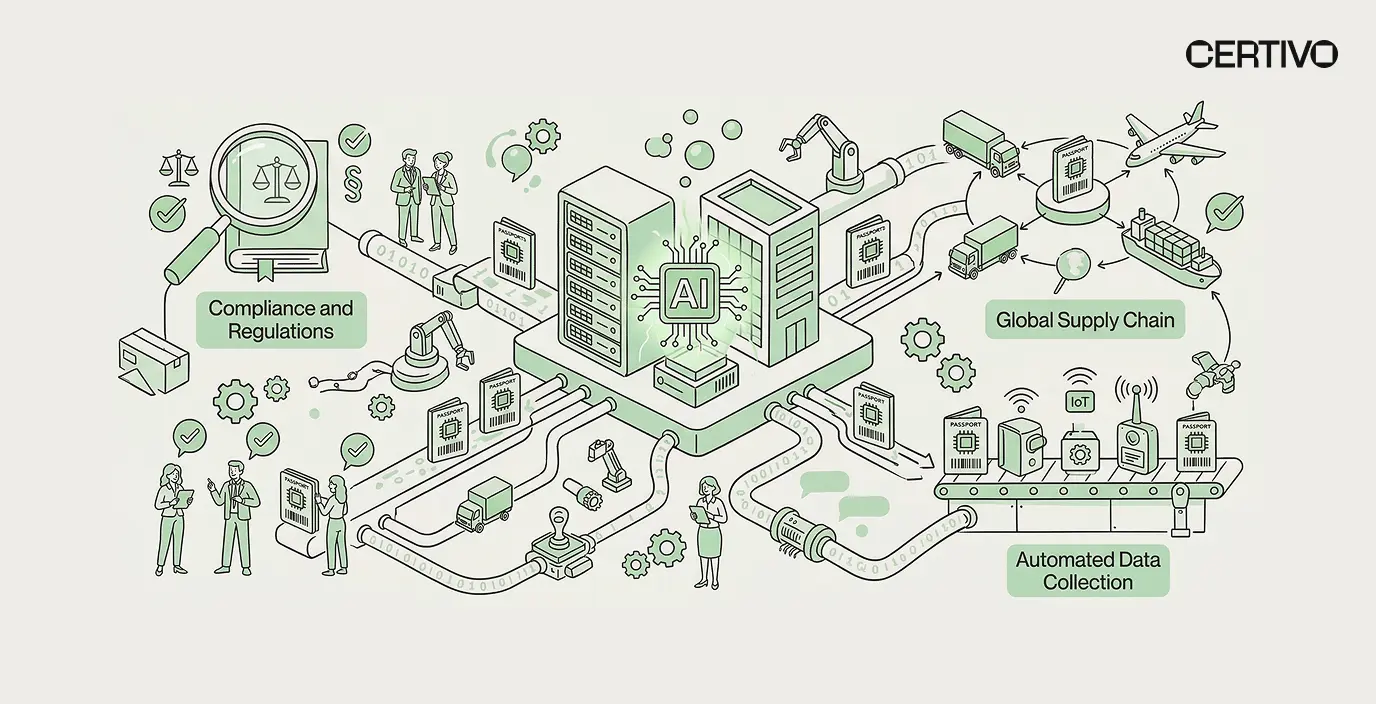
The European Union's Digital Product Passport (DPP) mandate represents the most significant shift in product transparency and compliance infrastructure since the introduction of CE marking. Under the Ecodesign for Sustainable Products Regulation (ESPR), manufacturers must establish digital traceability systems that link every product to its material composition, supply chain origin, repair history, and end-of-life handling by 2027. This is not a documentation upgrade—it is a fundamental restructuring of how manufacturers prove compliance, manage supplier data, and demonstrate market readiness across jurisdictions.
Unlike traditional compliance frameworks that rely on static declarations, Digital Passport & Traceability Systems require continuous data flows from multi-tier suppliers, real-time substance tracking, and integration with existing PLM and ERP systems. For global manufacturers operating under REACH, RoHS, PFAS regulations, and Conflict Minerals reporting, DPP introduces a unified compliance backbone that connects previously siloed regulatory obligations into a single, auditable system.
The operational challenge is clear: manufacturers must implement DPP infrastructure while maintaining compliance across existing frameworks, managing supplier data collection at scale, and ensuring Continuous Audit-Ready Documentation without disrupting production timelines or market access.
Table of Contents
What Is a Digital Product Passport and Why Is It Mandatory
Legal Framework: ESPR and the Regulatory Foundation of DPP
What Information Must Be Included in a Digital Product Passport
Industries and Product Categories Affected by DPP Requirements
How DPP Connects to Existing Compliance Frameworks
The Supply Chain and Traceability Challenge
Data Management Requirements: From BOM to End-of-Life
DPP Timeline and Enforcement Milestones
Compliance Risks and Penalties for Non-Implementation
How to Prepare: Strategic DPP Readiness Checklist
How AI-Native Compliance Automation Enables DPP at Scale
Conclusion: DPP as the Future of Multi-Framework Compliance
Frequently Asked Questions
What Is a Digital Product Passport and Why Is It Mandatory
A Digital Product Passport is a structured, machine-readable data set that accompanies every product placed on the EU market. It contains verifiable information about materials, components, manufacturing origin, environmental impact, and end-of-life instructions. The passport is accessible via a unique identifier—typically a QR code, RFID tag, or NFC chip—and must remain accessible throughout the product's lifecycle.
The DPP mandate stems from the EU's Circular Economy Action Plan and the ESPR, which replaces the previous Ecodesign Directive. The regulation aims to reduce waste, improve material recovery, and enable consumers, enforcement authorities, and recyclers to access critical product information in real time. For manufacturers, DPP is not optional—it is a market access requirement for regulated product categories starting in 2027.
Unlike legacy compliance systems that rely on paper-based declarations or supplier certifications stored in isolated databases, DPP requires Centralized Compliance Data Backbone architecture. This means manufacturers must maintain a single, continuously updated source of truth that links BOM-Level Compliance Intelligence with supplier attestations, test reports, and regulatory thresholds across multiple jurisdictions.
The strategic implication is clear: manufacturers who treat DPP as a standalone project risk creating another compliance silo. Those who integrate DPP into existing materials and environmental compliance workflows gain a unified infrastructure that supports REACH, RoHS, PFAS, and future regulations without duplicative data collection.
Legal Framework: ESPR and the Regulatory Foundation of DPP
The Ecodesign for Sustainable Products Regulation (ESPR) entered into force in July 2024 and establishes the legal basis for DPP implementation. The regulation grants the European Commission authority to set product-specific ecodesign requirements through delegated acts, which will define exactly what information must be included in passports for each product category.
The first DPP requirements will apply to batteries under the EU Batteries Regulation, with implementation beginning in 2027. Additional product categories—including electronics, textiles, furniture, and construction materials—will follow through subsequent delegated acts. Each category will have specific data fields, threshold limits, and verification requirements based on environmental impact and material composition.
The ESPR operates alongside, not in replacement of, existing compliance frameworks. Manufacturers subject to REACH SVHC reporting, RoHS exemptions, and Extended Producer Responsibility obligations must integrate these requirements into their DPP data structure. This creates a compound compliance burden: manufacturers must not only implement DPP infrastructure but also ensure it accurately reflects all applicable regulatory obligations in real time.
Book a demo to see how Certivo maps DPP data requirements to your existing compliance obligations across REACH, RoHS, PFAS, and ESG frameworks without duplicative supplier data collection.
Enforcement will be managed by national market surveillance authorities, who will have the power to conduct audits, request DPP data, and impose penalties for non-compliance. The regulation includes provisions for third-party verification, meaning manufacturers may need to engage independent auditors to validate passport accuracy before market entry.
What Information Must Be Included in a Digital Product Passport
The specific data requirements for DPPs will vary by product category, but the ESPR establishes core information fields that apply across all regulated products. These include:
Material Composition and Substance Data
Complete bill of materials with substance identifiers (CAS numbers, EC numbers)
Concentration levels for substances of concern (REACH SVHCs, RoHS-restricted materials, PFAS compounds)
Material origin and traceability to raw material extraction
Recycled content percentages and verification methods
Supply Chain and Manufacturing Information
Country of origin for each component and assembly stage
Supplier identification (name, location, registration number)
Manufacturing date and batch/lot identification
Conflict minerals declarations and ethical sourcing attestations
Environmental and Performance Data
Carbon footprint (cradle-to-gate or full lifecycle)
Energy efficiency ratings and performance benchmarks
Expected product lifespan and durability testing results
Repair and maintenance instructions with spare parts availability
End-of-Life and Circularity Information
Disassembly instructions for component recovery
Recycling pathways and material recovery rates
Hazardous material handling procedures
Take-back program details and disposal restrictions
The technical challenge is not creating individual data fields—it is maintaining accuracy across thousands of SKUs, managing updates when suppliers change, and ensuring data integrity when components are substituted or reformulated. Manufacturers operating multi-tier supply chain transparency programs report that 40-60% of supplier-provided data requires validation or correction before it can be used in regulatory declarations.
Certivo's platform enables BOM-Level Material Mapping that automatically links component-level substance data to finished product declarations, ensuring DPP accuracy even when suppliers update material specifications or reformulate products between production runs.
Industries and Product Categories Affected by DPP Requirements
The ESPR applies to physical goods placed on the EU market, with phased implementation based on environmental impact and material recovery potential. Priority categories include:
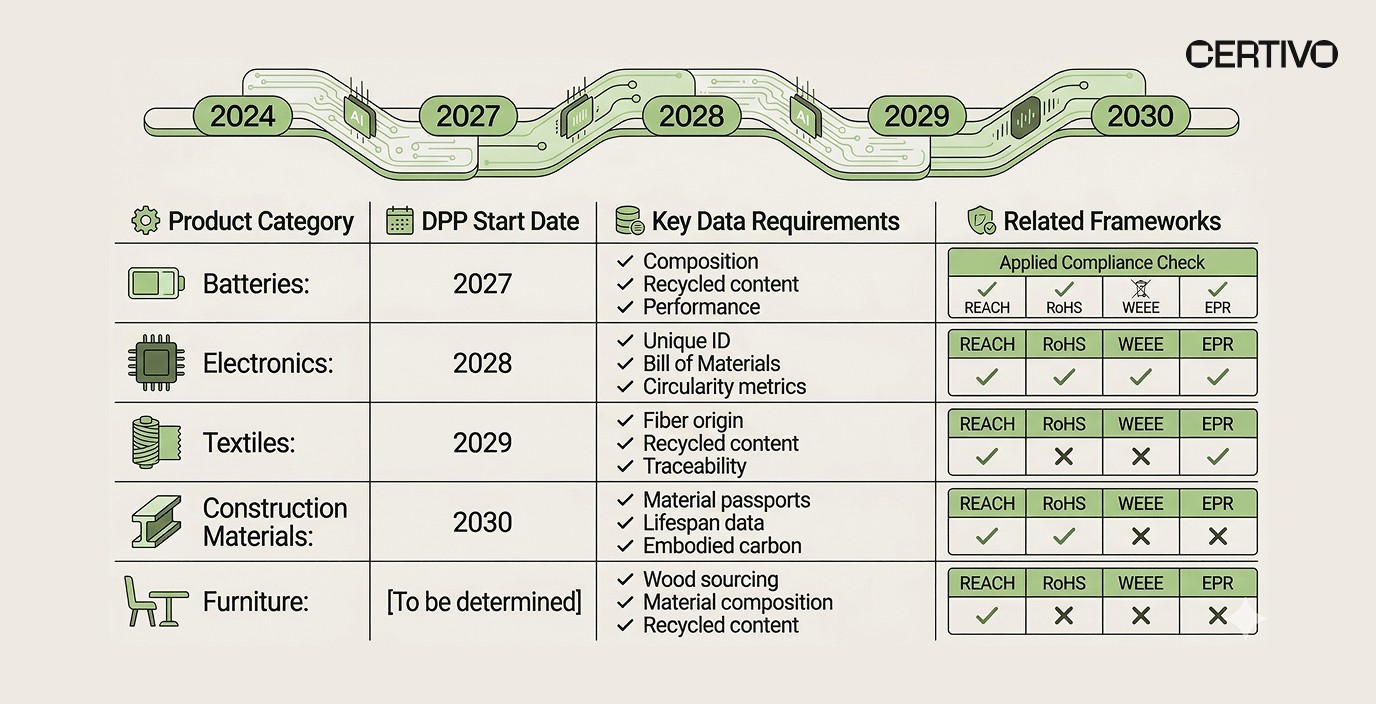
✓ Batteries and Energy Storage Systems – Mandatory DPPs beginning February 2027 under the EU Batteries Regulation, covering lithium-ion batteries, industrial batteries, and automotive battery packs.
✓ Electronics and Electrical Equipment – Expected DPP requirements by 2028-2029 for products currently regulated under RoHS and WEEE, including consumer electronics, IT equipment, and industrial control systems.
✓ Textiles and Apparel – DPP mandates likely by 2030, focusing on material composition, chemical content, and recycling instructions for garments and footwear.
✓ Construction Materials – Building products such as insulation, flooring, and structural components will require passports showing material safety data, lifecycle emissions, and demolition recovery procedures.
✓ Furniture and Home Goods – Products with high material diversity and chemical treatment requirements, particularly upholstered furniture and laminated wood products.
Manufacturers in electronics manufacturing, automotive, building materials, and industrial machinery sectors face the most immediate DPP implementation pressure due to regulatory convergence with existing substance restrictions and extended producer responsibility obligations.
The cross-industry challenge is managing DPP alongside sector-specific compliance frameworks. Electronics manufacturers must integrate DPP data with RoHS exemption tracking, REACH authorization requirements, and PFAS disclosure obligations. Battery manufacturers must coordinate DPP implementation with carbon footprint declarations and due diligence requirements. Without Integrated PLM ERP Compliance Thread infrastructure, manufacturers risk maintaining separate data sets for each framework, multiplying audit exposure and supplier data burden.
How DPP Connects to Existing Compliance Frameworks
Digital Product Passports do not replace existing regulations—they aggregate and standardize compliance data already required under multiple frameworks. The operational advantage of DPP infrastructure is that it creates a single data architecture supporting:
REACH and Substance Reporting
DPP material composition requirements align directly with REACH Article 33 SVHC disclosure obligations. Manufacturers must already track substances of very high concern at concentrations above 0.1% by weight. DPP mandates the same data but extends it to full material composition, including non-SVHC substances that may become regulated in the future.
RoHS and Restricted Substances
RoHS compliance requires demonstrating that electrical and electronic equipment does not exceed threshold limits for lead, mercury, cadmium, and other restricted materials. DPP passports must include this verification data along with exemption justifications and testing protocols, effectively transforming RoHS compliance from periodic declarations into continuous documentation.
PFAS and Emerging Chemical Restrictions
As PFAS regulations expand globally, manufacturers must track per- and polyfluoroalkyl substances across components, coatings, and packaging. DPP infrastructure provides the data backbone for managing TSCA Section 8(a)(7) reporting, state-level PFAS bans, and EU PFAS restrictions under a unified system.
Conflict Minerals and Ethical Sourcing
DPP supply chain transparency requirements overlap with Conflict Minerals due diligence under the EU Conflict Minerals Regulation and Section 1502 of the Dodd-Frank Act. Manufacturers must trace tin, tantalum, tungsten, and gold to smelter level—data that feeds directly into DPP supplier identification fields.
Carbon Accounting and ESG Reporting
Product carbon footprint declarations required for batteries under the EU Batteries Regulation will extend to other product categories through DPP implementation. This creates convergence between DPP, EU CBAM reporting, and CSRD sustainability disclosures, forcing manufacturers to integrate Multi Jurisdiction EHS & ESG Management into a single data infrastructure.
The strategic imperative is treating DPP as the common data layer that unifies these frameworks rather than implementing yet another standalone compliance system. Certivo's CORA-powered regulatory intelligence enables manufacturers to map DPP data fields to existing compliance obligations, automatically flagging gaps and triggering supplier data requests when thresholds change or new substances are regulated.
The Supply Chain and Traceability Challenge
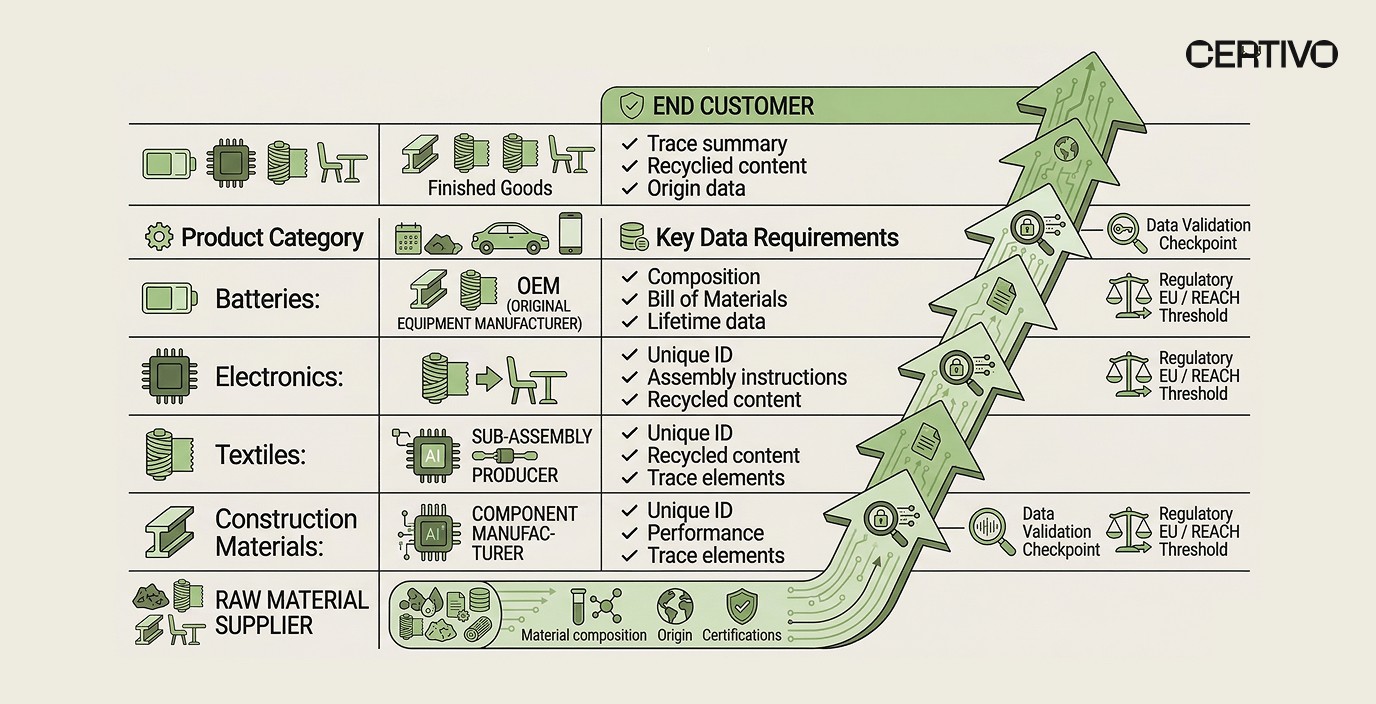
The most significant operational barrier to DPP implementation is not technology—it is supplier data collection at scale. Manufacturers must obtain verified material composition data, manufacturing origin, and environmental performance metrics from every tier of their supply chain, including component suppliers, raw material providers, and contract manufacturers.
Current supplier engagement models rely on periodic declarations, generic material safety data sheets, and inconsistent data formats. DPP requires Automated Supplier Data Collection & Portals that enable continuous information flow, automatic validation against regulatory thresholds, and real-time updates when material specifications change.
The data quality challenge compounds exponentially in multi-tier supply chains. A single electronic assembly may contain 500+ components from 200+ suppliers across 20+ countries. Each component has a unique material composition, and each supplier operates under different documentation standards. Without Standardized Supplier Questionnaire Frameworks, manufacturers receive incompatible data formats that require manual reconciliation before DPP integration.
Supplier Self-Service Compliance Portals address this by providing suppliers with pre-configured templates aligned to DPP data requirements, automatic validation rules that flag incomplete or non-compliant submissions, and direct integration with manufacturer compliance systems to eliminate manual data entry.
The enforcement risk is significant: manufacturers are legally responsible for DPP accuracy even when data originates from third-party suppliers. If a supplier provides incorrect material composition information and the manufacturer's DPP reflects that error, the manufacturer—not the supplier—faces penalties and potential market suspension.
Supplier Risk Scoring & Due Diligence capabilities enable compliance teams to prioritize verification efforts on high-risk suppliers, track submission completeness across thousands of suppliers, and maintain audit trails showing when data was requested, received, and validated. This infrastructure is not optional—it is the foundation of defensible DPP compliance.
Data Management Requirements: From BOM to End-of-Life
Implementing DPP requires a fundamental shift from static compliance documentation to dynamic product data management. Manufacturers must establish systems that:
Link BOMs to Material Declarations
Every finished product must be traceable to its bill of materials, and every BOM line item must link to verified material composition data. This requires BOM-Level Compliance Intelligence that automatically maps component-level substance data to finished product declarations, flagging threshold exceedances and triggering alerts when regulated substances are detected.
Manage Version Control and Change Management
Products evolve through design revisions, supplier changes, and material substitutions. DPP systems must track these changes and maintain historical records showing when specifications changed, why substitutions occurred, and how those changes affected regulatory status. Without automated version control, manufacturers face audit failures when inspectors discover discrepancies between current DPP data and actual product composition.
Integrate with PLM and ERP Systems
DPP data cannot exist in a standalone compliance database—it must integrate with existing Design-For-Compliance PLM Workflows and ERP systems where product specifications, BOMs, and supplier master data already reside. This integration prevents data drift, eliminates duplicate data entry, and ensures that compliance teams see the same product information as engineering and sourcing teams.
Enable Continuous Monitoring and Updates
Unlike traditional compliance declarations that remain static until the next audit cycle, DPP requires Continuous Compliance Monitoring & Audit Readiness. When REACH adds a new SVHC, RoHS revokes an exemption, or a state bans a PFAS compound, manufacturers must identify affected products, request updated supplier data, and revise DPP records—often within weeks of regulatory publication.
CORA-driven compliance intelligence monitors regulatory changes across 180+ jurisdictions and automatically maps new requirements to affected SKUs, triggering supplier data requests and updating DPP records without manual intervention. This eliminates the compliance lag that traditionally exists between regulatory publication and full supplier data collection.
DPP Timeline and Enforcement Milestones
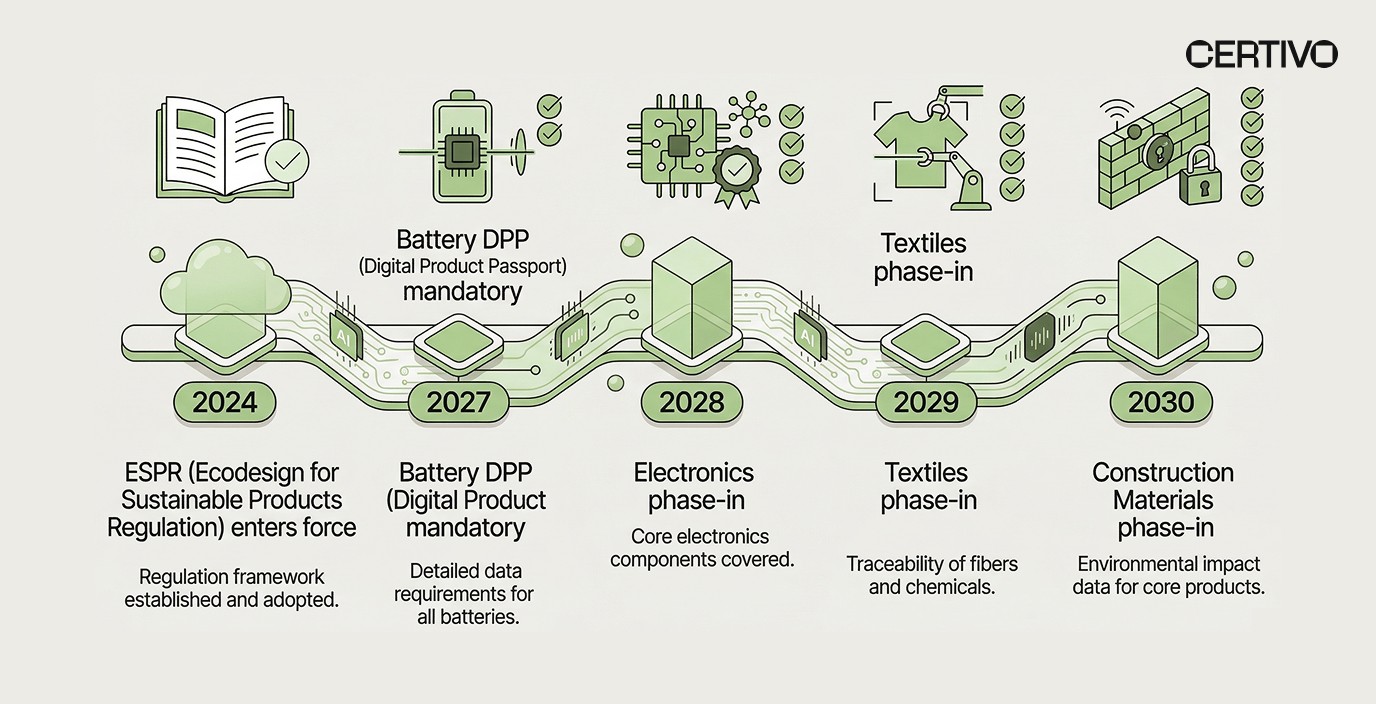
DPP implementation follows a phased timeline based on product category and regulatory priority:
📌 2024-2025: ESPR enters force; Commission develops delegated acts defining product-specific DPP requirements.
📌 February 2027: Battery DPP becomes mandatory for industrial, automotive, and portable batteries under the EU Batteries Regulation. Manufacturers must implement unique battery identifiers, material composition data, and carbon footprint declarations.
📌 2028-2029: Electronics and electrical equipment DPP requirements expected, covering products currently regulated under RoHS and WEEE.
📌 2030 and beyond: Textiles, furniture, and construction materials DPP mandates will phase in based on finalized delegated acts.
Manufacturers should note that DPP compliance does not begin the day regulations take effect—it requires 18-24 months of infrastructure development, supplier onboarding, and system integration before products can carry verified passports. Companies starting DPP preparation in 2026 face significant risk of market access delays in 2027-2028.
The enforcement model combines ex-ante verification (pre-market checks by notified bodies or competent authorities) with post-market surveillance. Market surveillance authorities can request DPP data at any time, audit underlying documentation, and impose corrective actions or penalties if passports are incomplete, inaccurate, or inaccessible.
Get a compliance risk assessment to understand your current DPP readiness across product portfolios and identify which SKUs face the highest market access risk under upcoming delegated acts.
Compliance Risks and Penalties for Non-Implementation
The ESPR grants EU member states authority to define penalties for DPP non-compliance, with enforcement frameworks expected to mirror those used for REACH and RoHS violations. Likely consequences include:
⚠ Market Access Denial – Products lacking valid DPP data cannot be placed on the EU market. Customs authorities and market surveillance bodies will have the power to block shipments, refuse market entry, and require product withdrawal until compliant passports are provided.
⚠ Financial Penalties – Fines for non-compliance typically range from €10,000 to €500,000 per violation depending on member state and infringement severity. Penalties scale based on company size, number of affected products, and whether non-compliance was intentional or negligent.
⚠ Product Recalls and Corrective Actions – Manufacturers discovered selling products with inaccurate DPP data may be required to recall products, update passports, and notify affected customers—creating significant logistics and reputational costs.
⚠ Supply Chain Liability – If DPP inaccuracies stem from supplier-provided data, manufacturers remain liable even though the error originated elsewhere in the supply chain. This creates compound risk: manufacturers must verify supplier data accuracy while maintaining continuous monitoring systems that detect when suppliers change specifications without notification.
⚠ Exclusion from Public Procurement – Government and institutional buyers in the EU increasingly require DPP compliance as a contract award criterion. Non-compliant manufacturers face exclusion from high-value public procurement opportunities.
The reputational dimension extends beyond regulatory penalties. Customers, investors, and ESG rating agencies increasingly evaluate manufacturers based on supply chain transparency and product traceability. Companies unable to demonstrate DPP compliance face competitive disadvantage in sustainability-driven markets.
How to Prepare: Strategic DPP Readiness Checklist
Manufacturers should approach DPP implementation as a multi-year infrastructure project, not a documentation exercise. Critical preparation steps include:
1. Conduct Product Portfolio Risk Assessment
Identify which SKUs fall under current or anticipated DPP requirements, assess data readiness for each product line, and prioritize implementation based on market access risk and regulatory timelines. Certivo's Rapid Risk Assessment Tool enables compliance teams to map regulatory exposure across product portfolios in minutes.
2. Establish BOM-to-Material Linkage
Implement BOM Substance & Threshold Management systems that automatically link component-level material composition to finished product declarations. This requires integration between PLM, ERP, and compliance systems to ensure a single source of truth.
3. Standardize Supplier Data Collection
Deploy Supplier Self-Service Compliance Portals with standardized questionnaires aligned to DPP data requirements, automatic validation against regulatory thresholds, and real-time feedback to suppliers when submissions are incomplete or non-compliant.
4. Integrate with Existing Compliance Frameworks
Map DPP data fields to existing REACH, RoHS, PFAS, and conflict minerals requirements to avoid duplicative data collection. Use Centralized Compliance Data Backbone architecture that serves multiple regulatory obligations from a single data set.
5. Implement Continuous Monitoring Infrastructure
Deploy Regulatory Intelligence & Horizon Scanning capabilities that automatically detect regulatory changes, map new requirements to affected SKUs, and trigger supplier data updates without manual tracking.
6. Plan for Third-Party Verification
Determine whether internal compliance teams can validate DPP accuracy or whether external auditors must certify passport data before market entry. Establish verification protocols and audit trails demonstrating data validation processes.
7. Prepare for Customer and Market Surveillance Requests
Build Customer Trust Centers & Self-Service Reporting capabilities that enable customers to access DPP data directly, reducing manual RFQ response times and demonstrating transparency proactively rather than reactively during audits.
Book a demo to see how Certivo enables DPP-ready compliance infrastructure without requiring complete ERP or PLM replacement, allowing manufacturers to layer DPP capabilities onto existing systems rather than starting from scratch.
How AI-Native Compliance Automation Enables DPP at Scale
Manual DPP management is operationally unfeasible for manufacturers with thousands of SKUs, hundreds of suppliers, and dozens of active markets. AI-Native Compliance Automation addresses this through:
AI Document Parsing & Certificate Validation
Suppliers submit declarations, test reports, and certifications in inconsistent formats—PDFs, scanned documents, spreadsheets. AI Document Parsing & Certificate Validation extracts substance data, verifies completeness against DPP requirements, and flags discrepancies automatically, eliminating manual data entry and reducing validation time from days to minutes.
CORA-Powered Regulatory Intelligence
Certivo's CORA intelligence continuously monitors regulatory updates across 180+ jurisdictions, automatically maps new substance restrictions to affected SKUs, and identifies which products require DPP updates when thresholds change—enabling proactive compliance rather than reactive firefighting when audits occur.
Automated Threshold Monitoring
DPP requires tracking substance concentrations against multiple thresholds simultaneously: REACH SVHC at 0.1%, RoHS restricted materials at ppm levels, PFAS compounds at state-specific limits. BOM Substance & Threshold Management automatically calculates roll-up concentrations from component-level data, flags exceedances, and triggers reformulation or exemption evaluation workflows.
Supplier Data Quality Scoring
Not all supplier-provided data is equally reliable. Supplier Risk Scoring & ESG Ratings evaluate submission completeness, certification validity, and historical accuracy, enabling compliance teams to prioritize verification efforts on high-risk suppliers while automating acceptance of data from trusted partners.
Predictive Compliance Analytics
CORA-enabled analysis identifies patterns in supplier data gaps, predicts which SKUs face highest audit risk based on substance profiles, and recommends proactive data collection strategies before regulatory deadlines trigger enforcement actions.
The operational transformation is significant: manufacturers using AI-powered compliance management report 60-80% reduction in manual data validation time, 40-50% improvement in supplier response rates through standardized portals, and 90%+ reduction in compliance lag between regulatory updates and full product portfolio reassessment.
Conclusion: DPP as the Future of Multi-Framework Compliance
Digital Product Passports represent the convergence point of product compliance, supply chain transparency, and sustainability reporting. For manufacturers, DPP is not an additional compliance burden—it is the infrastructure that finally unifies decades of fragmented regulatory obligations into a single, auditable system.
The strategic choice facing compliance leaders is whether to treat DPP as a standalone project or as the foundation of next-generation compliance operations. Manufacturers who implement DPP as an isolated documentation exercise will maintain separate systems for REACH, RoHS, PFAS, conflict minerals, and ESG reporting, multiplying supplier data burden and audit exposure. Those who treat DPP as the Centralized Compliance Data Backbone gain infrastructure that serves multiple frameworks, reduces duplicative data collection, and scales across jurisdictions without linear cost increases.
Implementation timelines are compressing rapidly. Battery manufacturers face mandatory DPP requirements in early 2027—less than 12 months from now. Electronics manufacturers should assume 2028-2029 implementation deadlines. Companies without active DPP preparation programs face significant market access risk, supplier engagement delays, and competitive disadvantage as customers prioritize vendors demonstrating product traceability.
Contact Certivo to evaluate your DPP readiness across product portfolios, assess supplier data gaps, and build the compliance infrastructure that transforms regulatory obligations from operational burden into strategic market advantage. See how Certivo's platform enables Continuous Audit-Ready Documentation without requiring complete PLM or ERP replacement, allowing manufacturers to achieve DPP compliance while maintaining existing operational workflows.
Frequently Asked Questions
What platforms consolidate environmental health safety and product compliance data across frameworks?
Platforms supporting Multi Jurisdiction EHS & ESG Management integrate substance reporting (REACH, RoHS, PFAS), carbon accounting (CBAM, CSRD), and supply chain transparency (DPP, conflict minerals) into a unified data architecture. Certivo's CORA-driven compliance intelligence enables manufacturers to manage DPP alongside existing regulatory obligations without maintaining separate databases for each framework, reducing supplier data burden and audit exposure.
How do manufacturers track and manage product registrations across different countries?
Global product registration management requires systems that map country-specific compliance requirements to SKU-level data, track submission deadlines, and maintain audit trails showing when registrations were obtained and renewed. Certivo's platform links DPP data to registration workflows, automatically flagging products requiring pre-market approvals and triggering documentation updates when regulations change.
What solutions support full traceability from finished goods back to raw materials?
End-to-end traceability requires Digital Passport & Traceability Systems that link finished products to BOMs, components to suppliers, and materials to raw extraction sources. Certivo enables BOM-Level Material Mapping that automatically traces substance data through multi-tier supply chains, providing the documentation foundation for DPP compliance, conflict minerals due diligence, and ESG supply chain transparency programs.
How do compliance platforms align with corporate codes of conduct and ethics requirements?
Platforms supporting ethical sourcing integration combine DPP traceability data with Conflict Minerals & Ethical Sourcing Automation, enabling manufacturers to demonstrate supply chain due diligence across environmental, social, and governance dimensions. Certivo's Supplier Risk Scoring & ESG Ratings capabilities evaluate suppliers against corporate conduct standards while collecting DPP material composition data through a single engagement process.
How do manufacturers align product compliance with corporate sustainability and ESG goals?
Aligning product compliance with ESG objectives requires systems that integrate DPP data with sustainability and carbon compliance frameworks including CSRD, CBAM, and lifecycle assessment. Certivo's centralized data backbone enables manufacturers to generate both regulatory declarations and ESG disclosures from a single product data set, eliminating duplicative supplier data collection and ensuring consistency between compliance reporting and sustainability commitments.
Kunal Chopra
Kunal Chopra is the CEO of Certivo, an AI-driven compliance management platform revolutionizing how manufacturers navigate regulatory challenges. With a career spanning over two decades, Kunal is a seasoned technology leader, 3x tech CEO, product innovator, and board member with a passion for driving transformative growth and innovation.
Before leading Certivo, Kunal spearheaded successful transformations at renowned companies like Beckett Collectibles, Kaspien, Amazon, and Microsoft. His strategic vision and operational excellence have led to achievements such as a 25x EBITDA valuation increase at Beckett Collectibles and a 450% shareholder return at Kaspien. He has a track record of turning challenges into opportunities, delivering operational efficiencies, and driving market expansions.
Kunal’s deep expertise lies in blending technology and business strategy to create scalable solutions. At Certivo, he applies this expertise to empower manufacturers, using AI to turn product compliance from an operational burden into a strategic advantage.
Kunal holds an MBA from The University of Chicago Booth School of Business, an MS in Computer Science from Clemson University, and a BE in Computer Engineering from The University of Mumbai. When he’s not transforming businesses, Kunal is an advocate for innovation, growth, and building cultures that inspire excellence.
Stay tuned for insights from Kunal on how technology can redefine compliance, drive efficiency, and create opportunities for growth in the manufacturing sector.