


The EU Packaging and Packaging Waste Regulation (PPWR) represents the most comprehensive overhaul of packaging rules in Europe since the original 1994 Directive. Unlike its predecessor, the PPWR is a regulation — directly applicable across all 27 EU member states without national transposition. For manufacturers placing packaged products on the EU market, this means a single, binding set of requirements with hard deadlines beginning August 2026.
This PPWR compliance checklist covers every critical obligation: substance restrictions including PFAS bans on food-contact packaging, recyclability and recycled content mandates, labeling and Digital Product Passport requirements, and extended producer responsibility (EPR) harmonization. Compliance engineers and regulatory directors at global manufacturers need a structured approach to assess packaging portfolios, collect supplier data, and establish continuous audit-ready documentation before enforcement begins.
📌 Book a free compliance assessment to evaluate your current PPWR readiness across packaging types, substances, and EU market obligations.
What Is the PPWR and Why Does It Replace the Packaging Directive
The PPWR (Regulation (EU) 2025/40) entered into force in 2025 and replaces Directive 94/62/EC on packaging and packaging waste. The shift from directive to regulation eliminates fragmented national interpretations that created inconsistent compliance obligations across EU markets.
For manufacturers, this is not a minor policy update. The PPWR introduces enforceable substance bans, mandatory recyclability criteria, minimum recycled content thresholds, standardized labeling, and Digital Product Passport (DPP) requirements — all with defined implementation timelines.
Organizations managing materials and environmental compliance across multiple EU markets now face a single regulatory framework that demands packaging-level data granularity, substance-level tracking, and supplier-verified documentation.
The regulation directly affects any economic operator — manufacturer, importer, distributor, or fulfiller — that places packaging or packaged products on the EU market. This includes e-commerce packaging, transport packaging, and reusable packaging systems.
PPWR Timeline: Key Compliance Deadlines Through 2030
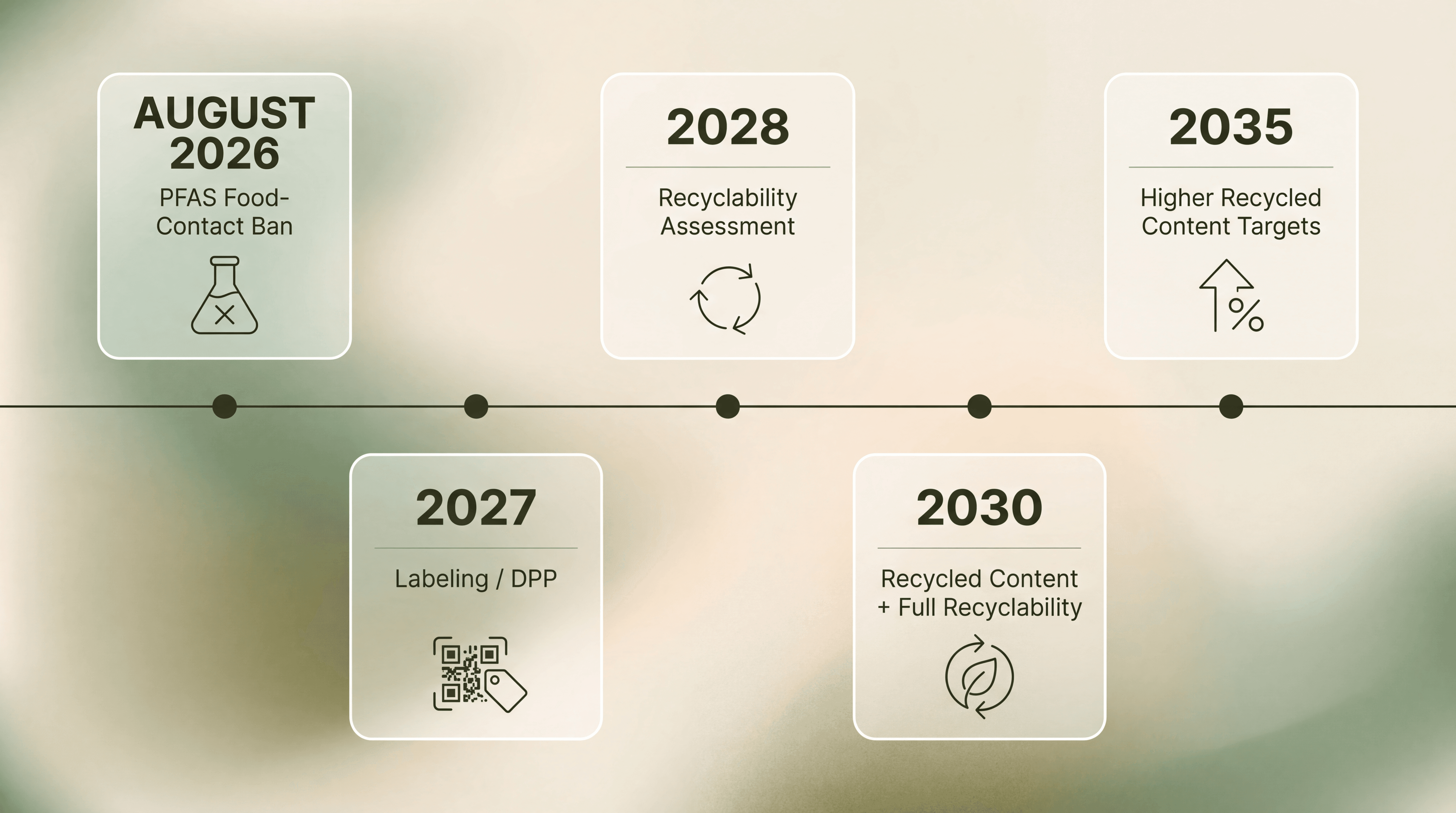
Understanding the phased implementation timeline is critical for prioritizing compliance investments. Key dates based on currently available regulatory guidance:
Deadline | Obligation |
|---|---|
August 2026 | PFAS ban on food-contact packaging takes effect; initial substance restrictions enforced |
2027 | Labeling and sortability requirements begin; DPP obligations phase in |
2028 | Mandatory recyclability assessment for all packaging; minimization requirements enforced |
2030 | Recycled content minimums enforced (30% for PET contact-sensitive, 10% for other contact-sensitive plastics, 30% for single-use plastic beverage bottles) |
2030 | All packaging must be recyclable; design-for-recycling criteria fully enforced |
2035 | Recycled content targets increase (50% for PET contact-sensitive, 25% for other contact-sensitive, 65% for single-use plastic beverage bottles) |
⚠ The August 2026 PFAS restriction on food-contact packaging is the first hard enforcement milestone. Manufacturers with food-contact packaging in their portfolio must treat this as the immediate priority.
For organizations using regulatory intelligence and horizon scanning capabilities, the PPWR timeline should already be mapped against product launch schedules, packaging redesign cycles, and supplier qualification timelines.
PPWR compliance checklist timeline showing key deadlines from 2026 to 2035 for manufacturers
Click on image to view full
Scope: Which Manufacturers and Packaging Types Are Affected
The PPWR applies to all packaging placed on the EU market, regardless of the material (plastic, glass, metal, paper, wood, composite) or the origin of the manufacturer. This includes:
✓ Primary packaging — directly in contact with the product (bottles, trays, pouches, blister packs)
✓ Secondary packaging — grouped packaging for retail display or handling (cartons, shrink wrap)
✓ Tertiary/transport packaging — pallets, crates, shipping containers, protective wrapping
✓ E-commerce packaging — corrugated boxes, void fill, mailers
✓ Reusable packaging — pallets, crates, and containers used in closed-loop systems
Industries With Highest PPWR Exposure
📊 Consumer goods manufacturers face the broadest impact — food, beverage, personal care, and household products packaging all fall under substance restrictions, recyclability mandates, and labeling rules.
📊 Electronics manufacturing — ESD packaging, blister packs, and foam inserts containing PFAS or non-recyclable composites require reformulation or substitution.
📊 Chemical manufacturing — Hazardous goods packaging must meet both PPWR and chemical and hazmat compliance requirements simultaneously.
📊 Pharmaceutical and biotech — Primary packaging for medicinal products involves complex material declarations that intersect PPWR with existing pharmacopoeia and GMP requirements.
📊 Automotive manufacturing — Parts packaging, service kits, and aftermarket product packaging all fall within scope.
Substance Restrictions: PFAS, Heavy Metals, and Hazardous Chemicals
PFAS Ban on Food-Contact Packaging (August 2026)
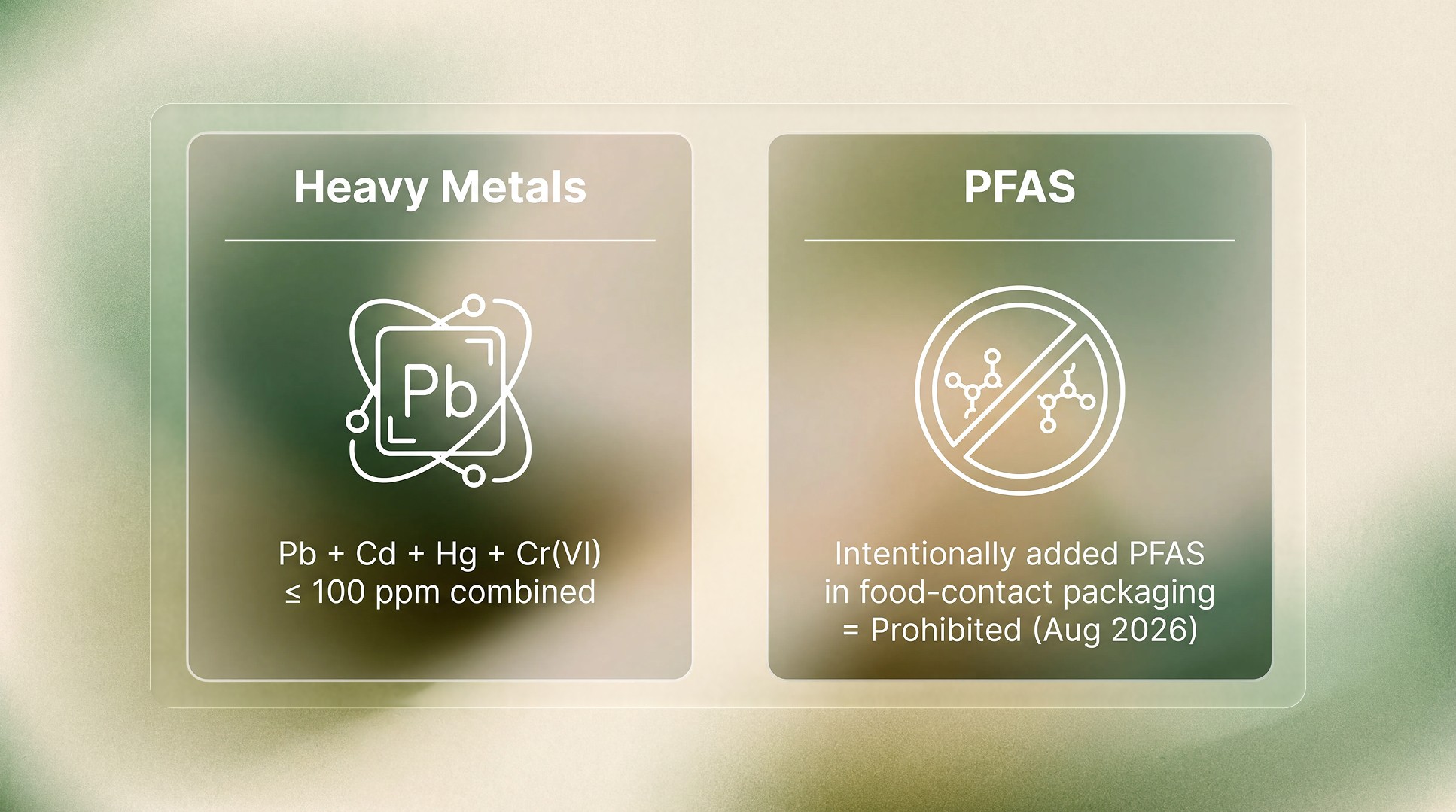
The PPWR prohibits intentionally added per- and polyfluoroalkyl substances (PFAS) in food-contact packaging beginning August 2026. This covers:
Grease-resistant paper and paperboard (fast food wrappers, bakery bags, microwave popcorn bags)
Coated food trays and bowls
Molded fiber packaging with fluorinated coatings
Any food-contact packaging where PFAS is intentionally added for performance properties
This ban intersects with the broader EU PFAS restriction proposal under REACH and state-level PFAS bans in the US. Manufacturers supplying food-contact packaging across both EU and US markets face overlapping compliance obligations that demand substance-level tracking across the supply chain.
Organizations already managing PFAS compliance across multi-tier supply chains will need to extend those workflows to packaging-specific material declarations.
Heavy Metals and Substances of Concern
The PPWR maintains and tightens concentration limits for heavy metals in packaging:
Substance | Threshold |
|---|---|
Lead (Pb) | Sum of Pb + Cd + Hg + Cr(VI) ≤ 100 ppm |
Cadmium (Cd) | Included in combined threshold above |
Mercury (Hg) | Included in combined threshold above |
Hexavalent Chromium (Cr VI) | Included in combined threshold above |
PFAS (food-contact) | Intentionally added = prohibited (Aug 2026) |
Other substances of concern | Subject to future restriction via delegated acts |
⚠ The regulation empowers the European Commission to add further substance restrictions through delegated acts without requiring a full legislative process. This makes BOM substance and threshold management an ongoing obligation, not a one-time assessment.
📌 Managing PFAS and substance restrictions across packaging suppliers? See how Certivo automates this → Book a Demo
PPWR compliance checklist substance restrictions showing PFAS ban and heavy metal thresholds for packaging
Click on image to view full
Recyclability Requirements and Design-for-Recycling Mandates
The PPWR introduces a tiered recyclability framework that becomes progressively more stringent:
Phase 1: Recyclability Assessment (2028)
All packaging placed on the EU market must be assessed for recyclability based on:
Design for recycling — packaging must be designed to be recyclable according to criteria set by the Commission
Sortability — packaging must be compatible with existing waste sorting infrastructure
Recyclability at scale — a proven recycling process must exist at commercial scale
Phase 2: Full Recyclability (2030)
By 2030, all packaging must meet recyclability performance grades. Packaging that scores below the minimum threshold cannot be placed on the EU market.
What This Means for Compliance Engineers
Manufacturers must evaluate every packaging SKU against design-for-recycling criteria. Multi-material packaging (e.g., paper-plastic laminates, metallized films) faces the highest compliance risk because these structures are often incompatible with single-stream recycling.
For organizations tracking compliance by BOM, the PPWR requires extending BOM-level compliance intelligence to packaging components — not just product materials. This means packaging material composition, layer structures, adhesive types, and coating chemistries must be documented and assessed.
Recycled Content Targets by Packaging Material
The PPWR sets mandatory minimum recycled content for plastic packaging, with deadlines in 2030 and 2035:
Packaging Type | 2030 Target | 2035 Target |
|---|---|---|
Contact-sensitive PET packaging | 30% recycled content | 50% recycled content |
Single-use PET beverage bottles | 30% recycled content | 65% recycled content |
Contact-sensitive plastic (non-PET) | 10% recycled content | 25% recycled content |
Non-contact-sensitive plastic | 35% recycled content | 65% recycled content |
Verification and Documentation
Manufacturers must provide verifiable evidence of recycled content through supplier declarations, chain-of-custody certificates, and mass-balance documentation. This creates a significant automated supplier data collection burden — particularly for manufacturers sourcing plastic packaging from multiple suppliers across regions.
Organizations relying on spreadsheets for tracking recycled content percentages across hundreds of packaging SKUs will struggle to maintain accuracy. Centralized supplier self-service portals that enable packaging suppliers to submit material declarations and recycled content certificates reduce the manual effort and error rates inherent in email-based workflows.
Labeling, Marking, and Digital Product Passport Obligations
Harmonized Labeling
The PPWR introduces standardized labeling requirements for all packaging placed on the EU market:
✓ Material composition identification (harmonized across all member states) ✓ Consumer sorting instructions (replacing inconsistent national systems) ✓ QR code or data carrier linking to Digital Product Passport
Digital Product Passport (DPP) for Packaging
The PPWR aligns with the EU's broader Digital Product Passport framework under the Ecodesign for Sustainable Products Regulation (ESPR). Packaging-specific DPPs must contain:
Material composition and substance declarations
Recycled content percentage (with verification)
Recyclability classification
Producer identification and EPR registration
Compliance declarations
This represents one of the first mandatory applications of digital passport and traceability systems at scale. Manufacturers must build the data infrastructure to populate DPPs with accurate, supplier-verified data for every packaging variant.
For a deeper understanding of DPP requirements, see Digital Product Passports 2027: Why DPP Is Becoming the Backbone of Compliance.
Extended Producer Responsibility Under PPWR
The PPWR harmonizes EPR schemes across EU member states. Key changes:
Mandatory EPR registration in every member state where packaging is placed on the market
Eco-modulated fees — EPR fees adjusted based on recyclability, recycled content, and reusability of packaging
Cross-border harmonization — standardized reporting formats and data requirements reduce the complexity of multi-jurisdiction EHS and ESG management
Manufacturers with packaging in multiple EU countries previously navigated dozens of different national EPR systems. The PPWR's harmonization reduces administrative fragmentation but introduces new data granularity requirements — EPR fee calculations now depend on packaging-level material data that must be accurate and auditable.
Organizations managing standardized compliance across plants and regions should align PPWR EPR registration with existing extended producer responsibility compliance programs.
How PPWR Intersects with REACH, RoHS, and Other Frameworks
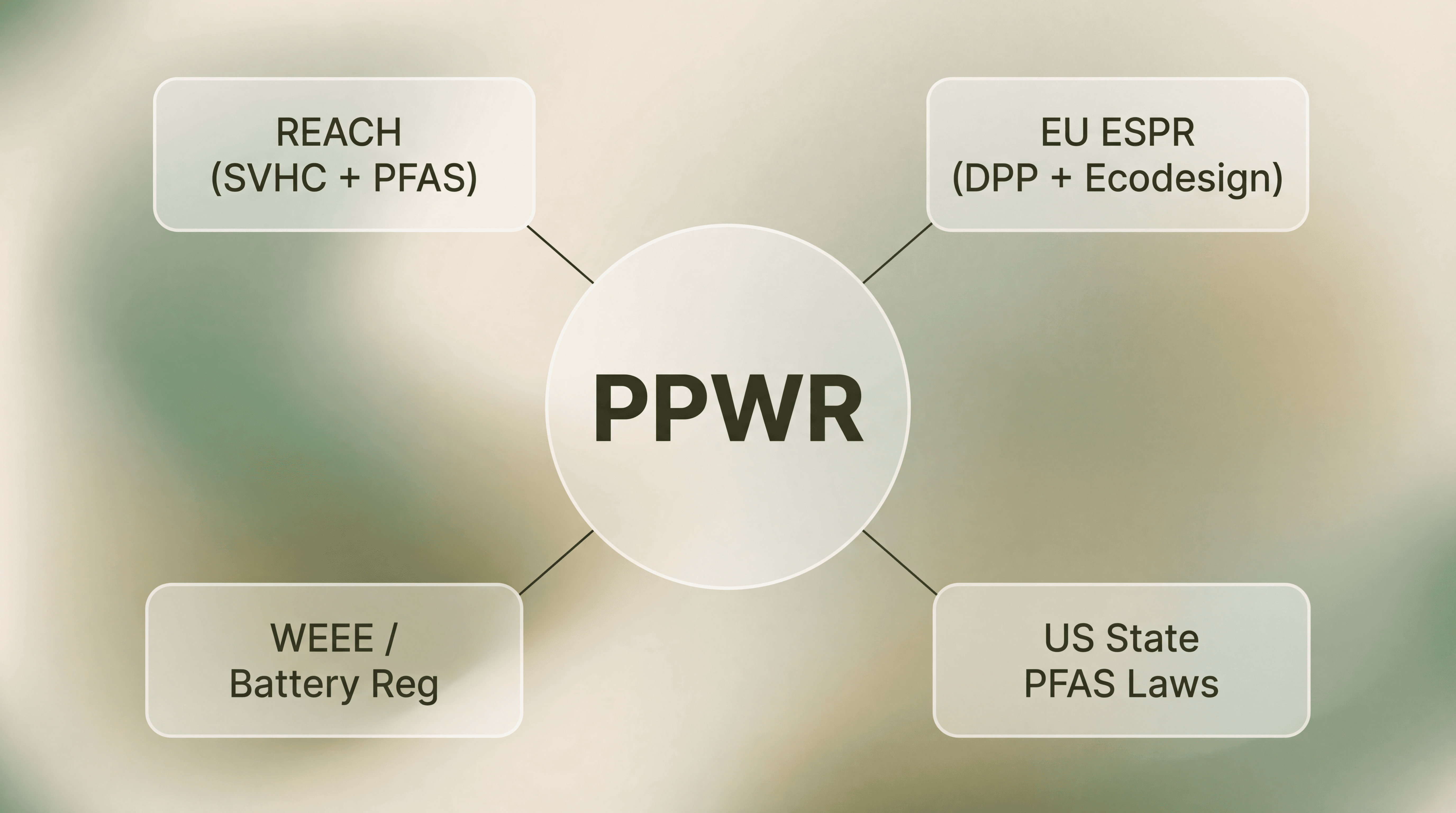
The PPWR does not exist in isolation. Compliance engineers must manage its requirements alongside overlapping regulatory frameworks:
Framework | Intersection with PPWR |
|---|---|
REACH | SVHC restrictions apply to packaging materials; PFAS restriction proposal under REACH may expand beyond PPWR's food-contact scope |
EU ESPR | DPP and ecodesign criteria for packaging align with ESPR's broader product sustainability requirements |
WEEE | Electronics packaging must meet both PPWR recyclability and WEEE obligations |
EU Battery Regulation | Battery packaging falls under both PPWR and EU Battery Regulation due diligence |
PPWR + National PFAS Laws | US state-level PFAS packaging bans (California, Connecticut, Minnesota) create parallel compliance obligations for manufacturers serving both markets |
This multi-framework complexity is where a centralized compliance data backbone becomes essential. Tracking PFAS restrictions simultaneously across PPWR, REACH, and US state-level bans — for the same packaging materials — is not feasible without a system that normalizes substance data across regulatory contexts.
For a broader perspective on PFAS complexity, see The Global PFAS Reckoning: How to Prepare for Bans, Thresholds, and Substitution Requirements.
PPWR compliance overlap diagram showing intersections with REACH PFAS ESPR and WEEE frameworks
Click on image to view full
Reporting, Documentation, and Data Challenges for Manufacturers
What Data Must Be Collected
For each packaging type placed on the EU market, manufacturers need:
📊 Full material composition (including coatings, adhesives, inks, and barrier layers) 📊 Substance declarations for PFAS, heavy metals, and substances of concern 📊 Recycled content percentage with chain-of-custody documentation 📊 Recyclability assessment results per design-for-recycling criteria 📊 EPR registration data for each applicable member state 📊 DPP-ready data in standardized digital format
Where Data Challenges Arise
Most packaging data resides with Tier 1 and Tier 2 packaging suppliers — not within the manufacturer's own systems. Collecting verified material declarations, recycled content certificates, and substance test reports from hundreds of packaging suppliers requires automated supplier data collection portals rather than manual email campaigns.
AI document parsing and certificate validation capabilities are particularly valuable for PPWR compliance because packaging supplier documentation is often non-standardized — test reports from different labs use different formats, recycled content certificates vary by certification body, and material declarations may reference different substance identification systems.
CORA-powered regulatory intelligence can extract, validate, and cross-reference packaging supplier documents against PPWR requirements automatically, reducing manual review cycles from weeks to hours.
Compliance Risks, Penalties, and Enforcement Exposure
Based on currently available regulatory guidance, PPWR enforcement will be handled by national market surveillance authorities in each EU member state. Non-compliance consequences include:
⚠ Market access denial — Packaging that does not meet substance restrictions, recyclability criteria, or labeling requirements cannot be legally placed on the EU market
⚠ Product recalls — Packaging found to contain prohibited PFAS in food-contact applications after August 2026 can trigger mandatory recalls
⚠ Financial penalties — Member states will set penalty levels; eco-modulated EPR fees penalize non-recyclable or low-recycled-content packaging
⚠ Supply chain disqualification — Brand owners and retailers increasingly require PPWR compliance evidence from packaging suppliers as a procurement condition
⚠ Reputational exposure — Non-compliance with packaging sustainability regulations creates ESG reporting gaps visible to investors and rating agencies
Maintaining continuous audit-ready documentation for packaging compliance is the most effective risk mitigation strategy.
Supply Chain and Operational Impact
Upstream: Packaging Suppliers
Packaging material suppliers must provide verified recycled content data, substance declarations, and recyclability assessments
Smaller packaging suppliers may lack the systems to produce compliant documentation — creating supplier risk scoring and due diligence requirements for manufacturers
Multi-material packaging suppliers face the greatest reformulation pressure
Downstream: Customers and Retailers
Brand owners and retailers will cascade PPWR requirements to contract manufacturers and co-packers
Customer RFQ responses will increasingly require packaging-level compliance declarations
Private label manufacturers must demonstrate PPWR compliance on behalf of brand owners
Operational Impact
Packaging redesign programs must be initiated for non-recyclable formats well before 2028 assessment deadlines
Procurement teams must integrate PPWR criteria into packaging supplier qualification processes
ERP and PLM systems require packaging material composition data fields that many organizations have not yet implemented
For manufacturers managing multi-tier supply chain transparency programs, PPWR extends transparency requirements from product materials to packaging materials — doubling the scope of supplier data collection.
Strategic PPWR Compliance Preparation Checklist
Compliance engineers and packaging managers should execute the following actions:
✅ 1. Inventory All Packaging SKUs — Map every packaging type (primary, secondary, tertiary, e-commerce) placed on the EU market, including material composition and supplier source.
✅ 2. Assess PFAS Exposure — Identify all food-contact packaging containing intentionally added PFAS. Prioritize reformulation or supplier substitution before August 2026. Use PFAS tracking tools to map exposure across products and supply chains.
✅ 3. Verify Heavy Metal Compliance — Confirm that all packaging materials meet the combined 100 ppm threshold for Pb + Cd + Hg + Cr(VI) through supplier test reports or third-party analysis.
✅ 4. Evaluate Recyclability — Assess each packaging format against design-for-recycling criteria. Flag multi-material or composite packaging structures for redesign.
✅ 5. Collect Recycled Content Evidence — Request verified recycled content declarations from all plastic packaging suppliers. Establish chain-of-custody documentation.
✅ 6. Prepare DPP Data Infrastructure — Ensure packaging material data is structured, digital, and ready for DPP population. Align with digital passport and traceability systems requirements.
✅ 7. Register for EPR in All Applicable Member States — Audit current EPR registrations against PPWR requirements. Close gaps before harmonized reporting obligations take effect.
✅ 8. Update Supplier Questionnaires — Incorporate PPWR-specific data fields (PFAS declarations, recycled content, recyclability assessments) into standardized supplier questionnaire frameworks.
✅ 9. Align with Cross-Framework Obligations — Map PPWR packaging requirements against existing REACH, RoHS, and PFAS compliance programs to avoid duplicate effort.
✅ 10. Establish Ongoing Monitoring — PPWR substance restrictions will expand through delegated acts. Implement regulatory intelligence and horizon scanning to detect new requirements before they take effect.
How AI Automates PPWR Compliance Across Packaging Portfolios
Manual PPWR compliance management — tracking substance restrictions, recyclability assessments, recycled content verification, and DPP data across hundreds of packaging SKUs and dozens of suppliers — is not scalable.
Automated Supplier Data Collection
Certivo's supplier self-service compliance portals enable packaging suppliers to submit material declarations, PFAS attestations, recycled content certificates, and recyclability assessments through a guided digital interface. This eliminates email-based data collection and ensures version-controlled, validated submissions.
AI-Powered Document Parsing
CORA-driven compliance intelligence extracts data from packaging supplier documents — test reports, certificates of analysis, material safety data sheets, and recycled content certifications — and validates them against PPWR thresholds automatically. This AI document parsing and certificate validation capability reduces manual review time and catches discrepancies before they become audit findings.
BOM-Level Packaging Compliance
Certivo maps packaging material data to product BOMs, enabling compliance teams to assess PPWR status at the finished-product level. This BOM-level compliance intelligence approach answers the question every compliance engineer faces: "Which of my products are at risk because of their packaging?"
Continuous Monitoring
CORA's regulatory intelligence layer tracks PPWR implementation acts, delegated acts, and member state enforcement guidance — alerting compliance teams to new substance restrictions, deadline changes, or criteria updates. This shifts organizations from reactive to continuous compliance monitoring and audit readiness.
For a comprehensive view of AI capabilities in compliance, see AI Tools for Compliance Management: The Complete Guide.
Conclusion
The PPWR creates binding, EU-wide packaging compliance obligations that affect every manufacturer placing packaged products on the European market. The August 2026 PFAS ban on food-contact packaging is the first enforcement milestone, followed by recyclability assessments in 2028 and mandatory recycled content in 2030.
For compliance leaders at global manufacturers, the PPWR compliance checklist is clear: inventory packaging SKUs, eliminate prohibited substances, assess recyclability, verify recycled content, prepare DPP data infrastructure, and establish continuous monitoring for future delegated acts. Organizations that treat PPWR as a standalone exercise — rather than integrating it with existing REACH, RoHS, and PFAS compliance programs — will create redundant workstreams and increase audit risk.
Investing in AI-native compliance automation, centralized supplier self-service portals, and BOM-level packaging compliance intelligence is the most effective path to absorbing PPWR requirements without proportional increases in headcount or manual effort.
📌 Book a demo to see how Certivo automates PPWR compliance across your packaging portfolio and multi-tier supply chain — or get a free compliance risk assessment to evaluate your current packaging compliance readiness before the August 2026 deadline.
FAQs
1. What packaging materials fall under PPWR substance restrictions beyond PFAS?
The PPWR restricts intentionally added PFAS in food-contact packaging (from August 2026) and maintains a combined 100 ppm threshold for lead, cadmium, mercury, and hexavalent chromium in all packaging. The European Commission can add further substance restrictions through delegated acts. Certivo's CORA-powered regulatory intelligence monitors these additions and alerts compliance teams before new restrictions take effect.
2. How can manufacturers verify recycled content claims from packaging suppliers at scale?
Manufacturers must collect chain-of-custody certificates, mass-balance documentation, and third-party verification from plastic packaging suppliers. Certivo's automated supplier data collection portals enable packaging suppliers to submit verified recycled content declarations digitally, with CORA validating certificates against PPWR thresholds automatically.
3. Does the PPWR apply to packaging for products manufactured outside the EU?
Yes. The PPWR applies to all packaging placed on the EU market, regardless of where the product or packaging was manufactured. Importers and their authorized representatives bear compliance responsibility. This creates PPWR compliance obligations for any global manufacturer with EU market exposure.
4. How do PPWR recyclability requirements affect multi-material or composite packaging?
Multi-material packaging (paper-plastic laminates, metallized films, composite pouches) faces the highest compliance risk because these structures are often incompatible with single-stream recycling infrastructure. Manufacturers must assess these formats against design-for-recycling criteria by 2028 and may need to redesign packaging structures to meet the 2030 full-recyclability mandate.
5. Can PPWR compliance data be integrated with existing REACH and RoHS compliance programs?
Yes. Because PPWR substance restrictions overlap with REACH (SVHC and PFAS) and involve similar material declaration workflows, organizations benefit from managing all frameworks in a centralized compliance data backbone. Certivo enables manufacturers to link packaging substance data across PPWR, REACH, RoHS, and US PFAS regulations within a single system, eliminating duplicate data collection and reducing audit preparation time.
Vasanth
Vasanth is a skilled Compliance Engineer with over five years of experience specializing in global environmental regulations, including REACH, RoHS, Proposition 65, POPs, TSCA, PFAS, CMRT, EMRT, FMD, and IMDS. With a strong academic foundation in Chemical Engineering from Anna University, he brings a deep technical understanding to compliance processes across complex product lines.