


The Washington State Department of Ecology is expanding PFAS restrictions that directly affect manufacturers, importers, and retailers selling apparel and firefighting personal protective equipment (PPE) into the state. A mandatory Washington State PFAS ban on apparel products containing intentionally added PFAS takes effect January 1, 2027, while written PFAS disclosure obligations for firefighting PPE are already in force.
For compliance leaders managing product portfolios across multiple US jurisdictions, these requirements add another layer to an increasingly complex state-level PFAS regulatory landscape. The operational challenge is not the regulation itself—it is tracking, documenting, and proving substance-level compliance across every product line and supplier tier selling into Washington.
📌 Book a free compliance assessment to map your PFAS exposure across products and supply chains before the January 2027 deadline.
What Is Washington's PFAS Apparel Ban and PPE Disclosure Rule?
Washington State's Toxics in Products laws establish two distinct PFAS-related obligations:
✓ Firefighting PPE Disclosure (Active Now) — Manufacturers and sellers of firefighting personal protective equipment must provide written notice to purchasers if the equipment contains intentionally added PFAS substances. This applies to turnout gear, helmets, hoods, gloves, and other protective equipment where PFAS-based coatings or treatments are present.
✓ Apparel PFAS Ban (Effective January 1, 2027) — The sale of certain apparel products containing intentionally added PFAS will be restricted in Washington State. This targets water-resistant, stain-resistant, and other PFAS-treated textile products sold to consumers.
Both requirements fall under Washington's broader initiative to reduce consumer and occupational exposure to per- and polyfluoroalkyl substances. The Washington State Department of Ecology oversees implementation and enforcement.
For manufacturers already navigating PFAS compliance across the US and EU, this regulation reinforces the need for product-level PFAS substance tracking and BOM-level material mapping.
Washington State PFAS ban 2027 apparel compliance deadline for manufacturers
Click on image to view full

Which Products and Industries Are Affected?
The Washington State PFAS ban targets specific product categories and extends compliance obligations across several industry segments:
Products in Scope
📊 Firefighting PPE — Turnout coats, pants, hoods, gloves, helmets, and boots containing PFAS-based moisture barriers, coatings, or treatments
📊 Apparel Products — Outdoor jackets, pants, and textile products treated with PFAS for water resistance, oil resistance, or stain resistance
📊 PFAS-Treated Textiles — Fabrics and coatings using per- and polyfluoroalkyl substances in manufacturing
Industries Affected
Industry | Compliance Impact |
|---|---|
Firefighting Equipment & PPE | Written PFAS disclosure to purchasers (active now) |
Apparel & Textiles | PFAS ban on applicable products (January 2027) |
Consumer Goods | Water-resistant and stain-resistant product restrictions |
Chemical Manufacturers | PFAS coatings and treatment supply chain impact |
Retailers & Distributors | Sale restrictions in Washington State |
Manufacturers in consumer goods and textile supply chains should evaluate whether their products contain intentionally added PFAS—even at coating or finishing stages—since the regulation targets the presence of PFAS in the final product regardless of where in the supply chain it was introduced.
Key Compliance Requirements and Thresholds
The regulation establishes clear obligations based on product category:
Firefighting PPE Requirements (Active Now)
⚠ Manufacturers and sellers must provide written notice to purchasers when firefighting PPE contains intentionally added PFAS
⚠ Disclosure must identify the presence of PFAS substances in the product
⚠ Applies at point of sale or distribution
Apparel Ban Requirements (Effective January 1, 2027)
⚠ Sale of certain apparel products containing intentionally added PFAS is restricted in Washington State
⚠ "Intentionally added" means PFAS deliberately used during manufacturing, not trace contamination
⚠ Requires supplier PFAS disclosure and material composition review
⚠ Product BOM and textile coating assessments are necessary
⚠ Potential reformulation and PFAS substitution activities required before the deadline
Based on currently available regulatory guidance, the threshold centers on "intentionally added" PFAS rather than a specific concentration limit. This means manufacturers must demonstrate through supply chain documentation that PFAS was not deliberately incorporated into the product—a requirement that demands BOM substance and threshold management capabilities across every product variant.
For teams managing PFAS compliance across multi-tier supply chains, the "intentionally added" standard requires supplier-level attestation, not just finished-product testing.
How Does Washington's PFAS Ban Compare to Other State Restrictions?
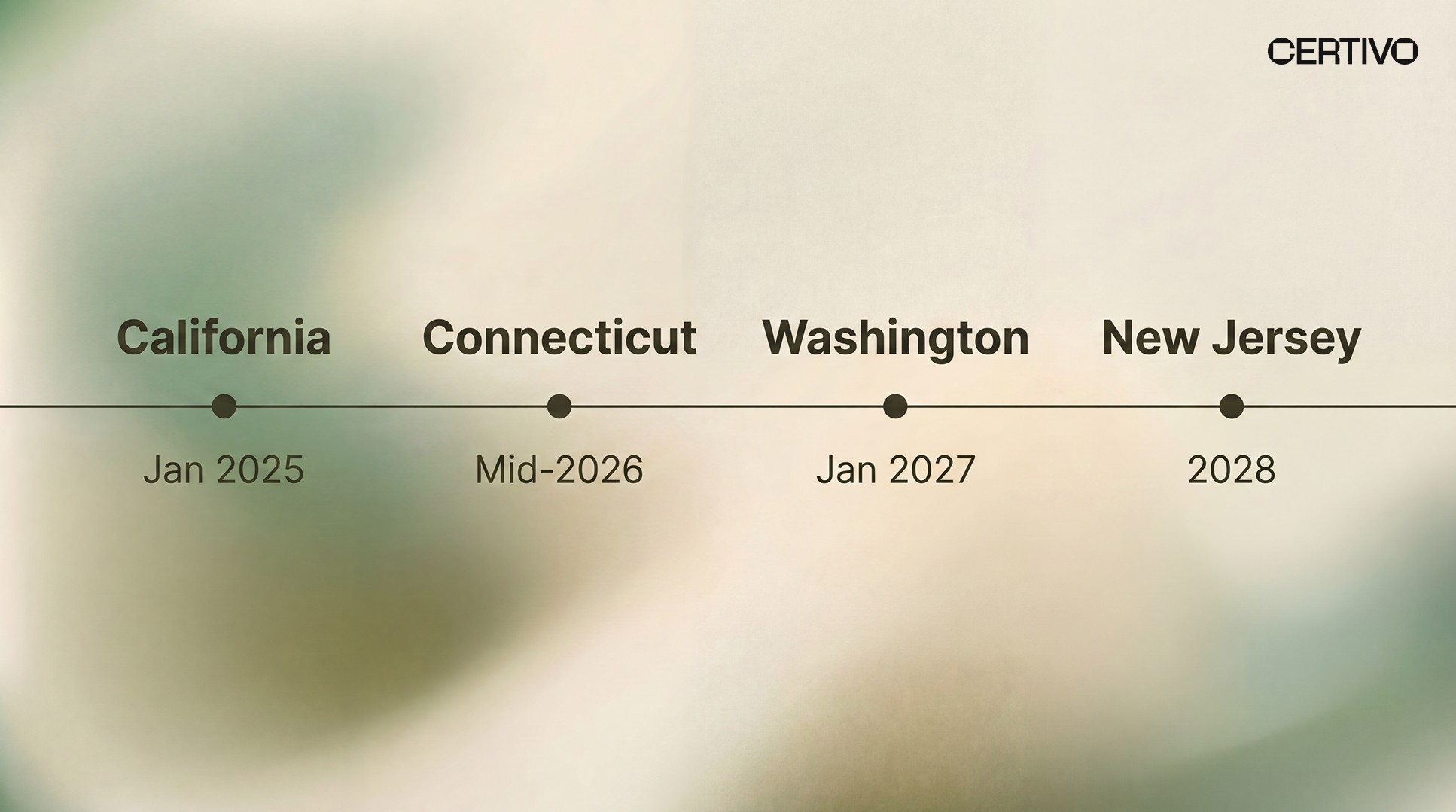
Washington is part of a growing wave of US state-level PFAS restrictions. Compliance leaders must track how each state's requirements differ in scope, timeline, and enforcement approach.
📌 California AB 1817 — Restricts PFAS in textiles; effective January 2025. See the California AB 1817 PFAS textiles ban compliance guide.
📌 Connecticut PFAS Labelling — Requires PFAS disclosure labelling for certain products by mid-2026. Details in the Connecticut PFAS labelling law guide.
📌 New Jersey PFAS Ban — Broader product category restrictions targeting 2028 enforcement. Covered in the New Jersey PFAS ban compliance guide.
📌 Federal TSCA PFAS Reporting — EPA's TSCA Section 8(a)(7) reporting rule creates overlapping federal obligations. See TSCA PFAS reporting requirements.
The operational reality is that manufacturers selling into multiple states cannot manage these overlapping requirements through spreadsheets or one-off regulatory reviews. This is a regulatory intelligence and horizon scanning problem that requires systematic tracking of deadlines, scope differences, and product-level applicability across jurisdictions.
📌 Managing PFAS compliance across multiple US states? See how Certivo automates multi-jurisdiction tracking → Get a compliance risk assessment
Washington State PFAS ban 2027 timeline compared to other US state PFAS restrictions
Click on image to view full
Reporting, Documentation, and Supply Chain Data Challenges
The "Intentionally Added" Documentation Problem
The Washington State PFAS ban requires manufacturers to determine whether PFAS was intentionally added at any stage of production. This creates a documentation challenge that flows through the entire supply chain:
Textile mills and coating suppliers must disclose PFAS use in treatments and finishes
Tier 1 suppliers must confirm whether their components or materials contain intentionally added PFAS
Finished product manufacturers must aggregate supplier declarations and make a compliance determination for each product variant
Without automated supplier data collection portals, this becomes an email-and-spreadsheet exercise that scales poorly across product lines and supplier networks.
Evidence Chain Integrity
For audit and enforcement purposes, manufacturers must maintain clear records of:
✓ Who provided the PFAS disclosure or attestation ✓ When it was provided ✓ With what authority — supplier certifications, test reports, or material declarations
This is fundamentally a data versioning problem. Declarations must be time-stamped, supplier-attributed, and retrievable as point-in-time records. CORA-powered regulatory intelligence can automate the intake, validation, and archival of these supplier documents—reducing manual data entry and ensuring that continuous audit-ready documentation is maintained without additional headcount.
Compliance Risks and Enforcement Exposure
Failure to comply with Washington's PFAS requirements carries material risk across several dimensions:
⚠ Regulatory Penalties — The Washington State Department of Ecology has enforcement authority over Toxics in Products violations, including potential fines and product removal orders
⚠ Customer Audit Findings — Retailers and brand customers selling into Washington may require PFAS-free certifications from suppliers, creating upstream audit exposure
⚠ Market Access Loss — Non-compliant products cannot legally be sold in Washington State after the effective date, risking revenue disruption for apparel and PPE manufacturers
⚠ Reputational Exposure — PFAS is a high-visibility consumer and investor issue; non-compliance findings attract media and NGO attention
⚠ Supply Chain Cascading Risk — If a supplier's PFAS attestation is later found inaccurate, the downstream manufacturer bears the compliance liability
No compliance system eliminates audit findings entirely. The objective is to reduce surprises and response time—ensuring that when a regulator, customer, or auditor asks for PFAS documentation, the evidence chain is complete, retrievable, and time-stamped.
Organizations building supplier risk scoring and due diligence programs should incorporate PFAS disclosure responsiveness as a supplier performance metric.
Strategic Compliance Preparation Checklist
How AI Reduces the Burden of Multi-State PFAS Compliance
The core challenge with state-level PFAS regulations is not any single rule in isolation—it is managing the cumulative burden of overlapping, divergent requirements across jurisdictions while maintaining product-level documentation for each.
CORA-driven compliance intelligence addresses this by:
✓ Automating PFAS substance tracking across product portfolios and supply chains, matching supplier material declarations against jurisdiction-specific requirements
✓ Parsing supplier documents — AI document parsing and certificate validation extracts PFAS-related data from supplier certificates, test reports, and declarations at intake, reducing manual review
✓ Flagging regulatory changes — Regulatory intelligence and horizon scanning capabilities alert teams when new state PFAS rules affect specific product categories, before deadlines arrive
✓ Maintaining continuous audit readiness — Every supplier submission, product assessment, and compliance determination is time-stamped, attributed, and retrievable as a point-in-time record
For a comprehensive view of how AI supports PFAS compliance workflows, see AI Tools for Compliance Management: The Complete Guide and How Certivo Automates PFAS Compliance Across Multi-Tier Supply Chains.
Executive Conclusion
Washington State's expanding PFAS restrictions—active PPE disclosure requirements and the January 1, 2027 apparel ban—represent the next step in a national trend toward product-level PFAS regulation. For manufacturers selling apparel, textiles, or firefighting PPE into Washington, the compliance path requires supplier-level PFAS disclosure, BOM-level substance mapping, and audit-ready documentation that can withstand regulatory inspection and customer audit scrutiny.
The Washington State PFAS ban does not exist in isolation. It sits alongside California AB 1817, Connecticut's PFAS labelling law, New Jersey's broader restrictions, and federal TSCA reporting obligations. Managing these overlapping requirements through manual processes is not sustainable at enterprise scale.
Certivo provides the centralized compliance data backbone, CORA-powered PFAS tracking, and automated supplier data collection infrastructure that manufacturers need to maintain continuous compliance across every US jurisdiction and product line.
📌 Book a demo to see how Certivo automates PFAS compliance across your product portfolio and multi-tier supply chain.
FAQs
1. What is the deadline for Washington State's PFAS apparel ban?
The ban on certain apparel products containing intentionally added PFAS takes effect January 1, 2027. Manufacturers and retailers must ensure affected products sold in Washington comply before this date. CORA-powered regulatory intelligence can track this and other PFAS deadlines across jurisdictions automatically.
2. Does the Washington PFAS PPE disclosure rule require testing or only notification?
Based on currently available regulatory guidance, the rule requires written notice to purchasers when firefighting PPE contains intentionally added PFAS. This is a disclosure obligation, not a testing mandate. However, manufacturers must have sufficient supply chain documentation to confirm PFAS presence or absence.
3. How does "intentionally added" PFAS differ from trace-level contamination?
"Intentionally added" means PFAS was deliberately used during manufacturing—as a coating, treatment, or component material. Trace contamination from environmental or process sources is not the target of this regulation. Proving the distinction requires supplier attestation and BOM-level material mapping.
4. Can manufacturers use the same PFAS documentation for multiple state regulations?
Partially. While supplier declarations and test reports may overlap, each state has different scope, thresholds, and disclosure requirements. A centralized compliance data backbone that maps product data against jurisdiction-specific rules is essential for efficient multi-state compliance.
5. What types of audits might enforce Washington's PFAS requirements?
Enforcement may come through state regulatory inspections by the Department of Ecology, customer audits from retailers requiring PFAS-free certifications, or internal audits as part of ISO 14001 or corporate ESG programs. Maintaining continuous audit-ready documentation reduces response time across all audit types.
Lavanya
Lavanya is an accomplished Product Compliance Engineer with over four years of expertise in global environmental and regulatory frameworks, including REACH, RoHS, Proposition 65, POPs, TSCA, PFAS, CMRT, FMD, and IMDS. A graduate in Chemical Engineering from the KLE Institute, she combines strong technical knowledge with practical compliance management skills across diverse and complex product portfolios.
She has extensive experience in product compliance engineering, ensuring that materials, components, and finished goods consistently meet evolving international regulatory requirements. Her expertise spans BOM analysis, material risk assessments, supplier declaration management, and test report validation to guarantee conformity. Lavanya also plays a key role in design-for-compliance initiatives, guiding engineering teams on regulatory considerations early in the product lifecycle to reduce risks and streamline market access.