

Canada has enacted one of its most consequential chemical restrictions in over a decade. The Prohibition of Certain Toxic Substances Regulations, 2025 (SOR/2025-270) officially repeals the 2012 framework and introduces a comprehensive Canada toxic substances ban on two persistent flame retardants — Dechlorane Plus (DP) and Decabromodiphenyl Ethane (DBDPE). The main prohibitions take effect June 30, 2026, with sector-specific exemptions extending through 2056.
For compliance and regulation managers at global manufacturers exporting to Canada, this regulation demands immediate action. It affects automotive, electronics, aerospace, construction, and textiles — industries where these flame retardants are deeply embedded in component materials and supply chains.
This guide covers every material detail: what changed, key chemical thresholds, phase-out timelines, affected industries, penalties, exemption structures, and how to prepare operationally.
📌 Table of Contents
What Changed: 2012 Framework vs. 2025 Regulations
Key Chemicals Banned: DP and DBDPE
Phase-Out Timeline and Exemption Deadlines
Affected Industries and Product Categories
Permit System and Time-Limited Exemptions
Compliance Risks and Penalties Under CEPA
Operational and Supply Chain Impact
Compliance Readiness Checklist
The Role of AI in Toxic Substance Compliance
FAQs
Executive Conclusion
1. What Changed: 2012 Framework vs. 2025 Regulations
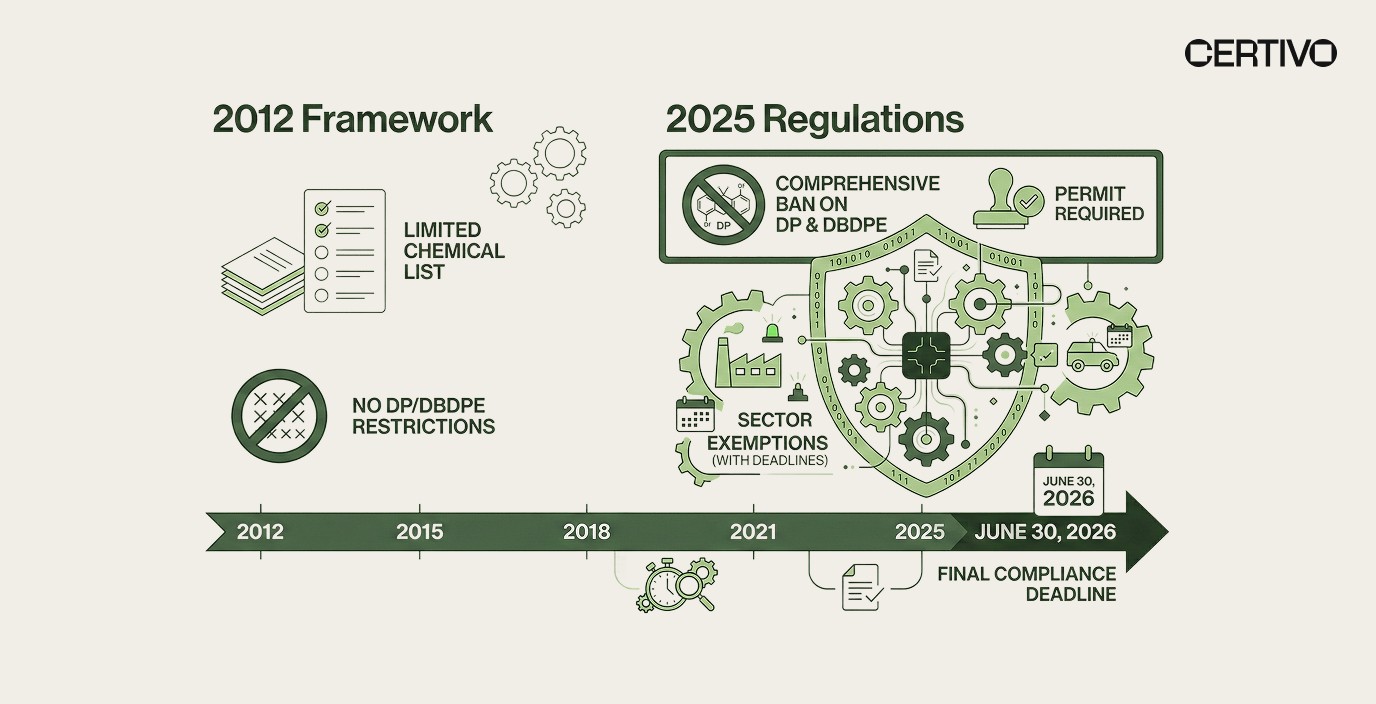
The previous Prohibition of Certain Toxic Substances Regulations, 2012 managed a limited list of chemicals under the Canadian Environmental Protection Act, 1999 (CEPA). That framework has now been fully repealed. The 2025 replacement — published December 31, 2025 in the Canada Gazette, Part II — represents a fundamental expansion in scope and enforcement.
The critical difference: DP and DBDPE were not previously banned under the 2012 framework. Environment and Climate Change Canada (ECCC) now classifies both as persistent and bioaccumulative toxic substances requiring strict prohibition. For manufacturers tracking global chemical restrictions, this aligns with ECHA's recent addition of DBDPE to the REACH SVHC list — signaling a global regulatory convergence on these flame retardants.
📊 Key regulatory shift summary:
Element | 2012 Framework | 2025 Regulations |
|---|---|---|
DP (Dechlorane Plus) | Not restricted | Fully banned (June 30, 2026) |
DBDPE | Not restricted | Fully banned (June 30, 2026) |
Permit system | Limited | Comprehensive short-term permit system |
Sector exemptions | Minimal | Time-limited exemptions for critical sectors |
Enforcement authority | CEPA 1999 | CEPA 1999 (strengthened provisions) |
Organizations managing compliance across multiple regulatory frameworks must now add this Canadian regulation to their monitoring scope alongside EU POPs, REACH, and RoHS obligations.
2. Key Chemicals Banned: DP and DBDPE
The regulation targets two specific brominated and chlorinated flame retardants that have been widely used in industrial manufacturing for decades. Both are now classified as persistent, bioaccumulative, and toxic under CEPA. Organizations needing background on how persistent organic pollutants are regulated globally should review navigating POPs regulations with proactive compliance strategies.
Dechlorane Plus (DP)
CAS Number: 13560-89-9
Common applications: Plastic connectors, wire and cable jacketing, hard plastics in electronics, adhesives and sealants in construction
Prohibition date: June 30, 2026 (general ban on manufacture, import, and sale)
Exemption expiry: December 31, 2030 (automotive and electronic replacement parts)
Decabromodiphenyl Ethane (DBDPE)
CAS Number: 84852-53-9
Common applications: Printed circuit boards, electronic housing materials, industrial fabric coatings, wire and cable insulation
Prohibition date: June 30, 2026 (general ban on manufacture, import, and sale)
Exemption expiry: January 1, 2041 (wire, cable, and plastic pellets)
Final legacy cutoff: January 1, 2056 (replacement parts only)
⚠ Critical note: The ban covers manufacture, import, sale, and use. This means organizations cannot simply stockpile these substances before June 30, 2026, and continue using them afterward — unless they qualify for a specific time-limited exemption. The ability to track compliance at the BOM level is essential for identifying where DP and DBDPE exist in your product architecture.
DBDPE is also under increasing scrutiny in Europe, where it was recently proposed for Stockholm Convention listing. Manufacturers should review the TBPH POPs listing proposal and its implications for global manufacturers for additional context on this convergence trend.
3. Phase-Out Timeline and Exemption Deadlines
The regulation establishes a staggered compliance timeline. While the core prohibitions take effect June 30, 2026, sector-specific exemptions extend the permissible use window for certain critical applications. CEOs and founders must understand these deadlines to allocate transition budgets and reformulation resources.
Chemical | CAS Number | Key Deadline | Scope |
|---|---|---|---|
Dechlorane Plus (DP) | 13560-89-9 | June 30, 2026 | General ban on manufacture, import, and sale |
Dechlorane Plus (DP) | 13560-89-9 | December 31, 2030 | Expiry of exemption for automotive/electronic parts |
DBDPE | 84852-53-9 | June 30, 2026 | General ban on manufacture, import, and sale |
DBDPE | 84852-53-9 | January 1, 2041 | Expiry for use in wire, cable, and plastic pellets |
DBDPE (Replacement Parts) | 84852-53-9 | January 1, 2056 | Final cutoff for legacy replacement parts |
📌 Key dates for compliance planning:
January 2026: Administrative and reporting provisions enter into force
June 30, 2026: Main prohibitions effective — no manufacture, import, sale, or use of DP or DBDPE without an exemption
December 31, 2030: All exempted automotive and electronic parts containing DP must cease
January 1, 2041: Wire, cable, and plastic pellet exemptions for DBDPE expire
January 1, 2056: Absolute final cutoff for all DBDPE legacy replacement parts
Organizations operating under multiple regulatory timelines should consider centralizing market readiness into a single source of truth to prevent compliance gaps across jurisdictions.
4. Affected Industries and Product Categories
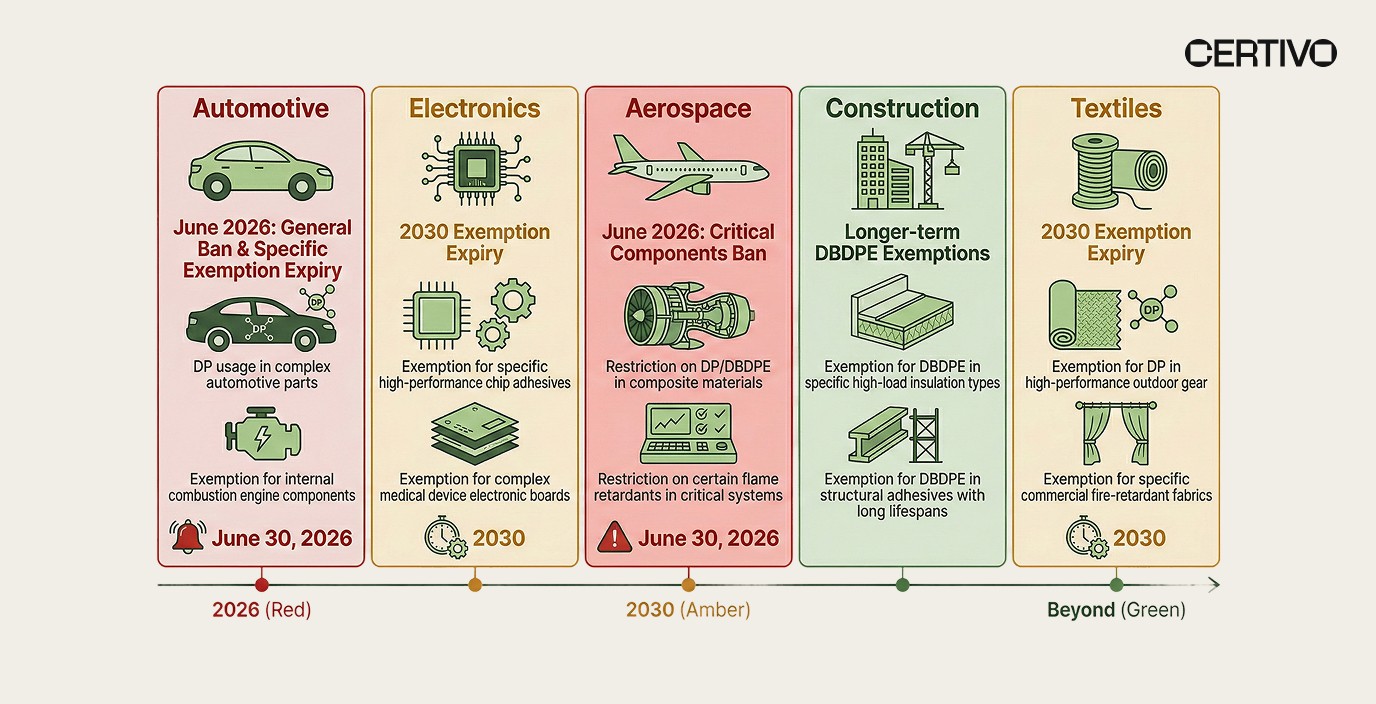
The ban impacts five major industrial sectors. Each faces distinct exposure depending on how DP and DBDPE are used in their products and supply chains. VP and directors of quality should lead cross-functional assessments to map chemical exposure across product lines.
✓ Automotive
Plastic connectors, wire and cable jacketing, and engine components commonly contain DP and DBDPE as flame retardants. The exemption for automotive replacement parts containing DP expires December 31, 2030. Manufacturers should reference the automotive regulatory landscape guide for compliance leaders for broader context on how this regulation fits within the sector's compliance obligations.
✓ Electronics & Appliances
Hard plastics, printed circuit boards, and housing materials are primary applications for both substances. Companies in the semiconductor and PCB sector face immediate exposure. The exemption for electronic replacement parts containing DP also expires December 31, 2030.
✓ Aerospace & Defence
Specialized rub strips for aircraft engines and wire insulation rely on these flame retardants for performance-critical applications. Organizations in the aerospace and defense industry should evaluate the permit system for short-term continued use where alternatives are not yet qualified. For sector-specific compliance strategies, see streamlining aerospace and defence compliance best practices.
✓ Building & Construction
Plastic roofing materials, sealants, and adhesives in the construction and building materials sector are affected. These materials often contain DP as a cost-effective flame retardant.
✓ Textiles
Coatings for industrial fabrics and furniture use DBDPE and DP for fire resistance. Organizations supplying into the Canadian market must verify substance content across their textile supply chains using standardized supplier questionnaire frameworks.
5. Permit System and Time-Limited Exemptions
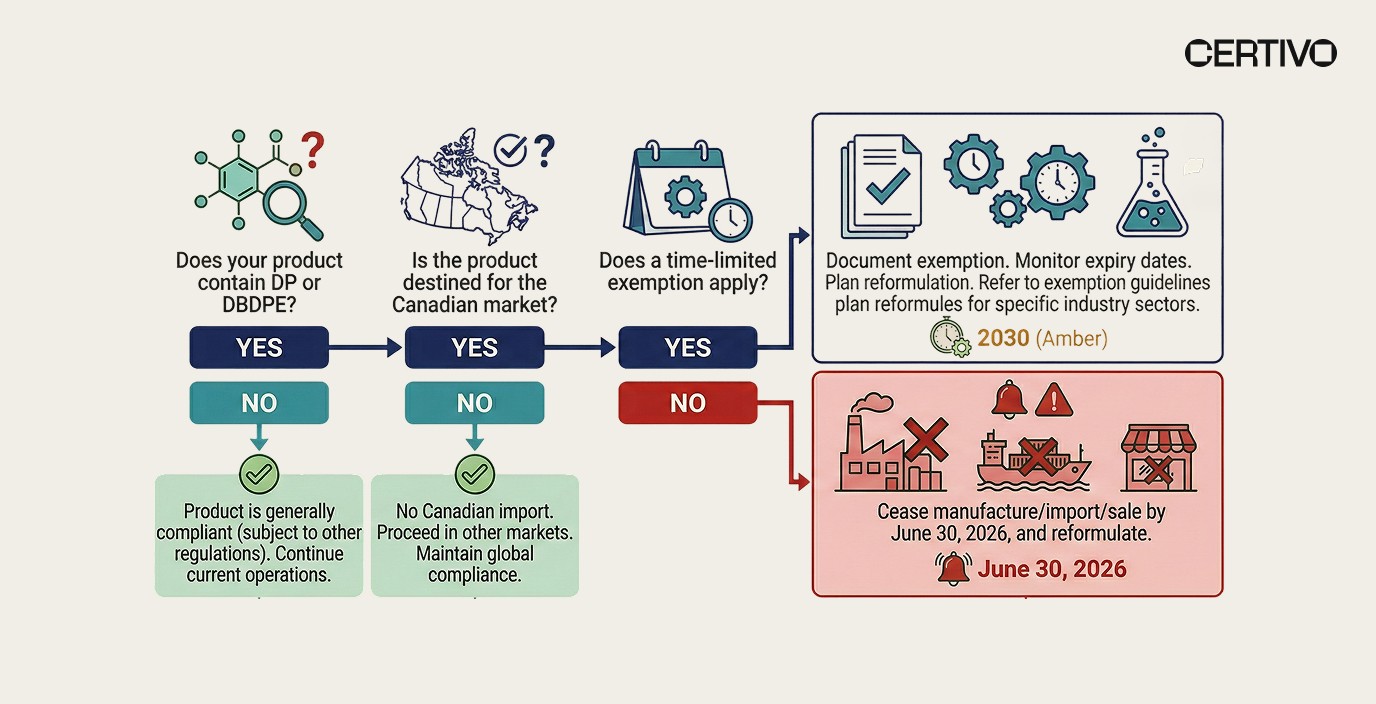
Unlike the 2012 framework, the 2025 regulations introduce a formal permit system. This allows organizations with demonstrable need — and no commercially viable alternative — to apply for short-term continued use of DP or DBDPE beyond the June 30, 2026, prohibition date.
⚠ Permit conditions include:
Demonstrated absence of commercially available alternatives
Time-limited authorization (not indefinite)
Reporting obligations on quantities manufactured, imported, or used
Compliance with specific conditions set by ECCC
The exemption structure also provides automatic time-limited carve-outs for specific applications:
Automotive and electronic replacement parts (DP): Exempt until December 31, 2030
Wire, cable, and plastic pellets (DBDPE): Exempt until January 1, 2041
Legacy replacement parts (DBDPE): Exempt until January 1, 2056
Organizations planning to rely on exemptions must maintain continuous audit-ready documentation that substantiates their eligibility. The permit application process requires detailed reporting — including quantities, intended use, and progress toward alternative substitution. Procurement and supply chain leaders should begin identifying alternative materials now, even if their current applications fall within an exemption window.
6. Compliance Risks and Penalties Under CEPA
The Canadian Environmental Protection Act, 1999 provides robust enforcement mechanisms. Violations of the Prohibition of Certain Toxic Substances Regulations carry significant consequences. Organizations should adopt a proactive compliance risk management approach rather than waiting for enforcement actions.
📌 Potential penalties include:
Summary conviction fines of up to $300,000 for individuals and $4,000,000 for corporations (per offence)
Indictable offence fines of up to $1,000,000 for individuals and $6,000,000 for corporations
Imprisonment of up to 3 years for indictable offences
Environmental Protection Compliance Orders (EPCOs) directing corrective action
Injunctions prohibiting continued manufacture, import, or sale
⚠ Non-compliance also carries reputational and market access risks. Canadian importers and distributors will increasingly require substance compliance declarations from suppliers. Companies unable to provide certificates of conformance demonstrating DP and DBDPE-free status risk losing access to the Canadian market entirely.
For organizations that rely on manual compliance tracking, the risk of missed deadlines and undocumented exemption claims is significant. Understanding why people-only compliance cannot scale is critical context for resource planning.
7. Operational and Supply Chain Impact
This regulation creates immediate operational imperatives across the value chain. The impact extends far beyond Canadian-domiciled manufacturers — any global company exporting products containing DP or DBDPE into Canada is subject to these prohibitions. VPs of operations must assess exposure across all product lines destined for the Canadian market.
For manufacturers:
✓ Conduct a full substance audit across all BOMs and product formulations for DP (CAS 13560-89-9) and DBDPE (CAS 84852-53-9)
✓ Identify alternative flame retardants and initiate reformulation programs for affected products
✓ Evaluate whether any applications qualify for time-limited exemptions or permit applications
✓ Update product technical documentation and material declarations
For importers:
✓ Request updated substance declarations from all suppliers for Canadian-destined products
✓ Verify exemption eligibility for any products containing DP or DBDPE
✓ Establish incoming material verification processes
✓ Prepare for potential ECCC audits and documentation requests
For supply chain teams:
⚠ Engage upstream suppliers to identify DP and DBDPE presence in components, sub-assemblies, and raw materials
⚠ Assess multi-tier supply chain exposure — these substances may be present in materials several tiers deep
⚠ Align Canadian requirements with parallel restrictions under EU POPs regulations and digital product passport requirements
Organizations managing documentation workloads across multiple regulatory changes should understand how tariffs and reshoring are compounding material compliance demands — this Canadian ban adds another layer of complexity.
The ability to achieve multi-tier supply chain transparency is now a regulatory prerequisite, not a best practice.
8. Compliance Readiness Checklist
📌 Use this checklist to assess your organization's preparedness for the Canada toxic substances ban:
# | Action Item | Owner | Status |
|---|---|---|---|
1 | Identify all products containing DP (CAS 13560-89-9) or DBDPE (CAS 84852-53-9) | Engineering / Compliance | ☐ |
2 | Map DP and DBDPE presence across full BOM structures | Product Engineering | ☐ |
3 | Determine exemption eligibility for each affected product line | Regulatory Affairs | ☐ |
4 | Issue structured supplier substance declarations for DP and DBDPE | Procurement | ☐ |
5 | Initiate alternative substance evaluation and reformulation programs | R&D / Materials Engineering | ☐ |
6 | Apply for ECCC permits where no alternatives exist and exemptions apply | Regulatory Affairs | ☐ |
7 | Update product compliance documentation and material data sheets | Quality / Compliance | ☐ |
8 | Align Canadian compliance with EU POPs and REACH SVHC obligations for DBDPE | Global Compliance | ☐ |
9 | Configure compliance tracking systems for Canadian toxic substances requirements | IT / Compliance | ☐ |
10 | Monitor Canada Gazette for implementation updates and guidance | Regulatory Intelligence | ☐ |
Organizations still managing this level of complexity on spreadsheets should evaluate replacing spreadsheets with a scalable compliance system before the June 2026 deadline. IT and systems leaders should be involved in items 8, 9, and 10.
9. The Role of AI in Toxic Substance Compliance
Managing substance-level compliance across global product portfolios — especially when regulations introduce staggered phase-out timelines and permit systems — exceeds what manual processes can reliably deliver. For perspective on how AI transforms daily compliance work, see a compliance engineer's week with and without AI.
The Canada toxic substances ban creates specific operational demands:
BOM-level substance identification for DP and DBDPE across thousands of components and formulations
Exemption classification for each affected product by application type and deadline
Supplier substance data collection verified against CAS numbers and concentration thresholds
Cross-jurisdictional alignment with EU POPs, REACH SVHC, and RoHS obligations for the same substances
AI-native compliance platforms address these demands through:
✓ Automated BOM scanning and material mapping to flag DP and DBDPE presence at the component level
✓ Regulatory horizon scanning that tracks Canadian, EU, and global substance restriction timelines simultaneously
✓ Supplier self-service portals that enable structured substance declaration collection at scale
✓ Audit-ready documentation generation mapped to specific regulatory reporting fields
For a comprehensive overview of these capabilities, see AI tools for compliance management: the complete guide. Organizations evaluating platform options should also review what tools support end-to-end product compliance from design through shipment.
The convergence of Canadian, European, and Stockholm Convention restrictions on the same substances makes AI-driven supply chain compliance management infrastructure essential for any manufacturer operating across multiple jurisdictions. CTOs and VPs of engineering play a key role in evaluating and deploying these systems.
10. Frequently Asked Questions (FAQs)
Q1: What substances are banned under Canada's 2025 toxic substances regulations?
The regulation bans Dechlorane Plus (DP, CAS 13560-89-9) and Decabromodiphenyl Ethane (DBDPE, CAS 84852-53-9). Both are flame retardants classified as persistent and bioaccumulative under CEPA. The ban covers manufacture, import, sale, and use effective June 30, 2026. For broader context on how DBDPE is being restricted globally, see the DBDPE REACH SVHC update.
Q2: Are there any exemptions to the ban?
Yes. The regulation provides time-limited exemptions for specific critical applications. Automotive and electronic replacement parts containing DP are exempt until December 31, 2030. DBDPE in wire, cable, and plastic pellets is exempt until January 1, 2041. Legacy replacement parts containing DBDPE have a final cutoff of January 1, 2056. A formal permit system also allows short-term continued use where no alternatives exist. Organizations can learn more about managing exemption documentation through Certivo's compliance solutions.
Q3: Does this regulation affect companies outside Canada?
Yes. Any company that manufactures, imports, or sells products containing DP or DBDPE into the Canadian market is subject to these prohibitions — regardless of where the company is headquartered. Global manufacturers should review the complete guide to product compliance management for multi-jurisdictional planning.
Q4: How does this regulation relate to EU restrictions on the same substances?
DBDPE was recently added to the REACH SVHC Candidate List, and both substances are under evaluation for Stockholm Convention listing. The Canadian ban signals a global regulatory convergence. Manufacturers should align their substance phase-out programs across jurisdictions to avoid duplicated effort. See RoHS and REACH compliance lessons for 2026 for cross-framework planning guidance.
Q5: What penalties apply for non-compliance?
Under CEPA, penalties include fines of up to $4,000,000 for corporations on summary conviction and up to $6,000,000 on indictment. Individuals face fines up to $1,000,000 and imprisonment of up to 3 years. Environmental Protection Compliance Orders and injunctions can also be issued. Review the ECCC toxic substances management overview for official enforcement guidance.
11. Executive Conclusion
The Prohibition of Certain Toxic Substances Regulations, 2025 represents a decisive shift in Canadian chemical compliance. The Canada toxic substances ban on Dechlorane Plus and DBDPE — effective June 30, 2026 — demands that manufacturers, importers, and supply chain partners act now. With exemptions staggering through 2030, 2041, and 2056, this is not a single-event compliance obligation but a multi-decade phase-out requiring sustained monitoring, documentation, and reformulation investment.
The convergence of Canadian, EU, and international restrictions on the same flame retardants makes this a global compliance event — not a regional one. Organizations that build substance compliance infrastructure today will be positioned to handle not only this ban but the next wave of persistent organic pollutant restrictions.
📌 Official regulatory sources:
Organizations managing complex product portfolios, global supply chains, and multi-jurisdictional substance restrictions need compliance infrastructure that can scale with regulatory complexity. Explore how AI-driven compliance platforms like Certivo support continuous regulatory readiness.
Lavanya
Lavanya is an accomplished Product Compliance Engineer with over four years of expertise in global environmental and regulatory frameworks, including REACH, RoHS, Proposition 65, POPs, TSCA, PFAS, CMRT, FMD, and IMDS. A graduate in Chemical Engineering from the KLE Institute, she combines strong technical knowledge with practical compliance management skills across diverse and complex product portfolios.
She has extensive experience in product compliance engineering, ensuring that materials, components, and finished goods consistently meet evolving international regulatory requirements. Her expertise spans BOM analysis, material risk assessments, supplier declaration management, and test report validation to guarantee conformity. Lavanya also plays a key role in design-for-compliance initiatives, guiding engineering teams on regulatory considerations early in the product lifecycle to reduce risks and streamline market access.
Her contributions further extend to compliance documentation, certification readiness, and preparation of customer deliverables, ensuring transparency and accuracy for global stakeholders. She is adept at leveraging compliance tools and databases to efficiently track regulatory changes and implement proactive risk mitigation strategies.
Recognized for her attention to detail, regulatory foresight, and collaborative approach, Lavanya contributes significantly to maintaining product compliance, safeguarding brand integrity, and advancing sustainability goals within dynamic, globally integrated manufacturing environments.