

The state of New Hampshire is joining the accelerating wave of US state-level PFAS restrictions with new rules targeting intentionally added per- and polyfluoroalkyl substances in consumer products. Effective January 1, 2027, the New Hampshire Department of Environmental Services (NHDES) will enforce restrictions that require manufacturers, distributors, and retailers to verify that products sold in the state do not contain intentionally added PFAS.
For compliance leaders at global manufacturers already managing a patchwork of state PFAS regulations, this adds another jurisdiction to an increasingly complex multi-state compliance landscape. The operational challenge is not the regulation itself—it is managing PFAS compliance across dozens of overlapping state deadlines, product categories, and disclosure requirements simultaneously.
📌 Book a free compliance risk assessment to map your PFAS exposure across products and jurisdictions before the January 2027 deadline.
What Is the New Hampshire Consumer Products PFAS Ban?
The NHDES is implementing restrictions on intentionally added PFAS in certain consumer products sold within New Hampshire, effective January 1, 2027. The regulation targets the deliberate use of PFAS compounds—persistent fluorinated chemicals valued for water resistance, stain resistance, and thermal stability—in product formulations and material compositions.
This is not a total PFAS ban. The restriction focuses on intentional addition, meaning trace contamination from manufacturing processes or environmental background may be treated differently than purposeful formulation with PFAS-containing materials.
⚠ The distinction between intentionally added PFAS and incidental contamination is a critical compliance determination. Manufacturers must evaluate whether PFAS substances are deliberately introduced into products or components at any stage of the supply chain.
For a comprehensive view of PFAS regulatory frameworks, see Certivo's PFAS framework page.
New Hampshire PFAS ban 2027 consumer product compliance deadline overview
Click on image to view full

Which Products and Industries Are Affected?
Based on currently available regulatory guidance, the New Hampshire PFAS restrictions apply to consumer products containing intentionally added PFAS. Affected industries and product categories include:
📊 Consumer Goods — Household products, cleaning agents, personal care items, and everyday consumer items where PFAS may be used for performance properties.
📊 Textiles & Apparel — Water-resistant and stain-resistant fabrics, outdoor gear, and treated clothing materials. This is one of the most heavily impacted categories across all state PFAS bans.
📊 Packaging & Food Contact Materials — PFAS-treated packaging, grease-resistant food wrappers, and coated containers. Multiple states have already restricted PFAS in food packaging, and New Hampshire aligns with this trend.
📊 Electronics & Electrical Equipment — PFAS-containing coatings, lubricants, and insulation materials used in electronic components and assemblies. For electronics manufacturers, see PFAS in electronics manufacturing.
📊 Automotive & Industrial Products — Specialty coatings, seals, gaskets, and performance materials that rely on PFAS chemistry for thermal or chemical resistance.
📊 Retailers & Distributors — Any entity selling affected products within New Hampshire carries compliance obligations, regardless of where the product was manufactured.
Key Compliance Requirements for Manufacturers
The New Hampshire PFAS ban creates several direct operational requirements:
Supplier PFAS Disclosure Collection
Manufacturers must collect PFAS disclosure data from suppliers across the bill of materials. This means confirming whether PFAS substances are intentionally added to raw materials, components, coatings, or sub-assemblies at any tier of the supply chain.
For organizations managing complex BOMs, this is a BOM substance and threshold management challenge. Every material input must be evaluated for intentional PFAS content—a task that scales rapidly with product complexity.
✓ Collect supplier declarations confirming PFAS-free status or identifying intentionally added PFAS
✓ Map PFAS presence at the component and material level across product BOMs
✓ Maintain documented evidence for audit and regulatory inquiry
Product Formulation Review
Companies must review existing product formulations and material compositions to identify where PFAS substances are intentionally used. This includes:
Direct product ingredients and additives
Surface treatments and coatings
Processing aids that remain in finished products
Component-level materials sourced from suppliers
PFAS Substitution Assessment
Where intentionally added PFAS is identified, manufacturers may need to evaluate alternative materials and reformulation strategies. This is not a simple material swap—PFAS alternatives must meet performance, safety, and regulatory requirements across all target markets.
Organizations managing materials and environmental compliance across multiple jurisdictions must ensure that substitution decisions do not create new compliance gaps in other regulatory frameworks such as REACH, RoHS, or Prop 65.
How Does This Fit the Broader US State PFAS Landscape?
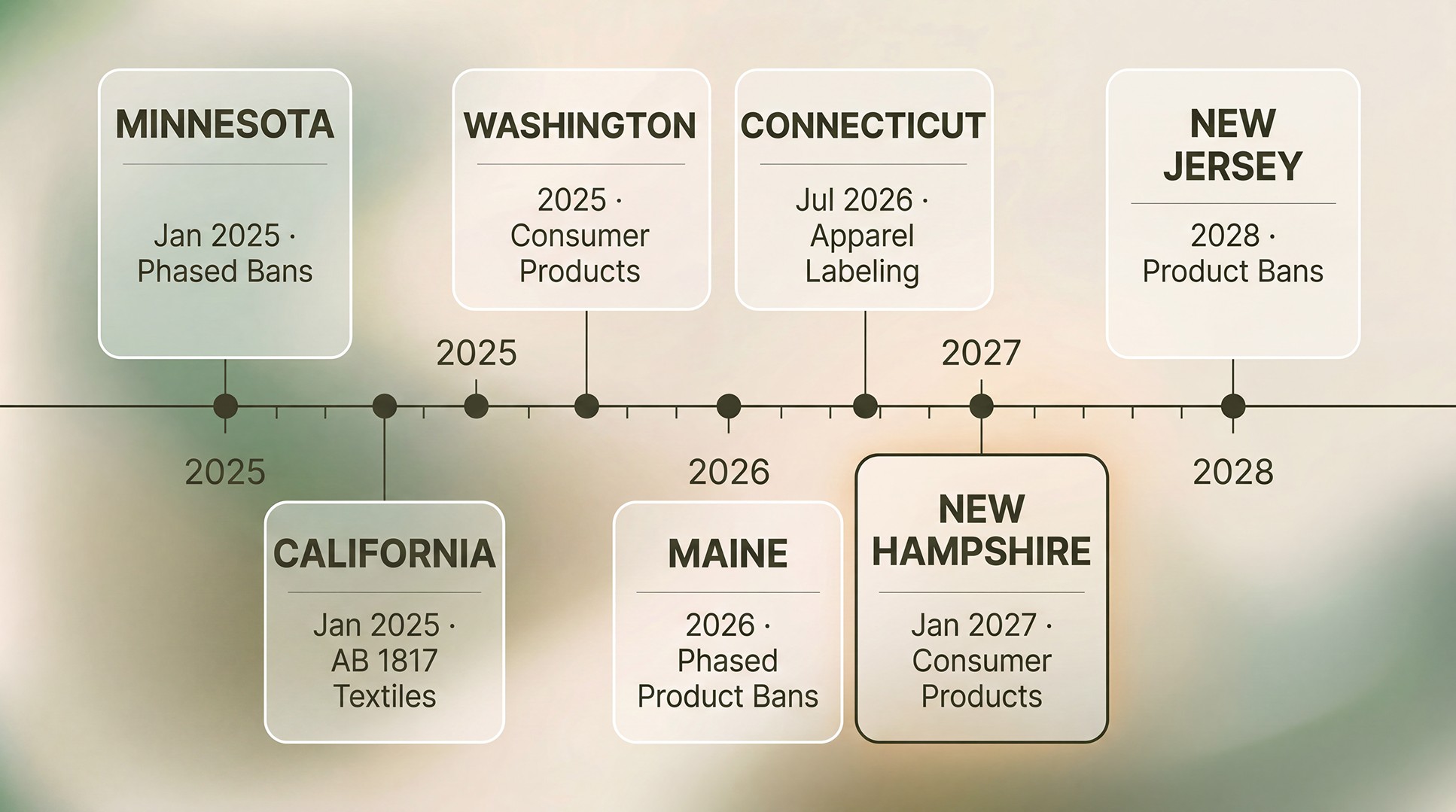
New Hampshire is not acting in isolation. As of 2026, multiple US states have enacted or proposed PFAS restrictions on consumer products, each with different effective dates, product scopes, and threshold definitions.
State | Key Focus | Status |
|---|---|---|
Reporting + product bans | Active 2025–2026 | |
Textiles PFAS ban | Active | |
Labeling requirements | 2026 deadline | |
Sales ban | 2027 | |
Consumer product ban | 2028 | |
Reporting + restrictions | Active | |
New Hampshire | Consumer product PFAS ban | January 1, 2027 |
This patchwork creates a multi-jurisdiction compliance management challenge that cannot be solved on a state-by-state basis. Manufacturers selling nationally must track overlapping deadlines, differing product category scopes, and varying definitions of "intentionally added."
CORA-powered regulatory intelligence enables compliance teams to monitor these state-level changes automatically and map them to affected products and SKUs—replacing the manual process of tracking legislative updates across 50 states.
📌 Managing PFAS compliance across multiple US states? See how Certivo centralizes multi-state tracking → Book a Demo
US state PFAS bans timeline 2025 to 2028 including New Hampshire consumer products
Click on image to view full
Reporting, Documentation, and Supply Chain Challenges
Evidence Chain Integrity
For any PFAS compliance program, the evidence chain matters as much as the conclusion. Auditors—whether internal, customer-driven (OEM audits), or regulatory (state enforcement agencies)—evaluate:
Who provided the PFAS declaration (supplier identity and authority)
When the declaration was made (time-stamped, version-controlled)
What scope the declaration covers (product-specific vs. facility-level)
Organizations relying on email-based supplier data collection cannot maintain this evidence chain at scale. Automated supplier data collection portals create immutable audit logs with time-stamped declarations that support point-in-time compliance queries.
Managing 12,000+ PFAS Compounds
PFAS is not a single chemical—it is a class of over 12,000 substances. Determining whether a product contains "intentionally added PFAS" requires substance-level identification across the entire BOM. This is a data problem that exceeds human capacity for any manufacturer with more than a handful of products.
For a detailed look at this challenge, see Managing 12,000 PFAS Compounds on Certivo.
Historic State Tracking
Compliance is not a snapshot—it is a continuous state. Manufacturers must maintain historic compliance records showing that products met PFAS-free requirements at the time of sale. This is fundamentally a data versioning problem: immutable audit logs, time-stamped supplier declarations, and the ability to run point-in-time compliance queries against any product, in any jurisdiction, at any date.
No software eliminates audit findings. The objective is to reduce surprises and compress response time from days to hours.
Compliance Risks and Enforcement Exposure
Based on currently available regulatory guidance, manufacturers and sellers of non-compliant products in New Hampshire face potential enforcement actions from NHDES, including:
⚠ Product removal or sales restrictions within the state
⚠ Regulatory penalties as defined under the implementing statute
⚠ Customer and OEM audit findings triggering supply chain disqualification
⚠ Reputational exposure from non-compliance with state consumer protection regulations
The risk is compounded for manufacturers selling across multiple states. A PFAS compliance failure in New Hampshire may simultaneously trigger issues in Connecticut, Washington, Minnesota, and other states with active PFAS regulations.
Organizations maintaining continuous audit-ready documentation across all PFAS-regulated jurisdictions reduce their exposure to cascading enforcement actions.
Strategic Compliance Preparation Checklist
How AI Reduces Multi-State PFAS Compliance Burden
The New Hampshire PFAS ban is one regulation in one state. The real compliance challenge is managing PFAS restrictions across dozens of US states and international jurisdictions simultaneously—each with different timelines, product scopes, and requirements.
AI-native compliance automation addresses this through:
✓ Automated supplier PFAS data collection — CORA-driven compliance intelligence enables bulk supplier outreach, template-standardized responses, and automated validation of PFAS declarations at intake.
✓ BOM-level PFAS material mapping — AI maps PFAS substance data to product BOMs, identifying which finished products contain intentionally added PFAS across the entire portfolio.
✓ Multi-jurisdiction regulatory tracking — CORA's regulatory intelligence layer monitors state-by-state PFAS legislative changes and maps them to affected products and SKUs—eliminating the manual effort of tracking 50 state legislatures.
✓ AI document parsing — Automated extraction and classification of supplier certificates, test reports, and declarations reduces manual data entry and accelerates evidence collection.
For a broader view of how AI supports PFAS compliance at scale, see How Certivo Manages PFAS Compliance Across 12,000 Substances.
Executive Conclusion
New Hampshire's consumer products PFAS ban, effective January 1, 2027, adds another compliance obligation to the rapidly expanding US state-level PFAS landscape. For manufacturers selling across multiple states, the operational challenge is not any single regulation—it is the cumulative burden of tracking overlapping PFAS restrictions, collecting supplier data at scale, and maintaining audit-ready documentation across every jurisdiction.
Organizations that treat each state PFAS ban as an isolated project will exhaust compliance resources. Those that invest in a centralized compliance data backbone with automated supplier data collection, BOM-level PFAS material mapping, and continuous regulatory intelligence will absorb current and future PFAS restrictions without proportional increases in manual effort.
📌 Book a demo to see how Certivo automates PFAS compliance across your product portfolio, supply chain, and every US state with active PFAS restrictions.
FAQs
1. What is the effective date for New Hampshire's PFAS consumer product restrictions?
The restrictions on intentionally added PFAS in consumer products take effect January 1, 2027. Manufacturers, distributors, and retailers selling affected products in New Hampshire should begin compliance preparation now, including supplier PFAS disclosure collection and BOM-level material review.
2. How does the New Hampshire PFAS ban define "intentionally added" PFAS?
Based on currently available regulatory guidance, the restriction targets PFAS substances deliberately introduced into product formulations or materials at any stage of manufacturing. Trace contamination from environmental background or incidental manufacturing contact may be treated differently. Certivo's CORA intelligence helps classify PFAS presence at the substance level.
3. Which consumer product categories are most affected by New Hampshire PFAS restrictions?
Key affected categories include textiles, packaging and food contact materials, consumer electronics, automotive coatings, and household consumer goods. Any product containing PFAS-based water-resistant, stain-resistant, or grease-resistant treatments is likely in scope.
4. How can manufacturers track PFAS compliance across multiple US states simultaneously?
Multi-state PFAS compliance requires centralized regulatory tracking, standardized supplier data collection, and product-level substance mapping. Certivo provides a centralized compliance data backbone that maps state-specific PFAS requirements to products and BOMs across all active jurisdictions.
5. What supplier data do manufacturers need to collect for New Hampshire PFAS compliance?
Manufacturers should collect PFAS disclosure declarations from suppliers confirming whether intentionally added PFAS is present in raw materials, components, coatings, or sub-assemblies. These declarations should be time-stamped, version-controlled, and linked to specific products for audit readiness.
Lavanya
Lavanya is an accomplished Product Compliance Engineer with over four years of expertise in global environmental and regulatory frameworks, including REACH, RoHS, Proposition 65, POPs, TSCA, PFAS, CMRT, FMD, and IMDS. A graduate in Chemical Engineering from the KLE Institute, she combines strong technical knowledge with practical compliance management skills across diverse and complex product portfolios.
She has extensive experience in product compliance engineering, ensuring that materials, components, and finished goods consistently meet evolving international regulatory requirements. Her expertise spans BOM analysis, material risk assessments, supplier declaration management, and test report validation to guarantee conformity. Lavanya also plays a key role in design-for-compliance initiatives, guiding engineering teams on regulatory considerations early in the product lifecycle to reduce risks and streamline market access.