


New Mexico has become one of the most aggressive US states on PFAS regulation. On May 5, 2026, the Environmental Improvement Board published the final rule (20.13.2 NMAC) implementing the PFAS Protection Act (HB212). The rule takes effect July 1, 2026, and establishes reporting, labeling, testing, and phased sales prohibition requirements for products containing intentionally added PFAS sold or distributed in the state.
For manufacturers, distributors, and retailers selling consumer products into New Mexico, this regulation creates concrete compliance obligations with the first product bans arriving January 1, 2027. That leaves a narrow window to assess product portfolios, collect supplier PFAS data, and prepare for New Mexico PFAS compliance 2026 obligations before enforcement begins.
📌 Book a free compliance assessment to map your PFAS exposure across products and supply chains before New Mexico's July 2026 effective date.
Key Takeaways
🔹 New Mexico's PFAS Protection Act final rule (20.13.2 NMAC) takes effect July 1, 2026
🔹 First product sales bans begin January 1, 2027 for cookware, food packaging, juvenile products, dental floss, and firefighting foam
🔹 Second wave of bans hits January 1, 2028 covering cosmetics, textiles, carpets, cleaning products, and upholstered furniture
🔹 By January 1, 2032, all consumer products with intentionally added PFAS are prohibited unless granted a "currently unavoidable use" exemption
🔹 Reporting, labeling, and testing obligations apply to manufacturers, distributors, and retailers
🔹 The New Mexico Department of Environment (DoE) can test products and prohibit sales if manufacturers fail to provide required notifications
🔹 Companies must begin supplier-level PFAS data collection now to meet phased deadlines
What the New Mexico PFAS Protection Act Requires
The HB212 final rule establishes a comprehensive framework targeting intentionally added PFAS in consumer products. The regulation covers the full class of per- and polyfluoroalkyl substances, not a limited list of individual chemicals.
Three core compliance mechanisms apply:
✓ Reporting requirements for products containing intentionally added PFAS, with established compliance schedules and reporting fees
✓ Labeling obligations for covered products sold in New Mexico
✓ Testing authority granted to the New Mexico Department of Environment, which can test products and take enforcement action based on findings
This is not a voluntary disclosure program. The regulation carries mandatory obligations for any entity that manufactures, distributes, or retails affected products in New Mexico. Companies managing PFAS and chemicals risk across multiple US jurisdictions should treat this as one of the most prescriptive state-level PFAS frameworks now in effect.
Phased Product Sales Prohibitions and Deadlines
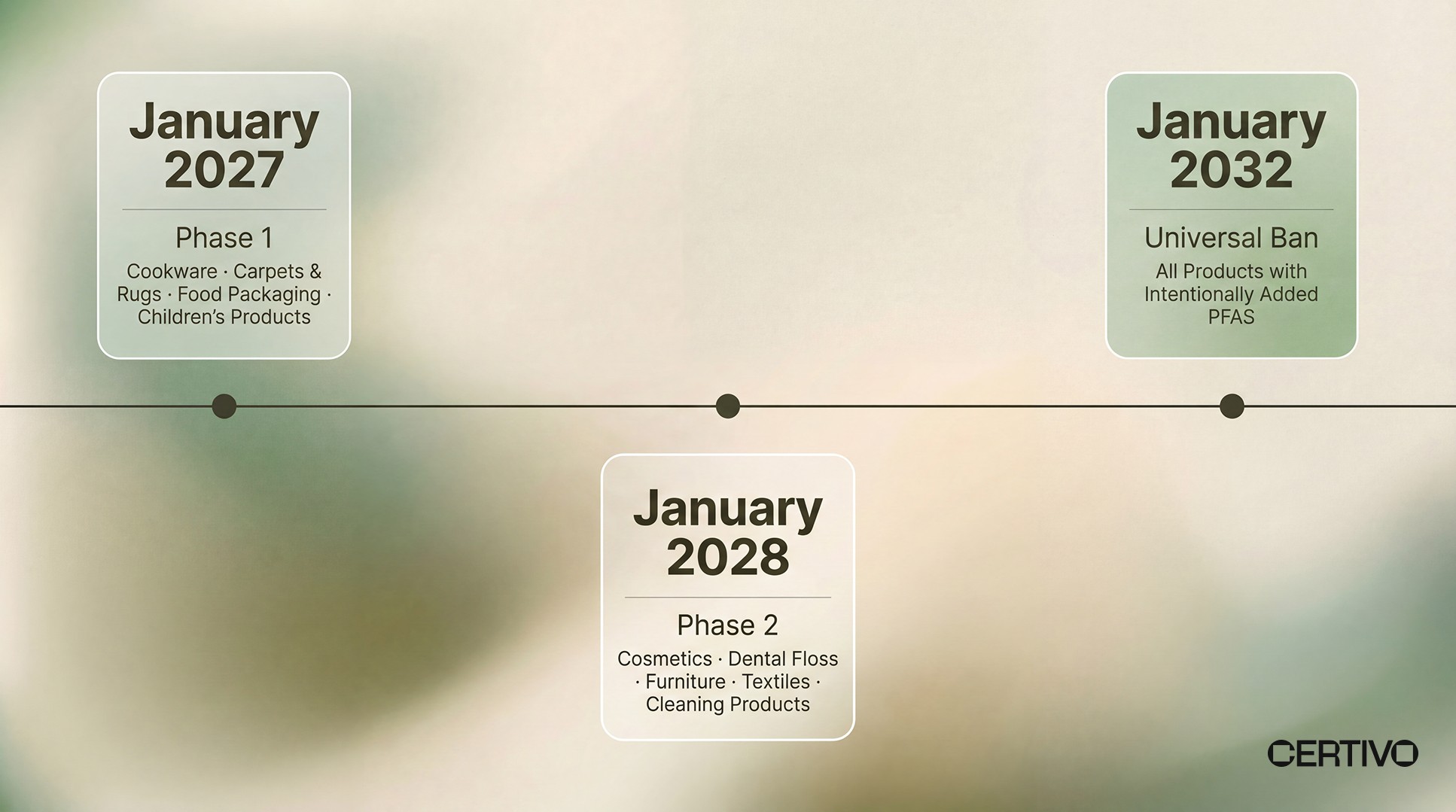
The regulation uses a three-phase approach to eliminate intentionally added PFAS from consumer products:
Phase | Effective Date | Product Categories Prohibited |
|---|---|---|
Phase 1 | January 1, 2027 | Cookware, food packaging, dental floss, juvenile products, firefighting foam |
Phase 2 | January 1, 2028 | Carpets and rugs, cosmetics, textiles, cleaning products, upholstered furniture |
Phase 3 | January 1, 2032 | All remaining consumer products (unless qualifying for "currently unavoidable use" exemption) |
The Phase 1 deadline is approximately six months away. Manufacturers with products in the cookware, food packaging, juvenile products, or firefighting foam categories need to complete PFAS content assessments immediately if they have not already done so.
The 2032 universal ban is the most significant long-term obligation. It shifts the burden entirely: every consumer product containing intentionally added PFAS will be prohibited unless the manufacturer can demonstrate the use qualifies as "currently unavoidable" under the Act. This makes proactive PFAS tracking across product portfolios a strategic priority rather than an optional exercise.
New Mexico PFAS compliance 2026 phased product ban timeline for manufacturers
Click on image to view full
Reporting, Labeling, and Testing Obligations
Beyond the phased sales prohibitions, the rule creates ongoing compliance obligations that require operational infrastructure:
⚠ Reporting requires manufacturers to disclose products containing intentionally added PFAS, with established reporting fees and compliance schedules. This is not a one-time filing. Companies need systems that support continuous audit-ready documentation for ongoing state reporting cycles.
⚠ Labeling requires covered products to carry appropriate PFAS-related labels before sale in New Mexico. This creates region-specific labeling requirements that must be managed alongside federal and other state-level obligations.
⚠ Testing authority allows the New Mexico DoE to test products independently. If a product is found to contain intentionally added PFAS and the manufacturer has not provided required notifications, the product may be prohibited. This enforcement mechanism means that even products not yet in a banned category can be pulled if reporting obligations are not met.
For companies managing compliance across multiple US states, each with different PFAS thresholds, definitions, and timelines, the documentation burden is substantial. Automated supplier data collection becomes essential for gathering PFAS content data from suppliers at the material and component level.
📌 Managing PFAS compliance across multiple states? See how Certivo centralizes supplier PFAS data collection at scale. Get a compliance risk assessment →
Which Industries and Product Categories Are Affected
The New Mexico PFAS Protection Act affects a broad cross-section of consumer-facing manufacturers:
📊 Consumer products manufacturing across cookware, cleaning products, and household goods
📊 Food packaging manufacturers using PFAS-treated food contact materials
📊 Personal care and cosmetics companies with PFAS-containing formulations
📊 Textile and apparel manufacturers producing PFAS-treated fabrics and clothing
📊 Furniture manufacturing companies using PFAS-treated upholstery materials
📊 Juvenile products manufacturers producing children's accessories and goods
📊 Firefighting equipment manufacturers producing PFAS-containing foam
📊 Retailers and distributors selling or distributing affected products in New Mexico
Companies in the electronics manufacturing and consumer goods sectors should evaluate whether any components or finished products fall within scope, particularly where PFAS-treated coatings, adhesives, or packaging materials are used.
What Happens If Products Are Found to Contain PFAS
The enforcement mechanism in 20.13.2 NMAC goes beyond standard self-reporting. The New Mexico DoE has authority to test products available in the marketplace. If testing reveals intentionally added PFAS and the manufacturer has not provided the required notifications, the product may be prohibited from sale.
This creates a dual compliance risk. Even if a product category is not yet subject to a sales ban, failure to meet reporting and notification requirements can trigger enforcement independently. Manufacturers cannot rely on phase timelines alone. Reporting obligations are active from the rule's July 1, 2026 effective date.
Organizations maintaining a centralized compliance data backbone with substance-level tracking can respond to DoE inquiries and testing notifications with documented evidence rather than scrambling to reconstruct data after the fact.
How This Fits into the Broader US PFAS Compliance Landscape
New Mexico joins a growing list of US states with active PFAS product restrictions. Manufacturers selling across multiple states must now navigate overlapping and sometimes conflicting requirements from jurisdictions including Minnesota, Massachusetts, Connecticut, Washington State, and California.
At the federal level, TSCA Section 8(a)(7) PFAS reporting adds another layer of obligation for manufacturers and importers.
The operational challenge is not any single regulation. It is managing the interaction between federal PFAS reporting, state-level bans with different product scopes and timelines, and customer-driven PFAS disclosure requirements, all simultaneously. This is where regulatory intelligence and horizon scanning capabilities, combined with multi-jurisdiction EHS management, become essential infrastructure rather than optional tools.
For a comprehensive view of active and upcoming PFAS regulations, see Certivo's Global PFAS Regulations Master Guide.
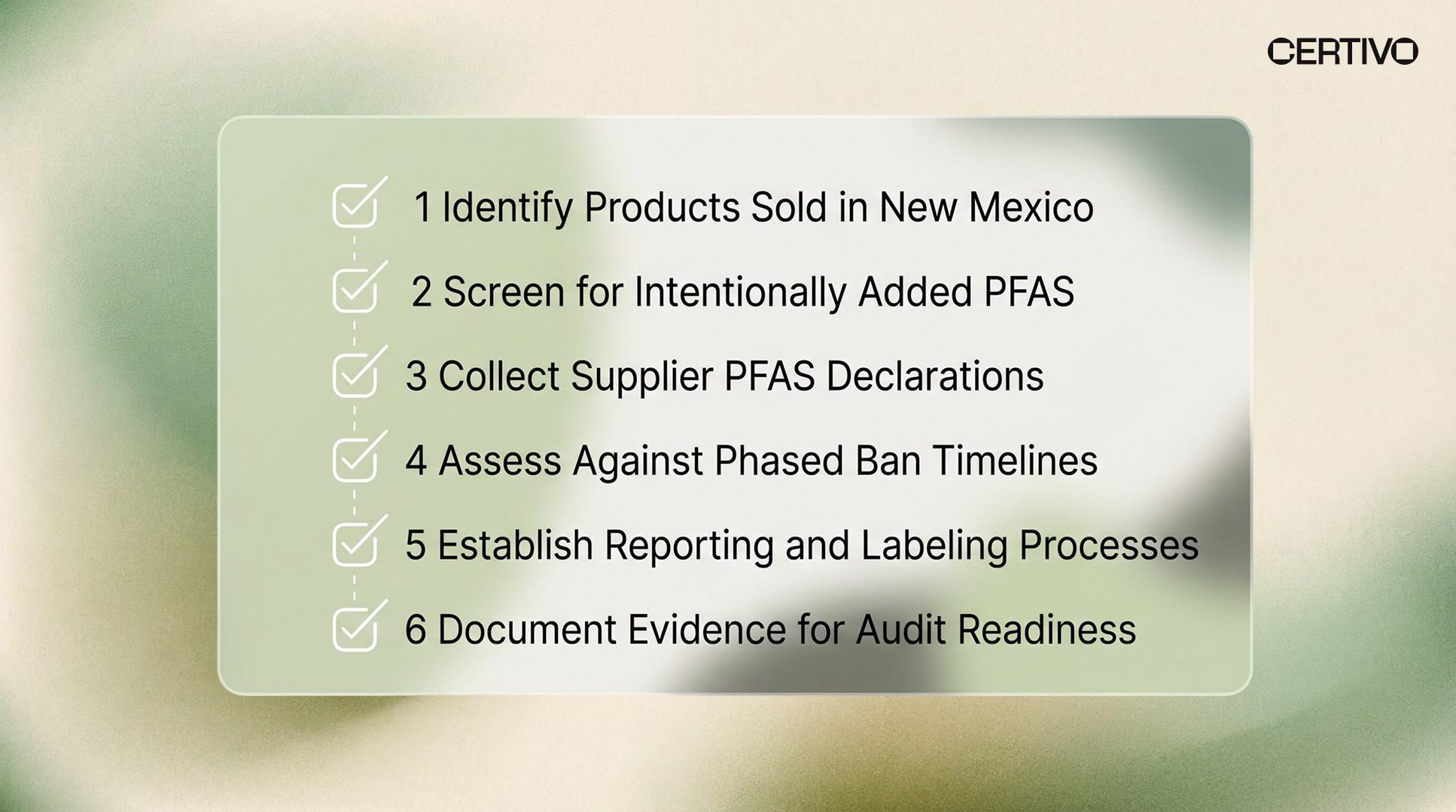
New Mexico PFAS compliance 2026 preparation checklist for manufacturers
Click on image to view full
Preparing Your Organization for New Mexico PFAS Compliance
Compliance engineers and regulatory directors should prioritize these actions:
✅ Identify in-scope products sold or distributed in New Mexico and map them against Phase 1, Phase 2, and Phase 3 product categories
✅ Screen product portfolios for intentionally added PFAS at the material, component, and finished-product level
✅ Collect supplier PFAS declarations through structured questionnaires or supplier self-service compliance portals to build an evidence base
✅ Establish reporting and labeling workflows that meet the July 1, 2026 effective date for notification obligations
✅ Map New Mexico requirements against other active state PFAS regulations to identify overlaps and conflicts in your compliance program
✅ Build audit-ready documentation with time-stamped supplier declarations, PFAS screening results, and reporting receipts. No software eliminates audit findings, but the objective is to reduce surprises and response time when the DoE or customers request evidence.
Certivo's CORA-powered regulatory intelligence automates PFAS substance tracking across 12,000+ PFAS compounds and maps them against product BOMs and supplier declarations, enabling compliance teams to shift from reactive firefighting to continuous readiness across every US state with active PFAS requirements.
📌 Book a demo to see how Certivo automates PFAS compliance across your product portfolio and multi-tier supply chain before New Mexico's phased bans take effect.
FAQs
1. When does the New Mexico PFAS Protection Act take effect?
The final rule (20.13.2 NMAC) takes effect July 1, 2026. Reporting, labeling, and notification obligations begin on that date, with the first product sales prohibitions starting January 1, 2027. Certivo's CORA intelligence tracks state-level PFAS deadlines automatically.
2. Which products are banned first under New Mexico HB212?
Cookware, food packaging, dental floss, juvenile products, and firefighting foam containing intentionally added PFAS are prohibited beginning January 1, 2027. A second wave covering cosmetics, textiles, carpets, cleaning products, and upholstered furniture follows on January 1, 2028.
3. Does the New Mexico rule apply to all PFAS or only specific chemicals?
The regulation targets the full class of per- and polyfluoroalkyl substances when intentionally added to products. It is not limited to a specific list of individual PFAS chemicals, making substance-level screening across the entire PFAS class essential.
4. What happens if the New Mexico DoE tests a product and finds PFAS?
If testing reveals intentionally added PFAS and the manufacturer has not provided required notifications, the product may be prohibited from sale. This enforcement mechanism applies independently of the phased ban timelines.
5. How does the 2032 universal ban work?
Starting January 1, 2032, all consumer products containing intentionally added PFAS are prohibited unless the manufacturer demonstrates the use qualifies as a "currently unavoidable use" under the Act. Companies should begin evaluating exemption pathways well before this deadline.
Lavanya
Lavanya is an accomplished Product Compliance Engineer with over four years of expertise in global environmental and regulatory frameworks, including REACH, RoHS, Proposition 65, POPs, TSCA, PFAS, CMRT, FMD, and IMDS. A graduate in Chemical Engineering from the KLE Institute, she combines strong technical knowledge with practical compliance management skills across diverse and complex product portfolios.
She has extensive experience in product compliance engineering, ensuring that materials, components, and finished goods consistently meet evolving international regulatory requirements. Her expertise spans BOM analysis, material risk assessments, supplier declaration management, and test report validation to guarantee conformity. Lavanya also plays a key role in design-for-compliance initiatives, guiding engineering teams on regulatory considerations early in the product lifecycle to reduce risks and streamline market access.