


On April 17, 2026, the Environmental Protection Authority (EPA) New Zealand announced a public consultation on restricting three newly listed Stockholm Convention Persistent Organic Pollutants: chlorpyrifos, medium-chain chlorinated paraffins (MCCPs), and long-chain perfluorocarboxylic acids (LC-PFCAs). This consultation represents a critical regulatory shift for global manufacturers, importers, and downstream users with exposure to the New Zealand market. Companies that manufacture or source products containing flame retardants, plasticizers, surface treatments, or organophosphate pesticides face direct compliance obligations under this proposal.
Book a free compliance assessment to understand your exposure to New Zealand's proposed POP restrictions across your product portfolio and supply chains.
For organizations managing multi-tier supply chain transparency across Asia-Pacific, this consultation signals an acceleration in New Zealand's alignment with global chemical management standards. The proposed restrictions carry implications for BOM-level substance tracking, supplier documentation, and continuous audit-ready compliance postures.
Table of Contents
Executive Regulatory Overview
Stockholm Convention Alignment: Why New Zealand Is Acting Now
Which Substances Are Affected: Chlorpyrifos, MCCPs, and LC-PFCAs
Time-Limited Exemptions and Specific Use Cases
Industries and Product Categories at Risk
Compliance Obligations for Manufacturers and Importers
Supply Chain Documentation and Data Challenges
Compliance Risks and Enforcement Exposure
Timeline and Consultation Deadlines
Strategic Compliance Preparation Checklist
How AI-Native Compliance Automation Addresses POP Restrictions
Executive Conclusion
FAQs
Executive Regulatory Overview
The EPA New Zealand consultation targets three substance groups that have been added to the Stockholm Convention on Persistent Organic Pollutants. The proposal aims to introduce stricter controls and potential bans on these chemicals, updating compliance obligations for importers, manufacturers, and downstream users operating within New Zealand.
📌 Key regulatory objectives include:
Alignment of New Zealand's chemical management framework with international Stockholm Convention obligations
Introduction of restrictions and potential prohibitions on chlorpyrifos, MCCPs, and LC-PFCAs
Emphasis on environmental protection and human health risk reduction
Updated documentation and reporting requirements for affected stakeholders
This consultation builds on New Zealand's existing POPs regulatory framework and extends the country's substance-level restrictions to cover chemicals with wide industrial and consumer applications. Manufacturers with products entering New Zealand must evaluate their BOM-level material mapping against these proposed thresholds.
Stockholm Convention Alignment: Why New Zealand Is Acting Now
The Stockholm Convention on Persistent Organic Pollutants is the primary international treaty governing the elimination or restriction of hazardous persistent chemicals. When the Conference of Parties lists new substances, signatory nations are obligated to implement domestic restrictions.
New Zealand, as a party to the Stockholm Convention, is now moving to restrict chlorpyrifos, MCCPs, and LC-PFCAs following their international listing. The EPA New Zealand consultation is the formal mechanism through which stakeholders can provide feedback before these restrictions become enforceable.
Based on currently available regulatory guidance, the consultation process is designed to:
✓ Gather industry input on implementation feasibility
✓ Define transition periods and time-limited exemptions
✓ Establish reporting and documentation standards for affected substances
✓ Confirm alignment with existing Hazardous Substances regulations
For compliance teams managing regulatory intelligence and horizon scanning across multiple jurisdictions, this consultation is a leading indicator. The EU has already moved on MCCPs and LC-PFCAs under its own POPs regulation, and New Zealand's alignment creates a multi-jurisdiction compliance requirement that demands centralized substance tracking.
Which Substances Are Affected: Chlorpyrifos, MCCPs, and LC-PFCAs
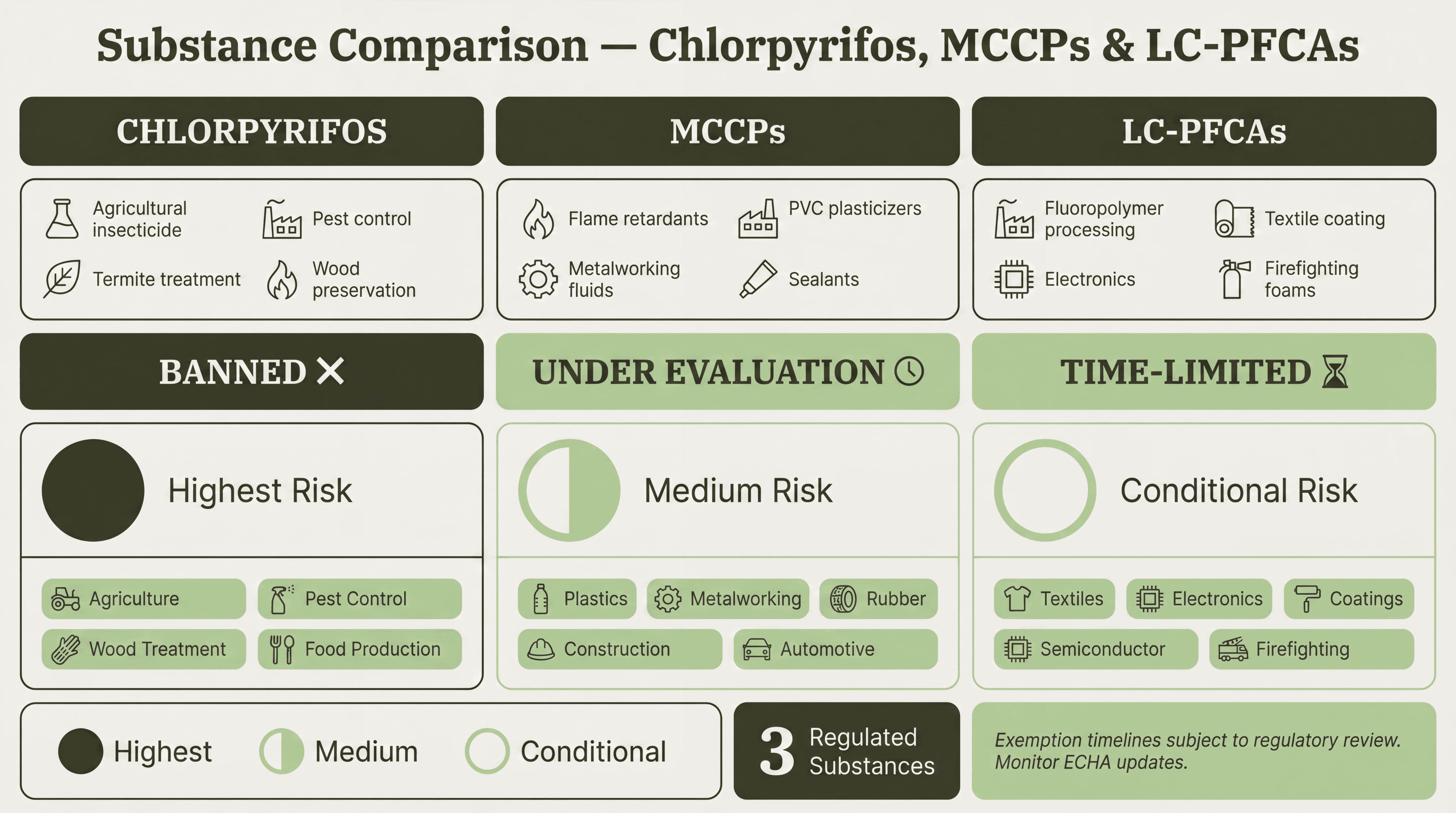
The consultation covers three distinct substance groups, each with different industrial applications and compliance implications.
Chlorpyrifos
Chlorpyrifos is an organophosphate pesticide with wide agricultural use. The proposed restriction targets its importation, manufacture, and use within New Zealand. Agricultural suppliers and chemical manufacturers with chlorpyrifos-containing formulations must assess their New Zealand market exposure.
Medium-Chain Chlorinated Paraffins (MCCPs)
MCCPs are used across a broad range of industrial applications:
Application | Sector |
|---|---|
Adhesives, paints, sealants | Construction, industrial manufacturing |
Rubbers and synthetic polymeric materials | Automotive, consumer goods |
Metal working fluids | Industrial machinery |
Secondary plasticizer and flame retardant in PVC | Electronics, construction |
Recycled PVC materials (traffic cones, roadside barriers, plastic sports courts, synthetic turfs) | Infrastructure, public sector |
⚠ The consultation contains time-limited exemptions for specific MCCP uses. Manufacturers relying on recycled PVC containing MCCPs must track exemption timelines carefully.
Long-Chain Perfluorocarboxylic Acids (LC-PFCAs)
LC-PFCAs are part of the broader PFAS chemical family and appear in an extensive range of products:
Automotive industries
Cleaning and washing agents
Electronic articles
Firefighting foams (FFF)
Food contact materials
Inks
Medical and laboratory devices
Paints, coatings, and varnishes for building and construction materials
Photo-imaging
Ski waxes
Textiles and apparel
⚠ LC-PFCAs also carry time-limited exemptions for specific uses. Organizations managing PFAS and chemicals risk management across global supply chains must map LC-PFCA exposure at the substance and component level.
For teams already tracking PFAS compliance across multi-tier supply chains, the New Zealand LC-PFCA restrictions add another jurisdictional layer requiring centralized compliance data management.
New Zealand POP chemicals restriction substance comparison table for chlorpyrifos MCCPs and LC-PFCAs
Click on image to view full
Time-Limited Exemptions and Specific Use Cases
Both MCCPs and LC-PFCAs contain time-limited exemptions for specific industrial uses under the proposed New Zealand restrictions. Based on the consultation documentation, these exemptions recognize that certain applications lack commercially viable alternatives at present.
📌 Key considerations for manufacturers:
Exemptions are time-bound, not permanent. Compliance teams must calendar exemption expiry dates and plan substitution strategies.
Recycled PVC materials containing MCCPs used for traffic cones, roadside barriers, plastic sports courts, and synthetic turfs may qualify for temporary continued use.
LC-PFCA exemptions cover specific applications where replacement substances are not yet available at scale.
Organizations should not treat exemptions as compliance clearance. Instead, compliance leaders should use this window to initiate BOM substance and threshold management processes that identify where exempted substances appear in their product architectures and develop phase-out timelines.
Certivo's CORA-powered regulatory intelligence enables teams to track exemption windows across jurisdictions, flagging expiry timelines and triggering supplier data collection workflows before deadlines arrive.
Industries and Product Categories at Risk
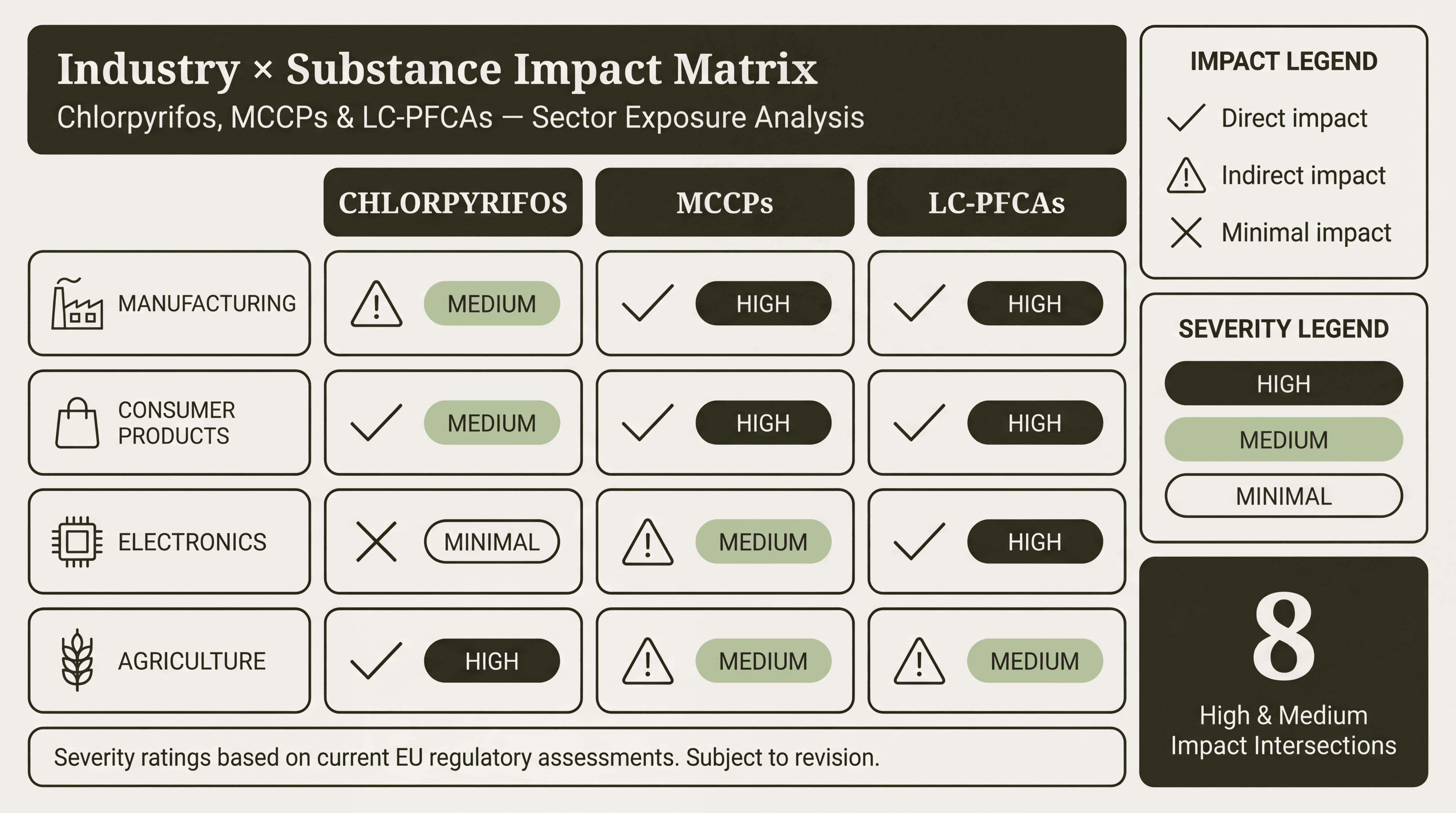
The scope of this consultation extends across multiple manufacturing sectors. Based on the substances and applications identified by EPA New Zealand, the following industries face direct compliance exposure:
Manufacturing and Industrial
Chemical production, coatings, industrial processing, and metal working operations using MCCPs or chlorpyrifos-based formulations.
Consumer Products
Textiles, treated materials, household products, and any goods containing LC-PFCAs in surface treatments, coatings, or water-repellent finishes. Companies managing consumer goods compliance must assess product-level substance declarations.
Electronics and Electrical
Components containing flame retardants, PVC-based materials with MCCP content, and electronic articles using LC-PFCAs. The intersection with electronics manufacturing compliance and existing RoHS frameworks creates compounding documentation requirements.
Agriculture
Pesticide formulations containing chlorpyrifos, chemical supply chains serving agricultural markets, and downstream distributors.
Construction and Infrastructure
Building materials using MCCP-containing adhesives, sealants, paints, and recycled PVC products. Public sector procurement teams sourcing materials for New Zealand infrastructure projects face direct exposure.
New Zealand POP chemicals restriction industry impact matrix for manufacturers and importers
Click on image to view full
Compliance Obligations for Manufacturers and Importers
The proposed restrictions carry specific obligations that manufacturers and importers must prepare for, even before the consultation concludes.
Documentation Requirements
✓ Substance declarations at the component and material level for all three POP groups
✓ Supplier certifications confirming absence or controlled presence of restricted substances
✓ Evidence of exemption eligibility where time-limited exemptions apply
✓ Traceability records linking raw materials to finished products
Supplier Data Collection
Manufacturers cannot achieve compliance without upstream visibility. Automated supplier data collection becomes essential when tracking substance presence across multi-tier supply chains. The challenge intensifies for organizations sourcing from regions where chemical disclosure practices vary significantly.
Struggling with supplier documentation for POP substances? See how Certivo automates supplier evidence collection across your supply chain.
Record Retention
Based on currently available regulatory guidance, organizations should anticipate record retention requirements consistent with New Zealand's existing hazardous substances regulations. Maintaining continuous audit-ready documentation ensures that compliance evidence is accessible during regulatory audits or customer due diligence requests.
Supply Chain Documentation and Data Challenges
The practical difficulty of complying with POP restrictions lies in the supply chain. Most manufacturers do not produce the restricted substances directly but receive them embedded in components, sub-assemblies, or raw materials from upstream suppliers.
📊 Common data challenges include:
Challenge | Impact |
|---|---|
Suppliers lack substance-level disclosure capability | Gaps in BOM compliance data |
Multiple suppliers for the same component | Inconsistent documentation formats |
Time-limited exemptions require tracking per-application | Manual tracking leads to missed deadlines |
Multi-jurisdictional requirements (EU POPs, NZ POPs) | Duplicate data requests burden suppliers |
Organizations that have already invested in centralized supplier self-service portals are better positioned to scale data collection for New Zealand's POP requirements. For those still relying on spreadsheets and email chains, the transition to a scalable compliance system becomes urgent.
CORA-driven compliance intelligence can parse supplier certificates, validate substance declarations against regulatory thresholds, and flag non-conformances automatically, reducing the manual burden on compliance engineering teams.
New Zealand POP chemicals compliance workflow for supplier data collection and BOM-level tracking
Click on image to view full

Compliance Risks and Enforcement Exposure
While the consultation is still open, manufacturers should not delay compliance preparation. Historically, New Zealand's EPA has moved from consultation to enforcement within defined timelines, and organizations that wait for final rules face compressed preparation windows.
⚠ Key risk areas:
Market access disruption: Products containing banned POP substances may be prohibited from import or sale in New Zealand after restrictions take effect.
Customer audit failures: Major buyers increasingly require POP substance declarations as part of procurement due diligence. Organizations without documentation face contract loss.
Regulatory penalties: Non-compliance with New Zealand's Hazardous Substances framework carries enforcement consequences including fines and import restrictions.
Reputational exposure: Failure to manage POP substances signals broader quality and environmental management gaps to investors and customers.
Compliance leaders should integrate New Zealand's proposed POP restrictions into their supplier risk scoring and due diligence frameworks to quantify exposure before enforcement begins.
Timeline and Consultation Deadlines
Milestone | Date / Status |
|---|---|
EPA New Zealand consultation announced | April 17, 2026 |
Consultation period | Open — stakeholders invited to submit feedback |
Final rule publication | To be confirmed following consultation |
Enforcement date | To be confirmed |
📌 Manufacturers should treat the consultation period as the preparation window, not the waiting period. Organizations with regulatory intelligence and horizon scanning capabilities can monitor this regulation's progression and trigger internal compliance workflows proactively.
Strategic Compliance Preparation Checklist
Compliance teams should initiate the following actions immediately:
Substance inventory audit — Identify where chlorpyrifos, MCCPs, and LC-PFCAs appear in your product BOMs, raw materials, and component specifications.
Supplier engagement — Issue substance disclosure requests to all suppliers in your New Zealand supply chain. Use standardized supplier questionnaire frameworks to ensure consistent data collection.
Exemption mapping — Determine which product applications may qualify for time-limited exemptions and document eligibility evidence.
Substitution planning — For applications without exemptions, begin evaluating alternative substances and validate their regulatory status under REACH, RoHS, and other applicable frameworks.
Documentation system upgrade — Ensure your compliance data infrastructure supports substance-level tracking, exemption deadline management, and audit-ready documentation generation.
Consultation submission — Consider submitting formal feedback to EPA New Zealand, particularly if your organization relies on exempted applications or faces unique implementation challenges.
Multi-jurisdiction alignment — Cross-reference New Zealand POP requirements with EU POPs regulation and PFAS restrictions to avoid duplicated effort and leverage existing compliance data.
How AI-Native Compliance Automation Addresses POP Restrictions
Managing POP substance restrictions across multi-tier supply chains manually is not sustainable at enterprise scale. The volume of substances, the complexity of exemptions, and the pace of regulatory change across jurisdictions demand automated compliance infrastructure.
Certivo's AI-native compliance automation platform addresses the specific challenges of POP compliance:
AI document parsing and certificate validation — CORA intelligence parses supplier-submitted substance declarations, safety data sheets, and test reports to extract POP substance data automatically.
BOM-level compliance intelligence — Maps restricted substances against product BOMs to identify non-conformances at the component level.
Automated supplier data collection portals — Enables suppliers to submit substance declarations through standardized digital portals, reducing email-based data collection friction.
Regulatory intelligence and horizon scanning — CORA-powered monitoring tracks New Zealand EPA consultation progress, alerting compliance teams to regulatory changes as they occur.
Multi-jurisdiction compliance management — Consolidates POP compliance requirements from New Zealand, the EU, and other jurisdictions into a single centralized compliance data backbone.
Digital passports and traceability systems — Supports emerging digital product passport requirements by maintaining substance-level traceability from raw material to finished product.
Executive Conclusion
New Zealand's proposed restrictions on chlorpyrifos, MCCPs, and LC-PFCAs represent the latest step in a global tightening of POP chemical controls under the Stockholm Convention. For manufacturers and importers with New Zealand market exposure, the consultation period is the compliance preparation window.
The substances targeted span agriculture, electronics, consumer products, construction, and industrial manufacturing. Time-limited exemptions exist for certain MCCP and LC-PFCA applications, but these are temporary measures, not permanent clearances. Organizations that invest in substance-level BOM mapping, automated supplier data collection, and multi-jurisdiction regulatory tracking now will be positioned for seamless compliance when enforcement begins.
Compliance teams managing New Zealand POP chemicals restriction requirements alongside EU REACH, PFAS regulations, and other chemical frameworks need a centralized platform that scales with regulatory complexity.
Book a demo to see how Certivo automates POP substance tracking across your product portfolio and supply chain — or get a free compliance risk assessment to understand your current exposure to New Zealand's proposed restrictions.
FAQs
What substances does the New Zealand POP chemicals consultation propose to restrict?
The EPA New Zealand consultation targets three substance groups: chlorpyrifos (an organophosphate pesticide), medium-chain chlorinated paraffins (MCCPs) used in adhesives, PVC, and metalworking fluids, and long-chain perfluorocarboxylic acids (LC-PFCAs) found in electronics, textiles, firefighting foams, and coatings. Certivo's CORA intelligence enables teams to map these substances across product BOMs and supplier networks automatically.
Are there any exemptions for MCCPs or LC-PFCAs under the proposed New Zealand restrictions?
Yes. Both MCCPs and LC-PFCAs contain time-limited exemptions for specific industrial applications where viable alternatives are not yet commercially available. Recycled PVC materials containing MCCPs for uses such as traffic cones and synthetic turfs are among the exempted applications. Certivo's platform tracks exemption expiry timelines and triggers compliance workflows ahead of deadlines.
How should manufacturers prepare for New Zealand POP restrictions while the consultation is still open?
Manufacturers should conduct a substance inventory audit across their BOMs, issue supplier disclosure requests, map exemption eligibility, and begin evaluating alternative substances. Waiting for final rules significantly compresses the preparation window. Certivo's automated supplier data collection portals standardize this process across multi-tier supply chains.
How do New Zealand POP restrictions interact with EU POPs and PFAS regulations?
New Zealand's proposed restrictions align with Stockholm Convention obligations that also drive EU POPs regulation. LC-PFCAs fall within the broader PFAS chemical family, creating overlap with EU REACH PFAS restriction proposals and multiple US state-level PFAS requirements. CORA-driven regulatory intelligence consolidates these multi-jurisdiction requirements into a single compliance view.
Which industries are most affected by the proposed chlorpyrifos, MCCPs, and LC-PFCAs restrictions in New Zealand?
The most affected sectors include chemical manufacturing, consumer products (textiles, treated materials), electronics and electrical (flame retardants, PVC components), agriculture (pesticide formulations), and construction (adhesives, sealants, recycled PVC infrastructure materials). Certivo supports compliance management across all these industries with substance-level tracking and automated supplier evidence collection.
Lavanya
Lavanya is an accomplished Product Compliance Engineer with over four years of expertise in global environmental and regulatory frameworks, including REACH, RoHS, Proposition 65, POPs, TSCA, PFAS, CMRT, FMD, and IMDS. A graduate in Chemical Engineering from the KLE Institute, she combines strong technical knowledge with practical compliance management skills across diverse and complex product portfolios.