


The regulatory landscape for per- and polyfluoroalkyl substances (PFAS) has shifted from emerging concern to active enforcement across multiple jurisdictions simultaneously. Manufacturers shipping the same SKU into the United States, European Union, and individual US states now face overlapping reporting obligations under TSCA Section 8(a)(7) (40 CFR 705), the proposed EU REACH Annex XVII PFAS restriction, Minnesota's Amara's Law (Statute 116.943), Maine's amended LD 1503 (38 MRSA §1614), and California Proposition 65 listings—each with different PFAS definitions, thresholds, and deadlines.
No single compliance team can manually track this matrix. The organizations operationalizing PFAS compliance software for manufacturers today are the ones that will avoid enforcement exposure, shipment delays, and customer audit failures through 2027 and beyond. This guide breaks down each jurisdiction's requirements, identifies the operational gaps, and outlines how AI-native compliance automation closes them.
📌 Book a free PFAS compliance assessment to map your current regulatory exposure across products, supply chains, and jurisdictions.
Why PFAS Compliance Requires Multi-Jurisdiction Infrastructure in 2026
The fundamental challenge for compliance engineers in 2026 is not any single PFAS regulation—it is the stacking effect. A manufacturer of electronic assemblies shipping to Minnesota, exporting to the EU, and filing federal TSCA reports faces at least three distinct PFAS obligations with different:
Definitions of PFAS — The OECD definition, EPA's structural definition under 40 CFR 705, and individual state definitions vary materially. Minnesota defines "intentionally added PFAS" differently than Maine's product-category approach.
Reporting triggers — TSCA 8(a)(7) covers historical manufacture and import back to January 1, 2011. Minnesota requires ongoing annual reporting. The EU REACH restriction, once adopted, will impose substance-specific concentration thresholds.
Timelines — Federal, EU, and state deadlines do not align, creating a continuous reporting calendar rather than a single annual event.
This is not a problem that spreadsheets or email-based supplier outreach can solve. Organizations need a centralized compliance data backbone that normalizes PFAS data across jurisdictions, links it to products and BOMs, and maintains continuous audit-ready documentation as regulations evolve.
For a comprehensive overview of the PFAS regulatory landscape, see the Global PFAS Regulations: The 2025–2026 Compliance Master Guide on Certivo.
PFAS compliance software multi-jurisdiction regulatory stack for manufacturers
Click on image to view full
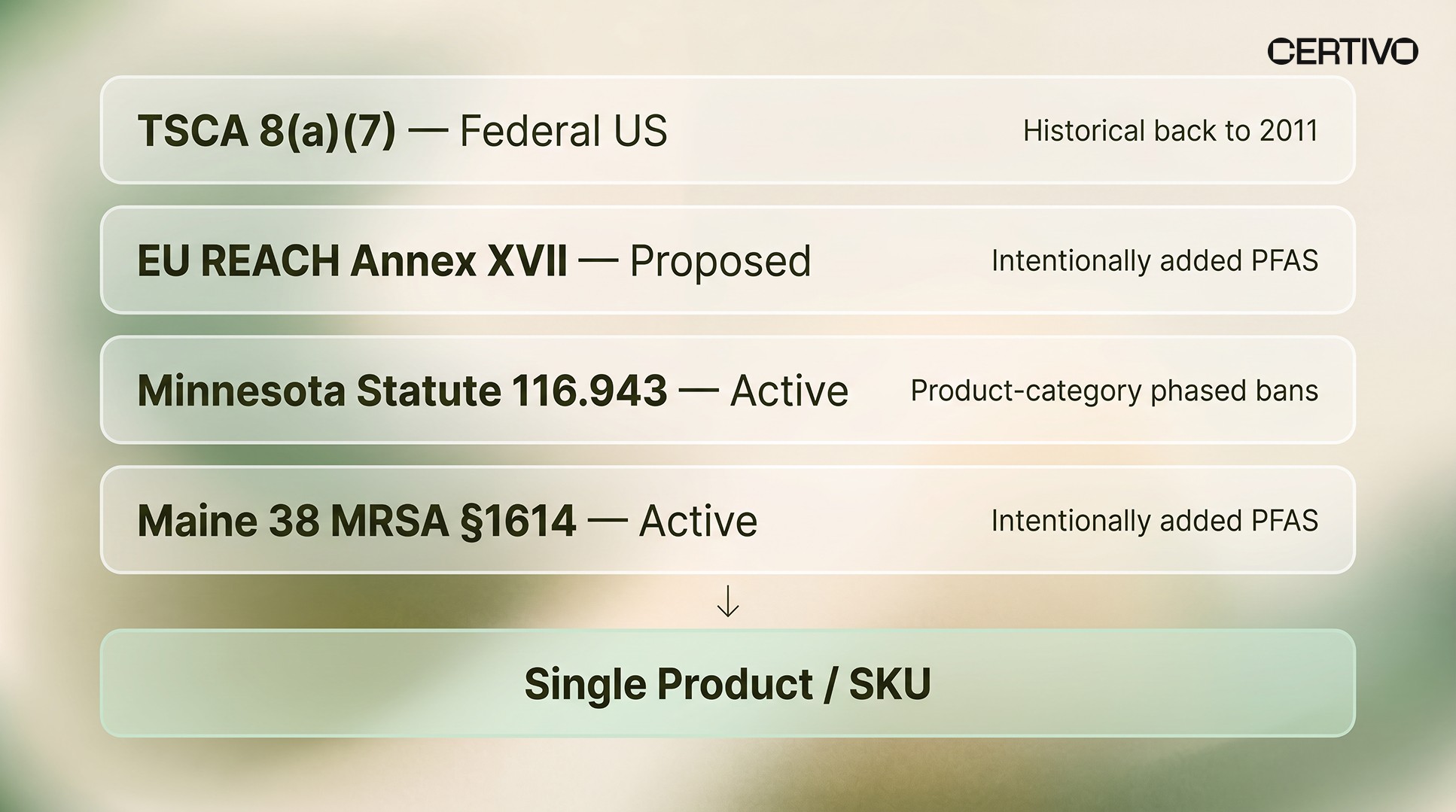
TSCA Section 8(a)(7): Federal PFAS Reporting Requirements for Manufacturers and Importers
TSCA Section 8(a)(7), codified at 40 CFR Part 705, establishes the broadest federal PFAS reporting obligation in US history. Key parameters that compliance engineers must understand:
Scope and Definitions
✓ Who reports: Any person who has manufactured (including imported) PFAS or PFAS-containing articles at any point since January 1, 2011.
✓ PFAS definition: EPA defines PFAS under §705.3 as any substance containing at least one of certain fluorinated carbon structures. This structural definition captures thousands of substances.
✓ "Manufacture" includes import: Article importers are within scope if their imported goods contain PFAS. This is the #1 source of confusion—many importers assume they are exempt.
⚠ Based on currently available regulatory guidance, the reporting deadline has been subject to extensions and EPA rulemaking updates. Compliance teams must verify the current effective deadline directly with EPA's TSCA reporting page before filing.
Reporting Obligations
Chemical identity of each PFAS substance manufactured or imported
Categories of use
Production volume estimates by year
Byproduct information
Worker exposure and environmental release data
All known disposal methods
For manufacturers managing thousands of parts, the challenge is BOM-level material mapping—identifying which products and components contain PFAS substances, then tracing those substances back through multi-tier supply chains to generate accurate federal reports.
Certivo's PFAS compliance automation addresses this by mapping PFAS substances against product BOMs and supplier declarations at scale, replacing the manual spreadsheet-to-spreadsheet reconciliation that most organizations currently rely on.
For a detailed walkthrough of TSCA 8(a)(7) obligations, see TSCA PFAS Reporting Rule 2026: What EPA's Proposed Exemptions Mean.
EU REACH PFAS Restriction: What Manufacturers Must Prepare For Before Adoption
The proposed EU-wide PFAS restriction under REACH Annex XVII—submitted jointly by five member states (Germany, Denmark, the Netherlands, Norway, and Sweden)—is currently under ECHA review. This is the most expansive chemical restriction proposal in EU regulatory history.
Current Status
⚠ This restriction is NOT yet in force. It is under ECHA's Committee for Risk Assessment (RAC) and Committee for Socio-Economic Analysis (SEAC) review. Based on currently available regulatory guidance, opinions are expected to progress through 2026–2027, with potential adoption timelines extending beyond that.
What Manufacturers Should Know
The proposal covers approximately 10,000+ PFAS substances under the OECD definition
It includes both broad bans and sector-specific use derogations with defined transition periods
Concentration thresholds vary by application sector
Exemptions are time-limited with sunset dates
For organizations already managing REACH SVHC compliance, the PFAS restriction adds a fundamentally different compliance burden: instead of tracking individual Substances of Very High Concern against the Candidate List, manufacturers must assess thousands of structurally defined PFAS compounds against sector-specific thresholds and derogation timelines.
Regulatory intelligence and horizon scanning capabilities are essential here. CORA-powered regulatory intelligence monitors ECHA opinion releases, committee votes, and adoption signals—alerting compliance teams to material changes before they become enforceable obligations.
For the latest on the EU PFAS proposal, see EU REACH PFAS Restriction Proposal: What the ECHA Review Means.
📌 Need to understand your current PFAS exposure? Run a rapid risk assessment to map your global PFAS regulatory exposure in 60 seconds.
State-Level PFAS Reporting: Minnesota, Maine, California, and Beyond
US state legislatures have moved faster than federal regulators on PFAS restrictions. Compliance teams must track a growing patchwork of state-level obligations:
Minnesota — Amara's Law (Statute 116.943)
✓ Effective January 1, 2025 for reporting of products with intentionally added PFAS
✓ Product-category prohibitions phased through 2032
✓ Requires manufacturers to notify the Minnesota Pollution Control Agency (MPCA)
✓ "Intentionally added" is the reporting trigger—this is narrower than TSCA's structural definition but operationally complex to verify across supply chains
See Minnesota PFAS Reporting: What Manufacturers Must Know for detailed compliance guidance.
Maine — 38 MRSA §1614 (Amended by LD 1537)
✓ Original law (LD 1503) significantly amended in 2024
✓ Requires reporting of intentionally added PFAS in products sold in Maine
✓ Phased product-category sales prohibitions
✓ Compliance teams must reference the amended statute structure, not the original
California — Proposition 65 and AB 1817
✓ PFAS-related Proposition 65 listings continue to expand
✓ AB 1817 banned PFAS in textile articles effective January 2025
✓ Additional PFAS restrictions under development across product categories
See California AB 1817 PFAS Textiles Ban and State PFAS Regulations 2026 for state-specific guidance.
Additional States
Massachusetts, Connecticut, New Jersey, Washington, and Kentucky have all enacted or proposed PFAS-related legislation with varying scopes and timelines. The compliance burden compounds with each additional state.
State | Key Mechanism | Trigger |
|---|---|---|
Minnesota | Amara's Law (116.943) | Intentionally added PFAS |
Maine | 38 MRSA §1614 (amended) | Product-category reporting + bans |
California | Prop 65 + AB 1817 | Chemical listings + textile ban |
Connecticut | Labeling law | Product labeling requirements |
New Jersey | Protecting Against Forever Chemicals Act | Product-category bans (2028+) |
For organizations shipping products into multiple US states, specialized substance reporting solutions that map state-specific PFAS definitions to product portfolios are no longer optional—they are operational infrastructure.
US state PFAS compliance timeline 2025 to 2028 for manufacturers
Click on image to view full
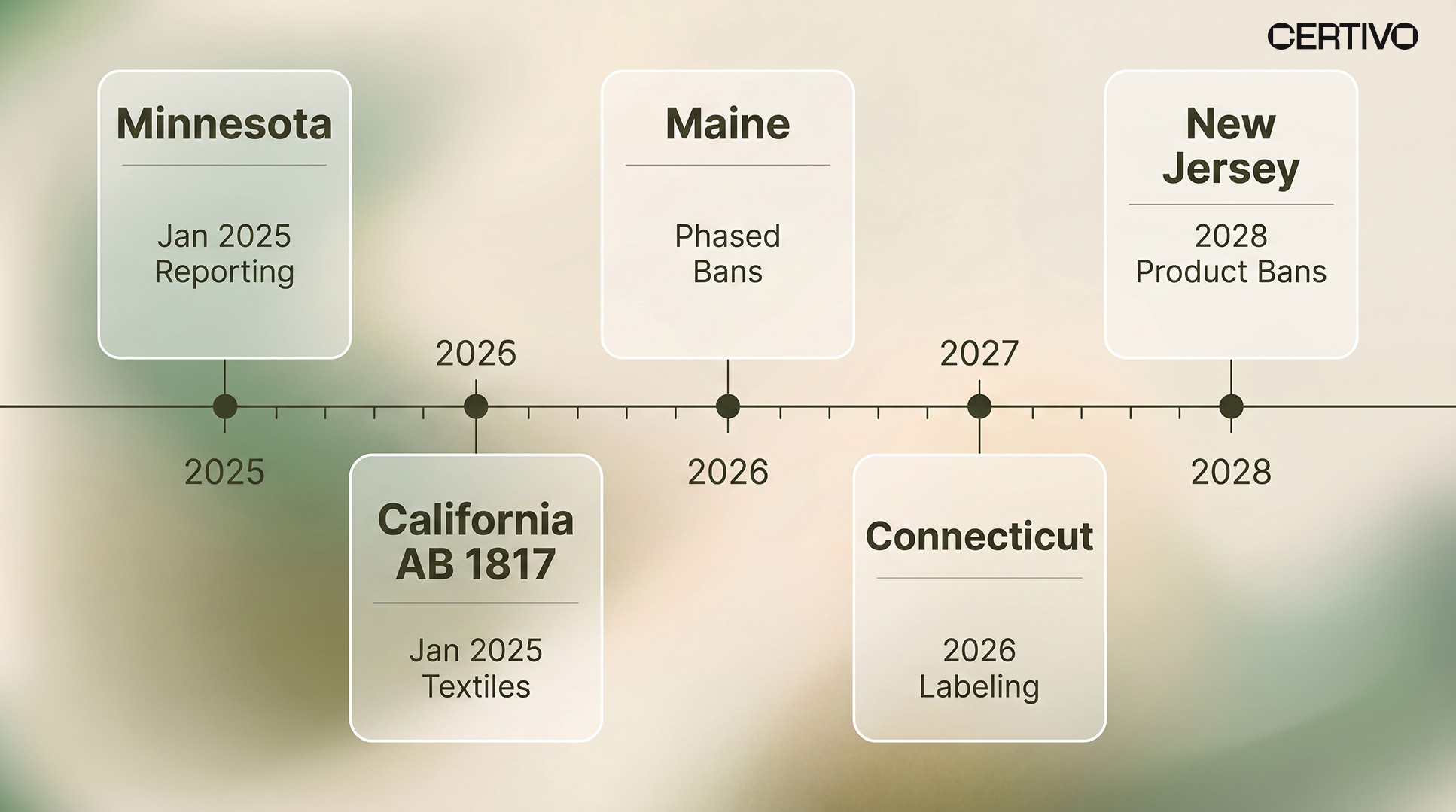
The Digital Infrastructure Manufacturers Need for Emerging PFAS Restrictions
Manual PFAS tracking fails at scale for three structural reasons:
1. Definition Mismatch — Each jurisdiction uses a different PFAS definition. A substance that triggers TSCA reporting may not meet Minnesota's "intentionally added" threshold, or vice versa. Managing these definitional overlaps requires substance-level mapping against jurisdiction-specific criteria.
2. Supplier Data Gaps — Most manufacturers do not have PFAS declarations from their full supplier base. Collecting this data through email and spreadsheets yields low response rates, inconsistent formats, and unverifiable claims. Automated supplier data collection portals with standardized PFAS questionnaires are the minimum viable infrastructure.
3. Product-Level Granularity — Regulators increasingly require product-level or product-category-level PFAS data, not facility-wide declarations. This demands BOM-level compliance intelligence that links supplier substance declarations to individual products and SKUs.
Certivo addresses each gap through its PFAS and chemicals risk management framework:
CORA intelligence maps the OECD PFAS definition, EPA's structural definition, and state-specific definitions against your product portfolio simultaneously
Supplier self-service compliance portals enable standardized PFAS data collection at scale
BOM-level substance mapping connects PFAS declarations to specific products, components, and shipping destinations
Multi-Jurisdiction PFAS Tracking: TSCA, REACH, and State Laws on One Pane
The question compliance teams face is not "are we compliant with TSCA?" or "are we ready for REACH?"—it is "for every product we ship, across every destination, which PFAS obligations apply, and are we compliant with all of them simultaneously?"
Answering this requires:
✓ A centralized compliance data backbone that aggregates PFAS substance data from suppliers, internal testing, and third-party databases
✓ Jurisdiction-specific rule engines that evaluate each product against applicable PFAS thresholds and definitions
✓ Continuous compliance monitoring and audit readiness that updates compliance status dynamically as regulations change
✓ Reporting outputs aligned with each jurisdiction's format and submission requirements
CORA-driven compliance intelligence continuously scans regulatory updates from EPA, ECHA, and US state legislatures, then auto-flags every BOM containing at-risk PFAS substances against jurisdiction-specific thresholds—including reporting triggers, sales prohibitions, and exemption sunsets.
For example: "Show me every SKU shipping to Minnesota with intentionally added PFAS"—CORA returns a ranked list with BOM drill-down and supplier declaration status.
This level of multi-tier supply chain transparency transforms PFAS compliance from a quarterly fire drill into an always-current operational capability.
Continuous Due Diligence Workflows for Supply-Chain Chemical Compliance
PFAS compliance is not a one-time filing exercise. Each jurisdiction imposes ongoing obligations:
TSCA 8(a)(7) covers historical data but EPA enforcement creates ongoing documentation preservation requirements
Minnesota Amara's Law requires annual reporting as product-category prohibitions phase in through 2032
EU REACH, once the restriction is adopted, will require ongoing substance tracking against evolving threshold limits and derogation sunset dates
Maine's amended statute phases in product-category restrictions over multiple years
Organizations need ongoing due diligence workflows for supply-chain chemical compliance that:
Automatically re-survey suppliers when regulations change
Track supplier certification expirations and renewal status
Flag new products entering regulated markets before shipment
Maintain auditable evidence trails for each compliance determination
AI document parsing and certificate validation accelerates this process by extracting PFAS-relevant data from supplier test reports, safety data sheets, and material declarations—then validating that data against jurisdiction-specific requirements without manual review.
Managing Exemptions, Waivers, and Sunset Dates for Restricted Substances
Both the EU REACH PFAS restriction proposal and US state-level laws include sector-specific exemptions with defined sunset dates. Tracking these is operationally critical:
⚠ A product currently exempt under a sector derogation may become non-compliant when the exemption expires
⚠ Exemption conditions often require specific documentation (e.g., proof that no viable alternative exists)
⚠ Sunset dates differ by sector and substance within the same regulation
Certivo's regulatory intelligence and horizon scanning layer tracks exemption timelines alongside restriction deadlines, alerting compliance teams months before a sunset date triggers a compliance gap. This prevents the common failure mode where teams discover an exemption has expired only during a customer audit or shipment review.
Industry Spotlight: Semiconductor and Electronics PFAS Compliance
PFAS substances are embedded throughout semiconductor and electronics manufacturing—in photoresists, etchants, coatings, thermal management materials, and packaging. The industry faces unique PFAS compliance challenges:
Critical-use exemptions under the EU REACH proposal may apply to some semiconductor applications, but with defined phase-out timelines
TSCA 8(a)(7) reporting captures many semiconductor-grade PFAS chemicals
State-level restrictions on PFAS in consumer products increasingly affect downstream electronics manufacturers
See PFAS in Electronics Manufacturing: How to Track PFAS Materials Across the Supply Chain and Semiconductor Compliance: Navigating Complex Global Regulations for industry-specific guidance.
How AI Reduces the PFAS Reporting Burden Across Jurisdictions
The scale of PFAS compliance—tracking thousands of substances across dozens of product lines against multiple jurisdictions—exceeds the capacity of manual processes. AI-native compliance automation addresses the structural bottlenecks:
Automated Substance Identification
CORA-enabled analysis identifies PFAS substances within supplier-provided documentation—safety data sheets, test reports, material declarations—using AI document parsing to extract substance identifiers and cross-reference them against jurisdiction-specific PFAS definitions.
BOM-Level Risk Scoring
Each product and component receives a dynamic PFAS risk score based on:
Known PFAS content from supplier declarations
Supplier response gaps (missing data increases risk)
Destination-specific regulatory exposure
Exemption status and sunset timelines
This supplier risk scoring and due diligence capability enables compliance teams to prioritize follow-up actions on the highest-risk items rather than treating every product equally.
Regulatory Change Propagation
When EPA issues a TSCA update, ECHA publishes a new opinion, or a US state amends its PFAS law, CORA's regulatory intelligence layer propagates the change across every affected product, BOM, and supplier relationship—automatically updating compliance status and generating action items.
For a broader perspective on AI in compliance, see AI Tools for Compliance Management: The Complete Guide.
Strategic PFAS Compliance Preparation Checklist
The following checklist translates the regulatory obligations outlined above into a sequenced action plan. Compliance leaders should use this as an internal readiness benchmark across teams.
PFAS Compliance Preparation Checklist
Click on image to view full

Conclusion
PFAS compliance in 2026 is defined by jurisdictional stacking: the same product simultaneously triggers federal TSCA reporting, proposed EU REACH restrictions, and multiple US state-level obligations—each with distinct PFAS definitions, thresholds, exemptions, and timelines. The manufacturers that operationalize this complexity through PFAS compliance software for manufacturers will maintain market access, avoid enforcement exposure, and preserve customer trust.
The compliance teams still managing PFAS through spreadsheets and email face exponentially growing risk. Every new state law, every ECHA opinion, every EPA rulemaking update adds another layer to an already unmanageable manual process.
Investing in PFAS and chemicals risk management infrastructure—with AI-powered substance mapping, automated supplier data collection, multi-jurisdiction rule engines, and continuous regulatory monitoring—is the only scalable path forward.
📌 Book a demo to see how Certivo automates PFAS compliance across your product portfolio and multi-tier supply chain—or run a rapid PFAS risk assessment to map your global PFAS exposure in 60 seconds.
FAQs
1. Does TSCA Section 8(a)(7) require reporting for imported articles containing PFAS?
Yes. Under 40 CFR 705, "manufacture" includes import. If you import articles containing PFAS substances as defined by EPA's structural definition, you are within reporting scope for any manufacture or import occurring since January 1, 2011. Certivo's BOM-level substance mapping identifies PFAS-containing imported components across your product portfolio to support accurate federal reporting.
2. How does the proposed EU PFAS restriction differ from existing REACH SVHC obligations?
REACH SVHC obligations focus on individual substances added to the Candidate List. The proposed PFAS restriction under Annex XVII would regulate an entire class of approximately 10,000+ substances based on structural definitions, with sector-specific concentration thresholds and time-limited derogations. CORA intelligence tracks both SVHC obligations and the evolving PFAS restriction proposal to provide unified compliance visibility.
3. What PFAS definition should manufacturers use for multi-jurisdiction compliance?
There is no single universal PFAS definition. EPA's TSCA definition, the OECD definition, and individual US state definitions vary materially. Manufacturers should screen against the broadest applicable definition and then map results to each jurisdiction's specific scope. Certivo's platform normalizes multiple PFAS definitions against product and BOM data simultaneously.
4. How can manufacturers track PFAS exemptions and sunset dates across jurisdictions?
Both the EU REACH PFAS proposal and US state laws include sector-specific exemptions with defined expiration dates. Tracking these requires jurisdiction-by-jurisdiction monitoring with advance alerting before sunset dates trigger compliance gaps. CORA-powered regulatory intelligence automates this tracking and generates action items months before exemptions expire.
5. What tools help track PFAS regulations and ensure product compliance across multiple US states?
State-level PFAS laws in Minnesota, Maine, California, Connecticut, New Jersey, Washington, and others each carry unique definitions, reporting triggers, and timelines. A centralized platform with jurisdiction-specific rule engines—mapping state requirements to individual products and shipping destinations—is necessary for scalable compliance. Certivo provides multi-jurisdiction PFAS tracking with automated BOM-level substance mapping against each state's requirements.
Kunal Chopra
Kunal Chopra is the CEO of Certivo, an AI-driven compliance management platform revolutionizing how manufacturers navigate regulatory challenges. With a career spanning over two decades, Kunal is a seasoned technology leader, 3x tech CEO, product innovator, and board member with a passion for driving transformative growth and innovation.
Before leading Certivo, Kunal spearheaded successful transformations at renowned companies like Beckett Collectibles, Kaspien, Amazon, and Microsoft. His strategic vision and operational excellence have led to achievements such as a 25x EBITDA valuation increase at Beckett Collectibles and a 450% shareholder return at Kaspien. He has a track record of turning challenges into opportunities, delivering operational efficiencies, and driving market expansions.