


Minnesota's PFAS reporting landscape shifted on May 26, 2026, when Governor Tim Walz signed Chapter 127 into law. The amendment narrows the scope of the state's PFAS reporting obligations under Amara's Law, limiting requirements to products manufactured after July 1, 2023, that contain intentionally added PFAS and are sold or distributed in Minnesota.
For compliance teams managing Minnesota PFAS reporting 2026 obligations across large product portfolios, this amendment changes which products require disclosure, but it does not change the reporting deadline itself. Initial PFAS reports remain due by September 15, 2026, with approved extensions available through December 14, 2026.
The practical question for every affected manufacturer: do you know, with confidence, which of your products were manufactured after July 1, 2023, and which contain intentionally added PFAS?
📌 Book a free compliance assessment to evaluate your Minnesota PFAS reporting readiness before the September 2026 deadline.
Key Takeaways
🔹 Minnesota amended Amara's Law on May 26, 2026, narrowing PFAS reporting scope to products manufactured after July 1, 2023
🔹 Legacy products manufactured before that date are now excluded from reporting obligations
🔹 The September 15, 2026, reporting deadline remains unchanged despite the amendment
🔹 Approved extensions may push the deadline to December 14, 2026, but are not guaranteed
🔹 Consumer products, electronics, automotive, packaging, and textiles industries are affected
🔹 Manufacturers must verify product manufacturing dates and PFAS content simultaneously
🔹 Supplier-level PFAS data collection remains the primary operational bottleneck
🔹 Minnesota is one of several states with active 2026 PFAS obligations, compounding multi-jurisdiction workload
What Changed in the Minnesota PFAS Reporting Amendment
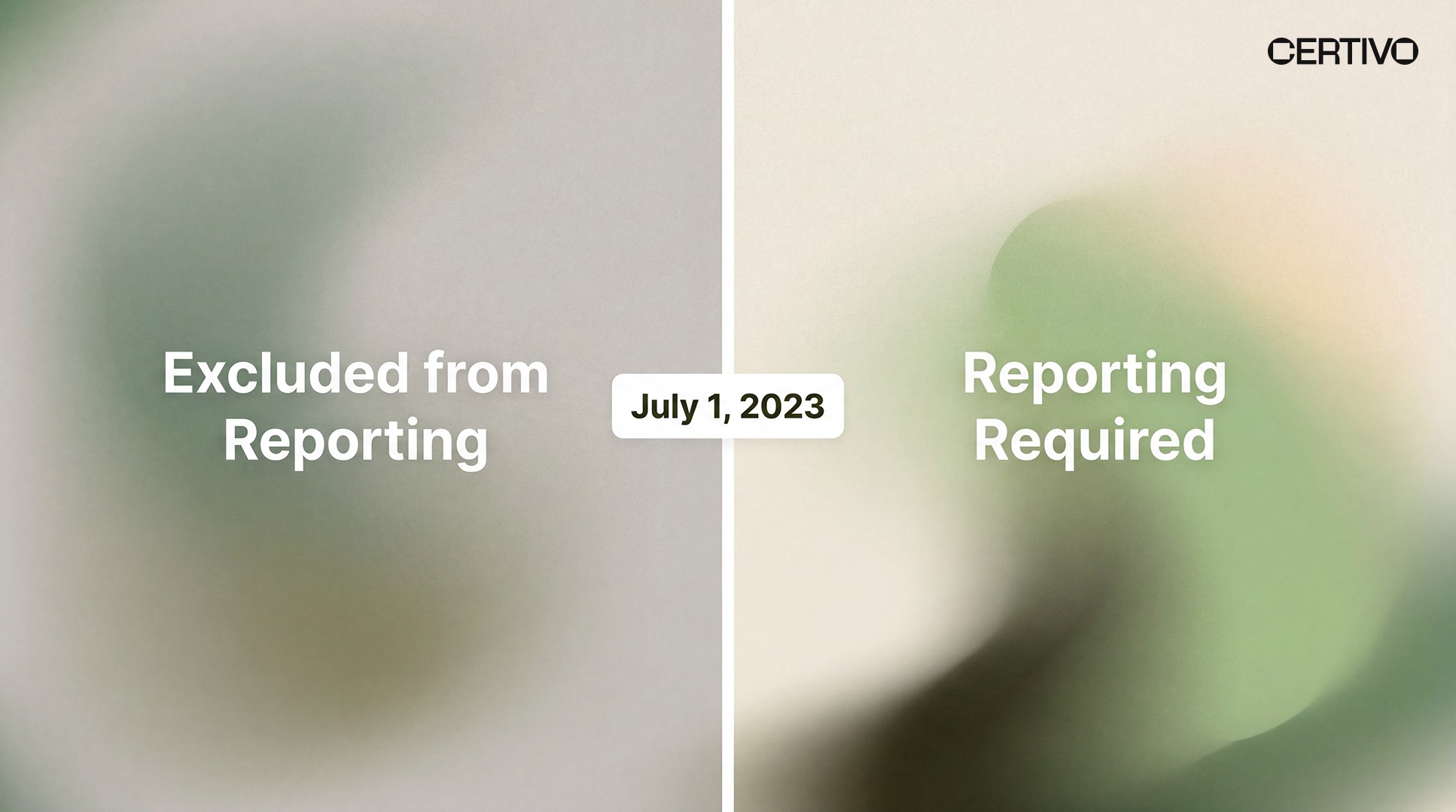
The original Amara's Law required manufacturers to report on all products containing intentionally added PFAS sold or distributed in Minnesota, regardless of when those products were manufactured. The May 2026 amendment introduces a manufacturing date threshold that removes legacy products from the reporting obligation.
Under the amended law:
✓ Products manufactured after July 1, 2023, containing intentionally added PFAS, and sold in Minnesota must be reported
✓ Products manufactured before July 1, 2023 are excluded, even if they contain intentionally added PFAS
✓ Reporting deadlines, submission processes, and PFAS definitions remain unchanged
This change reduces the compliance burden for manufacturers with older product lines still in distribution. However, it introduces a new data requirement: manufacturers must now verify and document manufacturing dates alongside PFAS content for every product in their Minnesota portfolio.
For organizations already tracking PFAS compliance across multi-tier supply chains, this amendment adds a date-validation layer on top of existing substance-level reporting.
Which Products Are Now in Scope Under Amara's Law
The amendment does not change which chemicals trigger reporting. PFAS, the broad class of per- and polyfluoroalkyl substances commonly referred to as "forever chemicals," remains the target. What changes is the product population subject to disclosure.
A product falls within Minnesota PFAS reporting 2026 scope if all three conditions are met:
The product was manufactured after July 1, 2023
The product contains intentionally added PFAS
The product is sold or distributed in Minnesota
Products that fail any one of these conditions are excluded. This three-part test sounds straightforward, but the operational complexity increases rapidly for manufacturers selling hundreds or thousands of SKUs into the Minnesota market.
The distinction between "intentionally added" and trace-level or contaminant PFAS remains critical. Manufacturers should reference their existing PFAS compliance frameworks to ensure consistent interpretation of what qualifies as intentional addition.
Minnesota PFAS reporting 2026 manufacturing date threshold for compliance scope
Click on image to view full
Industries and Product Categories Affected
The amendment applies across every sector that sells PFAS-containing products in Minnesota.
Consumer Products Manufacturing
Cookware, cleaning products, personal care items, and household goods with PFAS coatings or additives fall within scope if manufactured after July 1, 2023.
Electronics and Electrical Equipment
Components, coatings, and materials where PFAS serves as a dielectric, lubricant, or protective layer require evaluation. See PFAS in electronics manufacturing for a deeper breakdown of tracking requirements.
Automotive and Transportation
Vehicle components, seals, gaskets, and coatings incorporating PFAS-based materials are affected. Automotive manufacturers with long production runs should pay close attention to the manufacturing date threshold.
Packaging and Food Contact Materials
PFAS-containing packaging now falls under both the EU packaging PFAS ban and Minnesota's state-level reporting, creating overlapping compliance obligations.
Textile and Apparel
Performance fabrics, water-resistant treatments, and stain-resistant coatings are in scope. Manufacturers should also monitor California AB 1817 PFAS textiles requirements for additional obligations.
Chemical Manufacturing and Industrial Equipment
PFAS-containing formulations and industrial products distributed through Minnesota channels require reporting if they meet all three scope criteria.
Reporting Deadlines and Key Compliance Dates
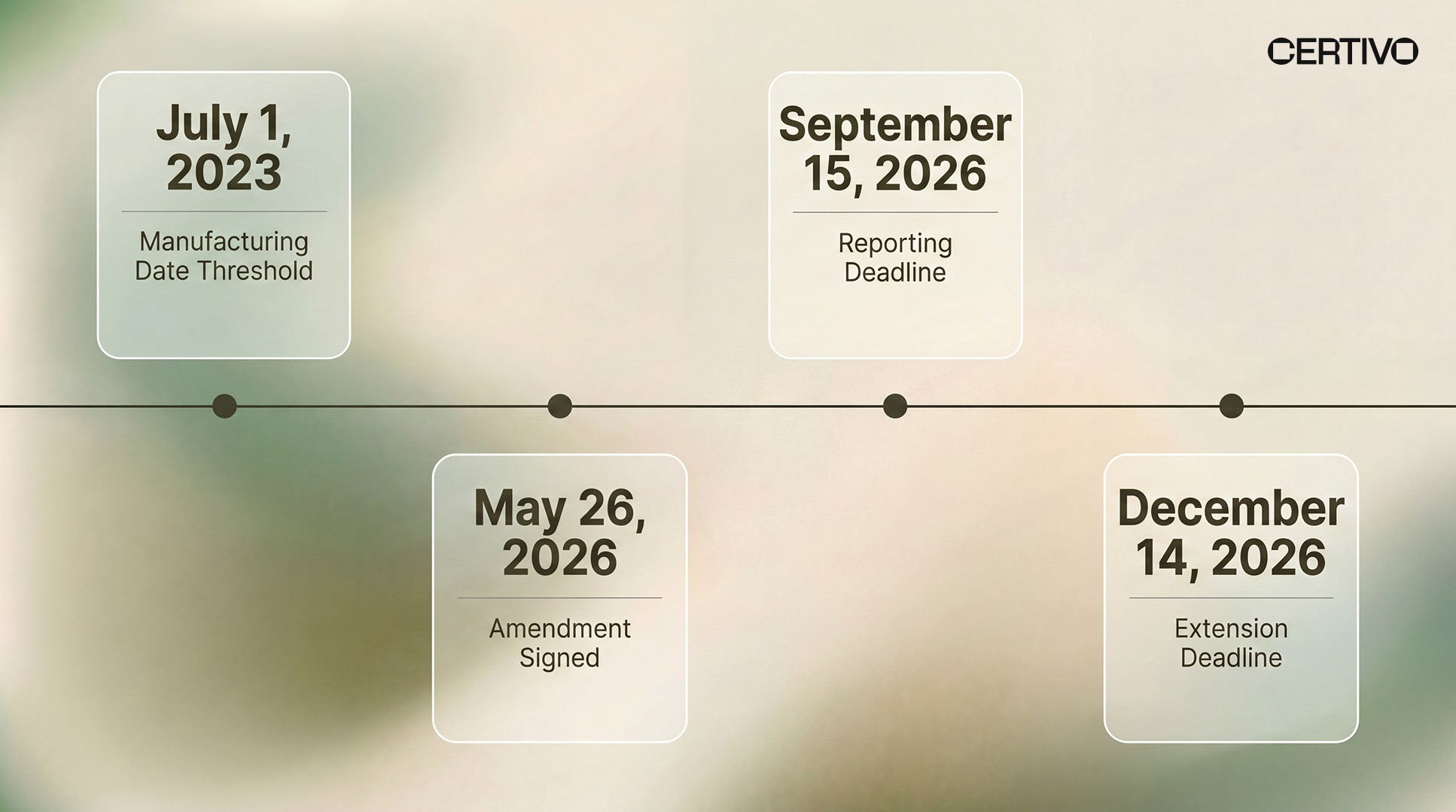
Date | Event |
|---|---|
July 1, 2023 | Manufacturing date threshold for reporting scope |
May 26, 2026 | Governor Walz signs Chapter 127 amendment |
September 15, 2026 | Initial PFAS reports due to Minnesota |
December 14, 2026 | Extended deadline (approved extensions only) |
⚠ The amendment does not delay or modify the September 15, 2026, reporting deadline. Manufacturers who assumed the amendment would push deadlines should correct that assumption immediately.
Extension requests must be submitted and approved before the September deadline. Organizations managing multi-jurisdictional PFAS obligations should review Certivo's state PFAS regulations overview for a consolidated view of overlapping deadlines.
Minnesota PFAS reporting 2026 deadlines and compliance timeline for manufacturers
Click on image to view full
Why Manufacturing Date Verification Is the Real Challenge
The amendment narrows the product scope, which is welcome. But it also creates a new verification burden that many manufacturers are unprepared to handle.
The Two-Question Problem
For each product sold in Minnesota, compliance teams must now answer two questions simultaneously:
Does this product contain intentionally added PFAS? This requires substance-level data from suppliers, often collected through standardized questionnaires or material declarations.
Was this product manufactured after July 1, 2023? This requires linking production dates to individual products or product batches, a data point that does not always live in compliance systems.
Where This Breaks Down Operationally
For manufacturers with long product lifecycles, mixed inventory (pre- and post-July 2023 batches of the same SKU), and complex distribution networks, determining which specific units meet all three reporting criteria is not trivial.
Organizations relying on spreadsheets to manage PFAS compliance across product portfolios will find that adding a date-verification layer on top of substance tracking exponentially increases manual effort.
This is fundamentally a data versioning problem. Compliance teams need immutable records showing which products contained PFAS, when they were manufactured, and where they were distributed. Time-stamped declarations and point-in-time queries become essential, not optional.
📌 Need help mapping PFAS exposure across your Minnesota product portfolio? → Get a compliance risk assessment
How Manufacturers Should Prepare for Minnesota PFAS Reporting
✅ Audit Product Portfolios — Identify every product sold or distributed in Minnesota and flag those manufactured after July 1, 2023.
✅ Verify PFAS Content — Collect or update supplier declarations confirming whether products contain intentionally added PFAS. Centralized supplier self-service compliance portals reduce the email and spreadsheet burden.
✅ Cross-Reference Manufacturing Dates — Link production date data from ERP or manufacturing systems to compliance records. Ensure traceability between batch-level dates and SKU-level reporting.
✅ Evaluate Extension Eligibility — If the September 15, 2026, deadline is not achievable, prepare and submit extension requests before the deadline.
✅ Document Exclusion Rationale — For products excluded under the amendment, maintain records showing they were manufactured before July 1, 2023. This creates an evidence chain for potential audits. The goal is audit-ready documentation, not a claim of audit-proof status. No system eliminates audit findings; the objective is to reduce surprises and response time.
✅ Monitor Other State PFAS Deadlines — Minnesota is one of many states with active PFAS reporting or ban requirements. Review the complete PFAS compliance roadmap to identify overlapping obligations across jurisdictions.
How AI Reduces PFAS Reporting Burden at Scale
Minnesota PFAS reporting 2026 adds another jurisdiction to the growing patchwork of state-level PFAS requirements across the United States. For manufacturers already navigating federal TSCA Section 8(a)(7) obligations, Massachusetts PFAS deadlines, and Connecticut PFAS labeling requirements, the operational load is compounding.
Automated Supplier Data Collection
Certivo's supplier portals collect PFAS declarations from suppliers at scale, validate completeness, and flag missing data automatically. This replaces the manual email chase that consumes weeks of compliance engineering time.
PFAS Substance Tracking Across 12,000+ Compounds
CORA-powered regulatory intelligence maps intentionally added PFAS across product BOMs and supplier declarations, supporting substance-level reporting required by Minnesota and other jurisdictions. See managing 12,000 PFAS compounds for detail on how this works operationally.
Regulatory Intelligence and Horizon Scanning
As states continue to amend, expand, and create new PFAS requirements, CORA-driven compliance intelligence monitors regulatory changes and alerts compliance teams before deadlines, not after missed filings. This supports multi-jurisdiction EHS and ESG management without proportional increases in headcount.
No compliance platform eliminates audit findings entirely. The objective is to reduce surprises, shorten response time to audit requests, and maintain continuous audit-ready documentation across every jurisdiction where PFAS obligations apply.
FAQs
Does the Minnesota PFAS amendment change which chemicals are covered?
No. The amendment only changes the product scope by excluding products manufactured before July 1, 2023. PFAS as a chemical class remains the target. Certivo's CORA intelligence tracks PFAS across 12,000+ substances to support reporting at the substance level.
Are manufacturers required to prove a product was manufactured before July 1, 2023, to claim exclusion?
Based on currently available regulatory guidance, manufacturers should maintain documentation verifying manufacturing dates for products they exclude from reporting. This creates an evidence chain in the event of an audit or regulatory inquiry. Who provided the evidence, when it was provided, and with what authority all matter.
Can manufacturers request an extension for the September 15, 2026, reporting deadline?
Yes. Approved extension requests may extend the reporting deadline to December 14, 2026. Extension requests must be submitted before the original deadline. Manufacturers should not assume extensions will be automatically granted.
How does Minnesota PFAS reporting interact with federal TSCA PFAS reporting requirements?
Minnesota's Amara's Law is a state-level reporting obligation separate from the federal TSCA Section 8(a)(7) PFAS reporting rule. Manufacturers may need to comply with both. Certivo supports multi-jurisdiction PFAS compliance management through centralized supplier data collection and substance tracking.
What is the best way to determine if a product contains intentionally added PFAS?
Manufacturers should collect supplier declarations specifying whether PFAS was intentionally added during manufacturing. Automated supplier self-service portals reduce collection time and improve data quality compared to manual spreadsheet-based approaches.
Conclusion
The Minnesota PFAS reporting amendment under Amara's Law is a scope refinement, not a reprieve. Products manufactured after July 1, 2023, containing intentionally added PFAS, and sold in Minnesota remain subject to full reporting by September 15, 2026. Legacy product exclusions help reduce reporting volume, but they introduce a new manufacturing-date verification requirement that adds operational complexity.
Minnesota is one piece of an expanding multi-state PFAS compliance landscape. Manufacturers that invest in centralized PFAS substance tracking, automated supplier data collection, and regulatory intelligence capabilities will absorb both current and future state-level requirements more efficiently than those managing obligations through manual processes.
📌 Book a demo to see how Certivo automates Minnesota PFAS reporting 2026 compliance across your product portfolio and multi-tier supply chain.
Lavanya
Lavanya is an accomplished Product Compliance Engineer with over four years of expertise in global environmental and regulatory frameworks, including REACH, RoHS, Proposition 65, POPs, TSCA, PFAS, CMRT, FMD, and IMDS. A graduate in Chemical Engineering from the KLE Institute, she combines strong technical knowledge with practical compliance management skills across diverse and complex product portfolios.
She has extensive experience in product compliance engineering, ensuring that materials, components, and finished goods consistently meet evolving international regulatory requirements. Her expertise spans BOM analysis, material risk assessments, supplier declaration management, and test report validation to guarantee conformity. Lavanya also plays a key role in design-for-compliance initiatives, guiding engineering teams on regulatory considerations early in the product lifecycle to reduce risks and streamline market access.