


Minnesota's proposed House File 4257 represents a significant shift in how the state approaches PFAS compliance obligations for manufacturers, importers, and supply chain operators. The bill proposes extending the Minnesota PFAS reporting deadline from January 1, 2026, to July 1, 2027, while introducing clearer definitions around "currently unavoidable uses" (CUU) that will determine which products may continue to contain PFAS compounds.
For compliance leaders, regulatory directors, and supply chain executives, this proposed legislation demands immediate strategic attention. The extension is not a reprieve — it is a restructuring of obligations that will require deeper substance-level reporting, enhanced supplier data collection, and a more rigorous approach to product-level PFAS documentation.
📌 Book a free compliance assessment to understand your PFAS exposure across products and supply chains before the Minnesota reporting timeline shifts.
📖 Table of Contents
Executive Regulatory Overview of HF 4257
What Is Minnesota HF 4257 and Why Was It Proposed?
Key Requirements and Reporting Obligations Under HF 4257
Which Industries and Product Categories Are Affected?
Currently Unavoidable Uses: What Qualifies for CUU Exemption?
Reporting Data Requirements and Documentation Challenges
Compliance Risks and Enforcement Exposure
Supply Chain and Operational Impact
Timeline: From 2025 Bans to the 2032 Full Restriction
Strategic Compliance Preparation Checklist
How AI-Native Compliance Automation Supports Minnesota PFAS Reporting
Conclusion
FAQs
Executive Regulatory Overview of HF 4257
Minnesota continues to lead among U.S. states in regulating PFAS across consumer and industrial products. The proposed HF 4257, introduced during the 94th Legislature (2025–2026), amends Minnesota Statutes Section 116.943 to address practical challenges manufacturers have raised regarding the original reporting timeline.
The bill's two central provisions are:
Extension of the mandatory PFAS reporting deadline from January 1, 2026, to July 1, 2027
Clarification of currently unavoidable use (CUU) categories, which define where PFAS may remain in products due to functional necessity
This is not a rollback of PFAS restrictions. Minnesota's prohibition on PFAS in specified consumer product categories, which took effect in 2025, remains intact. The bill instead refines the reporting architecture and provides manufacturers with a structured compliance pathway toward the state's broader 2032 phase-out goal.
Manufacturers relying on spreadsheet-based compliance tracking should recognize that the complexity of this reporting framework makes manual processes unsustainable at scale.
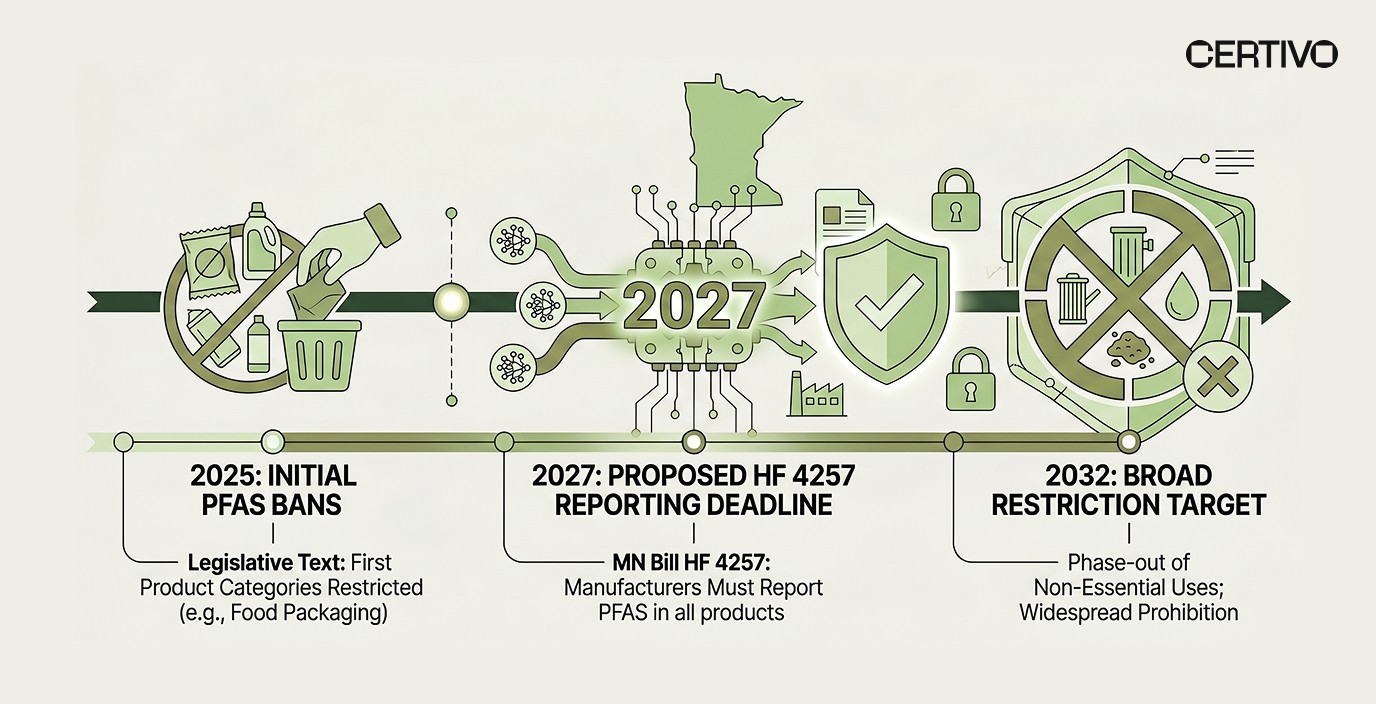
Minnesota PFAS reporting timeline from 2025 bans to 2032 phase-out under HF 4257
Click on image to view full
What Is Minnesota HF 4257 and Why Was It Proposed?
House File 4257 was introduced in March 2026 as a legislative bill proposal during the 94th Minnesota Legislature. It seeks to amend Section 116.943 of Minnesota Statutes, which governs the disclosure, restriction, and eventual prohibition of PFAS in products sold within the state.
The original statute established a January 1, 2026, deadline for manufacturers to report PFAS presence in their products. Industry feedback indicated that the timeline was insufficient for manufacturers to:
✓ Identify PFAS across complex, multi-tier supply chains
✓ Collect chemical-level data from global suppliers
✓ Map substance presence at the product and component level
The proposed 18-month extension to July 1, 2027, reflects the operational reality that multi-tier supply chain transparency for PFAS substances requires significant infrastructure investment.
Based on currently available regulatory guidance, HF 4257 has not yet been enacted. Manufacturers should treat this proposal as a strong signal of legislative intent and begin compliance preparation immediately.
For a broader perspective on how states are approaching PFAS regulation, Certivo's analysis of state PFAS regulations in 2026 provides additional context across jurisdictions.
Key Requirements and Reporting Obligations Under HF 4257
Mandatory Disclosure Elements
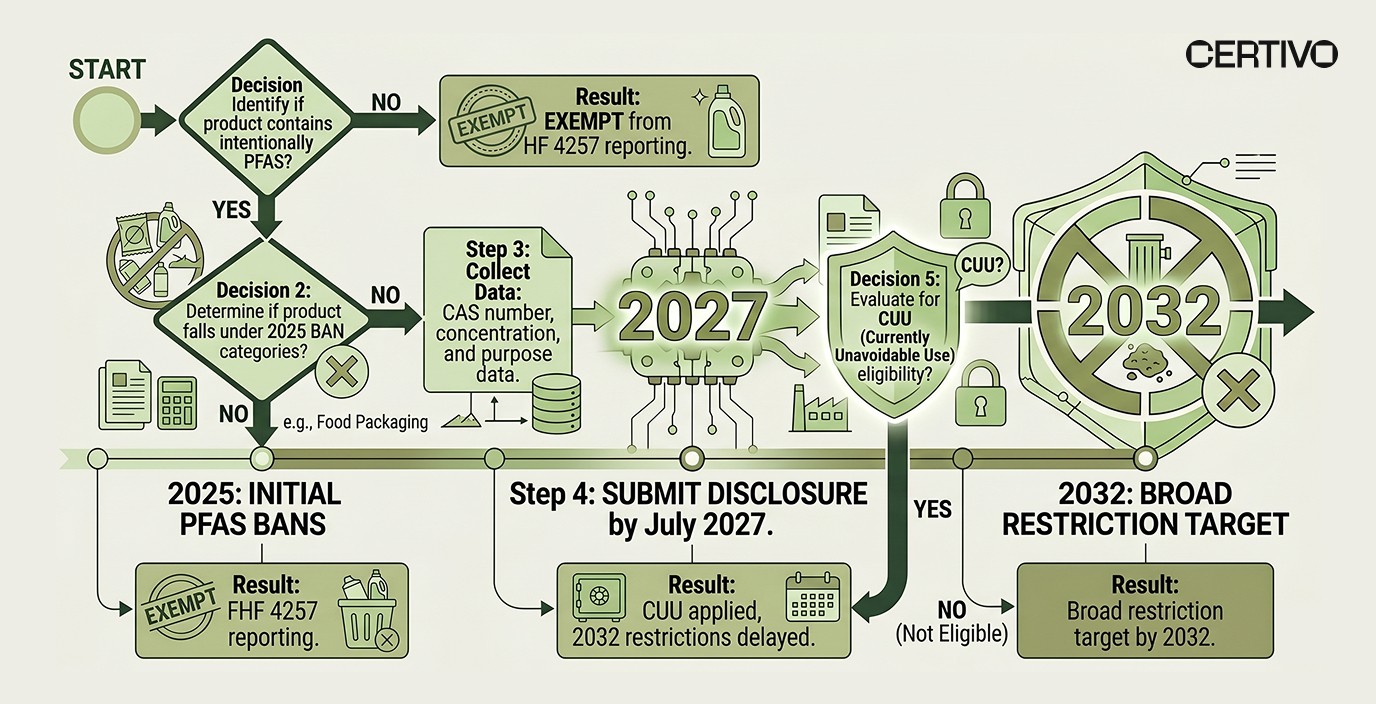
Under HF 4257, manufacturers selling products containing intentionally added PFAS in Minnesota must submit detailed disclosures. The proposed reporting requirements include:
Data Field | Description |
|---|---|
Product Identification | UPC or SKU-level product details |
Purpose of PFAS Use | Functional role of PFAS in the product |
Chemical Identity | CAS number for each PFAS substance |
Concentration Details | Amount or concentration range of PFAS present |
Sales Restriction Mechanism
A critical enforcement provision within the proposal: products cannot be sold in Minnesota if the manufacturer has not completed the required PFAS reporting. This creates a direct commercial consequence for non-compliance — not merely a regulatory penalty, but a market access barrier.
Prohibition Timeline Under the Statute
The bill maintains the existing prohibition structure:
2025: Ban on PFAS in selected consumer product categories (already in effect)
2027 (proposed): Mandatory reporting deadline for all other PFAS-containing products
2032: Broad prohibition on PFAS unless classified as a currently unavoidable use
This layered approach means manufacturers must implement continuous compliance monitoring and audit readiness across their product portfolios to track which products fall under existing bans, which require reporting, and which may qualify for CUU exemptions.
Certivo's PFAS compliance management capabilities are designed to handle exactly this type of multi-layered regulatory structure at the substance and product level.
Minnesota PFAS reporting compliance workflow for manufacturers under HF 4257
Click on image to view full
Which Industries and Product Categories Are Affected?
Consumer Product Categories Under Existing PFAS Prohibition (2025)
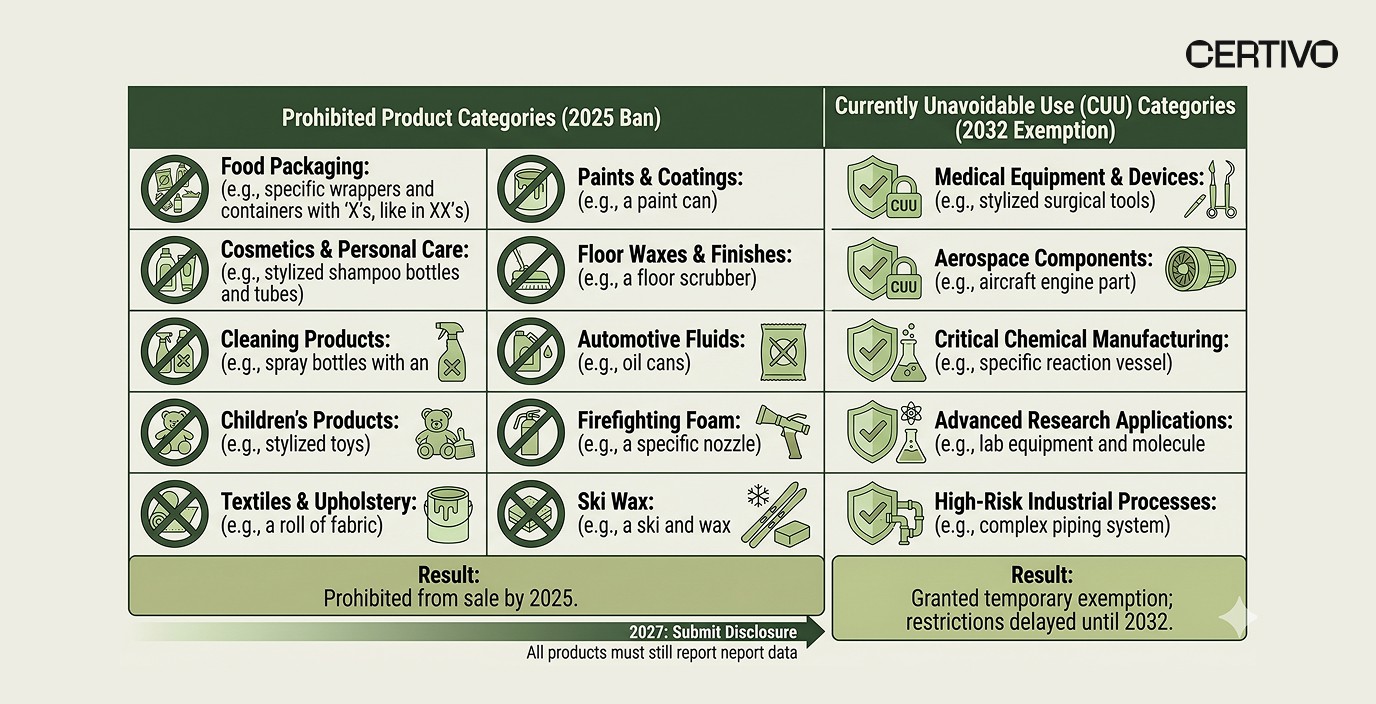
The following product categories are already subject to PFAS sales prohibitions in Minnesota, and HF 4257 does not alter these restrictions:
Carpets or rugs
Cleaning products
Cookware
Cosmetics
Dental floss
Fabric treatments
Juvenile products
Menstruation products
Textile furnishings
Ski wax
Upholstered furniture
Manufacturers in these categories must ensure zero intentional PFAS content. For all other product categories, the proposed 2027 reporting deadline applies.
Broader Industry Impact
While the ban list targets specific consumer goods, the reporting obligation extends to any manufacturer selling PFAS-containing products in Minnesota. This creates compliance exposure for industries including:
Electronics manufacturing — PFAS used in coatings, semiconductors, and thermal management
Aerospace and defense — PFAS in hydraulic fluids, fire suppression, and surface treatments
Medical devices — PFAS in tubing, seals, and implantable components
Chemical manufacturing — PFAS as processing aids and intermediates
For electronics manufacturers specifically, Certivo's guide on PFAS in electronics supply chains outlines practical approaches to substance tracking at the component level.
Organizations operating across multiple jurisdictions should also review how to track PFAS regulations across the U.S. and EU to build a unified regulatory response strategy.
Currently Unavoidable Uses: What Qualifies for CUU Exemption?
One of the most significant elements of HF 4257 is its proposed clarification of "currently unavoidable uses." This framework defines specific applications where PFAS use may continue beyond the 2032 broad prohibition, provided the use meets defined criteria.
Proposed CUU Categories
Based on the bill proposal, the following applications may qualify for CUU status:
⚠ Medical and veterinary products — including devices, diagnostics, and pharmaceutical manufacturing
⚠ Aerospace, defense, and transportation equipment — where PFAS provides critical performance characteristics
⚠ Semiconductors and non-consumer electronics — PFAS used in fabrication processes and component coatings
⚠ Energy generation and electrical systems — including grid infrastructure and power generation equipment ⚠ Products regulated under federal safety standards — where PFAS removal would conflict with existing federal requirements
What CUU Classification Means Operationally
CUU designation does not eliminate compliance obligations. Manufacturers claiming CUU status will still need to:
✓ Report PFAS presence with full chemical identity and concentration data
✓ Demonstrate that no viable non-PFAS alternative exists for the specific application
✓ Maintain documentation supporting the CUU classification
This requires BOM-level compliance intelligence — the ability to trace PFAS substances from raw materials through finished products and map them against regulatory thresholds and exemption criteria.
Certivo's approach to BOM substance and threshold management enables manufacturers to link substance data directly to product structures, supporting both reporting obligations and CUU justification.
Minnesota PFAS prohibited products versus currently unavoidable use exemptions under HF 4257
Click on image to view full
Reporting Data Requirements and Documentation Challenges
The Scale of PFAS Substance Tracking
PFAS is not a single chemical — it encompasses over 12,000 individual substances. Minnesota's reporting framework requires manufacturers to identify specific CAS numbers for each PFAS compound present in their products. This level of specificity creates substantial data collection challenges, particularly for manufacturers with:
Hundreds or thousands of SKUs
Multi-tier supply chains spanning multiple countries
Components sourced from suppliers who may lack PFAS testing capabilities
Data Collection at the Supplier Level
The reporting obligation effectively cascades through the supply chain. Manufacturers must obtain PFAS substance data from their suppliers, who must in turn collect data from their own suppliers. Without automated supplier data collection and portals, this process becomes a bottleneck that can delay reporting by months.
📊 Key data challenges include:
Inconsistent supplier responses — Different suppliers use different formats, languages, and testing methodologies
Missing CAS number data — Many suppliers cannot identify specific PFAS compounds at the CAS level
Concentration threshold ambiguity — Determining whether PFAS is "intentionally added" versus present as a contaminant requires analytical rigor
Certivo's platform addresses these challenges through centralized supplier self-service portals that standardize data collection across the supply chain. Combined with AI document parsing and certificate validation, CORA intelligence can extract substance data from supplier documentation — including safety data sheets, test reports, and material declarations — reducing manual processing time significantly.
📌 Struggling with supplier PFAS data collection? See how Certivo automates this at scale → Book a Demo
Compliance Risks and Enforcement Exposure
Market Access as an Enforcement Mechanism
Unlike many regulatory frameworks that rely primarily on fines, Minnesota's approach under HF 4257 ties compliance directly to market access. Products cannot be sold in Minnesota if the manufacturer has not completed PFAS reporting. This means:
Revenue risk — Non-compliant products face immediate removal from Minnesota distribution
Retailer liability — Downstream retailers and distributors may require compliance documentation as a condition of purchase
Reputational exposure — Public reporting databases may make non-compliance visible to customers, investors, and competitors
Cascading Multi-Jurisdictional Risk
Minnesota is not operating in isolation. Manufacturers who fail to build PFAS reporting infrastructure for Minnesota will face similar challenges as other states — including Massachusetts, Connecticut, and Kentucky — enact their own PFAS reporting and restriction laws.
Building a centralized compliance data backbone now positions organizations to respond to emerging state-level PFAS requirements without rebuilding reporting infrastructure for each jurisdiction.
Supply Chain and Operational Impact
Procurement and Supplier Qualification
The reporting requirements under HF 4257 will fundamentally change how procurement teams evaluate and qualify suppliers. Manufacturers will need to:
✓ Integrate PFAS disclosure requirements into supplier qualification processes
✓ Establish standardized supplier questionnaire frameworks for PFAS data collection
✓ Implement supplier risk scoring and due diligence based on PFAS exposure levels
✓ Create escalation protocols for suppliers who cannot provide required substance data
Product Design and Reformulation
For product categories approaching the 2032 broad prohibition, engineering and R&D teams must begin evaluating PFAS alternatives now. This requires:
Cross-functional collaboration between compliance, engineering, and procurement
BOM-level material mapping to identify where PFAS substances exist in product architectures
Alternative material qualification and testing programs
Documentation of reformulation efforts to support CUU claims where alternatives are not yet viable
Certivo enables this cross-functional approach through design-for-compliance workflows that connect substance data to product structures, giving engineering teams visibility into compliance constraints during the design phase — not after production.
Timeline: From 2025 Bans to the 2032 Full Restriction
Understanding the full regulatory trajectory is essential for long-term compliance planning. Based on the legislative proposal and existing Minnesota statute:
Year | Milestone | Action Required |
|---|---|---|
2025 | PFAS ban on 11 consumer product categories | Ensure zero intentional PFAS in banned categories |
March 2026 | HF 4257 introduced (94th Legislature) | Monitor legislative progress; begin reporting preparation |
July 2027 (proposed) | Mandatory PFAS reporting deadline | Submit full substance disclosures (CAS, concentration, purpose) |
2032 | Broad PFAS prohibition (unless CUU) | All PFAS use prohibited except approved CUU applications |
What Happens if HF 4257 Does Not Pass?
If the bill is not enacted, the original January 1, 2026, reporting deadline under Minnesota Statutes Section 116.943 would remain in effect. Manufacturers should not assume the extension will be granted and should build compliance programs capable of meeting either timeline.
Regulatory intelligence and horizon scanning capabilities — such as those provided by CORA's regulatory intelligence layer — help compliance teams monitor legislative developments in real time and adjust preparation timelines accordingly.
Strategic Compliance Preparation Checklist
Regardless of whether HF 4257 is enacted in its current form, manufacturers should take the following steps to prepare for Minnesota PFAS reporting obligations:
Immediate Actions (Q2–Q3 2026)
✓ Conduct a product portfolio PFAS audit — Identify all products sold in Minnesota that contain intentionally added PFAS
✓ Map PFAS substances at the BOM level — Use BOM-level compliance intelligence to trace PFAS from raw materials through finished products
✓ Activate supplier data collection — Deploy automated supplier data collection portals to request CAS numbers, concentrations, and purpose-of-use data
✓ Classify CUU eligibility — Evaluate which products may qualify for currently unavoidable use exemptions
Medium-Term Actions (Q4 2026–Q2 2027)
✓ Validate supplier-provided data — Use AI document parsing to verify substance declarations against test reports and safety data sheets
✓ Build reporting submissions — Prepare disclosure packages with UPC/SKU-level product details, CAS numbers, and concentration data
✓ Establish continuous audit-ready documentation — Ensure all compliance records are centralized and retrievable for regulatory review
Long-Term Actions (2027–2032)
✓ Initiate PFAS reformulation programs — Begin alternative material evaluation for products approaching the 2032 prohibition
✓ Implement multi-jurisdiction PFAS tracking — Extend reporting infrastructure to cover obligations in other states and the federal TSCA PFAS reporting framework
✓ Prepare for digital product passport requirements — As digital passport and traceability systems become standard, substance-level data will become a permanent compliance asset
How AI-Native Compliance Automation Supports Minnesota PFAS Reporting
The scale of Minnesota's PFAS reporting requirements — covering thousands of substances across potentially thousands of products and hundreds of suppliers — makes manual compliance management impractical for any manufacturer operating at enterprise scale.
Where AI Delivers Measurable Value
📊 Substance identification and mapping: CORA-powered regulatory intelligence can scan supplier documentation, extract PFAS-related substance data, and map it against the 12,000+ known PFAS compounds — a task that would take compliance teams weeks to perform manually.
📊 Supplier data normalization: When suppliers provide data in different formats — PDF test reports, Excel material declarations, email attachments — CORA-driven compliance intelligence normalizes this data into a consistent structure aligned with Minnesota's reporting requirements.
📊 Regulatory horizon scanning: As HF 4257 moves through the legislative process, CORA's regulatory intelligence layer monitors updates and alerts compliance teams to changes that affect reporting timelines or requirements.
📊 CUU documentation support: CORA-enabled analysis can help manufacturers build the evidentiary basis for CUU claims by cross-referencing product formulations against exemption criteria.
Certivo's platform serves as a centralized compliance data backbone that connects substance data, supplier responses, product structures, and regulatory requirements in a single system — enabling continuous compliance monitoring and audit readiness across PFAS and other regulatory frameworks.
Conclusion
Minnesota's HF 4257 is a clear signal that PFAS compliance is becoming more structured, more data-intensive, and more consequential for manufacturers. The proposed extension to July 2027 provides additional preparation time, but the reporting obligations themselves are substantial — requiring CAS-level substance identification, product-level disclosure, and supply chain-wide data collection.
Manufacturers who invest in AI-native compliance automation now will be positioned not only for Minnesota's requirements but for the broader wave of state-level and federal PFAS regulations that are reshaping the compliance landscape through 2032 and beyond.
The cost of inaction is not a fine — it is loss of market access.
📌 Book a demo to see how Certivo automates Minnesota PFAS reporting across your product portfolio and supply chain — or get a free compliance risk assessment to understand your current PFAS exposure across products and jurisdictions.
FAQs
What is the proposed new deadline for Minnesota PFAS reporting under HF 4257?
HF 4257 proposes extending the mandatory PFAS reporting deadline from January 1, 2026, to July 1, 2027. This applies to manufacturers selling products containing intentionally added PFAS in Minnesota. Until the bill is enacted, the original deadline technically remains in effect. Certivo's CORA-powered regulatory intelligence monitors legislative progress so compliance teams can adjust timelines proactively.
Can manufacturers still sell PFAS-containing products in Minnesota after the reporting deadline?
Under the proposed framework, products cannot be sold in Minnesota if the manufacturer has not completed PFAS reporting by the applicable deadline. This makes reporting a market access requirement, not just a regulatory formality. Certivo's automated supplier data collection portals help manufacturers compile the required substance disclosures at the SKU level before the deadline.
How do manufacturers determine if their PFAS use qualifies as currently unavoidable?
The bill proposes CUU exemptions for medical devices, aerospace and defense equipment, semiconductors, energy systems, and federally regulated safety products. Manufacturers must document that no viable PFAS alternative exists for the specific application. CORA-enabled analysis supports this by cross-referencing BOM-level substance data against exemption criteria and available alternatives.
What specific data must be reported for each PFAS-containing product?
Manufacturers must disclose product identification (UPC/SKU), the purpose of PFAS use, chemical identity by CAS number, and concentration details for each PFAS substance. This level of specificity requires systematic data collection from suppliers across the supply chain. Certivo's centralized platform normalizes supplier-provided data into a format aligned with Minnesota's reporting requirements.
How does Minnesota's PFAS regulation interact with federal TSCA PFAS reporting requirements?
Minnesota's reporting obligations operate independently from the federal TSCA Section 8(a)(7) PFAS reporting rule. Manufacturers may need to comply with both frameworks, each with different data requirements and timelines. Building a centralized compliance data backbone allows organizations to serve both state and federal reporting obligations from a single system of record.
Lavanya
Lavanya is an accomplished Product Compliance Engineer with over four years of expertise in global environmental and regulatory frameworks, including REACH, RoHS, Proposition 65, POPs, TSCA, PFAS, CMRT, FMD, and IMDS. A graduate in Chemical Engineering from the KLE Institute, she combines strong technical knowledge with practical compliance management skills across diverse and complex product portfolios.