


The Minnesota Pollution Control Agency (MPCA) has announced a second extension of the PFAS in products reporting deadline, moving the compliance date from July 1, 2026, to September 15, 2026. For manufacturers selling products containing intentionally added PFAS into Minnesota, this extension recalibrates immediate timelines but does not reduce the scope or seriousness of the reporting obligation.
This regulation requires product-level PFAS disclosure through the state's PRISM reporting system, accompanied by an $800 reporting fee per submission. The extension gives compliance teams additional runway to collect supply chain data, validate substance identification, and complete accurate filings. However, organizations that treat this as a reason to delay preparation risk compressing critical workflows into a shrinking window.
📌 Book a free compliance assessment to understand your PFAS reporting exposure across products and supply chains before the September 2026 deadline.
For compliance leaders managing multi-product portfolios across jurisdictions, this Minnesota PFAS reporting rule is part of a broader national and global trend toward mandatory PFAS disclosure. Understanding the precise requirements, affected product categories, and operational steps is essential for maintaining audit readiness and avoiding enforcement exposure.
What Is the Minnesota PFAS in Products Reporting Rule?
Minnesota's PFAS in products reporting rule requires manufacturers to disclose the presence of intentionally added PFAS (Per- and Polyfluoroalkyl Substances) in products sold within the state. The rule is administered by the Minnesota Pollution Control Agency (MPCA) and represents one of the most detailed state-level PFAS product reporting mandates in the United States.
The regulation applies to any manufacturer whose products containing intentionally added PFAS are sold or distributed in Minnesota. This is not limited to companies headquartered in the state — it covers any entity placing PFAS-containing products into Minnesota commerce.
Key elements of the rule include:
✓ Product-level PFAS identification and disclosure
✓ Submission through the state's PRISM online reporting portal
✓ Payment of an $800 fee per submission
✓ Ongoing reporting obligation for products sold within Minnesota
This regulation sits within the broader chemicals compliance framework and aligns with Minnesota's aggressive posture on PFAS regulation driven by the substances' environmental persistence and documented health risks. Organizations managing PFAS compliance across global supply chains must treat Minnesota as a leading-edge jurisdiction requiring dedicated attention.
Why Has the PFAS Reporting Deadline Been Extended Again?
The MPCA's decision to grant a second extension — from July 1, 2026, to September 15, 2026 — reflects the practical complexity manufacturers face in fulfilling this reporting obligation. Based on currently available regulatory guidance, the extension acknowledges three primary challenges:
Supply chain data collection complexity — Identifying intentionally added PFAS requires substance-level data from upstream suppliers, often across multiple tiers
Accurate PFAS identification — With thousands of PFAS compounds in commercial use, distinguishing intentional addition from trace contamination requires rigorous analytical processes
PRISM system readiness — Both the reporting entities and the system infrastructure benefit from additional preparation time
This extension does not signal reduced enforcement intent. Rather, it reflects the MPCA's recognition that accurate, complete data serves the regulation's purpose better than rushed, incomplete submissions. Manufacturers who have not yet begun supplier data collection for PFAS reporting should treat the new deadline as a hard boundary, not a soft target.
Key Compliance Requirements Under the Minnesota PFAS Rule
The reporting obligation is structured around several non-negotiable requirements. Compliance teams must ensure each element is addressed to avoid incomplete submissions or enforcement action.
Requirement | Detail |
|---|---|
Scope | Products containing intentionally added PFAS sold in Minnesota |
Reporting System | PRISM (MPCA's online portal) |
Fee | $800 per submission |
Data Required | Product-level PFAS identification and disclosure |
Deadline | September 15, 2026 (extended from July 1, 2026) |
Obligation Type | Ongoing for products sold within Minnesota |
What Qualifies as "Intentionally Added" PFAS?
The distinction between intentionally added PFAS and incidental presence is critical. Manufacturers must evaluate their product formulations, raw material inputs, and processing aids to determine whether PFAS has been deliberately included for a functional purpose — such as water resistance, heat resistance, or surface treatment.
This determination requires BOM-level material mapping and substance-level visibility into component materials. Organizations relying on spreadsheet-based tracking often lack the granularity to make this determination confidently. Platforms that support BOM-level compliance intelligence can systematically flag products requiring disclosure.
Data Submission Through PRISM
All submissions must be completed through the MPCA's PRISM reporting system. This requires manufacturers to:
✓ Register for PRISM access
✓ Prepare product-level PFAS data in the required format
✓ Submit reports electronically
✓ Retain documentation supporting each submission
For organizations managing compliance documentation across frameworks, integrating PRISM submission data into a centralized compliance data backbone prevents duplication of effort and supports continuous audit-ready documentation.
Which Industries and Product Categories Are Affected?
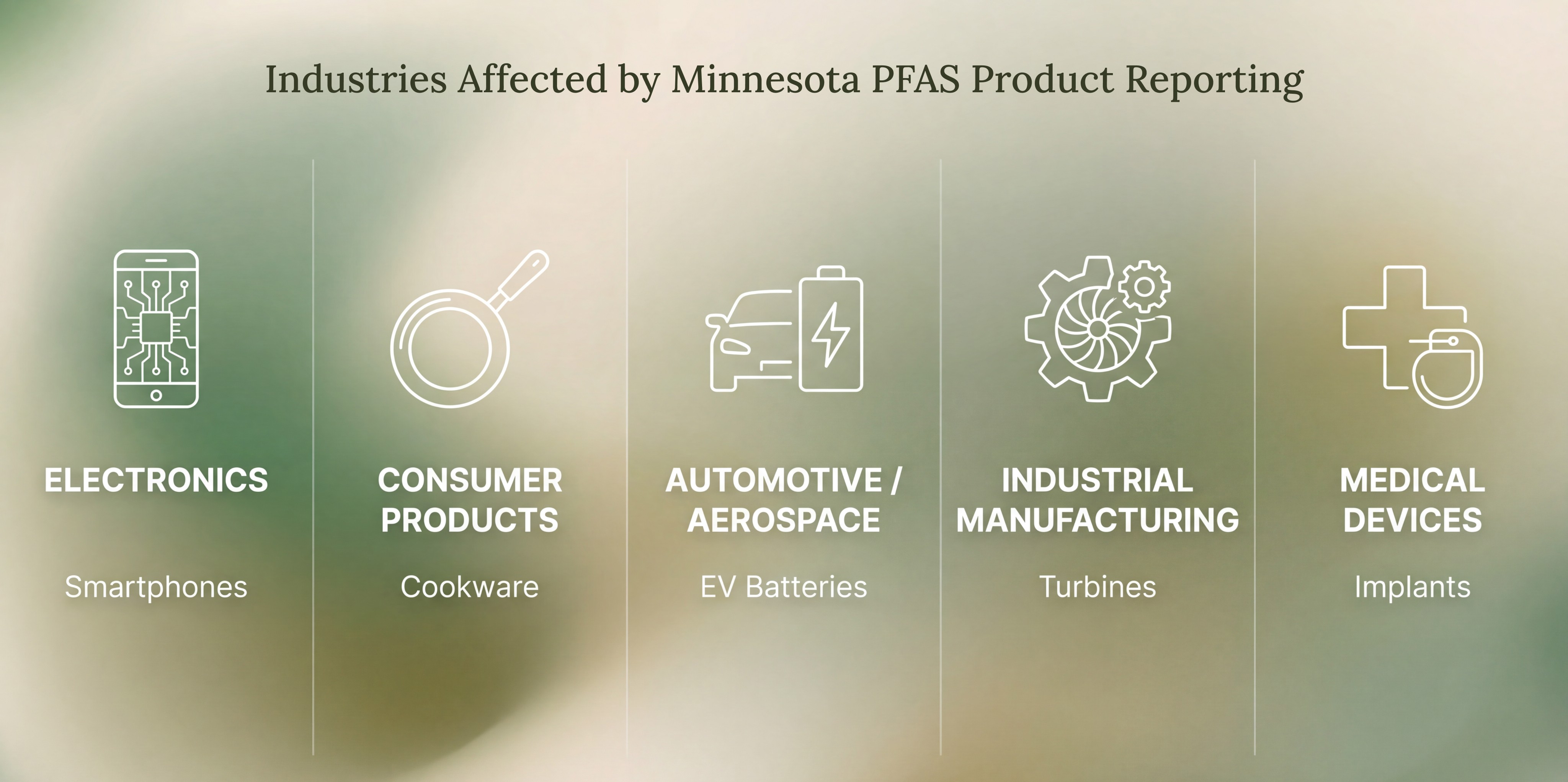
The Minnesota PFAS reporting rule applies broadly across manufacturing sectors. Any product containing intentionally added PFAS and sold in Minnesota falls within scope. Based on the regulation, the following industries face significant reporting obligations:
📊 Electronics and Electrical Equipment — Cables, coatings, circuit boards, connectors, and insulation materials frequently use PFAS for dielectric properties and thermal stability.
📊 Consumer Products — Textiles, cookware, cosmetics, and packaging materials represent high-volume product categories with widespread PFAS use for stain resistance, non-stick properties, and moisture barriers.
📊 Automotive and Aerospace — Lubricants, sealants, hydraulic fluids, and fuel system components commonly contain fluoropolymers and other PFAS-based materials. Manufacturers in these sectors face complex multi-tier supply chain transparency challenges.
📊 Industrial Manufacturing — Fluoropolymers, coatings, and processing aids used in equipment, machinery, and industrial applications.
📊 Medical Devices and Healthcare Products — Certain device components, tubing, and coatings may contain intentionally added PFAS for biocompatibility or performance characteristics.
Organizations that manufacture or import products across any of these categories should conduct a product portfolio assessment against the Minnesota PFAS rule's scope. The breadth of affected product categories makes automated supplier data collection essential for companies with large product lines.
Industries affected by Minnesota PFAS product reporting rule including electronics and automotive
Click on image to view full
PRISM Reporting System: How Submissions Work
The PRISM system is Minnesota's designated portal for PFAS product reporting. Manufacturers must use this system exclusively — no alternative submission methods are accepted. Key operational considerations include:
⚠ Registration lead time — Organizations should register for PRISM access well before the September 15 deadline to avoid last-minute access issues
⚠ Data format requirements — Submissions must conform to PRISM's data fields, requiring advance preparation of product and substance data
⚠ Validation and review — Each submission may undergo MPCA review, making accuracy at the point of filing critical
Companies managing hundreds or thousands of SKUs face a significant data preparation burden. The ability to export structured compliance data from an internal system directly into PRISM-compatible formats reduces manual error and accelerates filing. Specialized substance reporting solutions that map PFAS substances at the product level provide a direct advantage in meeting PRISM requirements.
Reporting Fee Structure and Financial Planning
The $800 per submission fee applies to each product report filed through PRISM. For manufacturers with broad product portfolios, this cost scales rapidly.
Example cost scenarios:
Number of Product Reports | Total Fee |
|---|---|
10 | $8,000 |
50 | $40,000 |
200 | $160,000 |
500 | $400,000 |
Compliance leaders should incorporate PRISM reporting fees into 2026 budgets and evaluate whether product-level consolidation or grouping strategies (where permitted under the rule) can reduce submission volume without sacrificing reporting accuracy.
This financial dimension reinforces the importance of precise product scoping — over-reporting wastes budget, while under-reporting creates enforcement exposure. Accurate BOM substance and threshold management helps organizations identify exactly which products require reporting, avoiding both unnecessary cost and compliance gaps.
Supply Chain Data Challenges for PFAS Identification
The single greatest operational barrier to Minnesota PFAS reporting compliance is obtaining reliable substance-level data from suppliers. Most manufacturers do not synthesize PFAS compounds themselves — they procure components and materials from upstream suppliers who may or may not have visibility into PFAS content.
Common challenges include:
⚠ Suppliers lacking analytical data on PFAS content in their materials
⚠ Multi-tier supply chains where PFAS enters at a raw material level several tiers removed from the reporting entity
⚠ Inconsistent response rates to supplier questionnaires
⚠ Difficulty distinguishing intentional addition from contamination without analytical testing
Organizations that rely on manual email-based supplier outreach often face response rates below 30%, creating data gaps that jeopardize filing accuracy. Centralized supplier self-service portals dramatically improve response rates by giving suppliers structured, guided data entry workflows rather than open-ended questionnaire formats.
📌 Struggling with supplier PFAS data collection? See how Certivo automates supplier evidence collection across multi-tier supply chains.
For organizations already managing PFAS compliance across the U.S. and EU, Minnesota's requirements add another jurisdiction-specific layer that benefits from centralized data management rather than siloed, jurisdiction-by-jurisdiction approaches.
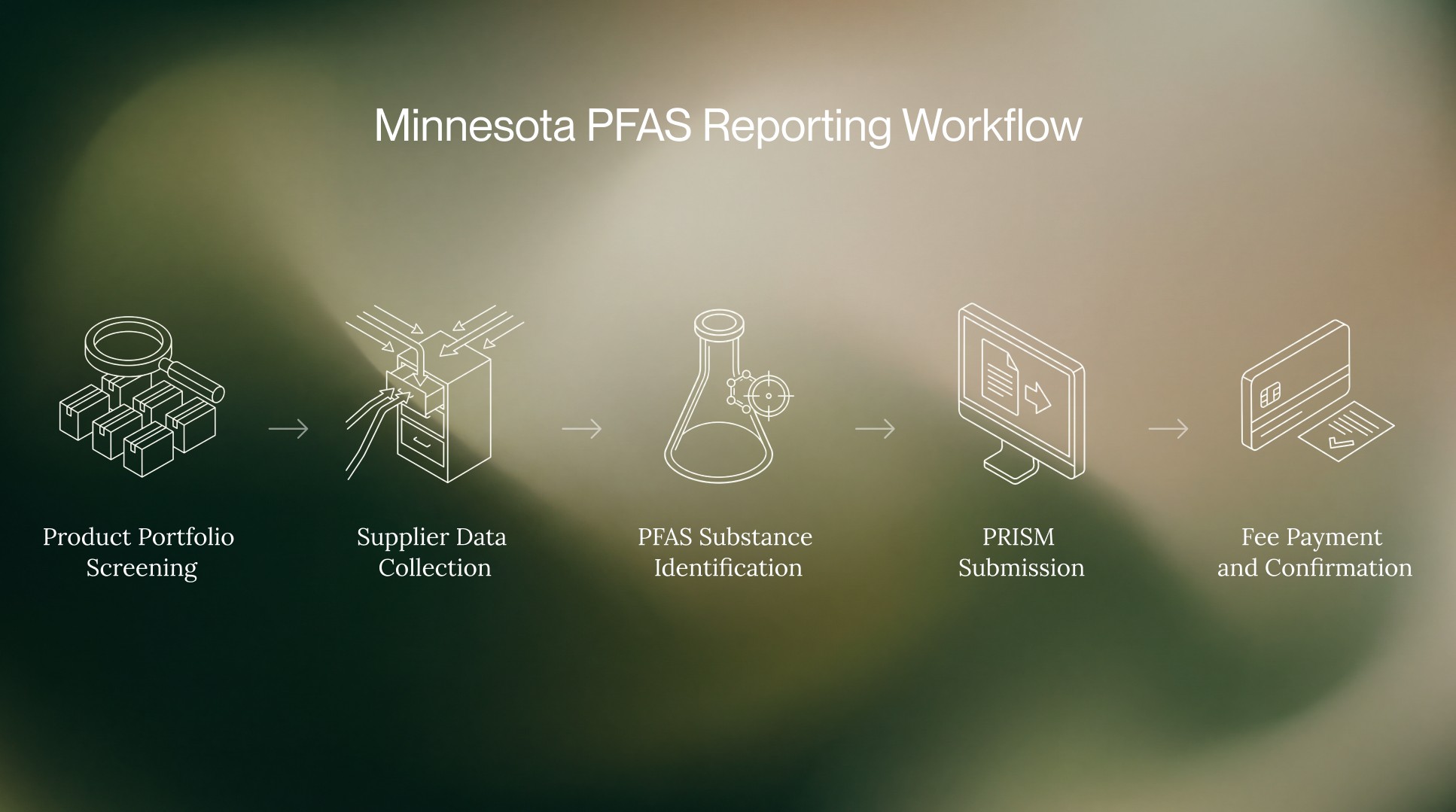
PFAS reporting compliance workflow for Minnesota PRISM system submission process
Click on image to view full
Compliance Risks and Enforcement Exposure
While the MPCA has extended the deadline, the underlying enforcement framework remains intact. Manufacturers that fail to report — or submit incomplete or inaccurate data — face potential regulatory consequences including:
⚠ Administrative penalties and fines
⚠ Mandatory corrective action requirements
⚠ Increased regulatory scrutiny on future submissions
⚠ Reputational risk with downstream customers and procurement partners
Equally significant is the commercial risk. Large OEMs and procurement organizations increasingly require PFAS compliance documentation from suppliers as a condition of continued business. Failure to demonstrate Minnesota PFAS reporting compliance can result in exclusion from qualified supplier lists.
Maintaining continuous compliance monitoring and audit readiness across jurisdictions ensures that regulatory filings, supporting documentation, and supplier evidence are always accessible for internal review or external audit.
How This Fits Into the Broader U.S. PFAS Regulatory Landscape
Minnesota's PFAS product reporting rule is not an isolated requirement. It operates within an accelerating national trend toward PFAS disclosure and restriction. Manufacturers must understand this broader context to allocate compliance resources efficiently.
Key parallel developments include:
Jurisdiction / Framework | Requirement | Status |
|---|---|---|
Federal — TSCA Section 8(a)(7) | PFAS manufacturing and import reporting to EPA | Active, with proposed exemptions under review |
Massachusetts | State-level PFAS reporting requirements | Active deadlines in 2026 |
Connecticut | PFAS labelling requirements | July 2026 deadline |
California | Proposition 65 PFAS-related listings | Ongoing |
EU — REACH | Broad PFAS restriction proposal under ECHA review | Under evaluation |
Organizations that build multi-jurisdiction PFAS compliance capabilities rather than addressing each state individually gain significant operational efficiency. Certivo's approach to regulatory intelligence and horizon scanning enables compliance teams to monitor evolving PFAS obligations across all active U.S. and international jurisdictions simultaneously.
For detailed federal PFAS reporting requirements, see Certivo's analysis of TSCA Section 8(a)(7) PFAS reporting obligations.
Timeline and Future Enforcement Outlook
Date | Event |
|---|---|
Original deadline | Initially set (pre-extensions) |
Previous extended deadline | July 1, 2026 |
Current deadline | September 15, 2026 |
Post-deadline | Ongoing obligation for products sold in Minnesota |
Based on currently available regulatory guidance, there is no indication that further extensions will be granted. Compliance teams should treat September 15, 2026, as a firm deadline and build preparation timelines accordingly.
The ongoing nature of the obligation means that reporting is not a one-time event. Products that continue to contain intentionally added PFAS and are sold in Minnesota will require continued compliance. This makes establishing scalable compliance systems — rather than one-off manual reporting exercises — a sound long-term investment.
Strategic Compliance Preparation Checklist
Compliance leaders should execute the following steps before September 15, 2026:
✅ 1. Conduct product portfolio screening — Identify all products sold in Minnesota that may contain intentionally added PFAS
✅ 2. Map BOM-level substance data — Determine which components and materials contain PFAS, at what concentration, and for what functional purpose
✅ 3. Initiate supplier data collection — Deploy structured questionnaires or supplier self-service compliance portals to gather substance data from upstream suppliers
✅ 4. Register for PRISM access — Complete registration early to avoid portal access delays
✅ 5. Prepare submission data — Format product-level PFAS data to PRISM requirements
✅ 6. Budget for reporting fees — Calculate expected $800-per-submission costs based on portfolio size
✅ 7. Establish documentation retention — Ensure all supporting evidence is stored and retrievable for audit purposes
✅ 8. Integrate into broader PFAS compliance strategy — Align Minnesota reporting with federal TSCA, EU REACH, and other state-level PFAS obligations
How AI and Automation Reduce PFAS Reporting Burden
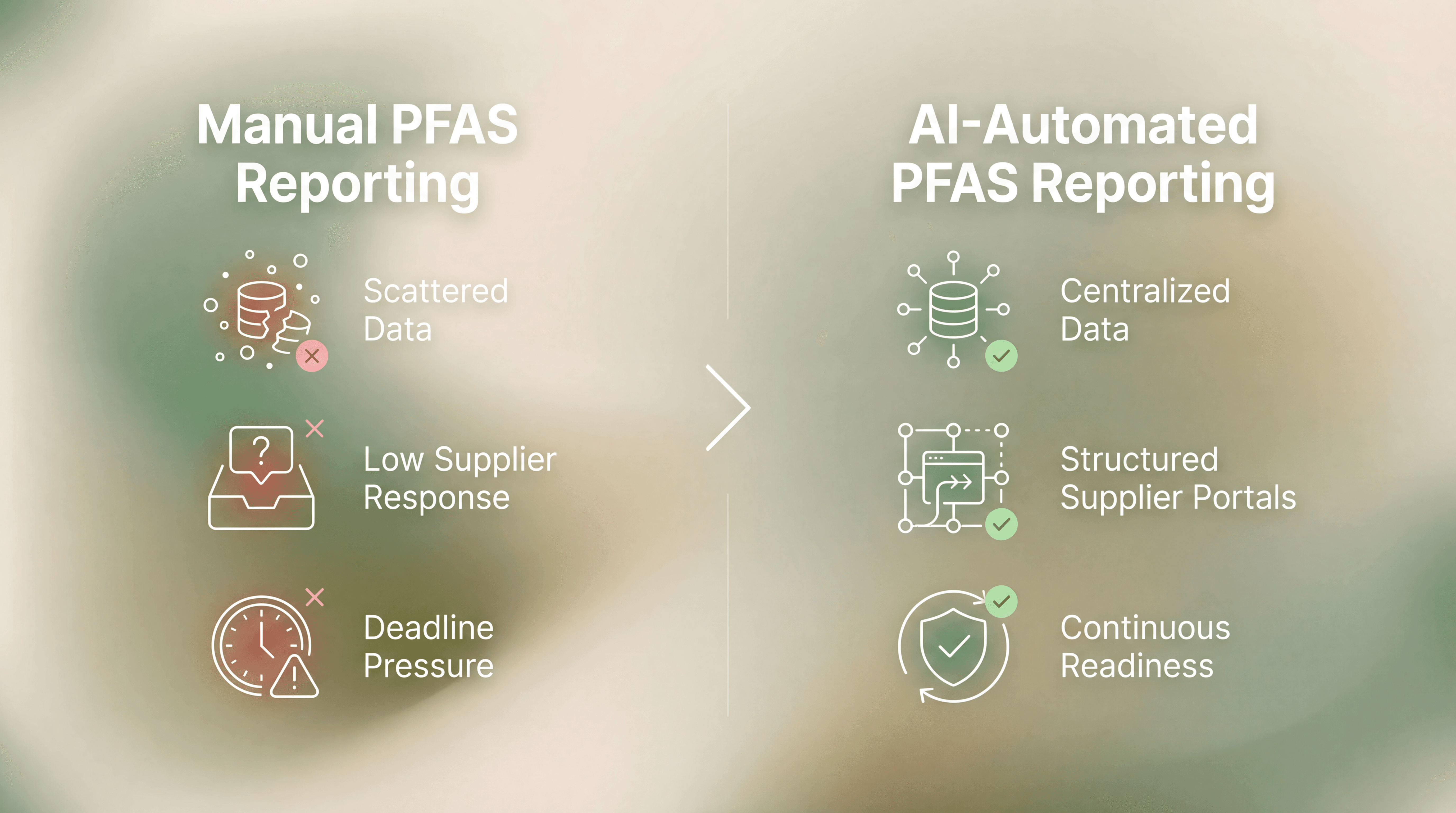
For manufacturers managing hundreds of products across multiple PFAS-regulated jurisdictions, manual compliance processes are operationally unsustainable. The volume of substance data, the number of supplier touchpoints, and the frequency of regulatory updates create a workload that exceeds what spreadsheet-based systems can reliably handle.
AI-native compliance automation addresses this at several levels:
📌 AI document parsing and certificate validation — Automatically extract PFAS substance data from supplier certificates, safety data sheets, and material declarations, reducing manual data entry and transcription errors.
📌 Automated supplier data collection — Deploy standardized questionnaire frameworks through digital portals that guide suppliers through structured PFAS disclosure, improving both response rates and data quality.
📌 Regulatory intelligence and horizon scanning — CORA-powered regulatory intelligence continuously monitors PFAS regulatory developments across jurisdictions, alerting compliance teams to new obligations, deadline changes, and threshold updates before they become urgent.
📌 BOM-level compliance intelligence — Map PFAS substances to specific products and components at the bill-of-materials level, enabling precise identification of in-scope products for Minnesota reporting and other PFAS frameworks.
Certivo's platform serves as a centralized compliance data backbone, connecting product data, supplier evidence, and regulatory requirements in a single system. This shift from reactive, deadline-driven compliance to continuous audit-ready documentation is what separates organizations that manage PFAS reporting as a recurring burden from those that treat it as an integrated operational capability.
Manual versus AI-automated PFAS compliance reporting comparison for manufacturers
Click on image to view full
Executive Summary and Next Steps
The Minnesota PFAS product reporting deadline extension to September 15, 2026, provides manufacturers with additional time but does not reduce the regulatory obligation. Every organization selling products containing intentionally added PFAS in Minnesota must submit product-level reports through the PRISM system, accompanied by an $800 per-submission fee.
The operational requirements — supply chain data collection, PFAS substance identification, PRISM registration, and fee budgeting — demand early and sustained preparation. Treating this as a last-minute exercise compresses critical data collection workflows and increases the risk of incomplete or inaccurate filings.
For compliance leaders responsible for managing PFAS compliance across multi-tier supply chains, Minnesota's reporting rule is one component of a rapidly expanding PFAS regulatory landscape. Building a scalable, AI-supported compliance infrastructure ensures that each new obligation is absorbed into an existing operational capability rather than addressed as a standalone crisis.
📌 Book a demo to see how Certivo automates PFAS compliance across your product portfolio and supply chain — or get a free compliance risk assessment to understand your current PFAS exposure across products and jurisdictions.
FAQs
What products are subject to Minnesota's PFAS reporting rule?
Any product sold in Minnesota that contains intentionally added PFAS falls within scope. This includes electronics, consumer goods, automotive components, industrial materials, and medical devices. The obligation applies regardless of where the manufacturer is headquartered. Organizations can use Certivo's BOM-level compliance tools to screen product portfolios for reportable PFAS content.
How much does it cost to file PFAS reports through PRISM?
Each submission through Minnesota's PRISM system requires an $800 reporting fee. For manufacturers with large product portfolios, total costs can escalate significantly — for example, 200 product reports would total $160,000 in fees alone. Accurate product scoping through substance-level data prevents unnecessary submissions.
Can suppliers outside Minnesota be required to provide PFAS data?
Yes. If a manufacturer's products contain components from any supplier — regardless of location — and those products are sold in Minnesota, the reporting manufacturer is responsible for obtaining PFAS substance data. Automated supplier data collection portals help standardize this process across global supply chains.
How does the Minnesota PFAS rule relate to federal TSCA PFAS reporting?
Minnesota's rule operates independently from the federal TSCA Section 8(a)(7) PFAS reporting requirement, though both require PFAS-related data collection. The data overlaps are significant, and organizations using centralized compliance platforms can leverage a single data collection effort to satisfy both obligations.
Is the September 2026 deadline likely to be extended again?
Based on currently available regulatory guidance, there is no indication of a further extension. The MPCA has already granted two extensions, and compliance teams should plan against the September 15, 2026 deadline as firm. CORA-driven compliance intelligence within Certivo continuously monitors for deadline changes and regulatory updates, ensuring teams are alerted immediately to any modifications.
Lavanya
Lavanya is an accomplished Product Compliance Engineer with over four years of expertise in global environmental and regulatory frameworks, including REACH, RoHS, Proposition 65, POPs, TSCA, PFAS, CMRT, FMD, and IMDS. A graduate in Chemical Engineering from the KLE Institute, she combines strong technical knowledge with practical compliance management skills across diverse and complex product portfolios.