


Every manufacturer selling into the United States or European Union in 2026 faces a single, uncomfortable reality: PFAS is almost certainly present somewhere in your bill of materials. Not because you chose it. Because your suppliers did — in coatings, seals, adhesives, lubricants, inks, and dozens of intermediate materials where per- and polyfluoroalkyl substances remain technically useful and commercially invisible.
The regulatory environment has shifted decisively. State-level PFAS bans, federal reporting mandates under TSCA Section 8(a)(7), and EU restriction proposals now demand that manufacturers prove PFAS compliance at the substance level — not through general assurances, but through documented, auditable evidence tied to specific products and components.
"I didn't know" is no longer a legal defense. The question has moved from whether PFAS is in your product to whether you can prove what's there, where it came from, and whether it complies.
📌 Book a free compliance assessment to understand your PFAS exposure across products and supply chains.
Why PFAS Compliance Has Become a Prove-It Problem
For most of the past decade, PFAS regulation was aspirational. Frameworks existed, but enforcement was limited, thresholds were undefined, and manufacturers could manage exposure through general supplier declarations.
That era ended in 2024–2025. Between Maine's comprehensive PFAS reporting law, Minnesota's PFAS reporting requirements under Amara's Law, and the EPA's TSCA Section 8(a)(7) rule, regulators have converged on a single expectation: manufacturers must identify, quantify, and disclose PFAS at the product and component level.
This is not a policy trend. It is a structural shift in how product compliance is enforced. The burden of proof has moved from regulators to manufacturers.
Three factors make this shift irreversible:
Scope expansion. PFAS encompasses over 12,000 chemical compounds. State and federal definitions continue to broaden, capturing substances previously considered outside scope.
Substance-level granularity. General supplier certifications no longer satisfy disclosure requirements. Regulators and customers demand BOM-level material identification.
Multi-jurisdictional enforcement. A single product sold across U.S. states, the EU, and international markets may face conflicting PFAS thresholds and reporting obligations simultaneously.
Manufacturers who rely on supplier self-reporting without structured automated supplier data collection are operating with incomplete evidence — which is functionally equivalent to no evidence at all.
The Regulatory Landscape: State Bans, Federal Mandates, and EU Restrictions
U.S. State-Level PFAS Bans and Disclosure Requirements
The most immediate compliance exposure for manufacturers selling into the U.S. comes from state legislation. As of 2026, the following states have enacted PFAS-specific restrictions or reporting requirements:
State | Regulation | Key Requirement | Compliance Deadline |
|---|---|---|---|
Maine | LD 1503 | Disclosure of all intentionally added PFAS in products | January 1, 2025 (reporting); January 1, 2030 (ban) |
Minnesota | Amara's Law (HF 2310) | PFAS reporting via PRISM portal for covered products | July 1, 2026 |
California | AB 1817 | Ban on PFAS in textiles above 100 ppm total organic fluorine | January 1, 2025 |
Connecticut | Public Act 23-135 | PFAS labelling requirements for consumer products | July 1, 2026 |
Massachusetts | S.2129 / H.4109 | PFAS restrictions in food packaging, textiles, and consumer products | Phased 2025–2027 |
This table is not exhaustive. Washington State's PFAS sales ban effective 2027 and New Jersey's Protecting Against Forever Chemicals Act targeting 2028 represent the next wave.
Each state defines PFAS differently. Each has distinct reporting formats, threshold levels, and product scope definitions. Without regulatory intelligence and horizon scanning capabilities, manufacturers risk missing jurisdiction-specific obligations entirely.
Federal: TSCA Section 8(a)(7)
The EPA's TSCA Section 8(a)(7) rule requires any entity that has manufactured (including imported) or processed PFAS in any amount since January 1, 2011, to report detailed information on chemical identity, production volumes, uses, and disposal. The October 2026 federal deadline applies to article importers — a category that captures a vast number of manufacturers who may not realize they fall within scope.
Based on currently available regulatory guidance, the EPA has proposed certain exemptions, but these remain subject to finalization. Manufacturers cannot rely on proposed exemptions as a compliance strategy. The rule's scope across 12,000+ PFAS compounds demands substance-level identification capabilities that most organizations do not possess today.
EU: REACH Universal PFAS Restriction Proposal
The European Chemicals Agency (ECHA) restriction proposal, if adopted, would represent the most comprehensive PFAS restriction globally — covering all PFAS uses with limited time-bound exemptions. While the final timeline remains under deliberation, the direction is clear. Manufacturers exporting to the EU must prepare for substance-level PFAS documentation requirements that will affect materials, chemicals, and finished goods across virtually all product categories.
Certivo's PFAS compliance guide for the EU restriction proposal provides detailed analysis of the current regulatory status and expected impacts.
Where PFAS Hides in Your Bill of Materials
PFAS enters the manufacturing supply chain through functional applications where its chemical properties — water resistance, heat stability, low friction, and chemical inertness — provide performance advantages that alternatives have not yet matched across all use cases.
The challenge for compliance teams is that PFAS presence is rarely declared by suppliers unless specifically requested, and it often exists in intermediate materials several tiers removed from the final assembler.
Common PFAS Entry Points by Product Category
✓ Coatings and surface treatments — Non-stick, anti-corrosion, and weather-resistant coatings on metals, plastics, and textiles
✓ Seals, gaskets, and O-rings — PTFE and fluoroelastomer components used in fluid handling, automotive, and industrial applications
✓ Adhesives and bonding agents — Fluoropolymer-based adhesives in electronics, aerospace, and medical devices
✓ Wire and cable insulation — PTFE and FEP insulation in high-temperature and chemically aggressive environments
✓ Lubricants and greases — Fluorinated lubricants in precision machinery and semiconductor manufacturing
✓ Inks and printing materials — PFAS-containing inks in packaging, labeling, and printed electronics
✓ Firefighting foams — AFFF and related formulations used in facility fire suppression
Most of these applications involve tier-2 or tier-3 suppliers who provide components or materials to your direct suppliers. Without multi-tier supply chain transparency, the BOM-level data necessary to prove compliance simply does not reach the manufacturer.
Effective BOM substance and threshold management requires mapping every material input against the applicable PFAS definitions — which vary by jurisdiction. A substance that falls outside scope under one state's definition may trigger reporting obligations under another.
Key PFAS Thresholds, Disclosure Requirements, and Reporting Deadlines
Threshold Complexity
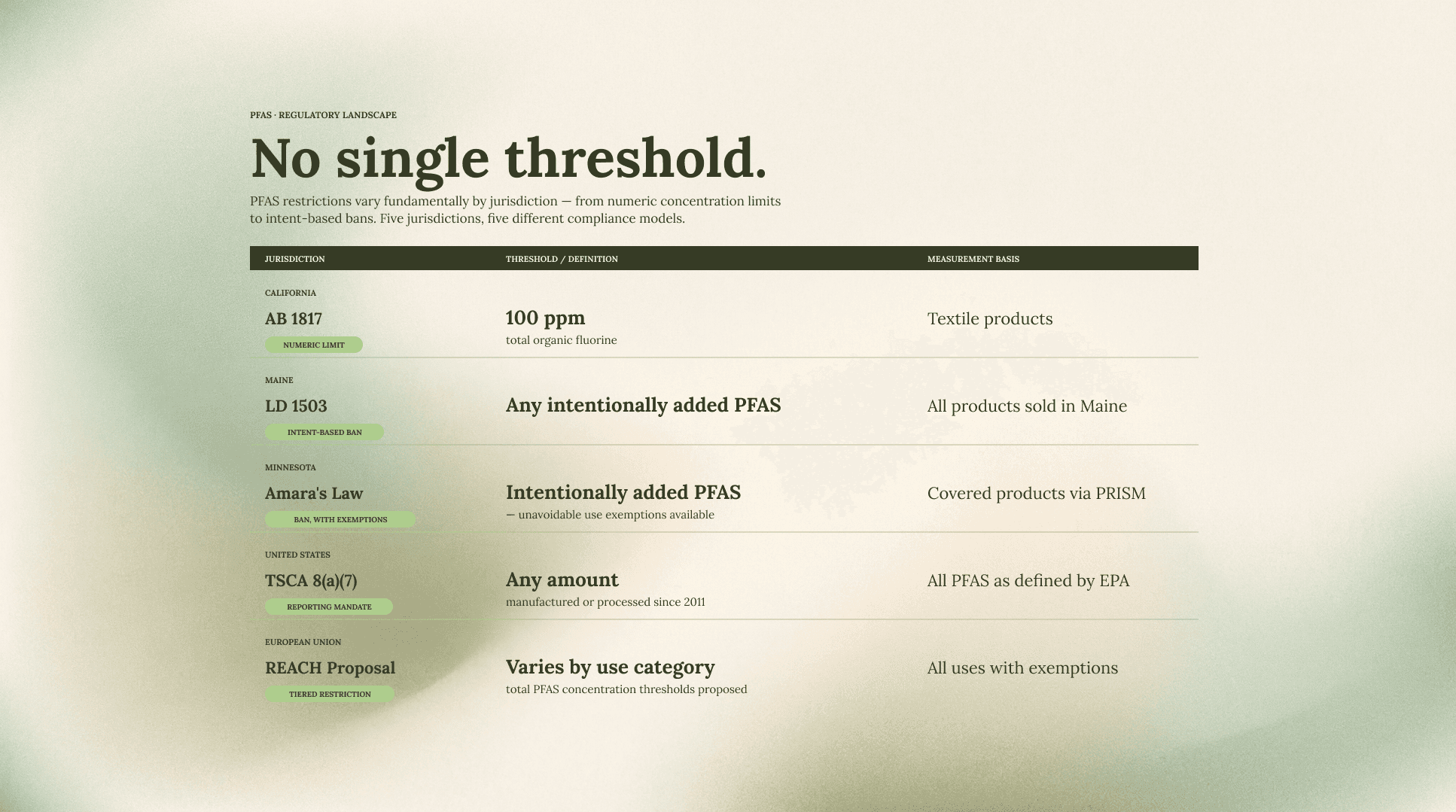
There is no single global PFAS threshold. Regulatory definitions and concentration limits vary by jurisdiction, product category, and intended use:
Jurisdiction | Threshold / Definition | Measurement Basis |
|---|---|---|
California AB 1817 | 100 ppm total organic fluorine | Textile products |
Maine LD 1503 | Any intentionally added PFAS | All products sold in Maine |
Minnesota Amara's Law | Intentionally added PFAS; currently unavoidable use exemptions available | Covered products via PRISM |
TSCA 8(a)(7) | Any amount manufactured or processed since 2011 | All PFAS as defined by EPA |
EU REACH Proposal | Varies by use category; total PFAS concentration thresholds proposed | All uses with exemptions |
The inconsistency across thresholds means manufacturers must maintain BOM-level compliance intelligence that can evaluate the same product against multiple regulatory definitions simultaneously. A single supplier declaration stating "PFAS-free" is insufficient when the definition of PFAS itself varies across jurisdictions.
Reporting Format and Documentation Requirements
State reporting requirements increasingly specify structured data formats. Minnesota's PRISM portal requires product-level submissions including chemical identity, function, and concentration. TSCA 8(a)(7) demands detailed historical data on production volumes, exposure, and disposal.
These requirements cannot be met through manual processes at scale. Manufacturers with hundreds or thousands of SKUs, each containing dozens of components, need AI document parsing and certificate validation to extract PFAS-relevant data from supplier documentation — safety data sheets, test reports, certificates of conformance, and material declarations.
Alt text
Click on image to view full
Which Industries Face the Highest PFAS Compliance Exposure
PFAS exposure is not limited to chemical manufacturers. Any industry that uses fluorinated materials, coated components, or treated surfaces has regulatory exposure. The following sectors face the most immediate compliance obligations:
⚠ Electronics manufacturing — PFAS in circuit board coatings, solder masks, wire insulation, and semiconductor processing chemicals. Certivo's guide on PFAS in electronics manufacturing details the specific exposure points.
⚠ Automotive manufacturing — Fluoropolymer seals, fuel system components, brake fluids, and coated wiring harnesses. The automotive sector faces simultaneous pressure from emissions compliance and PFAS substance restrictions.
⚠ Aerospace and defense — PFAS in hydraulic fluids, coatings, sealants, and firefighting systems. Defense contractors face additional complexity from DFARS and export control requirements.
⚠ Medical devices — PTFE-based materials in catheters, implants, and device coatings, compounded by FDA cybersecurity requirements and biocompatibility documentation.
⚠ Consumer goods — Textiles, food contact materials, and household products subject to state-level bans on intentionally added PFAS.
⚠ Industrial machinery — Fluorinated lubricants, seals, and coatings in high-performance equipment.
For each of these sectors, the compliance obligation extends beyond the manufacturer's own operations to the entire supply chain. Supplier risk scoring and due diligence is no longer optional — it is the mechanism through which manufacturers establish the evidence chain regulators require.
Why Most Manufacturers Cannot Prove PFAS Compliance Today
The core problem is not awareness. Most compliance leaders know PFAS regulations are tightening. The problem is evidence.
The Five Evidence Gaps
No BOM-level substance mapping. Most manufacturers track materials at the part or component level, not at the chemical substance level. PFAS regulations require substance-level identification — a fundamentally different data architecture.
Supplier declarations are generic. Standard supplier certifications rarely address PFAS specifically. Where they do, they often use broad statements ("compliant with applicable regulations") that do not satisfy jurisdiction-specific disclosure requirements.
Multi-tier visibility is absent. PFAS is typically introduced by sub-tier suppliers. Without centralized supplier self-service portals that enable structured data collection from tier-2 and tier-3 suppliers, the evidence chain breaks.
Historical data is fragmented. TSCA 8(a)(7) requires historical manufacturing and processing data going back to 2011. Most organizations do not have centralized compliance data systems capable of retrieving this information.
Manual processes cannot scale. A manufacturer with 5,000 SKUs, each containing 50–200 components, potentially needs to evaluate millions of substance-component combinations against multiple regulatory definitions. Spreadsheet-based workflows collapse under this volume.
Struggling with supplier data gaps on PFAS? See how Certivo closes the evidence gap → Book a Demo
Compliance Risks: Penalties, Market Access, and Litigation Exposure
The consequences of failing to prove PFAS compliance extend across three dimensions:
Regulatory Penalties
State PFAS laws carry enforcement mechanisms including fines, product sales prohibitions, and mandatory recalls. Maine's law authorizes the Department of Environmental Protection to prohibit sales of non-compliant products. California's AB 1817 violations expose manufacturers to civil penalties and enforcement actions by the Attorney General.
TSCA violations carry federal penalties of up to $50,120 per day per violation (adjusted annually). For a manufacturer with thousands of products containing unreported PFAS, cumulative exposure can reach tens of millions of dollars.
Market Access Loss
Increasingly, major OEMs and retailers are imposing PFAS disclosure requirements on their supply chains — independent of regulatory mandates. Manufacturers who cannot provide continuous audit-ready documentation on PFAS status risk losing contracts and preferred supplier status.
This is particularly acute in sectors where customer industry requirements are evolving faster than regulation. Automotive OEMs, electronics brands, and medical device companies are building PFAS into their supplier qualification criteria.
Litigation Exposure
PFAS-related litigation in the United States has expanded dramatically. Manufacturers face product liability claims, class actions, and contribution claims from downstream users. The ability to demonstrate a documented, proactive PFAS compliance program — supported by PFAS and chemicals risk management infrastructure — is increasingly relevant to legal defense strategies.
Supply Chain and Operational Impact of PFAS Regulations
PFAS compliance is fundamentally a supply chain problem. Manufacturers cannot comply without data from their suppliers, and suppliers cannot provide data without clear, structured requests.
Operational Impacts
📊 Procurement disruption. Suppliers of PFAS-containing materials may exit certain markets, forcing reformulation or resourcing. Early identification through BOM-level material mapping allows procurement teams to plan alternatives before supply disruptions occur.
📊 Engineering changes. Replacing PFAS-containing materials requires validation testing, qualification, and documentation — processes that can take 12–24 months for critical applications.
📊 Customer disclosure burden. OEMs and retailers are passing PFAS disclosure requirements upstream. Manufacturers must be able to respond faster to customer RFQs with accurate, product-level substance data.
📊 Documentation volume. Each PFAS regulation requires distinct documentation formats. Managing compliance evidence across multiple frameworks without a centralized compliance data backbone leads to duplication, inconsistency, and audit failure.
The manufacturers best positioned to navigate PFAS compliance are those who treat it as a data infrastructure problem — not a periodic reporting exercise.
How AI and Automation Close the PFAS Evidence Gap
The scale of PFAS compliance — 12,000+ substances, dozens of jurisdictions, thousands of products, multi-tier supply chains — exceeds what manual processes can manage. AI-native compliance automation addresses the specific bottlenecks that prevent manufacturers from proving compliance.
AI Document Parsing and Certificate Validation
Supplier documentation arrives in inconsistent formats: PDFs, scanned certificates, Excel files, and unstructured emails. CORA-powered regulatory intelligence within the Certivo platform extracts PFAS-relevant data from these documents, maps it against applicable regulatory definitions, and flags gaps or inconsistencies automatically.
This eliminates the single largest time sink in PFAS compliance: manually reviewing and transcribing supplier data into compliance databases.
BOM-Level Substance Mapping at Scale
CORA intelligence enables automated matching of supplier-reported substances against BOM structures, evaluating each component against every applicable PFAS threshold simultaneously. This provides compliance teams with a real-time view of their PFAS exposure — by product, by jurisdiction, and by supplier.
Automated Supplier Data Collection
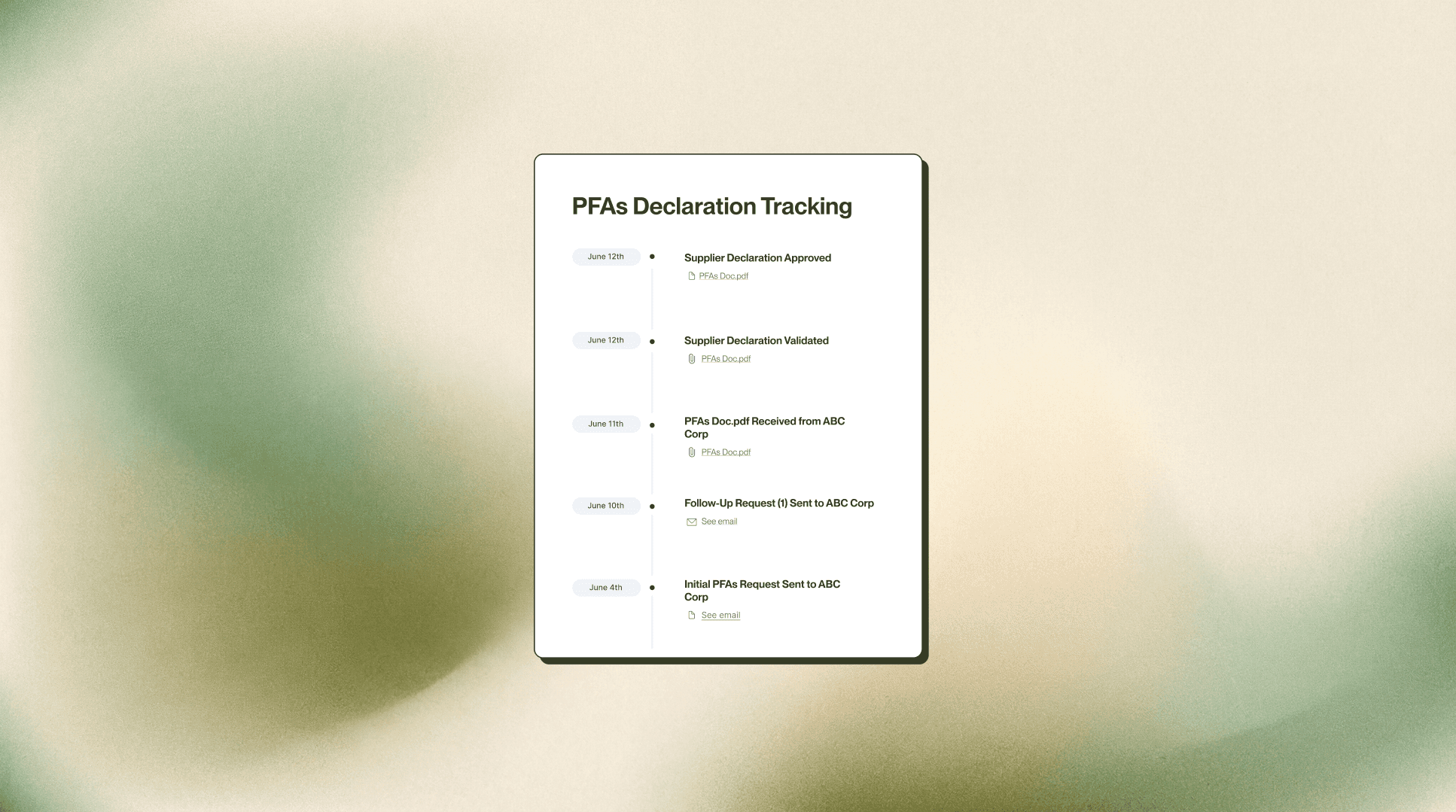
Certivo's supplier self-service portals enable structured PFAS data collection at scale. Rather than sending individual email requests and tracking responses manually, manufacturers can deploy standardized questionnaire frameworks that guide suppliers through jurisdiction-specific disclosure requirements.
Continuous Compliance Monitoring
Regulatory changes to PFAS definitions, thresholds, and deadlines are frequent. CORA-driven compliance intelligence continuously monitors regulatory updates and evaluates their impact on existing product compliance status — enabling proactive compliance risk management rather than reactive scrambling.
Alt text
Click on image to view full
Strategic PFAS Compliance Preparation Checklist
For compliance leaders preparing their organizations, the following actions represent the minimum necessary steps:
1. Inventory your PFAS exposure. Map every product, component, and material in your BOM against applicable PFAS definitions. Use BOM-level compliance intelligence to identify where PFAS presence is confirmed, suspected, or unknown.
2. Identify your jurisdictional obligations. Determine which state, federal, and international PFAS regulations apply to your product portfolio based on where products are manufactured, sold, and used. Regulatory intelligence and horizon scanning capabilities are essential for multi-jurisdiction compliance.
3. Audit supplier data completeness. Evaluate whether your current supplier declarations address PFAS at the substance level required by applicable regulations. Identify gaps and deploy automated supplier data collection to close them.
4. Establish substance-level tracking infrastructure. Move from part-level material tracking to substance-level identification. This requires a centralized platform capable of managing PFAS data across 12,000+ compounds at scale.
5. Prepare jurisdiction-specific reporting packages. Pre-build reporting templates aligned with each applicable regulation's format requirements. For Minnesota PRISM, TSCA CDX, and state disclosure portals, ensure data can be exported in the required structure.
6. Document your compliance program. Regulatory enforcement agencies and courts give credit to manufacturers who can demonstrate a proactive, documented compliance program. Maintain records of supplier outreach, substance evaluations, and regulatory assessments as part of continuous audit-ready documentation.
7. Plan for reformulation. Where PFAS is identified and bans are imminent, begin engineering qualification of alternative materials now. Reformulation timelines of 12–24 months mean that action in 2026 is necessary for compliance by 2027–2028 deadlines.
Conclusion: From Assumption to Proof
PFAS compliance is no longer about whether your products contain these substances. It is about whether you can prove — to regulators, to customers, and if necessary to courts — exactly what is in your products, in what concentrations, from which suppliers, and against which regulatory thresholds.
The manufacturers who build this evidence infrastructure now will retain market access, maintain customer relationships, and limit litigation exposure. Those who defer will face escalating penalties, supply chain disruptions, and competitive disadvantage.
The shift from reactive compliance to continuous readiness is not optional. It is the operating requirement for any manufacturer with PFAS compliance exposure in 2026 and beyond.
Book a demo to see how Certivo automates PFAS compliance across your product portfolio and supply chain — or get a free compliance risk assessment to understand your current PFAS exposure across products and jurisdictions.
Alt text
Click on image to view full

FAQs
How do manufacturers identify PFAS in their bill of materials when suppliers don't disclose it?
Most PFAS presence in BOMs is undisclosed because standard supplier declarations do not address substance-level chemistry. Manufacturers must deploy structured supplier questionnaires and AI document parsing capabilities — such as Certivo's CORA intelligence — to extract PFAS-relevant data from safety data sheets, test reports, and certificates of conformance. Without proactive, structured data collection from multi-tier suppliers, PFAS identification remains incomplete.
What happens if a manufacturer misses a state-level PFAS reporting deadline?
Consequences vary by jurisdiction but can include civil penalties, product sales prohibitions, and enforcement actions by state attorneys general. Under TSCA Section 8(a)(7), federal penalties can reach $50,120 per day per violation. Beyond regulatory fines, missed deadlines can trigger loss of customer contracts and increased litigation exposure. Continuous compliance monitoring through platforms like Certivo helps manufacturers track evolving deadlines across jurisdictions.
Can a general "PFAS-free" supplier declaration satisfy compliance requirements?
In most cases, no. Regulatory definitions of PFAS vary by jurisdiction, and a general declaration does not specify which PFAS compounds were evaluated, against which thresholds, or using which analytical methods. Compliance teams need substance-level evidence that maps to each applicable regulation's requirements. CORA-enabled analysis within Certivo validates supplier declarations against jurisdiction-specific PFAS definitions to identify where general claims fall short.
How does TSCA Section 8(a)(7) affect article importers who don't manufacture chemicals?
Article importers are within scope if any PFAS was present in imported articles at any time since January 1, 2011. This captures a vast number of manufacturers and distributors who import finished or semi-finished goods. Reporting requires detailed data on PFAS identity, volumes, and uses — data that most importers do not have readily available. Certivo's automated supplier data collection portals help importers gather this data from upstream suppliers before the October 2026 deadline.
What is the most effective way to manage PFAS compliance across multiple jurisdictions simultaneously?
Multi-jurisdiction PFAS compliance requires a centralized platform that can evaluate the same product against different regulatory definitions, thresholds, and reporting formats simultaneously. Manual processes and spreadsheets cannot scale across dozens of state, federal, and international requirements. Certivo's BOM-level compliance intelligence evaluates every product-component-substance combination against all applicable PFAS frameworks, providing a single source of truth for multi-jurisdictional compliance status.
Hari Prasanth
Hariprasanth is a Chemical Compliance Specialist with nearly four years of experience, underpinned by a degree in Chemical Engineering. He brings in-depth expertise in global product compliance, working across key regulations such as REACH, RoHS, TSCA, Proposition 65, POPs, FMD, and PFCMRT.